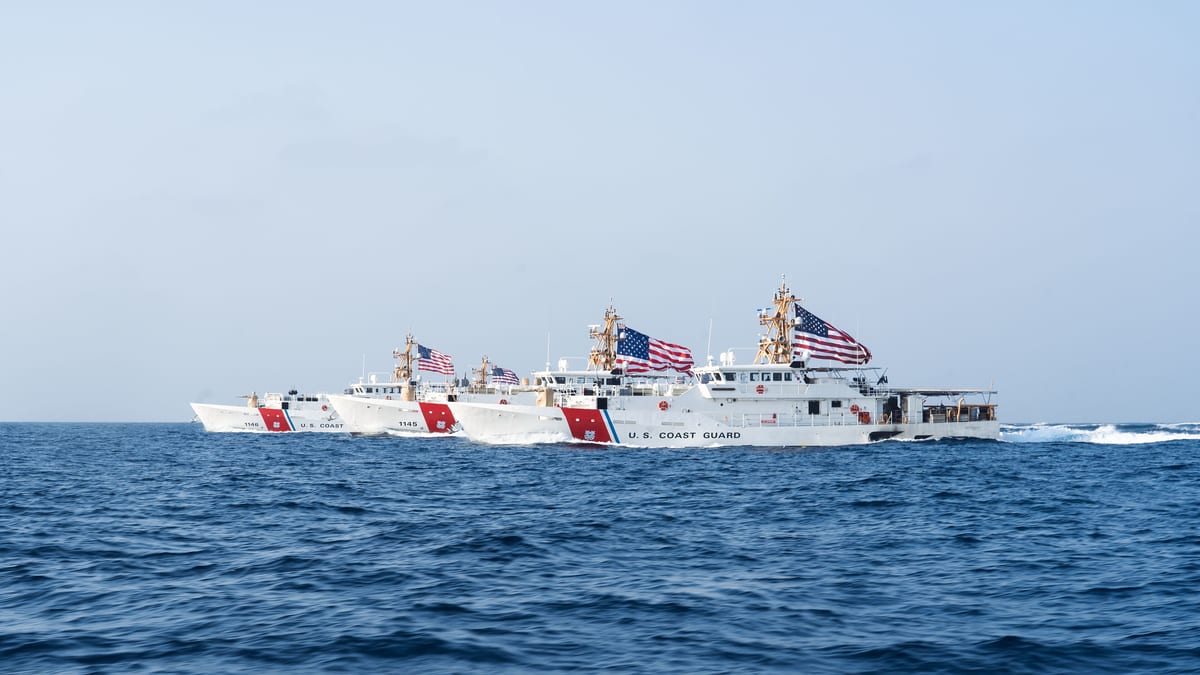
The United States is a civilian-led state actor whose armed forces combine global combatant commands, six military services, a large defense-industrial base, and recurring U.S.-led coalition operations across air, land, maritime, space, cyber, and special-operations domains.
260 weapon systemsOverviewShowHide
United States military power is organized under constitutional civilian control, with Congress holding core war, force-raising, naval, and regulation powers and the President serving as Commander in Chief of forces in federal service. The Secretary of Defense exercises authority, direction, and control over the Department of Defense, while operational command for deployed forces runs through unified combatant commands rather than through the service chiefs.
The equipment record reflects a force built for expeditionary reach and coalition operations: carrier aviation, land-attack cruise missiles, strategic and tactical aircraft, armored maneuver systems, air and missile defense, unmanned aircraft, electronic warfare, precision-guided munitions, and naval escorts. U.S. entries often sit at the center of coalition labels, so attribution needs careful separation between U.S.-operated systems, allied systems operating in U.S.-led coalitions, and partner forces supplied or supported by the United States.
The United States fields six armed forces: the Army, Marine Corps, Navy, Air Force, Space Force, and Coast Guard. The Army National Guard and Air National Guard are reserve components of their services and also operate partly under state authority. Statutory military departments organize, train, and equip forces, while combatant commanders plan and command operations assigned by the President and Secretary of Defense.
The public record attached to U.S. operations is unusually broad but uneven. Gulf War and Iraq War material emphasizes U.S.-led coalition command, airpower, armor, and precision strike. Libya and Syria strike material emphasizes carrier aviation, stand-off weapons, and suppression of air defenses. Red Sea and Yemen material emphasizes naval air defense, maritime strike, drones, and coalition protection of shipping lanes.
The U.S. defense-industrial base makes the side both an operator and a supplier. National defense-industrial planning focuses on resilient supply chains, flexible acquisition, workforce depth, critical materials, munitions and missile production, submarine production, and allied industrial collaboration. Ukraine assistance, 155 mm ammunition expansion, and autonomous-systems initiatives show how operational demand can push replenishment, production surge, and faster procurement cycles.
The side boundary is deliberately narrower than every American-supported actor. NATO missions, Afghan government forces, Iraqi security forces, Ukrainian recipients, Gulf coalition partners, and Red Sea partner navies remain separate actors unless a reviewed conflict-side label explicitly groups them with U.S. forces. That boundary keeps U.S. force employment, U.S.-led command structures, and U.S. security-assistance context from being collapsed into one undifferentiated Western or coalition category.
Represents the U.S. long-range maritime strike layer, with linked entries spanning Syria strikes, Yemen, Red Sea operations, and U.S.-Iran crisis records.
Munitions / Ship- and submarine-launched land-attack cruise missile
Represents U.S. air and missile defense, including Gulf War, Iraq War, and U.S.-Iran crisis links.
Air Defense / Long-range surface-to-air and ballistic missile defense system
Civilian Control and Joint CommandShowHide
United States military authority rests on a constitutional split: Congress declares war, raises and supports armies, provides and maintains a navy, and makes rules for the armed forces, while the President is Commander in Chief when forces are called into federal service. Title 10 places the Secretary of Defense at the head of the Department of Defense, subject to the President and law, with authority, direction, and control over the department.
The formal armed forces are the Army, Marine Corps, Navy, Air Force, Space Force, and Coast Guard. The military departments organize, train, and equip forces; operational control normally flows through unified combatant commands. The Defense Department lists 11 combatant commands with geographic or functional missions, and Title 10 assigns combatant commanders responsibility for missions, planning, deterrence, and command of forces assigned to them.
The Joint Chiefs of Staff are central to advice and service leadership, but they are not the operational command chain for combatant forces. The Chairman is the senior ranking member of the armed forces and principal military adviser to the President, Secretary of Defense, and National Security Council, while service chiefs remain responsible to their military departments for organizing, training, and equipping their services.
Coalition Operations and Attribution BoundariesShowHide
U.S. conflict records often use coalition labels because many major operations involved allied or partner forces. The Gulf War record is rooted in a U.S.-led coalition assembled after Iraq's invasion of Kuwait. The 2003 Iraq War record is framed by the George W. Bush Presidential Library as a United States-led coalition conflict against Saddam Hussein's regime. Red Sea records use a multinational maritime-security frame under Operation Prosperity Guardian and related U.S. Central Command strike reporting.
That coalition pattern affects side attribution. A U.S.-led coalition label does not automatically mean every aircraft, ship, missile, vehicle, or munition in the conflict row was U.S.-operated. Coalition records are strongest as command-and-context evidence unless the underlying weapon entry directly identifies U.S. custody, launch, operation, or transfer.
Civilian-harm and strike-outcome claims require particular caution. Official releases may report battle-damage assessments or state that no civilian casualties were known at the time of release, while independent monitors and later investigations may record different casualty ranges or uncertainty. Operational claims therefore stay at the command, equipment-ecosystem, and sourcing-boundary level rather than resolving disputed strike effects.
Defense Industry, Replenishment, and Security AssistanceShowHide
The United States defense-industrial system links federal acquisition, government-owned and contractor-operated production, prime contractors, suppliers, depots, allies, and partner production lines. The National Defense Industrial Strategy and its implementation reporting emphasize resilient supply chains, workforce readiness, flexible acquisition, critical materials, onshoring, industrial cybersecurity, missiles, munitions, and submarine production.
Ukraine assistance illustrates the scale and stress of that supplier role. Official oversight reporting tracks U.S. defense articles and services committed through Presidential Drawdown Authority, the Ukraine Security Assistance Initiative, and Foreign Military Financing, while the Defense Security Cooperation Agency describes USAI as a mechanism covering equipment, training, logistics support, supplies, sustainment, services, infrastructure, and defense articles.
Munitions expansion shows both adaptation and constraint. Army reporting connects Ukraine demand to 155 mm ammunition production growth, while GAO reported that replacement funding supported expanded capacity, including a major 155 mm capacity goal. GAO also warned that supplier reluctance, multiyear-contract challenges, and limited visibility into lower-tier suppliers can constrain industrial responsiveness.
Global Logistics and Maritime ReachShowHide
U.S. force projection depends on logistics organizations as much as on combat platforms. The Defense Logistics Agency's 2025-2030 strategy emphasizes contested logistics, resilient supply-chain solutions, partnerships, posture, and data-enabled decision advantage. U.S. Transportation Command describes its mission around projecting and sustaining the joint force by air, land, and sea across oceans and continents.
The connected equipment mix reflects that reach. Nimitz-class carriers, Arleigh Burke-class destroyers, MH-60 Seahawk helicopters, Standard Missile interceptors, Tomahawk land-attack missiles, P-8 maritime patrol aircraft, and Red Sea-linked air-defense systems point to a maritime architecture built around carrier aviation, escort defense, intelligence collection, strike options, and protection of sea lanes.
Recent Red Sea operations show how the U.S. side can blend unilateral and coalition action. Official releases describe multinational participation, Combined Maritime Forces structures, and strikes against Houthi military targets, while CENTCOM strike releases use dated operational language that is often narrower than later political or media summaries.
Selected Equipment and Organizational MilestonesShowHide
Libya strike operations
U.S. air and naval forces carried out Operation El Dorado Canyon against Libyan targets, a useful early reference point for carrier aviation, suppression of air defenses, and precision-strike records.
Gulf War air campaign
Operation Desert Storm opened with a U.S.-led coalition campaign that remains central to the side's linked airpower, armor, air-defense, and precision-munition records.
Iraq War coalition invasion
The 2003 Iraq War added dense U.S. and coalition records for armor, infantry weapons, aircraft, bombs, artillery, helicopters, and support systems.
Space Force established
The Space Force became the newest armed force, expanding the statutory service structure that frames modern U.S. military organization.
Operation Prosperity Guardian announced
A multinational Red Sea maritime-security effort put U.S.-led naval air defense, strike, ISR, and escort capabilities into a fast-moving public source environment.
National Defense Industrial Strategy released
The first National Defense Industrial Strategy formalized resilience, production capacity, workforce, flexible acquisition, and allied industrial-base cooperation as defense priorities.
United States ContextShowHide
Coalition Boundary
U.S.-led coalition labels identify command context and reviewed side grouping; they do not by themselves prove that every linked weapon was launched, crewed, transferred, or controlled by U.S. personnel.
SourcesShowHide
Public U.S. sourcing is strong for statutory structure, official operations, coalition announcements, defense-industrial strategy, and security-assistance mechanisms, but weaker for classified targeting, current battle-damage assessment, lower-tier supply chains, and disputed civilian-harm outcomes. Coalition labels are evidence of side grouping and command context, not proof that every linked system was directly operated by U.S. forces.
U.S. Constitution, Article I, Section 8Publisher: Library of Congress / Congress.gov | Note: Supports congressional war powers, force-raising authority, naval authority, and regulation of the armed forces. | Accessed: 2026-07-02
Commander in Chief ClausePublisher: Library of Congress / Congress.gov | Note: Supports the constitutional Commander in Chief framing. | Accessed: 2026-07-02
10 U.S.C. 101 - DefinitionsPublisher: Legal Information Institute, Cornell Law School | Note: Supports armed-forces, military-department, National Guard, and Secretary-concerned definitions. | Accessed: 2026-07-02
10 U.S.C. 113 - Secretary of DefensePublisher: Legal Information Institute, Cornell Law School | Note: Supports Secretary of Defense authority, direction, and control over the Department of Defense. | Accessed: 2026-07-02
10 U.S.C. 164 - Commanders of Combatant CommandsPublisher: Legal Information Institute, Cornell Law School | Note: Supports combatant commander duties, mission planning, deterrence, and command responsibilities. | Accessed: 2026-07-02
DoD Directive 5100.01Publisher: U.S. Department of Defense | Note: Supports DoD component structure, mission functions, operational chain of command, and Joint Chiefs role. | Accessed: 2026-07-02
About the Joint Chiefs of StaffPublisher: Joint Chiefs of Staff | Note: Supports the Joint Chiefs advisory role, Chairman role, and service-chief responsibilities. | Accessed: 2026-07-02
Our ForcesPublisher: U.S. Department of Defense | Note: Supports the official public list of U.S. armed forces and National Guard state/federal framing. | Accessed: 2026-07-02
Combatant CommandsPublisher: U.S. Department of Defense | Note: Supports the 11 combatant-command structure and geographic/functional command framing. | Accessed: 2026-07-02
Joint Doctrine PublicationsPublisher: Joint Chiefs of Staff | Note: Supports joint doctrine and coordinated employment of U.S. forces. | Accessed: 2026-07-02
The Gulf War, 1991Publisher: Office of the Historian, U.S. Department of State | Note: Supports Gulf War coalition framing and U.S. diplomatic and military leadership around Kuwait. | Accessed: 2026-07-02
The Iraq WarPublisher: George W. Bush Presidential Library | Note: Supports 2003 Iraq War framing as a United States-led coalition conflict. | Accessed: 2026-07-02
America's First Strike Against TerrorismPublisher: U.S. Naval Institute | Note: Supports Operation El Dorado Canyon context for Libya strike operations and U.S. air and naval participation. | Accessed: 2026-07-02
Civilian Harm Mitigation and ResponsePublisher: U.S. Department of Defense | Note: Supports official civilian-harm policy and reporting context. | Accessed: 2026-07-02
U.S.-led Coalition in Iraq and SyriaPublisher: Airwars | Note: Supports source caveats on disputed civilian-harm totals and independent monitoring. | Accessed: 2026-07-02
Delivering at SpeedPublisher: U.S. Army | Note: Supports 155 mm production ramping and Joint Munitions Command's Ukraine-support role. | Accessed: 2026-07-02