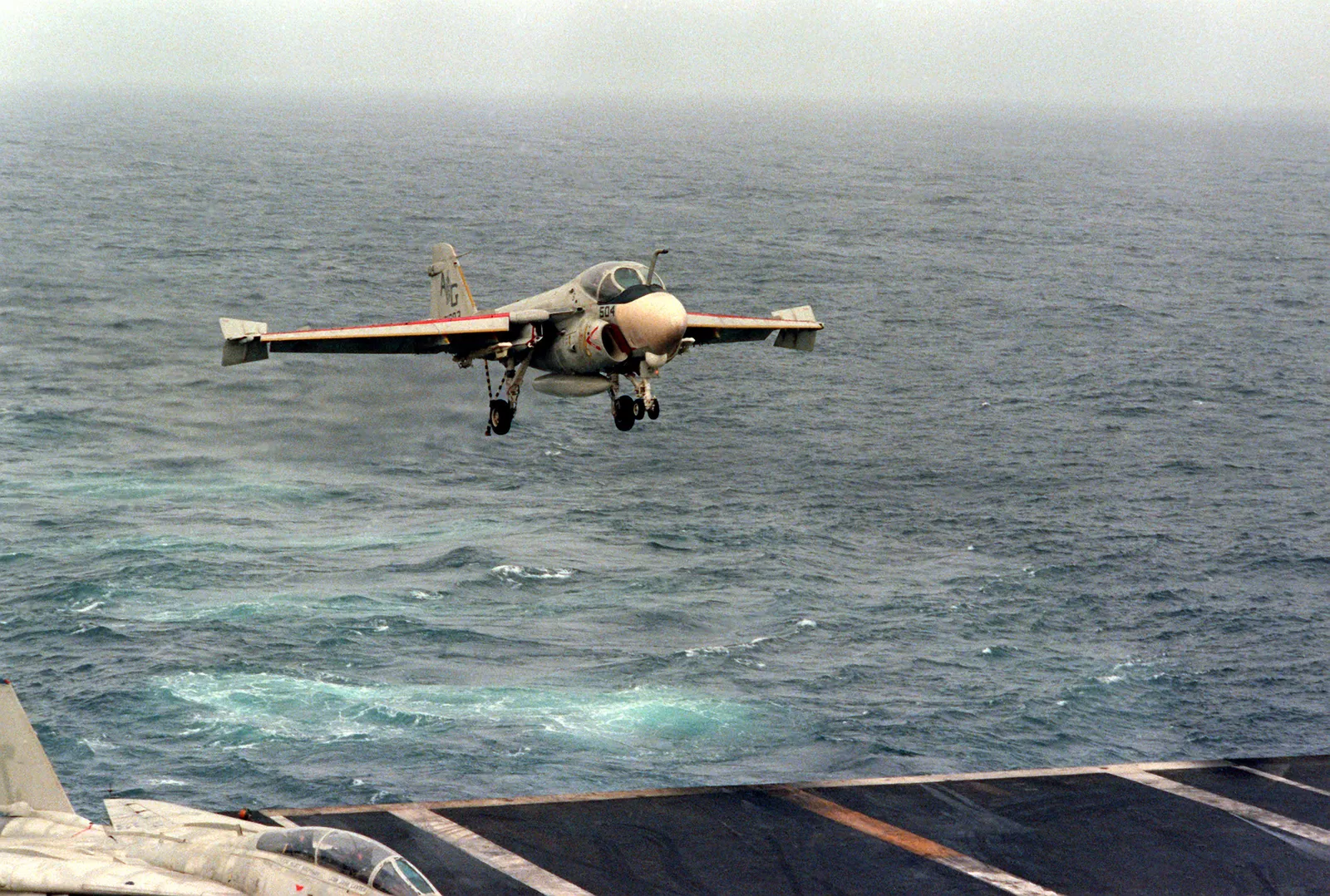
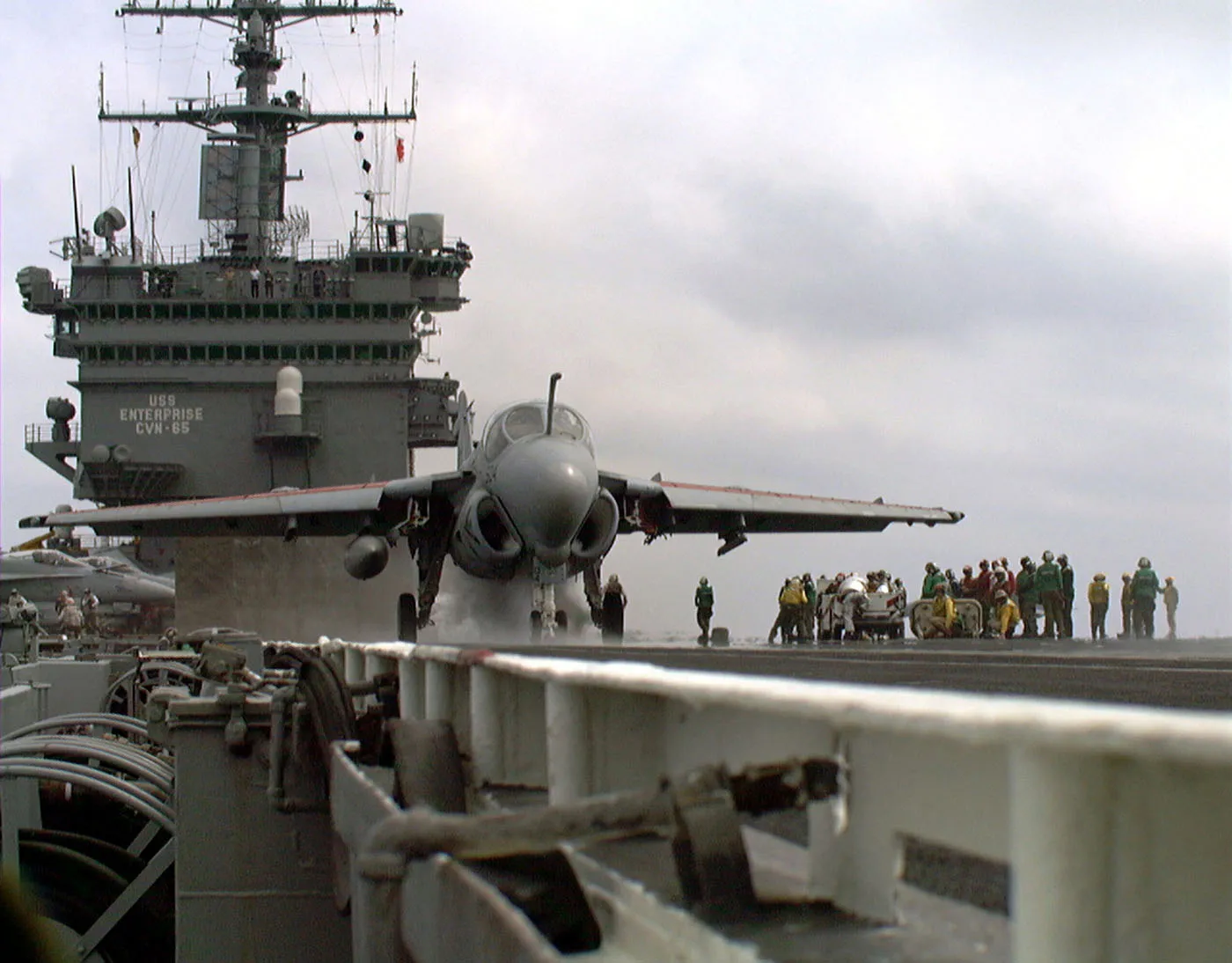
During Operation Desert Storm, TRAM-equipped A-6E Intruders handled much of the Navy laser-designation and laser-guided-bomb work, and FAS notes that Navy A-6Es dropped virtually all 219 GBU-16s used in the campaign.
Role detailsA-6E Intruder
- A-6E
- A-6 Intruder
- Grumman A-6E Intruder
- Intruder
- A2F Intruder
The A-6E Intruder was Grumman's final U.S. Navy and Marine Corps two-seat carrier attack variant, built around all-weather low-level strike, TRAM laser/infrared targeting, and later SWIP standoff-weapon integration. It served from the early 1970s through Desert Storm, Bosnia, and the type's 1997 retirement.
Role in Conflicts
In the 1980s U.S.-Libya confrontations, A-6E Intruders were used in carrier strikes, including Harpoon anti-ship employment and attacks tied to the Gulf of Sidra and Operation El Dorado Canyon period.
The Intruder's final combat missions were flown over Bosnia in 1994, after the A-6E/TRAM and SWIP upgrades had defined the fleet's late-service strike configuration.
Profile / Specs
Profile
- Origin
- United States
- Built by
- Grumman Aerospace
- Type
- Carrier-based attack aircraft
- Service note
- Cold War
- Designed
- 1957 specification; A-6E first flown in 1970
- Produced
- A-6E production and conversions from the 1970s
- Number built
- 240 conversions and 207 new-build A-6Es
Specifications
- Crew
- 2
- Wingspan
- 53 ft
- Length
- 54 ft 9 in
- Height
- 16 ft 2 in
- Max catapult take-off weight
- 58,600 lb
- Payload
- Up to 18,000 lb of ordnance
- Power plant
- Two Pratt & Whitney J52-P-8B turbojets
- Primary late sensor fit
- TRAM chin turret with FLIR, laser range/designation, and laser-spot sensing
- Late weapons integration
- SWIP digital armament and standoff-weapons capability
Late-Service Upgrade Path
The A-6E page is strongest when read as an upgrade path: a 1960s all-weather attack design became a 1970s avionics refresh, then a TRAM precision-strike aircraft, and finally a SWIP standoff-weapons platform before retirement.
| Stage | What changed | Reader relevance |
|---|---|---|
| A-6E baseline | Updated avionics, radar, and navigation computer replaced earlier A-6A equipment. | Defines this record as the final attack variant rather than the original Vietnam-era A-6A. |
| TRAM | Chin-mounted FLIR, laser ranging/designation, and laser-spot sensing entered fleet service from 1979. | Explains why A-6Es were important to laser-guided bomb work in Desert Storm. |
| Composite wing and SWIP | Fatigue-driven wing replacement paired with digital armament and standoff-weapons integration. | Connects late A-6E service to Harpoon and other standoff strike roles. |
Variants
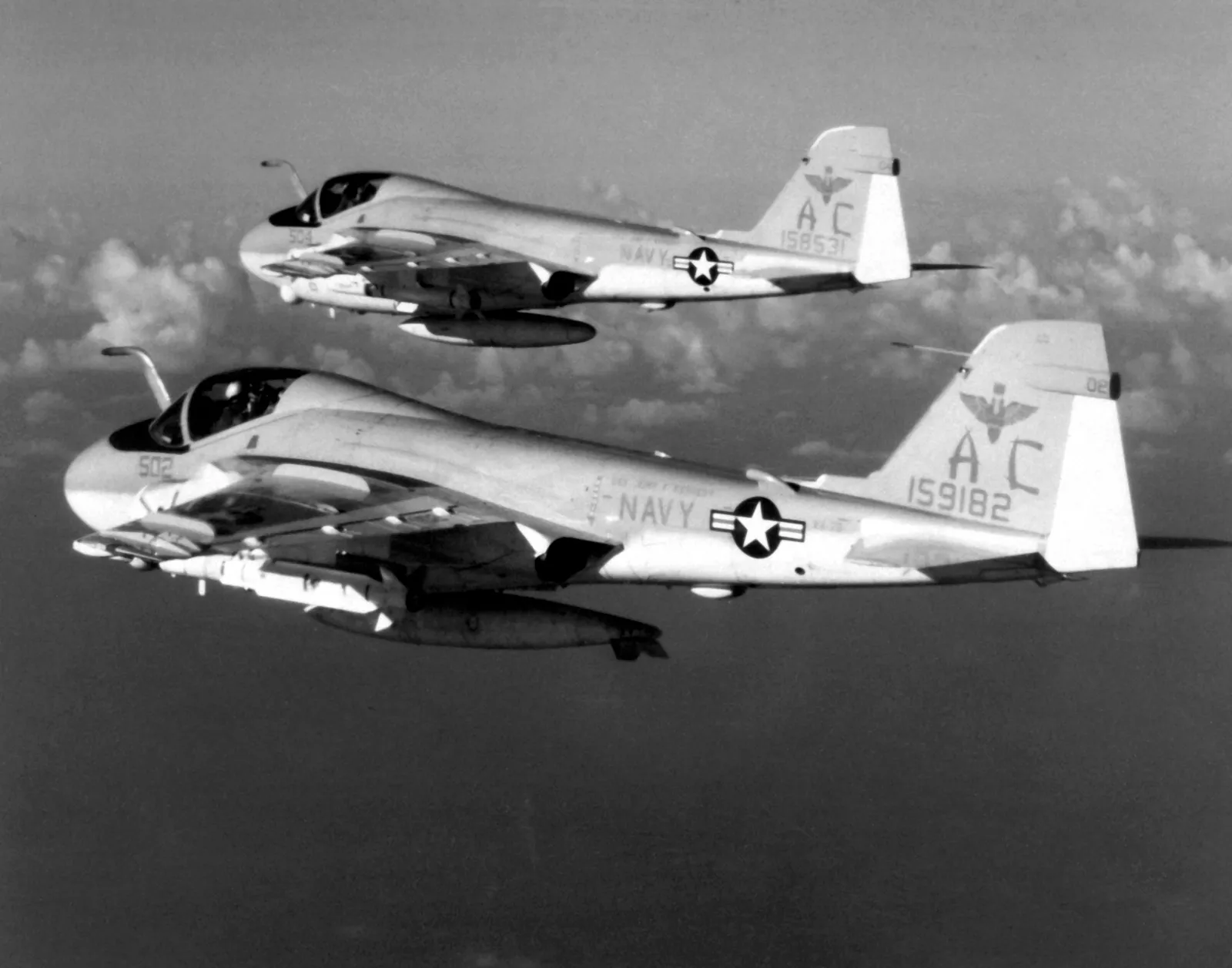
The A-6E was the final attack model in the Intruder line, with earlier A-6A/B/C configurations and the KA-6D tanker preceding late TRAM and SWIP A-6E upgrades.
| Variant | Configuration | Designation notes |
|---|---|---|
| A-6A | Original production attack aircraft | Initial Navy and Marine attack model delivered in the 1960s with DIANE all-weather attack/navigation equipment. Sources: A-6E Intruder - Smithsonian |
| A-6B | Anti-radar attack conversion | A small number of A models were modified for Iron Hand suppression of enemy air defenses. Sources: A-6E Intruder - Smithsonian |
| A-6C | Night/interdiction sensor conversion | The A-6C carried the TRIM multisensor belly pod before later A-6E TRAM sensor integration replaced that approach. Sources: A-6E Intruder - Smithsonian |
| KA-6D | Aerial refuelling derivative | The tanker variant followed an A-6 hose-and-drogue refuelling demonstration and provided carrier air wings with organic tanking support. Sources: A-6E Intruder - Smithsonian |
| A-6E TRAM | Targeting-sensor upgrade | TRAM added a stabilized chin turret with FLIR, laser ranging/designation, and laser-spot sensing, giving the A-6E a central late-service precision-strike role. Sources: A-6E Intruder - Smithsonian |
| A-6E SWIP | Standoff-weapons integration | Composite-wing A-6Es were also fitted with a digital armament system and standoff-weapons capability under the Systems Weapons Integration Program. Sources: A-6E Intruder - Smithsonian |
Carried and Launched Munitions
Late A-6E service combined heavy unguided payload capacity with precision and maritime-strike stores documented in Navy and specialist sources.
| Carried item | Item type | Carriage evidence |
|---|---|---|
![]() | Air-launched anti-ship missile | Naval Aviation News documents VA-85 A-6E Intruders launching Harpoon from USS Saratoga, confirming the aircraft's air-launched anti-ship role. Sources: Naval Aviation News Harpoon Launch |
![]() | 1,000-pound laser-guided bomb | FAS states that Navy A-6E aircraft dropped virtually all 219 GBU-16s used during Desert Storm because the aircraft could self-designate targets. Sources: GBU-16 Paveway II |
Timeline
A-6E Intruder Key Events
New Navy attack-aircraft requirement
A Navy specification called for a low-level, all-weather attack aircraft able to find and strike small targets while penetrating enemy defenses.
Sources: A-6E Intruder - Smithsonian
Intruder first flight
The first YA2F-1 prototype flew, beginning the program that became the A-6 Intruder after the 1962 designation change.
Sources: A-6E Intruder - Smithsonian
A-6E first flight
The final attack version first flew as a modified A-6A before Grumman built or converted hundreds of A-6Es.
Sources: A-6E Intruder - Smithsonian
A-6E reaches operational unit
After VA-42 training-unit service, VA-85 became the first operational A-6E squadron in December 1971.
Sources: A-6E Intruder - Smithsonian
TRAM enters fleet service
The Target Recognition Attack Multisensor turret began entering fleet service, adding FLIR and laser functions to late A-6E strike operations.
Sources: A-6E Intruder - Smithsonian
Composite wing and SWIP work
A graphite/epoxy replacement wing flew after fatigue issues, while SWIP added digital armament and standoff-weapons capability.
Sources: A-6E Intruder - Smithsonian
Desert Storm strike work
TRAM-equipped A-6E Intruders were central to Navy laser-guided-bomb use during Desert Storm, including GBU-16 drops by Navy A-6Es.
Sources: A-6E Intruder - Smithsonian, GBU-16 Paveway II
Final combat missions
The Intruder's last combat missions were flown over Bosnia before the type left service later in the decade.
Sources: A-6E Intruder - Smithsonian
Intruder retirement
The last Intruders retired from U.S. service in 1997.
Sources: A-6E Intruder - Smithsonian
Media
Related Weapon Systems