Munitions

Harpoon

Also known as
  • AGM-84
  • RGM-84
  • UGM-84
  • AGM/RGM/UGM-84
  • Harpoon Block II
  • Harpoon Block-2
  • Harpoon Block 2
  • Harpoon Block II+
  • Harpoon Block II Update
  • HIIU
  • RGM-84 Harpoon
  • AGM-84 Harpoon
  • UGM-84 Harpoon

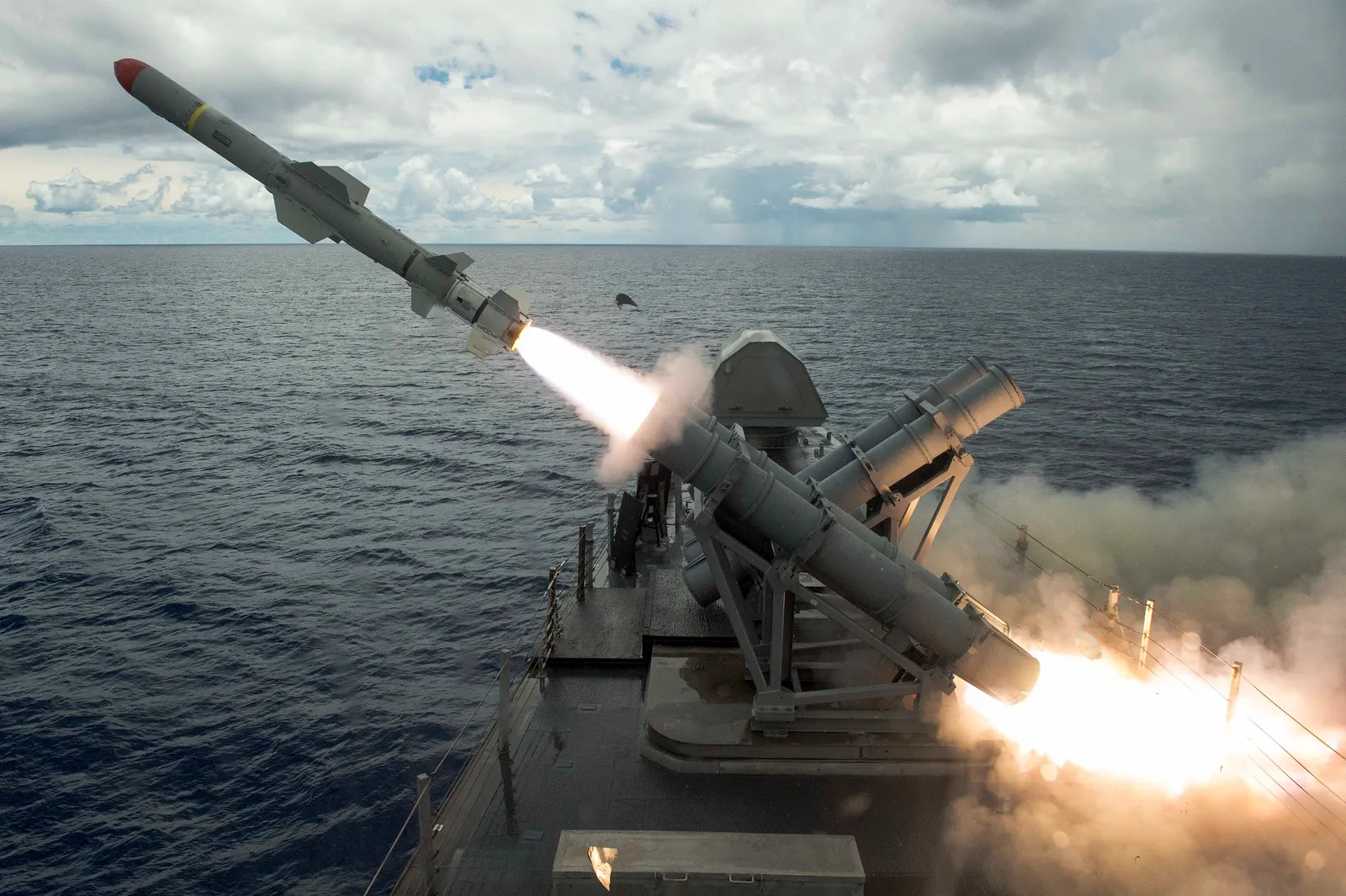
Harpoon is a U.S.-origin anti-ship cruise missile family used from aircraft, surface ships, submarines, and coastal launchers. The family combines sea-skimming flight with active radar terminal homing, while Block II adds GPS-aided inertial navigation for littoral anti-ship and land-attack missions and Block II+ adds a network-enabled upgrade path. Cataloged conflict use ranges from Iranian and Saudi naval launches in the late Cold War and Gulf War period to truck-mounted RGM-84 coastal defense missiles supplied for Ukraine's Black Sea defense.

Role in Conflicts

Side
Iran
Role in conflict
Anti-ship missile in Tanker War naval action

During Operation Praying Mantis in the Tanker War phase of the Iran-Iraq War, Iranian patrol boat Joshan launched a Harpoon at USS Wainwright; the missile missed after the U.S. ship used chaff.

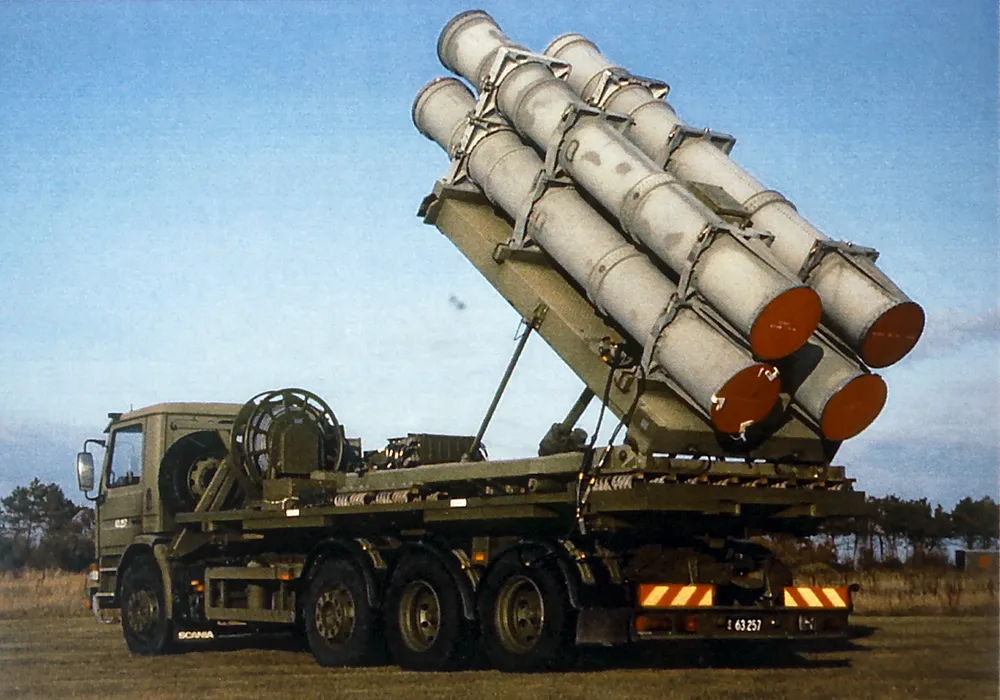
Ukraine received and deployed land-based Harpoon anti-ship missile systems for Black Sea coastal defense, including Danish coastal-defense missiles reported as RGM-84L-4 Harpoon Block II; U.S. officials later described truck-launched RGM-84 Harpoons supplied through partner arrangements as used by Ukraine against Russian vessels in June 2022.

Role details
Profile / Specs

Profile

Origin
United States; exported and donor-supplied in multiple launch configurations
Built by
Boeing
Type
Anti-ship cruise missile family
Service note
1977-present; donor-supplied coastal defense use in Ukraine from 2022
Designer
McDonnell Douglas / Boeing
Designed
1960s-1970s
Produced
1970s-present in upgraded variants

Specifications

Primary role
All-weather over-the-horizon anti-ship cruise missile for aircraft, ships, submarines, shore batteries, and mobile coastal defense vehicles
Launch platforms
Aircraft, surface ships, submarines, shore batteries, and mobile coastal defense vehicles depending on variant
Range
Harpoon Block II listed by Boeing at more than 67 nautical miles
Guidance
Midcourse GPS-aided inertial navigation on Block II; active radar terminal homing with sea-skimming cruise monitored by radar altimeter; Block II+ adds datalink-enabled in-flight updates
Warhead
Boeing lists a 500-pound blast-fragmentation warhead; U.S. Navy fact file lists 1,523 lb missile weight with booster
Propulsion
Air-breathing turbojet cruise engine with solid-propellant booster for surface, submarine, and land-based applications
Block II mission set
Anti-ship strike in open-ocean and congested littoral environments, plus land-target and ships-in-port attack using GPS-aided inertial navigation
Block II+ update
NAVAIR describes a new GPS guidance kit, datalink interface, in-flight updates, improved target selectivity, abort option, and enhanced resistance to electronic countermeasures
Variants

Harpoon designations primarily identify launch mode and block standard: AGM for air launch, RGM for ship or shore launch, and UGM for submarine launch.

VariantConfigurationDesignation notes
AGM-84D Harpoon, Air-launched anti-ship cruise missile, MunitionsAGM-84D HarpoonBlock IC family member

The D-series Block IC appears across air, surface, and submarine launch modes; the linked support page focuses on the air-launched AGM-84D evidence.

Sources: Designation Systems: AGM/RGM/UGM-84 Harpoon, P-8A Poseidon fires Harpoon, hits mark

Block IIGPS-aided anti-ship and land-strike upgrade

Boeing and NAVAIR describe Block II as adding GPS-aided inertial navigation for anti-ship, congested-littoral, coastal-target, and land-attack missions while retaining multi-platform Harpoon launch compatibility.

Sources: Harpoon Block II Product Card, NAVAIR Harpoon Product Page, Boeing Harpoon Block II Missile Tested by U.S. Navy, Boeing Harpoon Block II Missile Successfully Attacks Land Target

Block II+ / HIIUNetwork-enabled and obsolescence-update branch

NAVAIR says Block II+ adds a new GPS guidance kit, datalink interface, in-flight updates, target-selectivity and abort features, while the 2026 HIIU flight-test series modernized Block II for continued production and mixed anti-ship and land-strike mission sets.

Sources: NAVAIR Harpoon Product Page, NAVAIR Harpoon Block II Update Flight Test

AGM-84E SLAM / SLAM-ERLand-attack derivative

SLAM and SLAM-ER are Harpoon-derived land-attack missiles, but their target set and guidance package are distinct from the anti-ship Harpoon rows above.

Sources: Designation Systems: AGM/RGM/UGM-84 Harpoon

Carrier Aircraft
CarrierCarrier typeCarriage evidence
F/A-18E/F Super Hornet, Carrier-capable multirole strike fighter, Aircraft & UAVsF/A-18E/F Super HornetCarrier-capable multirole strike fighter

NAVAIR lists Harpoon among the F/A-18E/F Super Hornet's armament.

Sources: F/A-18E/F Super Hornet (NAVAIR)

P-3C Orion patrol aircraft, Maritime patrol aircraft, Aircraft & UAVsP-3C Orion patrol aircraftMaritime patrol aircraft

Boeing's chronology records a successful first drop test of the Harpoon anti-ship missile from a U.S. Navy P-3C Orion patrol aircraft.

Sources: Boeing chronology

F/A-18 Hornet (Tactical), Carrier-capable multirole strike fighter, Aircraft & UAVsF/A-18 Hornet (Tactical)Carrier-capable strike fighter

NAVAIR lists Harpoon among the Hornet's armament.

Sources: F/A-18 A-D Hornet

B-52 Stratofortress, Long-range heavy bomber, Aircraft & UAVsB-52 StratofortressLong-range heavy bomber

A U.S. Air Force photo caption shows a B-52H Stratofortress carrying the AGM-84D Harpoon missile.

Sources: AGM-84D Harpoon

F-15 family fighter aircraft, Fighter aircraft family, Aircraft & UAVsF-15 family fighter aircraftFighter aircraft family

Boeing's Advanced F-15 weapons inventory lists AGM-84 Harpoon Block II among the aircraft's external carriage options.

Sources: Advanced F-15 Weapons Inventory

Launch Platforms
LauncherLauncher typeLaunch evidence
Brandenburg class / F123 frigate, Anti-submarine frigate class, Naval SystemsBrandenburg class / F123 frigateAnti-submarine frigate

Bundeswehr lists two launchers for RGM-84 Harpoon on the Brandenburg class.

Sources: Fregatten der Brandenburg-Klasse

Baden-Württemberg / F125 frigate, Stabilization frigate class, Naval SystemsBaden-Württemberg / F125 frigateStabilization frigate

Bundeswehr lists two starters for RGM-84 Harpoon on the Baden-Württemberg-class frigates, giving the class an over-the-horizon anti-ship missile fit.

Sources: Bundeswehr: Fregatten der Baden-Wuerttemberg-Klasse

A-6E Intruder, Carrier-based attack aircraft, Aircraft & UAVsA-6E IntruderCarrier-based attack aircraft

Naval Aviation News documents VA-85 A-6E Intruders launching Harpoon from USS Saratoga, confirming the missile's air-launched role.

Sources: Naval Aviation News Harpoon Launch

P-8 Poseidon maritime-patrol aircraft, Maritime patrol aircraft, Aircraft & UAVsP-8 Poseidon maritime-patrol aircraftMaritime patrol aircraft

NAVAIR says a P-8A Poseidon successfully fired a Harpoon AGM-84D Block IC missile from station 10 during live-fire testing.

Sources: P-8A Poseidon fires Harpoon, hits mark

Compatible Aircraft
Compatible itemItem typeCompatibility evidence
F-16 Fighting Falcon, Multirole fighter aircraft, Aircraft & UAVsF-16 Fighting FalconFighter aircraft

Shaw AFB's F-16C Fighting Falcon fact sheet says Block 50/52 aircraft fully integrate the AGM-84 Harpoon anti-shipping missile.

Sources: F-16C Fighting Falcon

Launch Modes and Designations

Harpoon is best read as a missile family rather than a single launcher configuration. The designation prefix usually identifies how the missile leaves the platform, while block suffixes describe guidance, range, network, and software changes.

Designation familyLaunch modeReader note
AGM-84Aircraft launchAir-launched Harpoons appear on maritime patrol aircraft, strike fighters, and selected bombers.
RGM-84Surface, shore, or truck launchRGM rows cover ship canisters, fixed or mobile coastal-defense launchers, and Ukraine's truck-launched donor systems.
UGM-84Submarine launchSubmarine-launched variants use a capsule before the missile transitions to powered flight above the surface.
Block II and laterGuidance and mission upgradesBoeing and NAVAIR describe Block II as adding GPS-aided inertial navigation, while Block II+ adds network-enabled in-flight update features.
SLAM / SLAM-ERLand-attack derivativeThese AGM-84 derivatives share Harpoon lineage but are separated here because their land-attack seeker and mission profile differ from the anti-ship missile rows.

Sources: Harpoon Missile; Harpoon Block II Product Card; NAVAIR Harpoon Product Page; Designation Systems: AGM/RGM/UGM-84 Harpoon.
Timeline

Harpoon Key Events

  1. Operation Praying Mantis launches

    Naval History and Heritage Command describes Iranian and U.S. Harpoon launches during Operation Praying Mantis, including Joshan's shot at Wainwright and Harpoons fired at Sahand.

    Sources: NHHC H-Gram Operation Praying Mantis

  2. Saudi Harpoon strike in Desert Storm

    The U.S. Navy Desert Storm chronology records a Royal Saudi vessel using a Harpoon anti-ship missile to sink an Iraqi minelayer in the northern Persian Gulf.

    Sources: NHHC Desert Storm January 1991 Chronology

  3. Ukrainian coastal deployment reported

    USNI News reported that Ukraine had deployed Harpoon anti-ship missiles to the edge of the Black Sea for coastal defense.

    Sources: Ukraine Deploys Anti-Ship Harpoon Missiles to the Edge of Black Sea, MoD Says

  4. Block II Update test series concludes

    NAVAIR reported that the third Harpoon Block II Update flight test used an F-15 launch profile against a representative land target, following earlier events for guidance performance and a moving maritime surface target.

    Sources: NAVAIR Harpoon Block II Update Flight Test

Media
Related Weapon Systems
Harpoon Coastal Defense System (HCDS), Mobile coastal anti-ship missile system, Naval SystemsNaval SystemsHarpoon Coastal Defense System (HCDS)Mobile coastal anti-ship missile systemHarpoon Coastal Defense System (HCDS) is a land-based Harpoon launch-system package built around mobile launcher transporter units, radar trucks, command-and-launch equipment, and RGM-84L-4 Harpoon Block II missiles. U.S. records identify Boeing as the principal contractor for Taiwan's HCDS sale, document follow-on launcher and missile-package contracts, and separately record two Harpoon coastal defense systems funded for Ukraine after Russia's full-scale invasion.
Standard Missile-2 (SM-2), Shipboard surface-to-air missile family, MunitionsMunitionsStandard Missile-2 (SM-2)Shipboard surface-to-air missile familyThe Standard Missile-2 (SM-2) is a Raytheon-built shipboard surface-to-air missile family used by U.S. and allied navies for fleet area air defense and ship self-defense. Aegis ships launch SM-2 from vertical launch systems, guide it by inertial navigation and mid-course commands, and use semi-active radar or infrared terminal homing in later medium-range blocks. U.S. Navy reporting documents USS Carney firing an SM-2 in October 2023 during Red Sea defense operations against Houthi missiles and drones.
Evolved Sea Sparrow Missile, Ship self-defense missile, MunitionsMunitionsEvolved Sea Sparrow MissileShip self-defense missileThe Evolved Sea Sparrow Missile is a NATO-cooperative ship self-defense missile family built by Raytheon for surface combatants and carrier self-defense. U.S. Navy, RTX, and NATO Seasparrow sources describe it as a medium-range guided weapon for anti-ship cruise missiles, aircraft, drones, and maneuvering surface threats; documented combat use includes USS Mason's 2016 Yemen self-defense engagement and Red Sea crisis firings against Houthi threats.
BGM-109 Tomahawk Land Attack Missile, Ship- and submarine-launched land-attack cruise missile, MunitionsMunitionsBGM-109 Tomahawk Land Attack MissileShip- and submarine-launched land-attack cruise missileThe BGM-109 Tomahawk Land Attack Missile, often abbreviated TLAM, is a U.S. long-range subsonic cruise missile used for deep precision strikes from naval surface ships and submarines, with newer variants also adding maritime-strike and warhead modernization paths. Documented combat use spans the 1991 Gulf War through Libya, Syria, Yemen, the Red Sea Crisis, Operation Inherent Resolve, and U.S. strikes on Iranian targets during the 2020 United States-Iran Conflict and 2025 Israel-Iran Conflict.

Sources