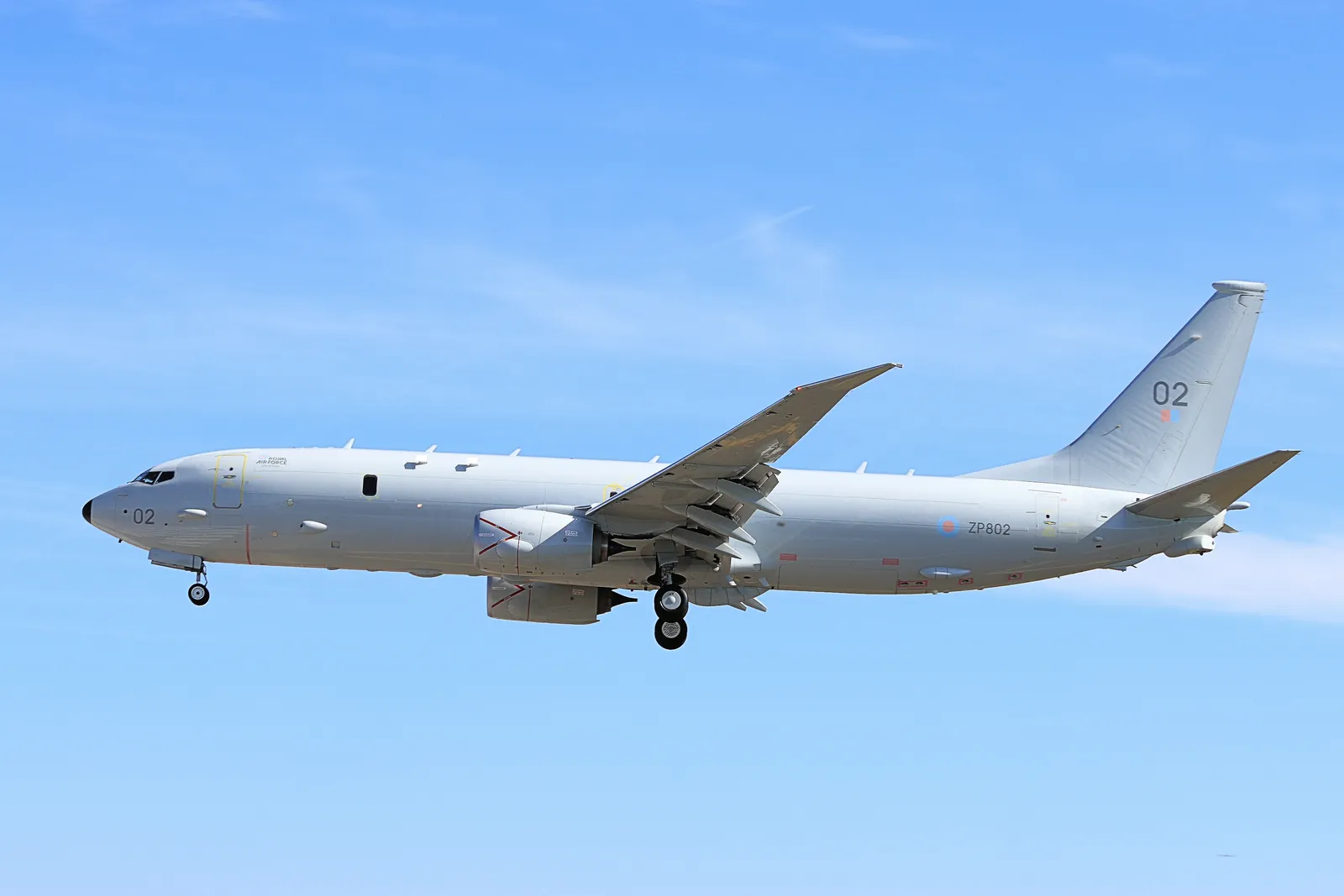

In the South China Sea Disputes, the U.S. Defense Department said an armed Chinese fighter intercepted a U.S. Navy P-8 Poseidon about 135 miles east of Hainan Island in international airspace on August 19, 2014.
Aircraft & UAVs
P-8 Poseidon maritime-patrol aircraft
Also known as
- Boeing P-8 Poseidon
- P-8 Poseidon
- P-8A Poseidon
- P-8I
- P-8I Neptune
- Poseidon MRA1
- Poseidon MRA Mk1
- P-8A
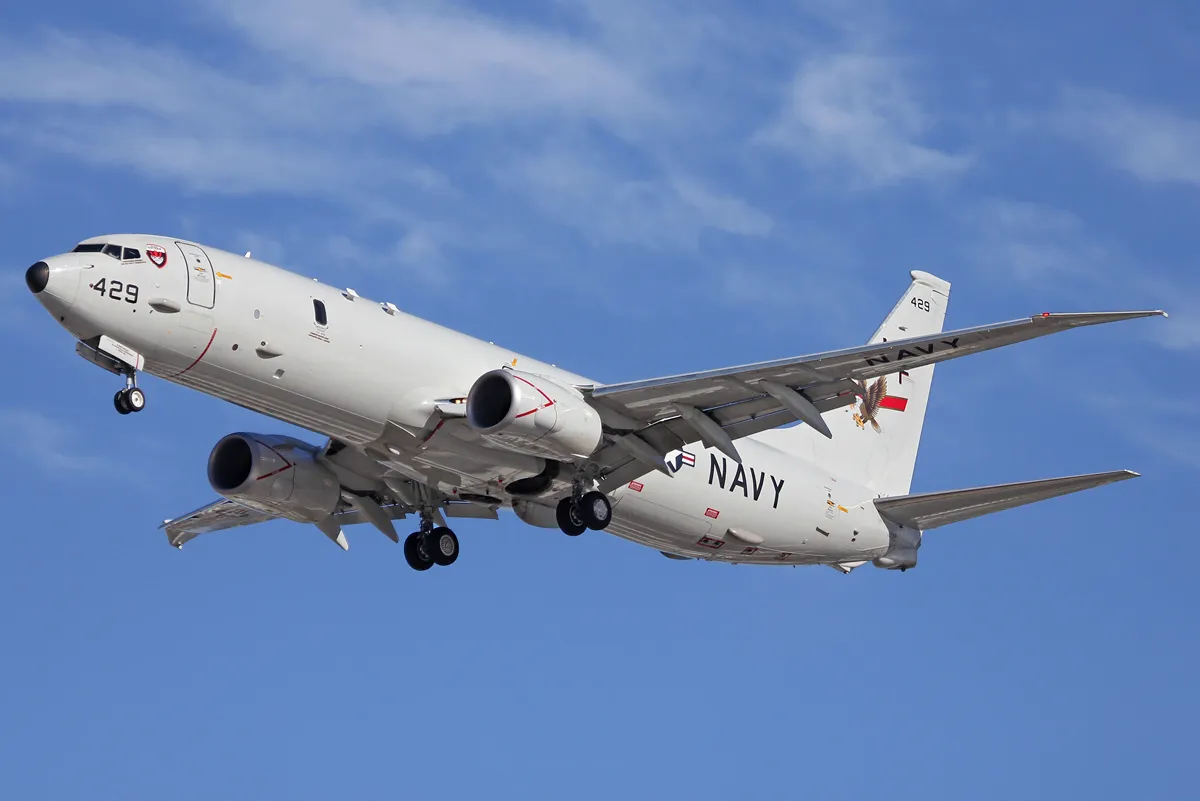
The Boeing P-8 Poseidon is a modified 737-800ERX-derived maritime patrol and reconnaissance aircraft built for anti-submarine warfare, anti-surface warfare, search and rescue, intelligence collection, and broad-area maritime-domain awareness. Official sources tie the family to A-size sonobuoys, Mk 54 torpedoes, Harpoon anti-ship missiles, and national designations including P-8A, P-8I Neptune, and Poseidon MRA1; conflict reporting places P-8s in South China Sea air-intercept incidents, 2020 Iran-crisis surveillance, and Indian Navy Operation Sindoor ISR support.
Role in Conflicts
- Side
- United States
During the 2020 United States-Iran Conflict, CENTCOM listed P-8 maritime patrol aircraft among U.S. assets employed in Operation Epic Fury, while defense reporting placed P-8 Poseidons over the Persian Gulf, Strait of Hormuz, and Gulf of Oman during the blockade.
- Side
- India

During Operation Sindoor, ET Now reported that an Indian Navy P-8I Neptune operated from forward airbases on an ISR mission, feeding target coordinates to Indian Army and Air Force units while operating in a GPS-denied environment.
Profile / Specs
Profile
- Origin
- United States
- Built by
- Boeing
- Type
- Maritime patrol aircraft
- Service note
- U.S. IOC in 2013; active U.S. and allied service
- Designer
- Boeing
- Designed
- 2004 development contract; first flight in 2009
- Produced
- 2009-present; first fleet delivery in 2012; full-rate production approved in 2014
- Number built
- More than 170 additional P-8s delivered after the first U.S. Navy aircraft, across eight operators, with Canada on contract to become the ninth operator
- Developed from
- Modified Boeing 737-800ERX
Specifications
- Range
- 1,200+ nautical miles; more than 4 hours on station
- Weapon stores compatibility
- 129 A-size sonobuoys; Harpoon; Mk 54; survival kit
- Radar and EO/IR sensors
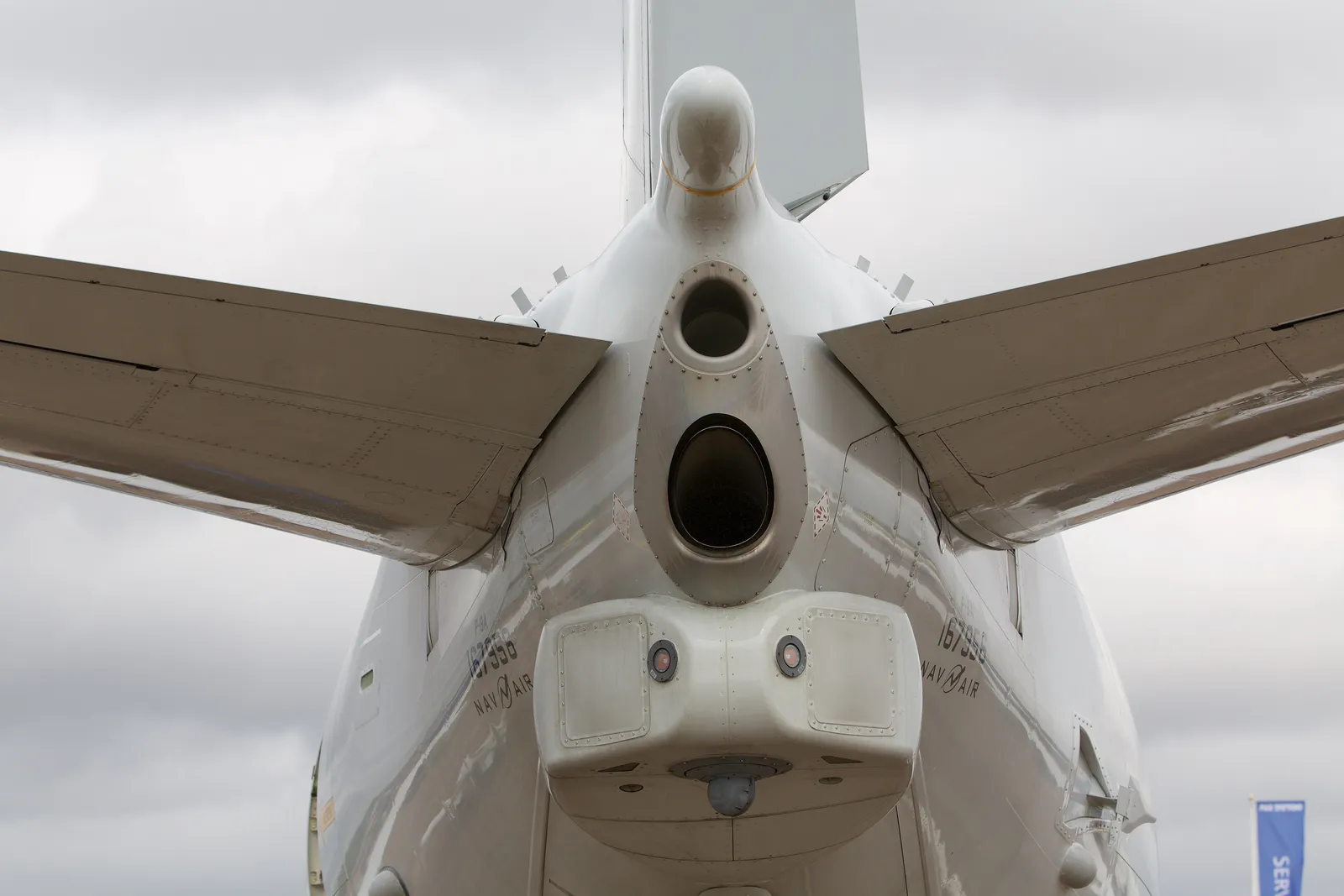
- Synthetic-aperture radar, electro-optical/infrared turret, and AN/APY-10 maritime, littoral, and overland surveillance radar
- ASW sensor system
- Acoustic sensor suite with sonobuoys and acoustic processing for anti-submarine missions
- Commercial airframe commonality
- 86% commonality with the Next-Generation 737
- Crew
- 9
- Wingspan
- 123.6 ft (37.6 m)
- Length
- 129.6 ft (39.5 m)
- Height
- 42.1 ft (12.8 m)
- Ceiling
- 41,000 ft (12,496 m)
- Engines
- 2x CFM56-7BE
- Max speed
- 490 knots
- Maximum gross takeoff weight
- 189,200 lb (85,820 kg)
National Designations
The catalog record covers the P-8 family rather than splitting national service names into separate pages. Boeing and official service sources distinguish the U.S. and allied P-8A, the Indian Navy P-8I Neptune, and the Royal Air Force Poseidon MRA1 name.
P-8A Poseidon
U.S. Navy and allied production designation for the P-8 maritime patrol aircraft.
P-8I Neptune
Indian Navy name used by Boeing for India's P-8 order and early P-8I service entry.
Poseidon MRA1
Royal Air Force service designation for the Boeing Poseidon P-8A in UK maritime patrol service.
Sources: Boeing P-8 Poseidon; Boeing Images Indian Navy P-8I over Mountains; RAF Poseidon MRA1; RAF Poseidon first UK flight.
Service Footprint
Boeing describes the P-8 as an in-service global maritime patrol family rather than a U.S.-only aircraft, with delivered P-8A customers and the Indian Navy P-8I forming the current operator base.
Delivered operators
Boeing lists P-8A deliveries to the U.S. Navy, Royal Australian Air Force, Royal Air Force, Royal Norwegian Air Force, New Zealand Defence Force, Republic of Korea Navy, and German Navy, plus Indian Navy P-8I operation.
Next contracted operator
The Royal Canadian Air Force is on contract to become the ninth P-8 operator.
737 sustainment base
Boeing cites 86 percent commonality with the Next-Generation 737 as part of the P-8 availability and sustainment argument.
Source: Boeing P-8 Poseidon.
Variants
The catalog keeps the P-8 family on one page and uses variants for upgrade blocks rather than repeating national designations that are already aliases of this record.
| Variant | Configuration | Designation notes |
|---|---|---|
| P-8A Increment 3 Block 2 | U.S. Navy upgrade package | NAVAIR says the Increment 3 Block 2 package reached initial operational capability in April 2026 with airframe, avionics, communications, ASW signals-intelligence, track-management, and acoustics upgrades; Boeing says the upgrade is being installed on U.S. Navy and Royal Australian Air Force P-8s. Sources: NAVAIR P-8A Increment 3 Block 2 IOC, Boeing P-8 Poseidon |
Launched Training Targets
The P-8A's sonobuoy launch system can deploy EMATT training targets.
| Launched item | Item type | Launch evidence |
|---|---|---|
 | Expendable anti-submarine warfare training target | A U.S. Navy VP-5 report says EMATTs are deployable through the P-8A's sonobuoy launch system and describes a P-8A training flight that employed an EMATT. Sources: VP-5 Joins Spain in Anti-submarine Warfare Exercise |
Carried Munitions
Boeing lists Harpoon as a P-8 anti-surface-warfare store, and NAVAIR documents the P-8A test-firing the AGM-84D Block IC.
| Carried item | Item type | Carriage evidence |
|---|---|---|
 | Anti-ship cruise missile | Boeing identifies Harpoon as a P-8 anti-surface-warfare store, and NAVAIR says a P-8A Poseidon successfully fired a Harpoon AGM-84D Block IC missile from station 10 during live-fire testing. Sources: Boeing P-8 Poseidon, Boeing P-8 Poseidon one-sheet, P-8A Poseidon fires Harpoon, hits mark |
Mission System and Stores
Official and manufacturer sources describe the P-8A as a maritime patrol aircraft whose mission system combines acoustic, radar, electro-optical/infrared, and electronic-support sensing with torpedo and anti-ship missile stores.
Weapon stores
Boeing lists 129 A-size sonobuoys, Harpoon, Mk 54, and a survival kit as weapon-store compatibility items.
ASW track-to-attack chain
Boeing describes the ASW fit as supporting submarine search, detection, classification, localization, tracking, and attack using acoustics, sonobuoys, ESM, ISAR, and torpedoes.
Maritime ISR sensors
Boeing describes radar modes including ISAR, SAR, periscope, search, and navigation; NAVAIR also identifies the AN/APY-10 maritime, littoral, and overland surveillance radar fit.
ASW weapon integration
NAVAIR says a P-8A launched a Mk 54 torpedo in 2011 to verify safe separation and weapon integration.
Sources: Boeing P-8 Poseidon; Boeing P-8 Poseidon one-sheet; NAVAIR P-8A Poseidon Program Page; P-8A successfully launches first Mk 54 weapon test.
Timeline
P-8 Poseidon maritime-patrol aircraft Key Events
Boeing test-vehicle contract
NAVAIR says Boeing received a 2004 contract for five P-8A test vehicles: three flight-test aircraft, one static-loads airframe, and one fatigue-test airframe.
Sources: NAVAIR P-8A first flight
First P-8A flight
The first P-8A test aircraft, T1, made the type's first flight from Renton Field and landed at Boeing Field after a 3-hour, 31-minute flight.
Sources: NAVAIR P-8A first flight
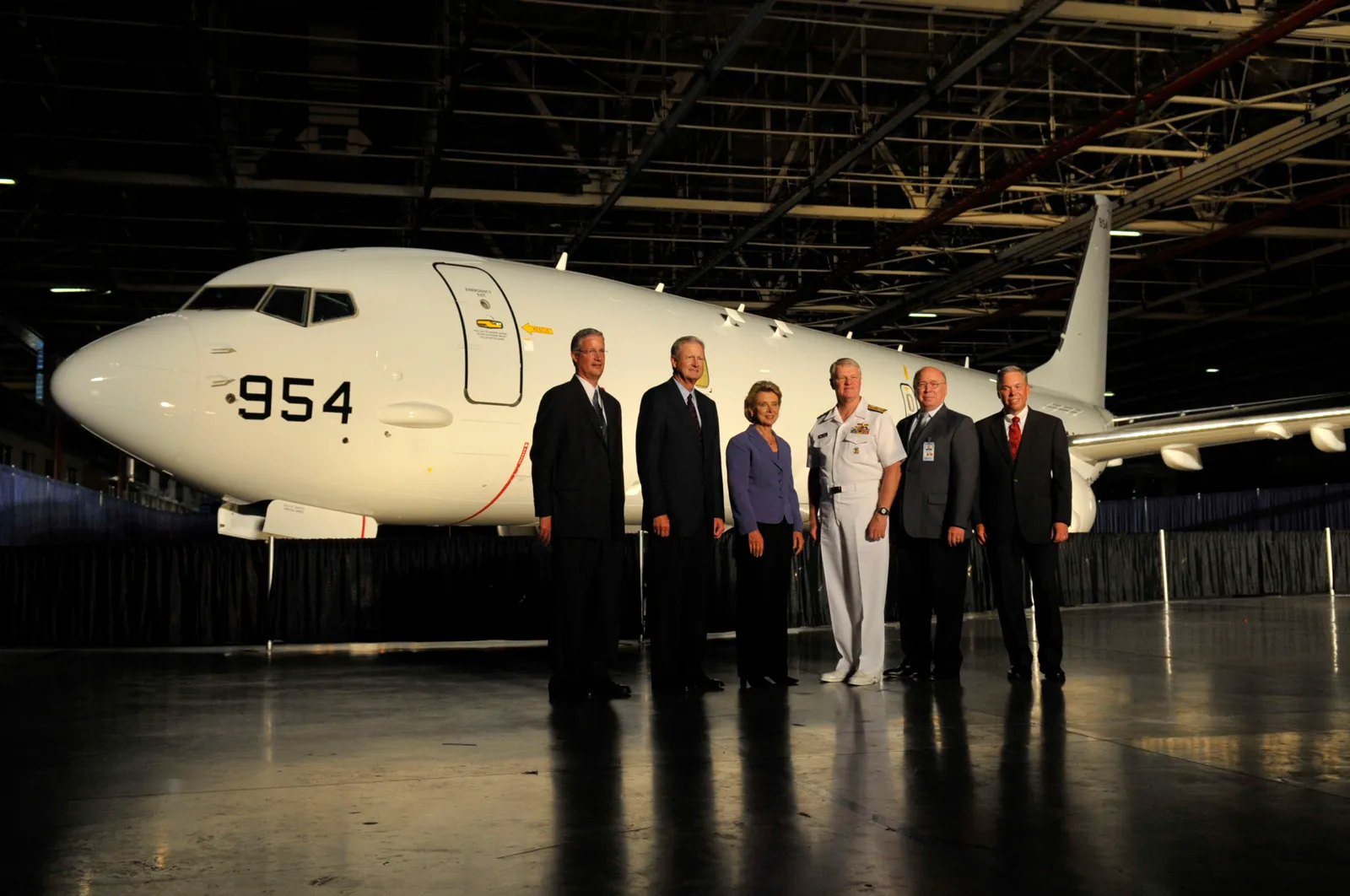
P-8A rollout ceremony
The U.S. Navy and Boeing unveiled the P-8A Poseidon at Boeing's Seattle-area manufacturing facility as the P-3C Orion replacement for long-range ASW, ASuW, ISR, and reconnaissance.
Sources: NAVAIR P-8A rollout
First U.S. Navy P-8A delivered
Boeing says the first P-8A Poseidon was delivered to the U.S. Navy on March 4, 2012, beginning the operational fleet handoff from development aircraft to service deliveries.
Sources: Boeing P-8 Poseidon
First fleet aircraft reaches VP-30
NAVAIR reported the Navy delivered the first low-rate initial production P-8A to fleet replacement squadron VP-30, followed by a public fleet-transition rollout at NAS Jacksonville.
Sources: NAVAIR first fleet P-8A
P-8A Harpoon live-fire test
A NAVAIR test aircraft fired a Harpoon AGM-84D Block IC missile from a P-8A during live-fire testing at Point Mugu.
Sources: P-8A Poseidon fires Harpoon, hits mark
Indian Navy P-8I enters service
Boeing says the P-8I is the Indian Navy variant and that India took command of its first P-8I in May 2013; a Boeing archive identifies the Indian order as eight P-8I Neptune aircraft contracted in January 2009.
Sources: Boeing P-8 Poseidon, Boeing Images Indian Navy P-8I over Mountains
U.S. Navy declares P-8A IOC
NAVAIR announced P-8A initial operational capability after VP-16's operational-readiness evaluation and ahead of the first operational P-8A squadron deployment.
Sources: NAVAIR P-8A IOC
First operational deployment
NAVAIR later described VP-16's December 2013-July 2014 Japan deployment as the inaugural operational deployment for P-8A aircraft in the U.S. 7th Fleet area of responsibility.
Sources: NAVAIR Navy Boeing Deliver 21st P-8A
Full-rate production approved
NAVAIR said the P-8A program received Milestone III approval to enter full-rate production, moving the aircraft out of low-rate initial production.
Sources: NAVAIR P-8A Full-Rate Production
South China Sea P-8 intercept
The U.S. Defense Department said an armed Chinese fighter intercepted a U.S. Navy P-8 Poseidon in international airspace east of Hainan Island.
Sources: DoD Registers Concern to China for Dangerous Intercept
RAF Poseidon MRA1 reaches IOC
The Royal Air Force says the first of nine Poseidon MRA1 aircraft arrived at RAF Kinloss on February 4, 2020, and initial operating capability was declared on April 1, 2020.
Sources: RAF Poseidon MRA1
Final active-duty U.S. P-3C squadron transition
The U.S. Navy said VP-40 completed the fleet's final active-duty transition from the P-3C Orion to the P-8A Poseidon on May 14, 2020.
Sources: Navy VP-40 Final Active Duty P-8A Transition
First Increment 3 Block 2 modification induction
NAVAIR reported that the Navy delivered the first P-8A to Boeing for Increment 3 Block 2 modification work, starting fleet retrofit activity before the package's 2026 IOC.
Sources: NAVAIR First Increment 3 Block 2 Modification Delivery
Increment 3 Block 2 IOC
NAVAIR said the U.S. Navy declared initial operational capability for the P-8A Increment 3 Block 2 system after initial operational testing, adding upgraded airframe, avionics, communications, ASW signals-intelligence, track-management, and acoustics capabilities.
Sources: NAVAIR P-8A Increment 3 Block 2 IOC
Media
P-8 Poseidon maritime-patrol aircraft Videos
Related Weapon Systems


Sources
Boeing P-8 PoseidonPublisher: Boeing | Note: Supports P-8 Poseidon manufacturer background, published specifications, weapon-store compatibility, variants, customer/operator footprint, 737 commonality, upgrade installation context, and delivery milestones. | Accessed: 2026-07-01NAVAIR P-8A Poseidon Program PagePublisher: NAVAIR | Note: Supports P-8A mission roles, sensors, armament categories, specifications, and initial operational capability date. | Accessed: 2026-07-01NAVAIR Navy Industry MMA WorkshopPublisher: NAVAIR | Note: Supports early P-8 / MMA development context, including the modified Boeing 737-800ERX airframe basis and P-3C replacement role. | Accessed: 2026-07-01NAVAIR P-8A first flightPublisher: NAVAIR | Note: Supports the P-8A's 2004 test-vehicle contract and first T1 flight on April 25, 2009. | Accessed: 2026-07-01NAVAIR P-8A rolloutPublisher: NAVAIR | Note: Supports the July 30, 2009 P-8A rollout and P-3C replacement role. | Accessed: 2026-07-01NAVAIR first fleet P-8APublisher: NAVAIR | Note: Supports first low-rate initial production P-8A delivery to VP-30 in March 2012 and fleet-transition rollout context. | Accessed: 2026-07-01NAVAIR P-8A IOCPublisher: NAVAIR | Note: Supports the November 29, 2013 P-8A initial operational capability announcement and VP-16 deployment-readiness context. | Accessed: 2026-07-01NAVAIR P-8A Full-Rate ProductionPublisher: NAVAIR | Note: Supports the January 2014 Milestone III approval moving the P-8A program from low-rate initial production into full-rate production. | Accessed: 2026-07-01NAVAIR Navy Boeing Deliver 21st P-8APublisher: NAVAIR | Note: Supports the December 2013-July 2014 VP-16 inaugural operational P-8A deployment to Japan in the U.S. 7th Fleet area of responsibility. | Accessed: 2026-07-01DoD Registers Concern to China for Dangerous InterceptPublisher: U.S. Department of Defense | Note: Supports South China Sea Disputes direct use: U.S. defense reporting said an armed Chinese fighter intercepted a U.S. Navy P-8 Poseidon about 135 miles east of Hainan Island in international airspace on August 19, 2014. | Accessed: 2026-07-01Boeing Images Indian Navy P-8I over MountainsPublisher: Boeing Images | Note: Supports the P-8I Neptune designation, India's January 2009 P-8I contract, and India as the P-8's first international customer. | Accessed: 2026-07-01RAF Poseidon MRA1Publisher: Royal Air Force | Note: Supports Poseidon MRA1 as the UK P-8A designation and RAF service milestones including 2020 initial operating capability. | Accessed: 2026-07-01RAF Poseidon first UK flightPublisher: Royal Air Force | Note: Supports the Poseidon MRA Mk1 (P-8A) designation wording used during the first UK aircraft flight. | Accessed: 2026-07-01Navy VP-40 Final Active Duty P-8A TransitionPublisher: U.S. Navy | Note: Supports VP-40 completing the U.S. Navy fleet's final active-duty transition from the P-3C Orion to the P-8A Poseidon on May 14, 2020. | Accessed: 2026-07-01NAVAIR First Increment 3 Block 2 Modification DeliveryPublisher: NAVAIR | Note: Supports the March 2024 delivery of the first P-8A aircraft to Boeing for Increment 3 Block 2 modification work. | Accessed: 2026-07-01NAVAIR P-8A Increment 3 Block 2 IOCPublisher: NAVAIR | Note: Supports the April 2026 initial operational capability announcement and capability scope for the P-8A Increment 3 Block 2 modification package. | Accessed: 2026-07-01Boeing P-8 Poseidon one-sheetPublisher: Boeing | Note: Supports the P-8 Poseidon's anti-surface warfare role, Harpoon delivery, weapon-store compatibility, and sensor/stores overview. | Accessed: 2026-07-01P-8A Poseidon fires Harpoon, hits markPublisher: NAVAIR | Note: Supports the P-8A Poseidon successfully firing a Harpoon AGM-84D Block IC missile during live-fire testing. | Accessed: 2026-06-28P-8A successfully launches first Mk 54 weapon testPublisher: NAVAIR | Note: Supports P-8A Mk 54 torpedo launch and integration testing and the AN/APY-10 radar fit. | Accessed: 2026-07-01Navy P-8A Poseidon Fact FilePublisher: U.S. Navy | Note: Supports P-8A Poseidon mission, background, and U.S. Navy specifications. | Accessed: 2026-06-20CENTCOM Operation Epic Fury Fact SheetPublisher: U.S. Central Command | Note: Supports the 2020 United States-Iran Conflict; CENTCOM said P-8 maritime patrol aircraft were used by U.S. forces in Operation Epic Fury. | Accessed: 2026-06-20100-Plus Aircraft Join US Military Blockade of IranPublisher: Air & Space Forces Magazine | Note: Supports the 2020 United States-Iran Conflict; P-8 Poseidon aircraft were used by U.S. forces over the Persian Gulf, Strait of Hormuz, and Gulf of Oman during the blockade, with the report noting precise missions were unclear. | Accessed: 2026-06-20ET Now Operation Sindoor P-8I MissionPublisher: ET Now | Note: Supports 2025 India-Pakistan Conflict direct use: an Indian Navy P-8I Neptune was deployed from forward airbases for ISR and targeting-support work during Operation Sindoor. | Accessed: 2026-07-01VP-5 Joins Spain in Anti-submarine Warfare ExercisePublisher: U.S. Naval Forces Europe and Africa / U.S. Sixth Fleet | Note: Supports the P-8A sonobuoy launch system deploying EMATT and the training flight that employed an EMATT. | Accessed: 2026-06-28P-8 Poseidon (52320190159) on Wikimedia CommonsPublisher: Wikimedia Commons | Note: Supports image provenance for the primary P-8 Poseidon photo. | Accessed: 2026-06-20P-8A Poseidon (19751705230) on Wikimedia CommonsPublisher: Wikimedia Commons | Note: Supports image provenance for a rear-view P-8A Poseidon photo. | Accessed: 2026-06-20Boeing P-8A rollout 30 July 2009 on Wikimedia CommonsPublisher: Wikimedia Commons | Note: Supports image provenance for the P-8A rollout photo. | Accessed: 2026-06-20US Navy P-8 Poseidon taking off at Perth Airport on Wikimedia CommonsPublisher: Wikimedia Commons | Note: Supports image provenance for the P-8 Poseidon takeoff photo. | Accessed: 2026-06-20