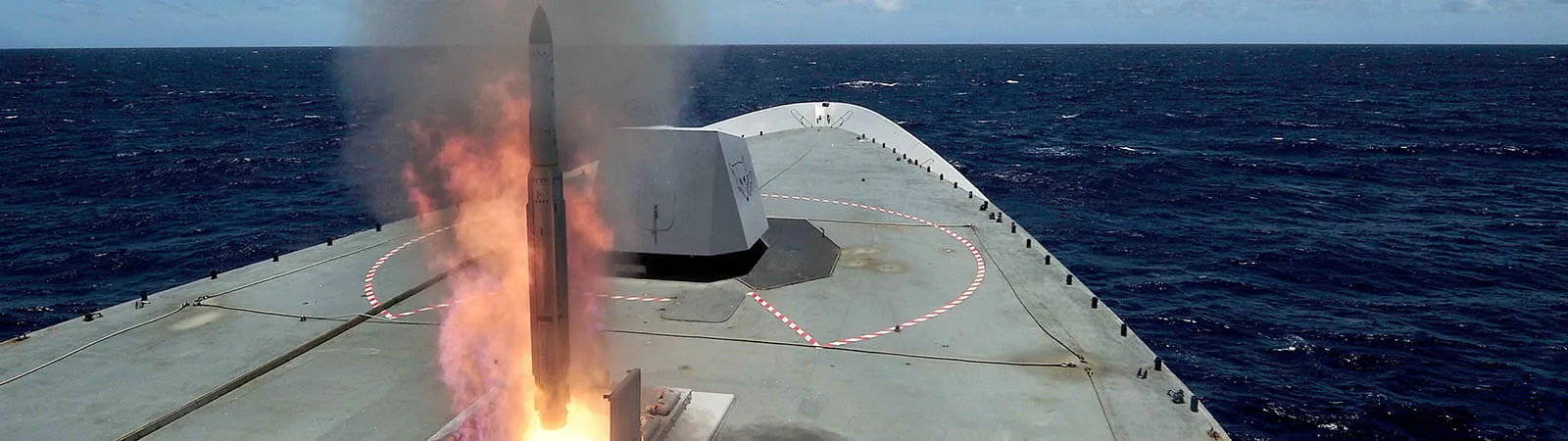
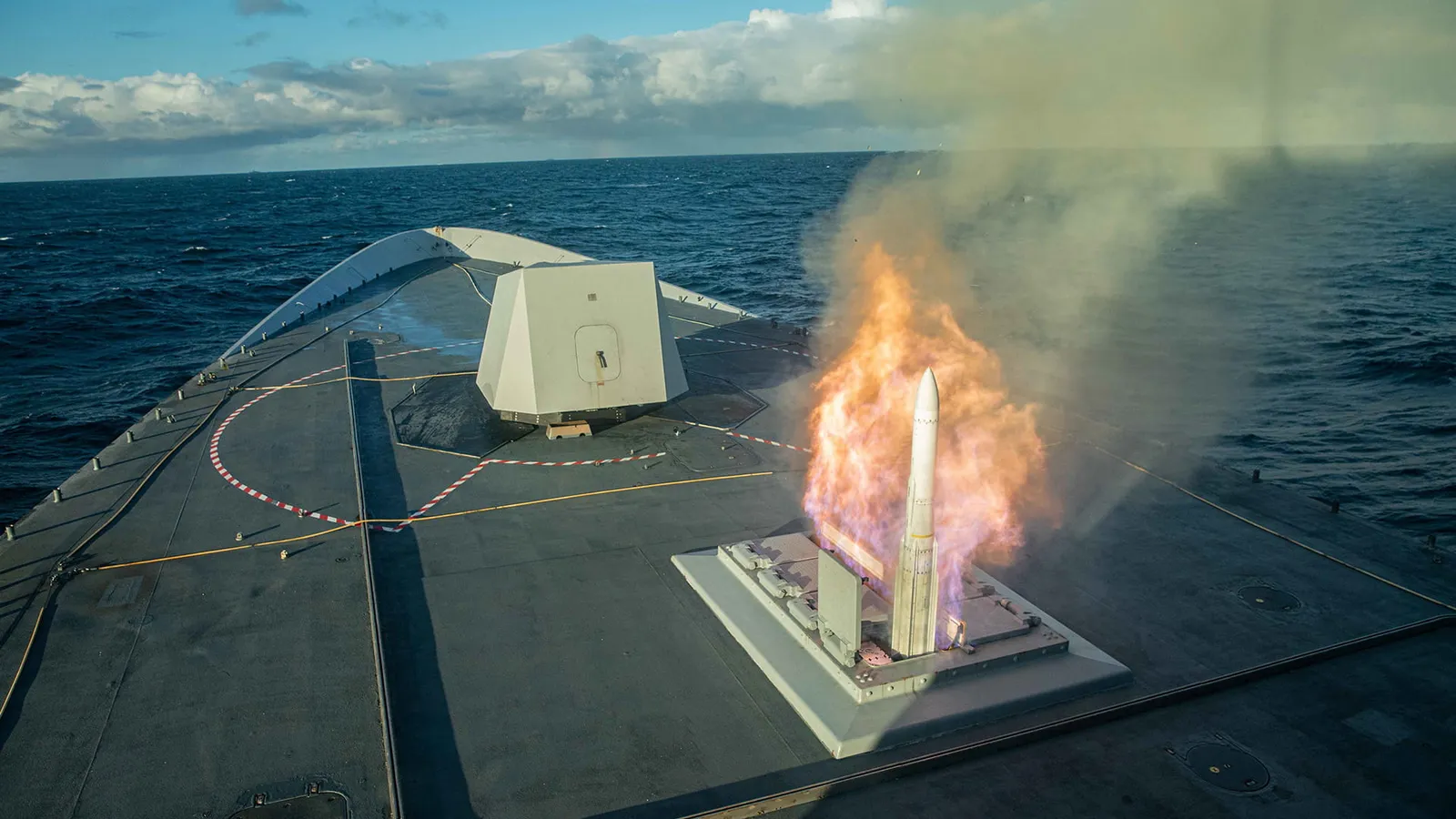
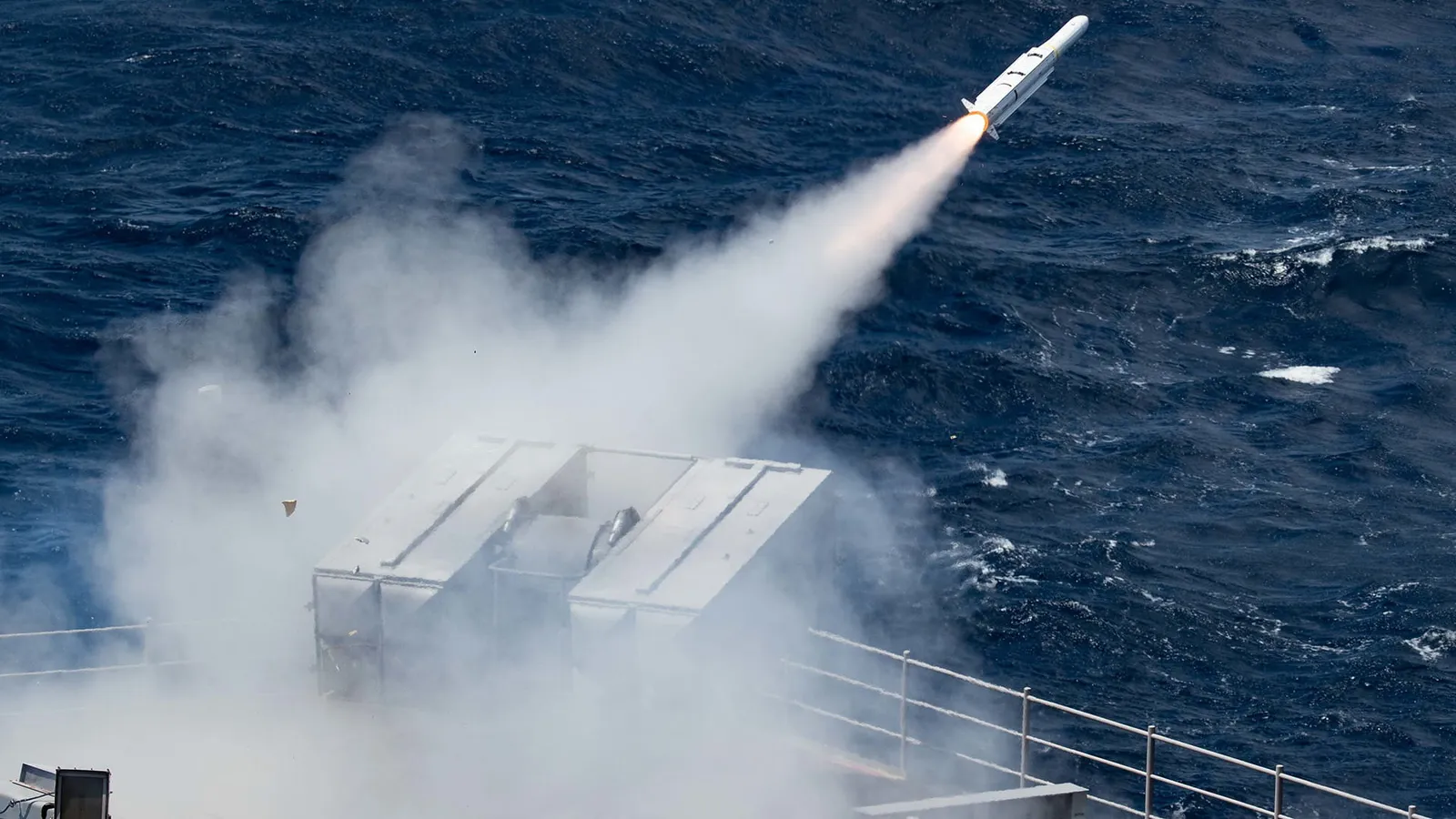
USS Mason launched one Evolved Sea Sparrow Missile, along with SM-2 missiles and Nulka decoys, while defending Mason and USS Ponce from suspected Houthi cruise missiles near Bab el-Mandeb in October 2016; reporting did not establish whether the ESSM caused an intercept.
Role detailsEvolved Sea Sparrow Missile
- ESSM
- RIM-162
- RIM-162 ESSM
- Evolved Seasparrow Missile
- ESSM Block 1
- ESSM Block 2
- RIM-162A
- RIM-162B
- RIM-162C
- RIM-162D
- RIM-162E
- RIM-162F
- RIM-162G
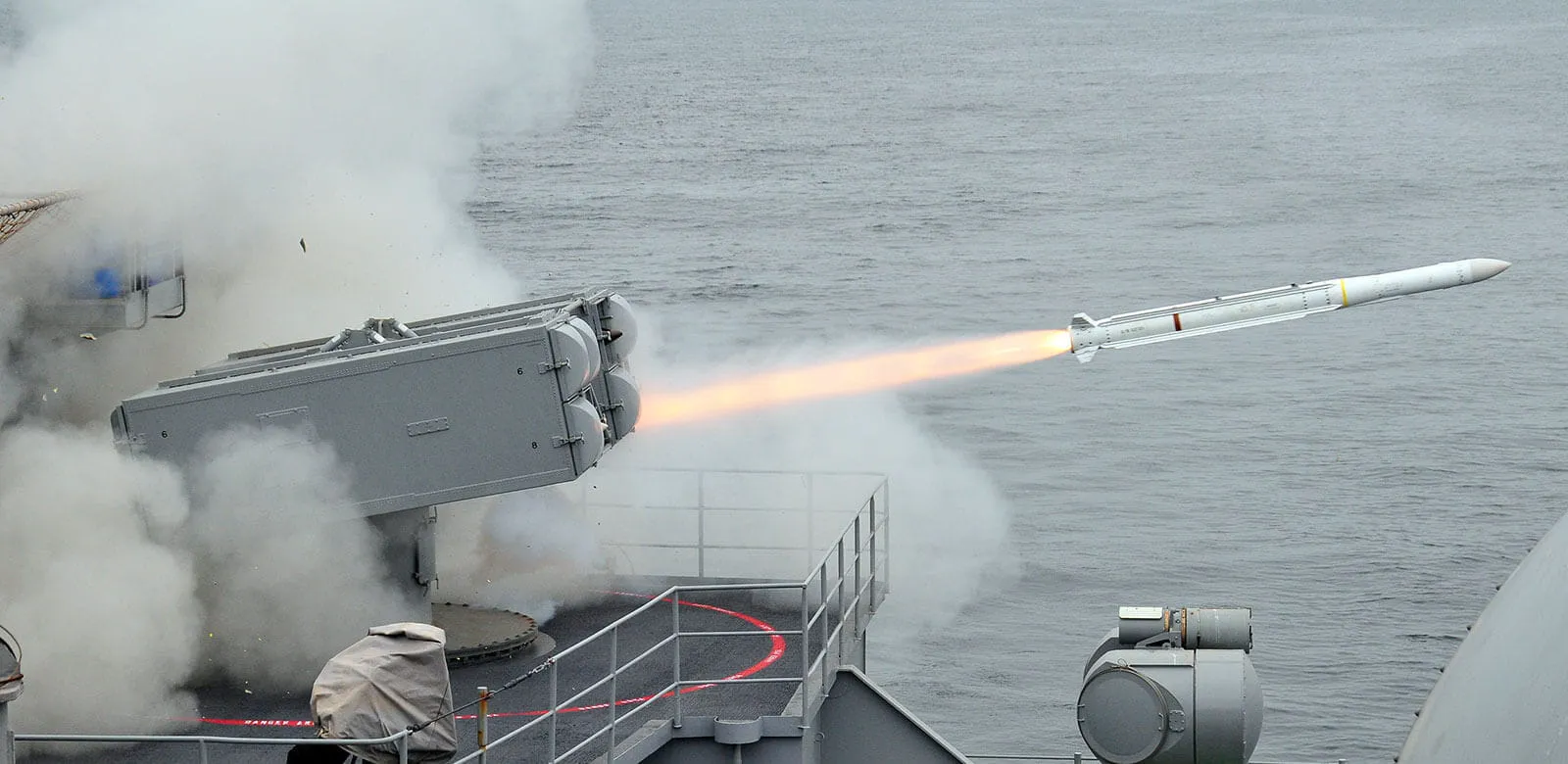
The Evolved Sea Sparrow Missile is a NATO-cooperative ship self-defense missile family built by Raytheon for surface combatants and carrier self-defense. U.S. Navy, RTX, and NATO Seasparrow sources describe it as a medium-range guided weapon for anti-ship cruise missiles, aircraft, drones, and maneuvering surface threats; documented combat use includes USS Mason's 2016 Yemen self-defense engagement and Red Sea crisis firings against Houthi threats.
Role in Conflicts
U.S. Navy reporting and later campaign accounts identify ESSM among defensive missiles fired against Houthi threats in the Red Sea crisis, while Danish reporting documents Iver Huitfeldt using ESSM and guns against drones during Operation Prosperity Guardian.
Role detailsProfile / Specs
Profile
- Origin
- United States
- Built by
- Raytheon
- Type
- Ship self-defense missile
- Service note
- 1980s-present
- Designed
- 1980s-1990s
- Unit cost
- $787K-$972K depending on configuration; later Block 2 procurement values vary by contract lot
- Produced
- 2002-present
- Developed from
- RIM-7P SeaSparrow Missile
Specifications
- Primary function
- Medium-range ship self-defense against anti-ship missiles, aircraft, helicopters, drones, and maneuvering surface threats
- Guidance
- Block 1 semi-active radar homing with radar and midcourse uplinks; Block 2 adds dual active/semi-active radar guidance
- Length
- 12 feet
- Diameter
- 8-inch guidance section; 10-inch control and rocket motor sections
- Weight
- 622 pounds
- Warhead
- 90-pound annular blast fragmentation warhead
- Propulsion
- 10-inch diameter rocket motor section retained into Block 2
- Range and speed
- Classified by the U.S. Navy
- Platforms
- MK 29, MK 41 VLS, MK 48 Guided Missile VLS, MK 56 Dual Pack ESSM Launching System, MK 57 VLS; integrated with Aegis, SSDS, and non-U.S. combat-system ships
Variants
ESSM Block 1 designations are tied largely to ship combat-system and launcher integration. Public official sources identify RIM-162D for the U.S. Navy Block 1 fact file, while specialist designation references enumerate additional Block 1 launcher variants; Block 2 keeps the same propulsion section but adds a dual active/semi-active guidance section.
| Variant | Configuration | Designation notes |
|---|---|---|
| ESSM Block 1 | Semi-active radar-guided baseline | The Navy describes Block 1 as a RIM-7P SeaSparrow kinematic upgrade that uses semi-active homing, radar, and midcourse data uplinks. Sources: Evolved Seasparrow Missile Block 1 (ESSM) (RIM 162D) |
| RIM-162A/B/C/D/E/F/G | Block 1 launcher and combat-system variants | Designation-Systems.Net maps the Block 1 lettered variants to Aegis, APAR, Mk 48, Mk 29, Mk 56, and Mk 57 launch or guidance configurations. Sources: Raytheon RIM-162 ESSM |
| ESSM Block 2 | Dual-mode active/semi-active seeker variant | Navy and NAVSEA sources describe Block 2 as retaining the propulsion section while adding a 10-inch guidance section with active and semi-active radar guidance, increased maneuverability, and networked ship-defense capability. Sources: Evolved Seasparrow Missile Block 1 (ESSM) (RIM 162D), NATO Seasparrow conducts successful flight test of ESSM Block 2 |
Ship And Carrier Launch Platforms
ESSM is carried by U.S. and allied surface combatants and carriers through Mk 29 launchers, Mk 41 vertical launch cells, and allied shipboard combat-system integrations.
| Carrier | Carrier type | Carriage evidence |
|---|---|---|
![]() | Guided-missile destroyer | The Navy's destroyer class info page identifies ESSM as VLS launched on DDG 79 AF ships, showing the Arleigh Burke class as a carrier platform for the missile. Sources: Destroyer Ship Class Info Page |
![]() | Air-defense frigate | Bundeswehr identifies the Sachsen-class Mk 41 vertical launching system as firing ESSM and SM-2, with four ESSMs carried per VLS cell. |
![]() | Guided-missile destroyer | The Royal Australian Navy says ESSM is launched from Mk 41 VLS aboard Hobart-class air warfare destroyers. Sources: RIM-162 Evolved Sea Sparrow missile | Royal Australian Navy |
![]() | Guided-missile destroyer | Canada's River-class fact sheet lists Raytheon Evolved Sea Sparrow Missile as the class's point-defense missile in the bow weapons fit. |
![]() | Nuclear-powered aircraft carrier | The Navy fact file lists CVN classes among ESSM platforms, and U.S. Navy imagery documents an ESSM launch from USS Nimitz. Sources: Evolved Seasparrow Missile Block 1 (ESSM) (RIM 162D), USS Nimitz ESSM launch image |
Launch Systems
ESSM is launched from Aegis-equipped ships through vertical launch systems and other shipboard launchers.
| Launcher | Launcher type | Launch evidence |
|---|---|---|
![]() | Anti-submarine frigate | Bundeswehr lists the Brandenburg class's Mk41 VLS as able to fire ESSM. Sources: Fregatten der Brandenburg-Klasse |
![]() | Shipboard integrated combat system | The AEGIS Weapon System fact file lists Evolved Sea Sparrow Missile among cruiser modernization improvements, and the Navy's Mobile Bay report says the cruiser test-fired an ESSM from the ship's forward launcher. Sources: AEGIS Weapon System Fact File, USS Mobile Bay Tests New AEGIS Weapon System |
Timeline
Evolved Sea Sparrow Missile Key Events
NATO Seasparrow project begins
The NATO Seasparrow Project traces its anti-ship missile-defense mission to 1968, providing the multinational program lineage behind later ESSM development.
Sources: NATO SEASPARROW | Protecting Navies Since 1968
ESSM production deliveries begin
U.S. Navy fact-file data place the first ESSM production delivery in 2002, before U.S. operational use began in 2004.
Sources: Evolved Seasparrow Missile Block 1 (ESSM) (RIM 162D)
U.S. operational use starts
The Navy lists 2004 as the start of U.S. operational use for ESSM Block 1.
Sources: Evolved Seasparrow Missile Block 1 (ESSM) (RIM 162D)
USS Mason fires ESSM off Yemen
USNI reported that USS Mason fired one ESSM, two SM-2s, and Nulka decoys while responding to suspected Houthi anti-ship cruise missiles in the Red Sea.
Sources: USS Mason Fired 3 Missiles to Defend From Yemen Cruise Missiles Attack
Block 2 controlled test firings
NAVSEA reported that two ESSM Block 2 controlled-test-vehicle firings took place at Point Mugu in June 2017.
Sources: NATO Seasparrow conducts successful flight test of ESSM Block 2
Block 2 active seeker intercept
The NATO Seasparrow Project Office conducted a Block 2 flight test that used the active guidance seeker-head and intercepted a BQM-74E aerial target.
Sources: NATO Seasparrow conducts successful flight test of ESSM Block 2
Block 2 low-rate production announced
Raytheon announced a $190 million U.S. Navy low-rate initial production contract for ESSM Block 2 missiles after the program shifted from development to production.
Sources: Low-rate initial production begins for Raytheon Evolved SeaSparrow Missiles
Block 2 IOC declared for Aegis platforms
DOT&E reported that the Navy declared ESSM Block 2 initial operational capability for Aegis platforms in December 2021 while later operational testing remained incomplete.
Sources: Evolved Sea Sparrow Missile (ESSM) Block 2
Danish ESSM fired in Red Sea drone engagement
Danish reporting on Iver Huitfeldt's March 2024 Red Sea engagement describes ESSM and ship-gun use during drone shootdowns under Operation Prosperity Guardian.
Sources: Redegorelse: Iver Huitfeldts nedskydning af droner den 9. marts 2024, Missile mishaps, ammo snags - report details Danish frigate deployment
Consortium And Block 2 Context
ESSM is a multinational ship-defense missile rather than a single-navy procurement item. The U.S. Navy identifies Block 1 as a cooperative program among NATO Seasparrow nations plus Australia, while RTX and NATO Seasparrow describe the family as a continuing anti-ship missile-defense effort for allied navies.
The NATO Seasparrow Project traces its mission to 1968; ESSM is the evolved missile family built from that ship self-defense program.
Sources: NATO SEASPARROW | Protecting Navies Since 1968; Evolved Seasparrow Missile Block 1 (ESSM) (RIM 162D).
Block 2 keeps the ESSM propulsion section but adds a dual-mode guidance section intended to reduce dependence on ship illumination during terminal engagement.
Sources: Evolved Seasparrow Missile Block 1 (ESSM) (RIM 162D); NATO Seasparrow conducts successful flight test of ESSM Block 2.
Public 2016 reporting documents an ESSM launch from USS Mason, while later Red Sea reporting documents ESSM use in defensive engagements; not every source identifies which interceptor defeated each target.
Sources: USS Mason Fired 3 Missiles to Defend From Yemen Cruise Missiles Attack; Redegorelse: Iver Huitfeldts nedskydning af droner den 9. marts 2024.
Media
Evolved Sea Sparrow Missile Videos
Evolved Sea Sparrow Missile Images
Related Weapon Systems