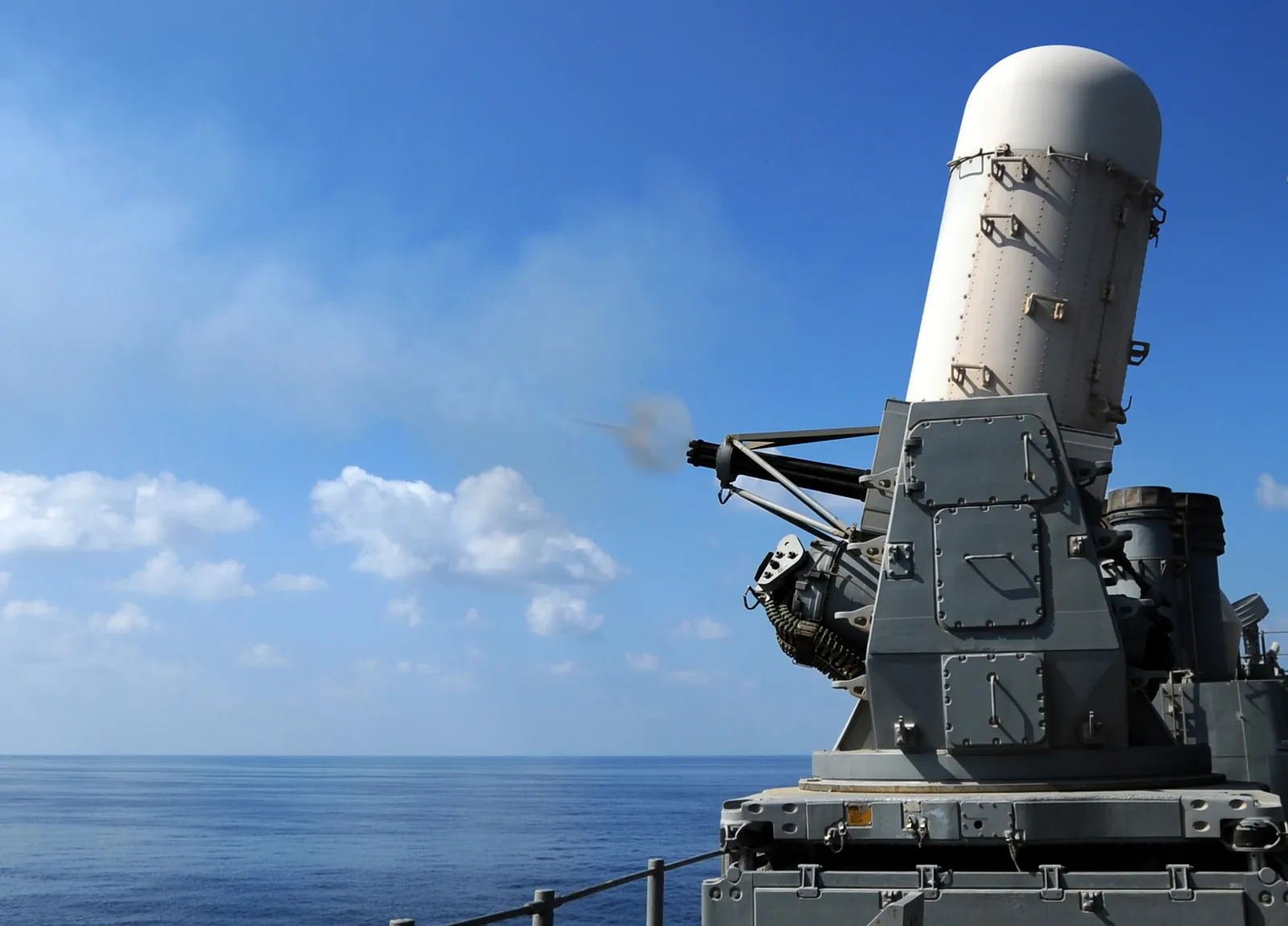
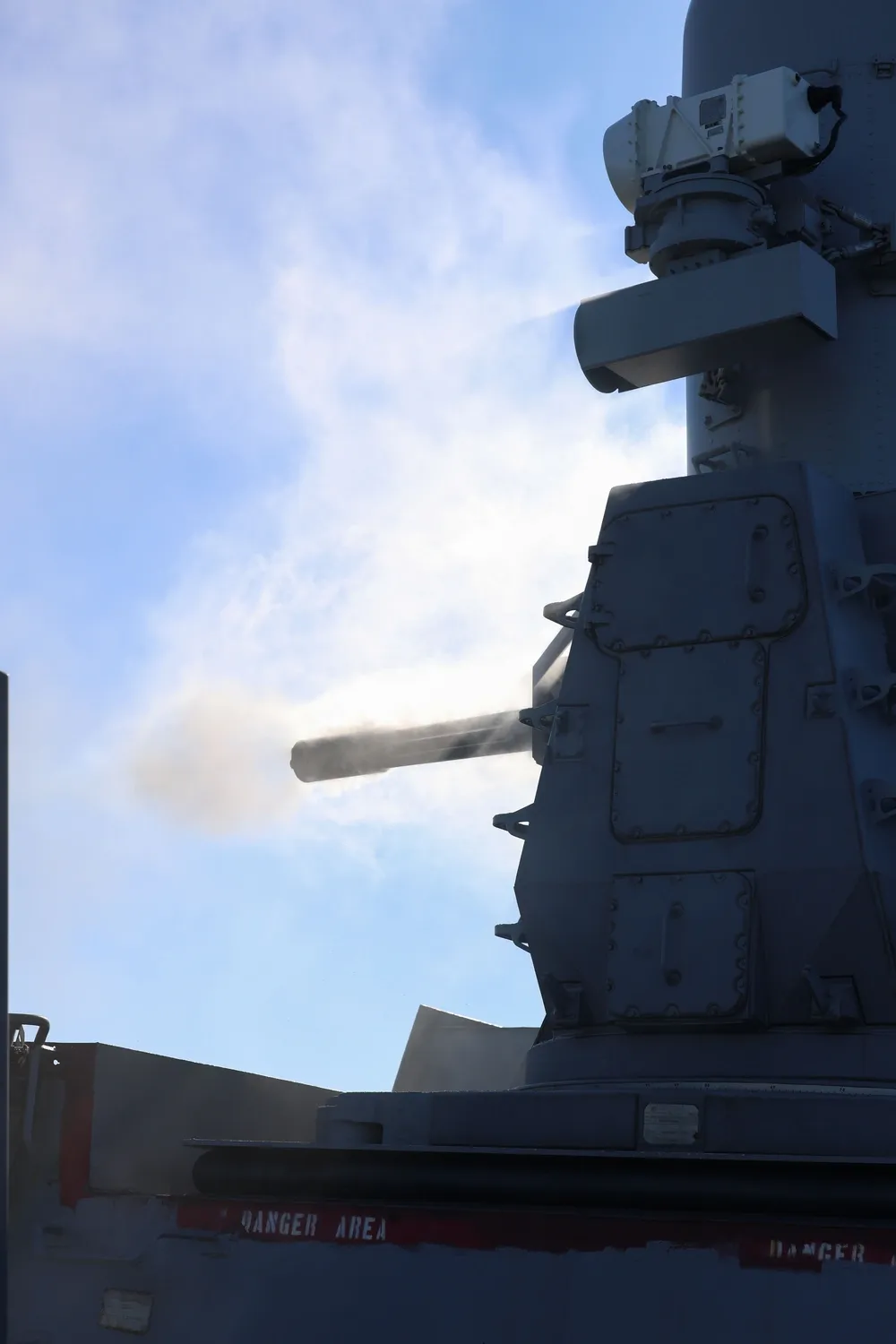
During the February 25, 1991 Iraqi Silkworm engagement near USS Missouri, USS Jarrett's Phalanx CIWS operated in automatic mode and fired at Missouri's chaff; the Iraqi missile was destroyed by HMS Gloucester's Sea Dart, and the Phalanx burst produced a friendly-fire strike on Missouri with no casualties.
Role details20mm Mk 15 Phalanx
- Mk 15 Phalanx
- MK 15 Phalanx CIWS
- Phalanx CIWS
- Phalanx Close-In Weapon System
- Close-In Weapon System
- CIWS
- Sea Whiz
- Block 1B Phalanx
- Mk 15 Close-In Weapon System
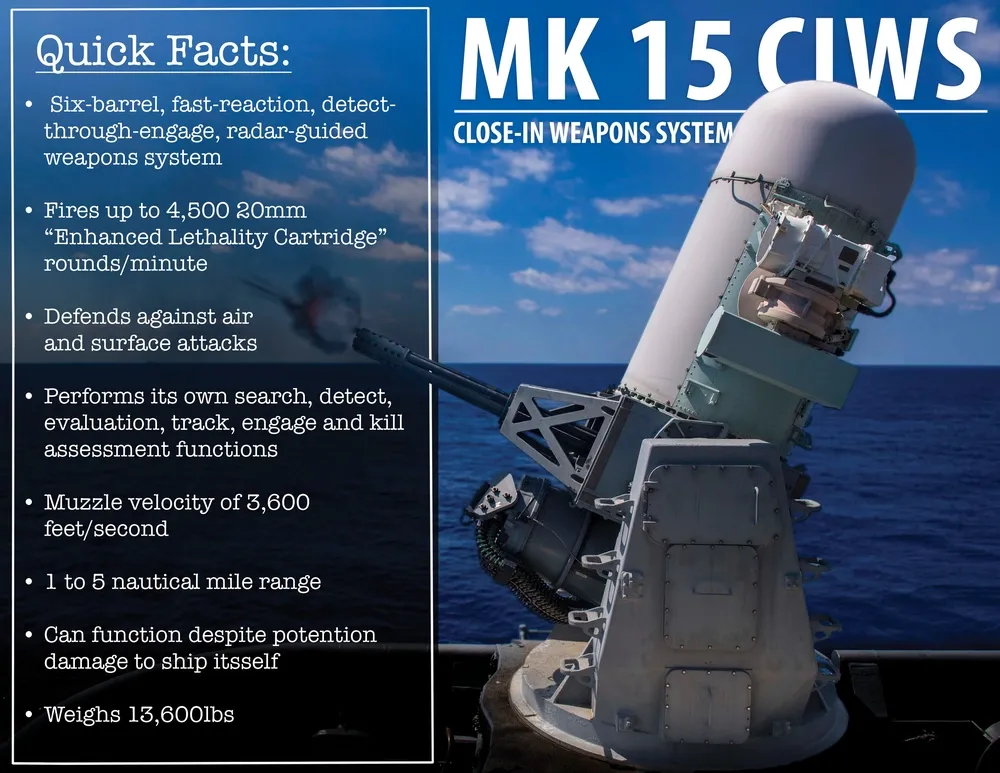
The 20mm Mk 15 Phalanx is a U.S.-origin shipboard close-in weapon system built around an M61A1 Gatling gun, self-contained search and track radar, and automated fire-control functions. Navy and manufacturer sources describe it as the U.S. Navy's inner-layer defense against anti-ship missiles, aircraft, unmanned aircraft, and small surface threats; direct combat-use evidence includes USS Jarrett's Gulf War Phalanx firing during the Iraqi Silkworm engagement near USS Missouri and USS Gravely's Red Sea interception of a Houthi anti-ship missile.
Role in Conflicts
USS Gravely used its Phalanx Close-In Weapon System in the Red Sea to destroy a Houthi anti-ship missile that came within about one nautical mile of the destroyer, making Phalanx the final defensive layer in that engagement.
Profile / Specs
Profile
- Origin
- United States
- Type
- Shipboard close-in weapon system
- Service note
- 1980-present
- Designer
- General Dynamics Pomona Division
- Designed
- 1969-1978 development and production approval period
- Produced
- 1978-present production, upgrade, and overhaul program
Specifications
- Primary function
- Fast-reaction detect-through-engage radar-guided 20 mm gun weapon system
- Gun
- M61A1 20 mm Gatling gun
- Caliber
- 20 mm
- Block 1B weight
- 13,600 pounds (6,120 kg)
- Rate of fire
- 4,500 rounds per minute against anti-ship missile and aircraft threats; 3,000 rounds per minute against asymmetric threats
- Magazine capacity
- 1,550 rounds
- Ammunition
- Armor Piercing Discarding Sabot; later Enhanced Lethality Cartridge context for Block 1B surface mode
- Sensors
- Self-contained search and track radar; Block 1B electro-optic/FLIR sensor
- Ship integration
- Can operate as an autonomous mount or integrate with ship combat-control systems for additional sensor and fire-control support
How The Mount Works
The Mk 15 is a self-contained terminal-defense mount. Navy and manufacturer sources describe a search-to-engage chain in which the system detects, evaluates, tracks, fires, and assesses close-in threats with its own radar-guided fire-control package, while Block 1B adds an electro-optical sensor path for visual identification and surface-mode engagements.
The Navy describes Phalanx as an inner-layer point-defense weapon for threats that have penetrated other fleet defenses.
The current Navy fact file says Phalanx can autonomously perform search, detection, evaluation, tracking, engagement, and kill assessment.
Block 1B adds a stabilized electro-optic/FLIR sensor path for small surface craft, aircraft, helicopters, and UAS.
Sources: U.S. Navy Mk 15 Fact File; RTX Phalanx Weapon System; General Dynamics Phalanx CIWS.
Variants
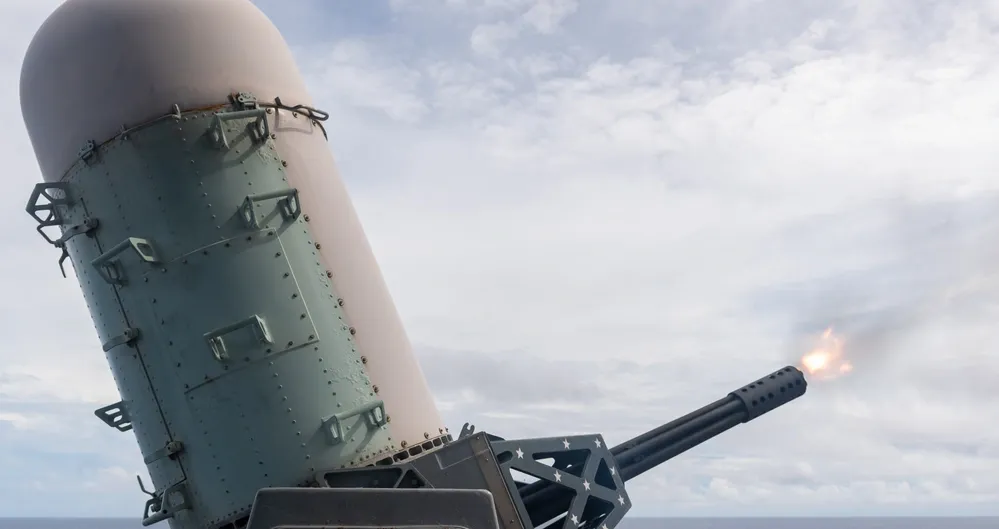
The Mk 15 Phalanx family is normally described by block configuration. Block 0 introduced the shipboard mount, Block 1 increased capability and rate-of-fire features, and Block 1B added the surface-mode electro-optical sensor package used on modern naval mounts.
| Variant | Configuration | Designation notes |
|---|---|---|
| Block 0 | Initial shipboard production configuration | Navy material places Block 0 production from 1978 and first deployment aboard USS Coral Sea in 1980. Sources: U.S. Navy Mk 15 Fact File |
| Block 1 | Late-1980s shipboard upgrade | The Navy fact file lists the Block 1 installation aboard USS Wisconsin in 1988; older Navy fact material ties later models to 4,500 rounds per minute and the larger magazine. Sources: U.S. Navy Mk 15 Fact File, GulfLINK Navy Phalanx Fact File |
| Block 1B | Surface-mode and electro-optical upgrade | Navy, RTX, and General Dynamics sources describe Block 1B as adding electro-optical/FLIR capability for asymmetric and surface-threat engagements while retaining the radar-guided gun mission. Sources: U.S. Navy Mk 15 Fact File, RTX Phalanx Weapon System, General Dynamics Phalanx CIWS |
![]() | Land-based Phalanx derivative | RTX describes the land-based version as a Phalanx application for countering rocket, artillery, and mortar systems; the catalog keeps that land C-RAM family in a separate record because its deployment and conflict-use evidence differ from shipboard Mk 15 mounts. Sources: RTX Phalanx Weapon System |
Gun System
The Mk 15 mount is built around the M61A1 20 mm Gatling gun rather than a missile interceptor.
| Compatible item | Item type | Compatibility evidence |
|---|---|---|
![]() | 20 mm Gatling gun | The Navy fact file identifies the Mk 15 gun type as the M-61A1 Gatling gun. Sources: U.S. Navy Mk 15 Fact File |
Shipboard And Land-Based Boundary
This page covers the shipboard Mk 15 Phalanx CIWS. The land-based Phalanx/C-RAM family shares the same broad Phalanx lineage but is tracked separately because public sources document different mount arrangements, ammunition context, operators, and base-defense conflict-use records.
A naval close-in weapon system for terminal defense of ships against missiles, aircraft, UAS, and small surface threats.
A ground force-protection adaptation used to counter rockets, artillery, and mortar threats around bases and high-value sites.
Timeline
20mm Mk 15 Phalanx Key Events
Production begins
Navy fact material says Phalanx production began in 1978 after operational testing and production approval.
Sources: U.S. Navy Mk 15 Fact File, GulfLINK Navy Phalanx Fact File
First shipboard deployment
The first Block 0 deployment was aboard USS Coral Sea in 1980.
Sources: U.S. Navy Mk 15 Fact File
Block 1 enters service
The Navy lists the first Block 1 installation aboard USS Wisconsin in 1988.
Sources: U.S. Navy Mk 15 Fact File
Gulf War Silkworm engagement
During an Iraqi anti-ship missile engagement near USS Missouri, USS Jarrett's Phalanx fired automatically at chaff and struck Missouri with several rounds; HMS Gloucester destroyed the incoming missile.
Sources: GulfLINK Friendly-Fire Incidents
First Block 1B installation
The Navy lists USS Underwood as the first Block 1B installation.
Sources: U.S. Navy Mk 15 Fact File
USS Gravely Red Sea Phalanx intercept
Reporting confirmed USS Gravely used Phalanx to destroy a Houthi anti-ship missile during the Red Sea crisis after the missile came within about one nautical mile.
Sources: Navy Times Gravely Phalanx Report, RTX Phalanx Weapon System
Media
20mm Mk 15 Phalanx Videos
Related Weapon Systems