- Side
- United States

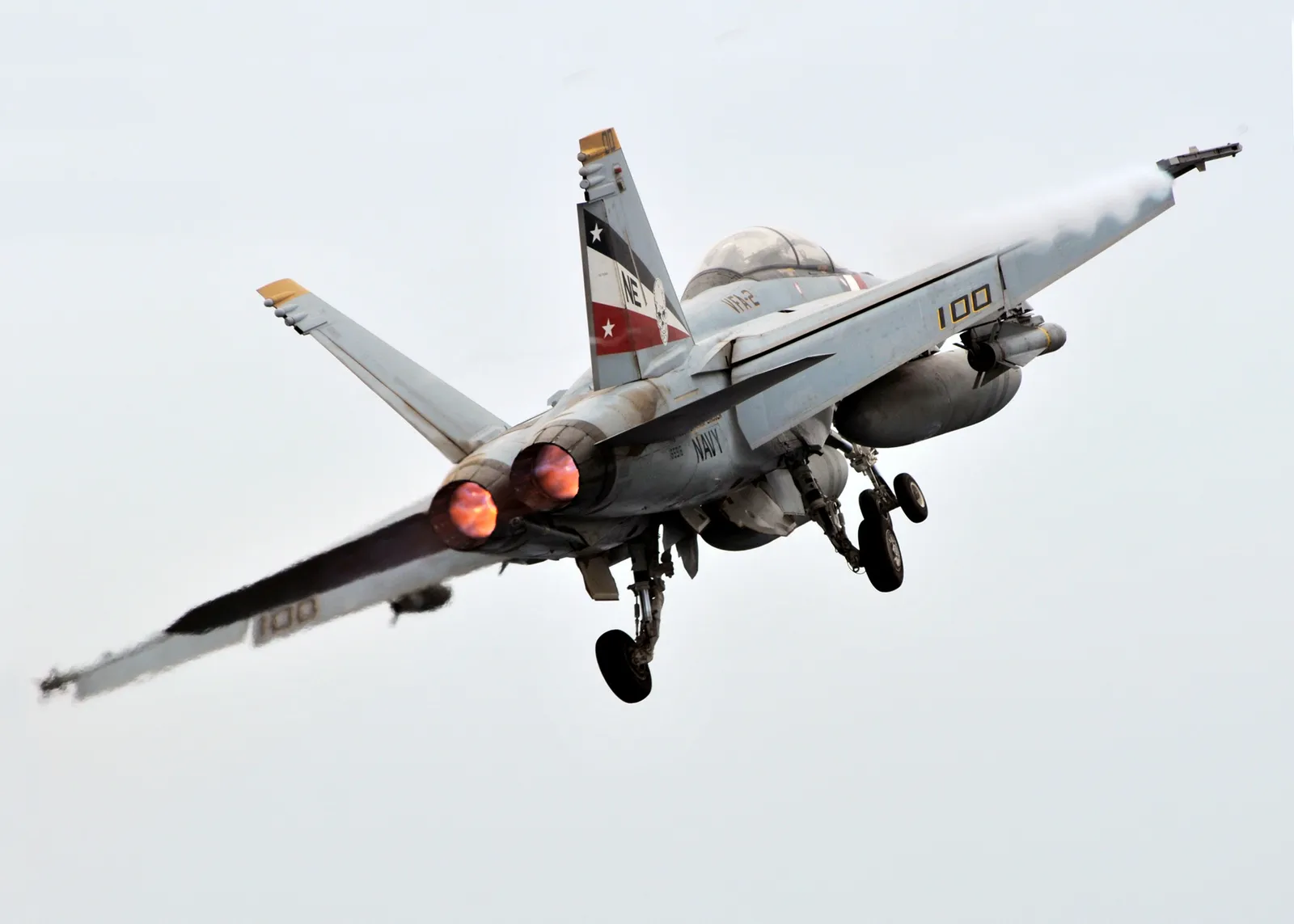
U.S. Navy F/A-18F Super Hornets launched from USS Abraham Lincoln in support of Operation Epic Fury against Iranian targets on March 1, 2026.
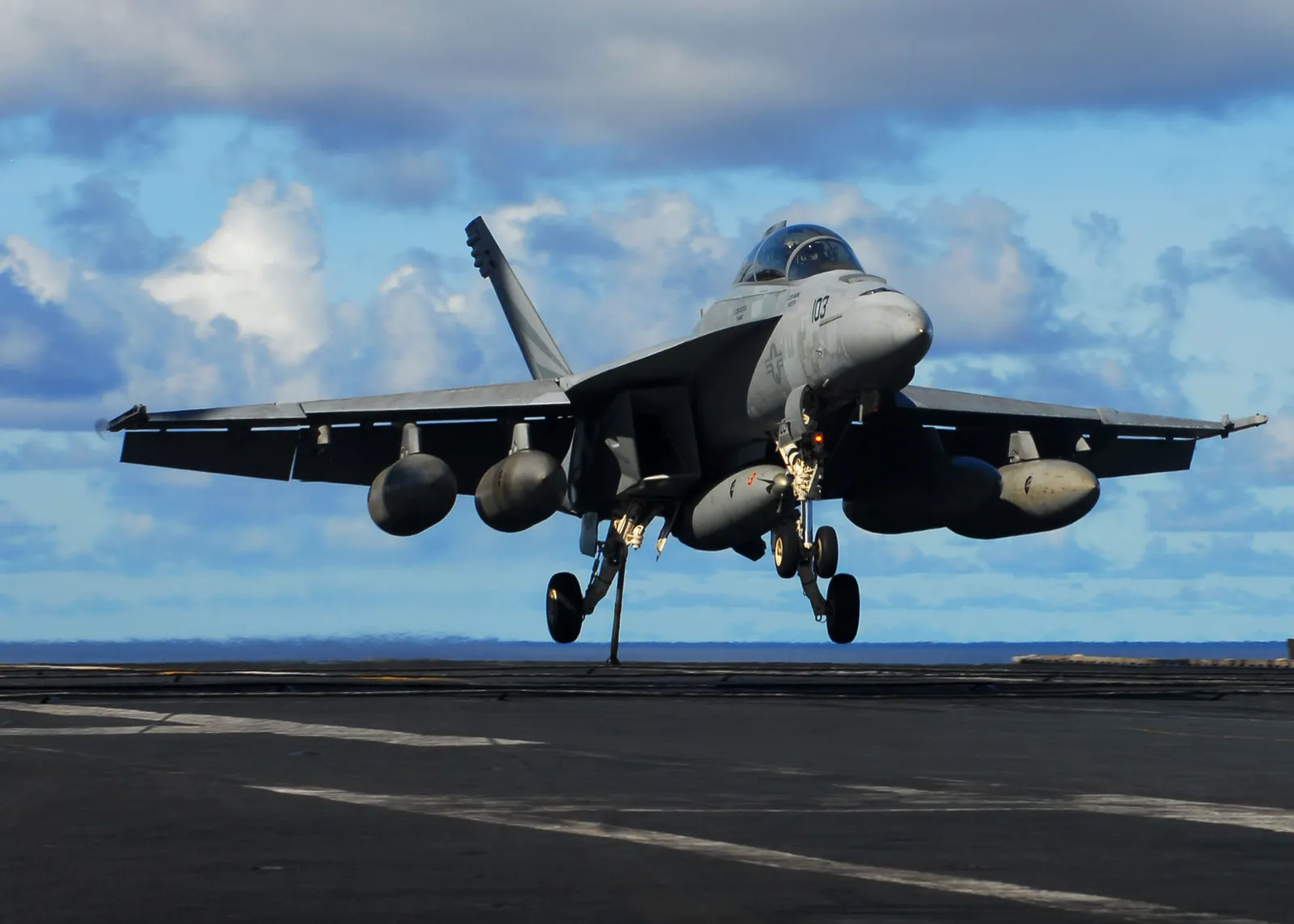
Boeing's F/A-18E/F Super Hornet is a U.S. Navy carrier-capable multirole strike fighter developed from the Hornet family for fleet air defense, escort, interdiction, close air support, aerial refueling, suppression of enemy air defenses, and day/night precision strike. The single-seat F/A-18E and two-seat F/A-18F anchor carrier air wings through Block II and Block III upgrades, with documented U.S. Navy use in Afghanistan drawdown support, Operation Inherent Resolve, the Red Sea crisis, Somalia strikes, and U.S. operations against Iran.
U.S. Navy F/A-18F Super Hornets launched from USS Abraham Lincoln in support of Operation Epic Fury against Iranian targets on March 1, 2026.
In the 2025 Israel-Iran Conflict, U.S. carrier air wing F/A-18E/F Super Hornets were used in Operation Epic Fury to project airpower against Iran and support regional deterrence.
Role detailsIn 2014 Operation Inherent Resolve, U.S. Navy F/A-18E/F Super Hornets were used from carrier strike groups to fly strike sorties in the U.S. 5th Fleet area of operations.
U.S. Navy reporting documents carrier air wing F/A-18E/F Super Hornets flying strike missions over Syria during 2014 Operation Inherent Resolve and a U.S. F/A-18E shooting down a Syrian regime Su-22 near Tabqah while defending coalition partner forces.
Role detailsIn the 2023 Red Sea Crisis, U.S. Navy F/A-18E/F Super Hornets were documented supporting Operation Prosperity Guardian and Operation Rough Rider, including expanded AIM-9X defensive carriage for Houthi attacks on merchant vessels and a VFA-143 Red Sea flight during the anti-Houthi campaign.
Role detailsIn the 2001 War in Afghanistan, U.S. Navy F/A-18E/F Super Hornets aboard USS Dwight D. Eisenhower provided carrier-based airpower during the 2021 Afghanistan drawdown.
Role detailsOn Feb. 1, 2025, Carrier Air Wing 1 launched 27 F/A-18 Super Hornets from USS Harry S. Truman as U.S. Africa Command conducted airstrikes against ISIS-Somalia in coordination with the Federal Government of Somalia.
NAVAIR says the Super Hornet's first combat action came in Iraq's no-fly zone in November 2002, but the catalog has no canonical pre-2015 Iraq no-fly-zone conflict page, so this use is held here as a fallback.
The Super Hornet family centers on the single-seat F/A-18E and two-seat F/A-18F, with Block II and Block III configurations and the EA-18G Growler as an electronic-attack derivative.
| Variant | Configuration | Designation notes |
|---|---|---|
| F/A-18E Super Hornet | Single-seat strike fighter | NAVAIR identifies the E model as the single-seat Super Hornet. Sources: F/A-18E/F Super Hornet (NAVAIR) |
| F/A-18F Super Hornet | Two-seat strike fighter | NAVAIR identifies the F model as the two-seat variant; the second crew station can support training and deployed mission workload. Sources: F/A-18E/F Super Hornet (NAVAIR) |
| F/A-18E/F Block II Super Hornet | AESA-equipped production configuration | Block II incorporated AESA radar, improved sensors and avionics, and precision-weapons capability; the final Block II aircraft was delivered in April 2020. Sources: F/A-18E/F Super Hornet (NAVAIR), Navy takes delivery of final Block II Super Hornet |
| F/A-18E/F Block III Super Hornet | Networked service-life-extension production and retrofit configuration | Block III adds advanced cockpit and networking features, reduced radar signature, and a 10,000-flight-hour service life. Sources: F/A-18E/F Super Hornet (NAVAIR), Navy accepts first new production Block III Super Hornet |
 | Electronic-attack derivative | Boeing presents the Growler alongside the Super Hornet as a complementary carrier-based electronic-attack aircraft using the same family ecosystem. Sources: F/A-18 Super Hornet & EA-18 Growler |
The Super Hornet's published armament options span air-to-air missiles, anti-ship and anti-radiation missiles, glide weapons, and guided bombs.
| Carried item | Item type | Carriage evidence |
|---|---|---|
 | Air-launched guided glide bomb | NAVAIR says JSOW-C is integrated on F/A-18C/D/E/F aircraft, and a later NAVAIR test report says a U.S. Navy F/A-18F Super Hornet completed the first captive carriage test of the AGM-154 JSOW C-1 variant. Sources: Navy's JSOW C Approved for Full Rate Production, JSOW C-1 variant successfully tested |
 | Medium-range air-to-air missile | NAVAIR's Super Hornet page lists AIM-7 Sparrow among the aircraft's armament options. Sources: F/A-18E/F Super Hornet (NAVAIR) |
 | Air-to-air missile | NAVAIR's Super Hornet page lists AIM-120 AMRAAM missiles among the aircraft's armament options. Sources: F/A-18E/F Super Hornet (NAVAIR) |
 | Short-range infrared air-to-air missile | Navy reporting says Super Hornets were carrying more AIM-9X missiles to bolster defensive capability in the Red Sea, and the Navy fact file identifies the F/A-18E/F as a Super Hornet strike fighter. Sources: Acquisition Standards Can Be a Two-Way Street, F/A-18A-D Hornet and F/A-18E/F Super Hornet Strike Fighter |
 | Short-range air-to-air missile | NAVAIR lists AIM 9 Sidewinder among the F/A-18E/F Super Hornet's armament. Sources: F/A-18E/F Super Hornet (NAVAIR) |
 | Anti-ship missile | NAVAIR lists Harpoon among the F/A-18E/F Super Hornet's armament. Sources: F/A-18E/F Super Hornet (NAVAIR) |
 | Anti-radiation missile | NAVAIR lists HARM among the F/A-18E/F Super Hornet's armament. Sources: F/A-18E/F Super Hornet (NAVAIR) |
 | Air-to-ground missile | NAVAIR lists Maverick missiles among the F/A-18E/F Super Hornet's armament. Sources: F/A-18E/F Super Hornet (NAVAIR) |
 | Precision-guided bomb | NAVAIR lists JDAM among the F/A-18E/F Super Hornet's armament. Sources: F/A-18E/F Super Hornet (NAVAIR) |
 | Laser-guided bomb family | NAVAIR lists Paveway Laser Guided Bomb among the F/A-18E/F Super Hornet's armament options. Sources: F/A-18E/F Super Hornet (NAVAIR) |
| Compatible item | Item type | Compatibility evidence |
|---|---|---|
 | Infrared search-and-track sensor | Boeing lists IRST among Block III Super Hornet capabilities, and Lockheed Martin says the Navy declared initial operational capability for IRST21 sensors integrated in the F/A-18E/F centerline fuel tank. Sources: F/A-18 Super Hornet & EA-18 Growler, IRST21 IOC for F/A-18E/F |
NAVAIR says the F/A-18E/F Super Hornet first flew in November 1995 during the program's development and flight-test phase.
Sources: F/A-18E/F Super Hornet (NAVAIR)
The Super Hornet entered fleet service in 1999 as the Navy's new strike fighter.
Sources: F/A-18E/F Super Hornet (NAVAIR)
NAVAIR and the Navy list September 2001 initial operational capability with VFA-115 at NAS Lemoore.
Sources: F/A-18E/F Super Hornet (NAVAIR)
The first Super Hornet operational cruise used F/A-18E aircraft from VFA-115 aboard USS Abraham Lincoln.
Sources: F/A-18E/F Super Hornet (NAVAIR)
NAVAIR says the first combat action for the F/A-18E occurred in November 2002 during a strike on hostile targets in Iraq's no-fly zone.
Sources: F/A-18E/F Super Hornet (NAVAIR)
U.S. Naval Forces Central Command reported Harry S. Truman carrier air wing F/A-18E/F Super Hornets flying their first 2014 Operation Inherent Resolve missions and conducting combat operations in Iraq and Syria.
Sources: Harry S. Truman CSG Launches First OIR Missions
The Navy said a U.S. F/A-18E Super Hornet shot down a Syrian regime Su-22 near Tabqah after the aircraft dropped bombs near Syrian Democratic Forces fighters.
Sources: Coalition Defends Partner Forces from Syrian Fighter Jet Attack
The Navy accepted the final Block II Super Hornet, closing a production run of 322 F/A-18E and 286 F/A-18F aircraft.
Sources: Navy takes delivery of final Block II Super Hornet
Boeing delivered two Block III Super Hornet test jets to the Navy for flight testing.
Sources: F/A-18E/F Super Hornet (NAVAIR)
The Navy accepted the first new-production Block III F/A-18 Super Hornet for continued test work.
Sources: Navy accepts first new production Block III Super Hornet
NAVAIR announced a contract for 17 additional F/A-18 Super Hornets and a technical data package, with deliveries scheduled from winter 2026 through spring 2027.
Sources: New Block III Super Hornet contract
Carrier Air Wing 1 launched 27 F/A-18 Super Hornets from USS Harry S. Truman in a coordinated airstrike against ISIS-Somalia operatives in Somalia with the Federal Government of Somalia.
Sources: USS Truman conducted largest airstrike in Navy history, official says
The Department of Defense published a captioned image of an F/A-18F Super Hornet launching from USS Abraham Lincoln in support of Operation Epic Fury against Iranian targets.
Sources: Hegseth Says 'Epic Fury' Goals in Iran Are 'Laser-Focused'