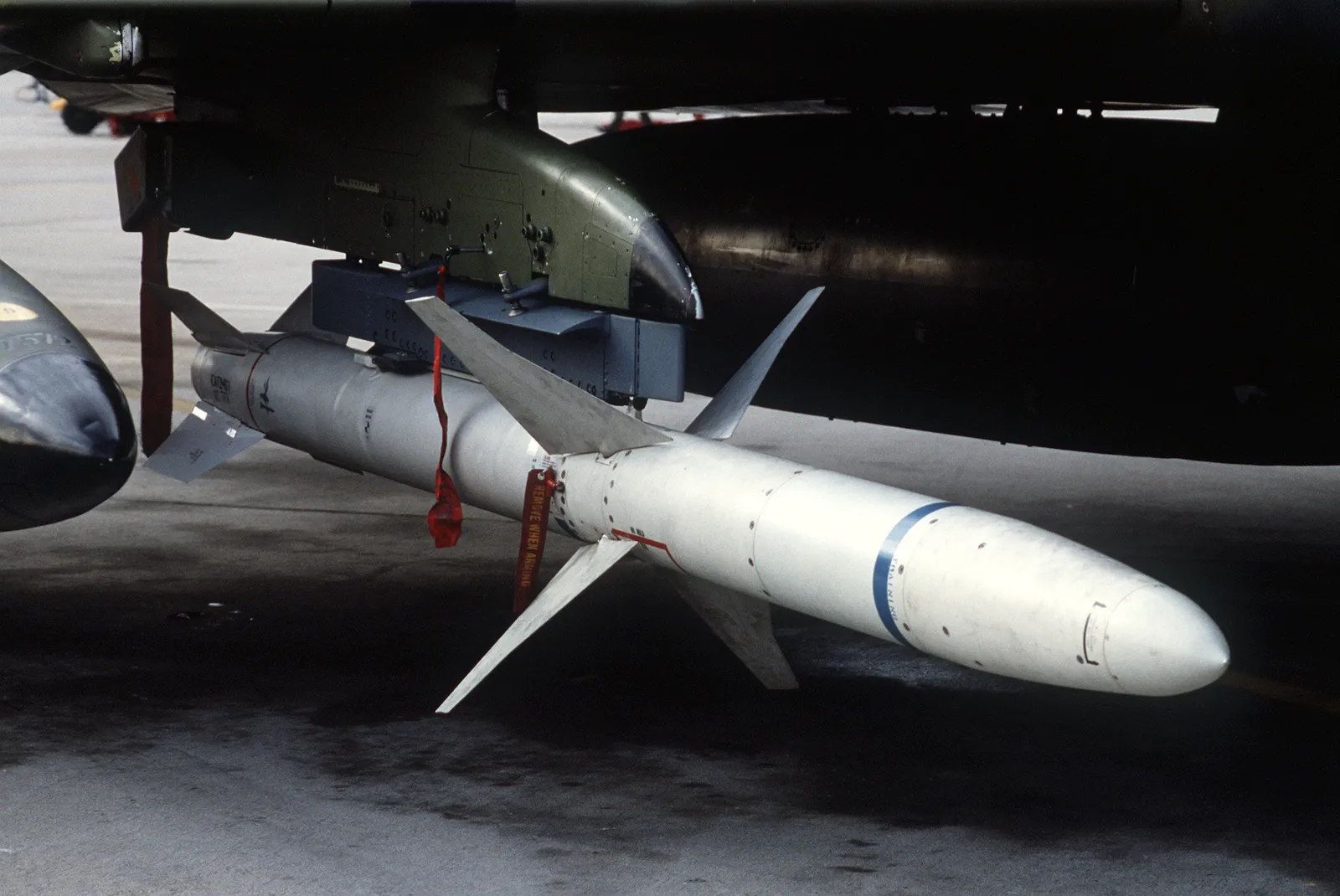
An F/A-18A Hornet from USS Coral Sea fired two AGM-88 HARM missiles at Libyan air-defense radar sites during the April 15, 1986 strike, the missile family's first operational use against Libyan radars.
AGM-88 HARM
- HARM
- High-speed Anti-Radiation Missile
- AGM-88A
- AGM-88B
- AGM-88C
- AGM-88D
- AGM-88E AARGM
- AGM-88G AARGM-ER
The AGM-88 HARM is a U.S. air-launched anti-radiation missile family built to home on hostile radar emissions and suppress air-defense networks. The AGM-88B Block II/III line made the missile easier to reprogram and was fired in large numbers during the 1991 Gulf War, while later AGM-88C, AARGM, and AARGM-ER developments extended the family into U.S., NATO, Ukrainian, and Red Sea operations.
Role in Conflicts
Coalition aircraft used AGM-88B HARM missiles for radar-suppression missions against Iraqi air-defense emitters, with a specialist designation reference recording more than 2,000 HARMs fired at Iraqi radars in 1991.
Role detailsNATO aircraft used earlier HARM missiles during the Kosovo air campaign; later Block VI work was shaped by the campaign problem of radar operators shutting down emitters before missile impact.
U.S. F-16CJ Wild Weasel aircraft carried AGM-88 HARM missiles during Operation Iraqi Freedom, including a documented March 2003 HARM launch at a Patriot radar in a coalition fratricide incident.
Role detailsItalian Tornado ECR aircraft flew NATO Operation Unified Protector suppression missions over Libya with AGM-88 HARM missiles as part of the NATO-led air campaign.
Supplied by the United States to Ukraine and adapted for launch from Ukrainian MiG-29 aircraft, with U.S. officials saying Ukrainian forces used HARM missiles against Russian radar systems in 2022.
Role detailsU.S. Navy EA-18G Growlers employed AGM-88E AARGM missiles during Red Sea operations against the Houthi movement, including a publicly reported first combat use of AARGM in the campaign.
Role detailsProfile / Specs
Profile
- Origin
- United States
- Built by
- Raytheon
- Type
- Air-to-surface anti-radiation missile
- Service note
- Cold War design in modern service
- Designed
- Development began in 1974; the first AGM-88A flight occurred in 1975.
- Unit cost
- $200,000 according to U.S. Air Force fact sheet
- Produced
- First production AGM-88A missiles were delivered in 1983; later HARM and AARGM production continued through Raytheon, ATK, and Northrop Grumman-led upgrade lines.
Specifications
- Primary function
- Air-to-surface anti-radiation missile
- Guidance
- Proportional guidance homing on enemy radar emissions
- Power plant
- Thiokol smokeless solid-propellant dual-thrust rocket motor
- Length
- 13 ft 8 in (4.14 m)
- Launch weight
- 800 lb (360 kg)
- Diameter
- 10 in (25.40 cm)
- Wingspan
- 3 ft 8 in (101.60 cm)
- Range
- 30+ miles (48+ km)
- Speed
- Supersonic
- Warhead
- High explosive
- Engagement modes
- Pre-briefed, target-of-opportunity, and self-protect HARM launch modes
- AGM-88B upgrade
- Block II/III line with improved computer hardware and reprogrammable threat-library capability
- AARGM seeker package
- Passive anti-radiation receiver with GPS/INS, data link, and millimeter-wave terminal seeker on AGM-88E
Guidance And Seeker Evolution
HARM began as a passive anti-radiation missile that exploited radar emissions. Later AARGM work kept the anti-radiation mission but added navigation and terminal-sensing tools intended to handle emitters that shut down, move, or try to deny a clean passive-radar target.
| Generation | Emitter problem addressed | Documented change |
|---|---|---|
| AGM-88A/B/C HARM | Radiating air-defense and fire-control radars | Passive homing modes for pre-briefed, target-of-opportunity, and self-protect launches. |
| Block VI / AGM-88D work | Radar shutdown before impact | GPS/INS navigation was added in the planned Block VI path, reflecting Kosovo-era experience with radar operators switching off emitters. |
| AGM-88E AARGM | Shutdown, relocatable, or ambiguous emitters | GPS/INS, data link, and millimeter-wave terminal sensing were added to the HARM family upgrade. |
| AGM-88G AARGM-ER | Range and internal-carriage constraints | A redesigned airframe and propulsion package extended the AARGM line and enabled F-35 internal carriage planning. |
Variants
AGM-88 designations cover the original HARM missile line and later AARGM/AARGM-ER developments that reuse or evolve HARM guidance, warhead, and airframe technology.
| Variant | Configuration | Designation notes |
|---|---|---|
| AGM-88A HARM | Initial production missile | Initial HARM production version; first production missiles were delivered in 1983 after development and flight testing in the 1970s. Sources: Raytheon AGM-88 HARM and AARGM |
| AGM-88B HARM | Block II/III upgrade | Block II introduced improved computer hardware and reprogramming capability; the Block III standard was widely fired against Iraqi radars in the 1991 Gulf War. Sources: Raytheon AGM-88 HARM and AARGM |
| AGM-88C HARM | Improved lethality variant | Operational from 1993 with upgraded guidance software and the WDU-37/B blast-fragmentation warhead. Sources: Raytheon AGM-88 HARM and AARGM |
| AGM-88D / Block VI | GPS-aided HARM upgrade | Planned Block VI upgrade added GPS/INS navigation to reduce the effect of radar shutdowns, but the U.S. AGM-88D production path was terminated before production. Sources: Raytheon AGM-88 HARM and AARGM |
Firing Aircraft
NAVAIR records the Hornet as an early firing platform for the AGM-88 HARM.
| Firing weapon | Weapon type | Firing evidence |
|---|---|---|
![]() | Carrier-capable strike fighter aircraft | Coral Sea launched Hornet 162417 and the aircraft fired two AGM-88 HARM missiles at Libyan air defense radar sites during the April 15, 1986 Libya strike. |
Launch Platforms
The Air Force Test Center says the AGM-88 HARM is launched from aircraft using the LAU-118/A launcher.
| Launcher | Launcher type | Launch evidence |
|---|---|---|
![]() | Multirole fighter aircraft | Boeing's Advanced F-15 weapons inventory lists AGM-88 HARM among the aircraft's external carriage options. Sources: Advanced F-15 Weapons Inventory |
![]() | Aircraft missile launcher | The Air Force Test Center says the LAU-118/A missile launcher is used to launch the AGM-88 HARM from aircraft such as the F-16 and F/A-18. |
![]() | Ukrainian-adapted fighter aircraft | U.S. officials said HARM missiles supplied to Ukraine were adapted for launch from Ukrainian MiG-29 aircraft, and later described the integration as a crisis-driven engineering adaptation. Sources: Undersecretary of Defense for Policy Dr. Colin Kahl Holds a Press Briefing on Security Assistance in Support of Ukraine, DOD Scouts Innovative Ideas From Industry, Allies, Partners |
Carrier Aircraft
The National Museum of the U.S. Air Force identifies the F-4G Wild Weasel as a carrier aircraft for AGM-88 HARM missiles.
| Carrier | Carrier type | Carriage evidence |
|---|---|---|
![]() | Multirole fighter | The Block 50/52 F-16 is recognized for its ability to carry AGM-88 HARM missiles in suppression of enemy air defenses missions and can carry as many as four HARMs. Sources: F-16C Fighting Falcon |
![]() | Electronic attack aircraft | NAVAIR says the EA-18G Growler typically carries one to two AGM-88 HARM missiles and lists the HARM among the aircraft's carried armament. Sources: EA-18G Growler |
![]() | Electronic warfare fighter aircraft | The museum fact sheet says the F-4G carried AGM-88A/B/C HARM missiles. Sources: McDonnell Douglas F-4G Wild Weasel | National Museum of the U.S. Air Force |
![]() | Wild Weasel fighter-bomber | The AGM-88 HARM fact sheet identifies the missile as an air-to-surface anti-radiation missile, and the F-4G fact sheet lists it in Wild Weasel armament. Sources: AGM-88 HARM, McDonnell Douglas F-4G Wild Weasel | National Museum of the U.S. Air Force |
![]() | Carrier-capable multirole strike fighter | NAVAIR lists HARM among the F/A-18E/F Super Hornet's armament. Sources: F/A-18E/F Super Hornet (NAVAIR) |
![]() | Tornado ECR SEAD aircraft | Italian Tornado ECR aircraft flew NATO Unified Protector suppression missions over Libya with AGM-88 HARM missiles. |
Timeline
AGM-88 HARM Key Events
HARM development contract
Texas Instruments was announced as prime contractor for the HARM program after the Navy and Air Force pursued a faster anti-radiation missile successor.
Sources: Raytheon AGM-88 HARM and AARGM
First AGM-88A flight
The first AGM-88A missile flight occurred during the original development effort.
Sources: Raytheon AGM-88 HARM and AARGM
Production begins
First production AGM-88A missiles were delivered in 1983, with full production approved as a joint U.S. Air Force and Navy project.
Sources: AGM-88 HARM, Raytheon AGM-88 HARM and AARGM
First combat use over Libya
A U.S. Navy F/A-18A fired AGM-88 HARM missiles at Libyan air-defense radar sites during the April 1986 strike.
Sources: First combat Hornet returned to service, Raytheon AGM-88 HARM and AARGM
AGM-88B mass Gulf War use
AGM-88B Block III missiles were fired in large numbers against Iraqi radars during the Gulf War.
Sources: Raytheon AGM-88 HARM and AARGM
AGM-88C operational
The AGM-88C became operational with an improved guidance section and WDU-37/B warhead.
Sources: Raytheon AGM-88 HARM and AARGM
AARGM enters low-rate production
NAVAIR announced a low-rate initial production contract for AGM-88E AARGM after developmental and operational tests.
Sources: AARGM enters low-rate initial production
Ukraine adaptation disclosed
The U.S. Department of Defense publicly confirmed that HARM missiles had been supplied to Ukraine, adapted for MiG-29 launch, and used against Russian radar systems.
Sources: Undersecretary of Defense for Policy Dr. Colin Kahl Holds a Press Briefing on Security Assistance in Support of Ukraine
AARGM combat use in the Red Sea
Reporting on U.S. Navy Red Sea operations identified EA-18G Growler employment of AGM-88E AARGM missiles in combat against Houthi targets.
Sources: AGM-88E AARGM combat use in Red Sea
Media
AGM-88 HARM Videos
Related Weapon Systems


