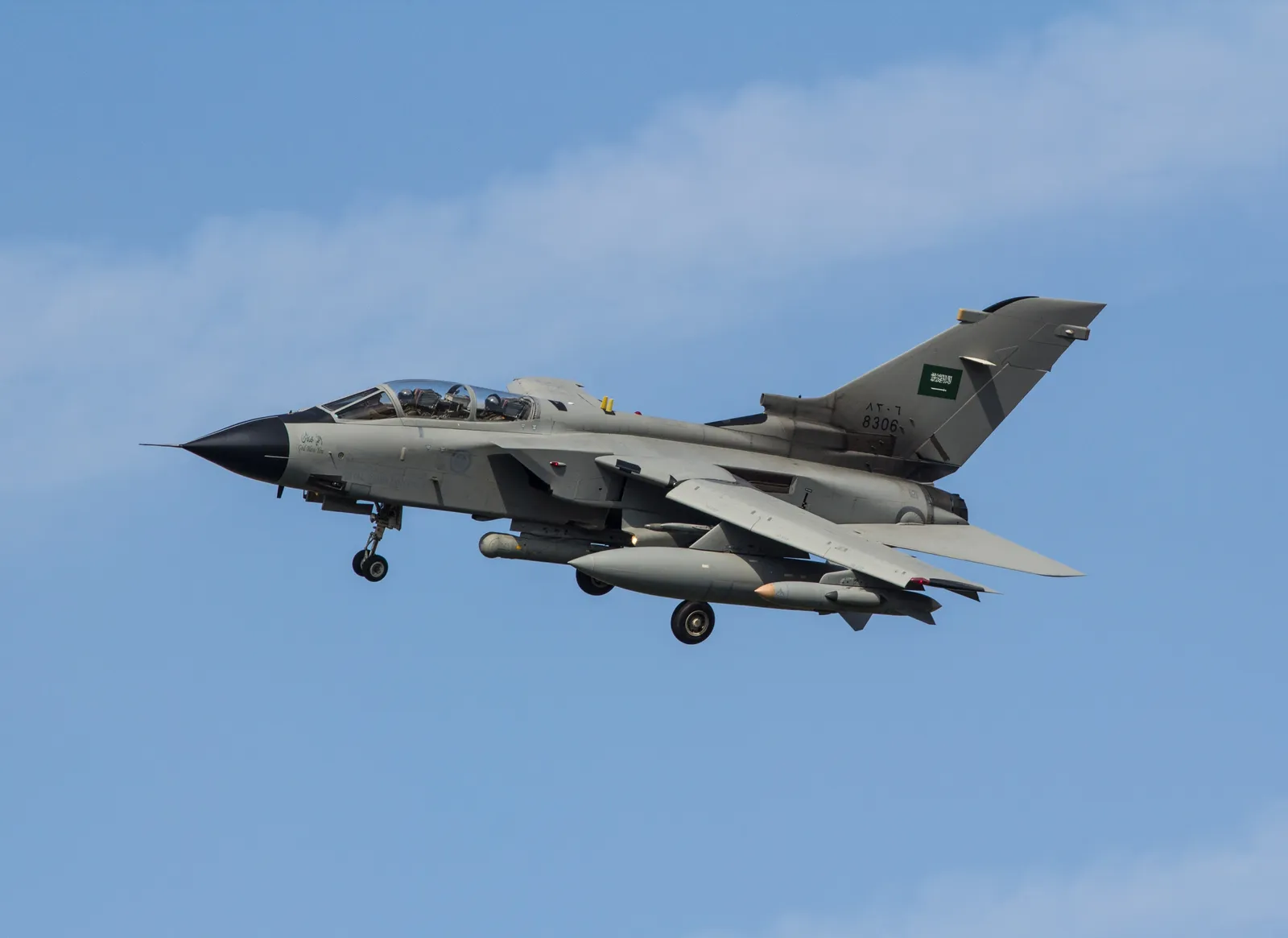
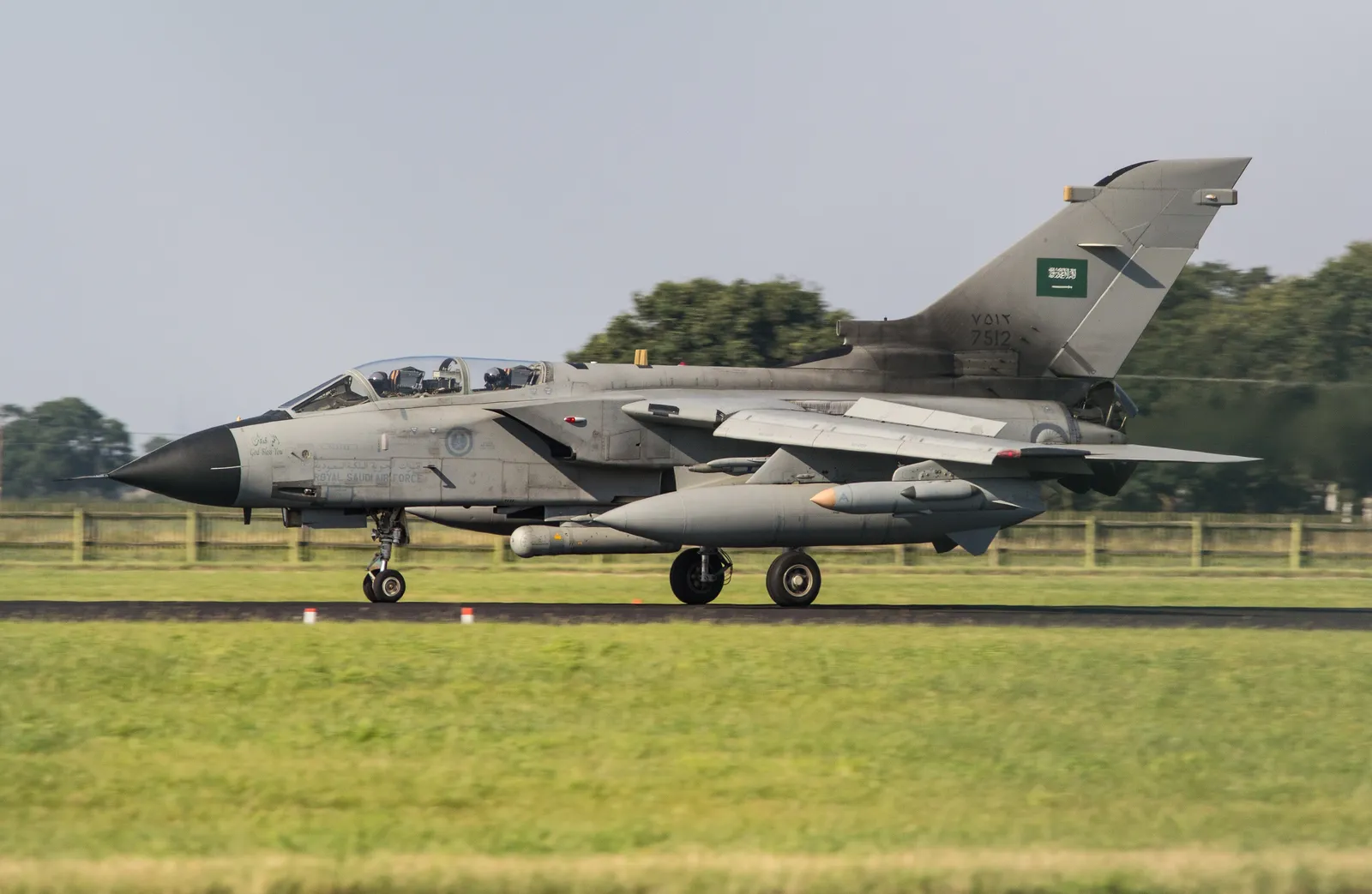
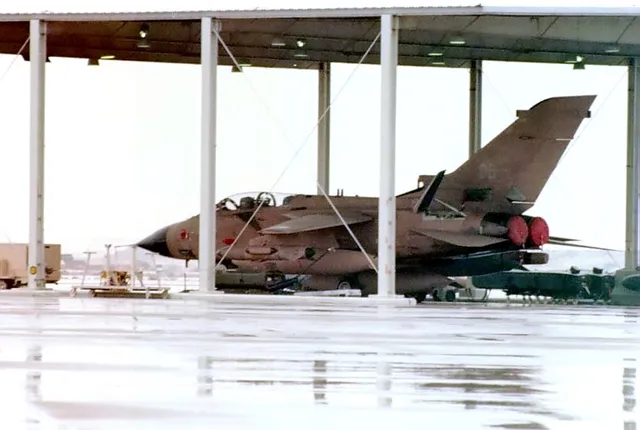
The Panavia Tornado is a UK-German-Italian variable-sweep combat aircraft family developed for low-level strike, interdiction, reconnaissance, electronic-combat, and air-defense roles. Tornado variants saw direct combat use from the 1990 Gulf War through Kosovo, Iraq, Libya, Afghanistan, the anti-Daesh campaign, the 2018 Syria strikes, and Saudi-led coalition operations in Yemen.
RAF Tornado GR1 aircraft flew coalition strike operations during Operation Granby, including the first British air strikes against Iraqi air-force targets, while Tornado F3 aircraft supported the air-defense effort.
RAF Tornado GR1 aircraft flew offensive sorties during Operation Allied Force, and German Tornado ECR and reconnaissance aircraft contributed suppression-of-enemy-air-defenses and reconnaissance missions for NATO.
RAF Tornado GR4 aircraft flew Operation TELIC missions from Kuwait against Iraqi targets, including 617 Squadron's first operational Storm Shadow mission on 21 March 2003.
RAF Tornado GR4 aircraft launched Storm Shadow strikes against Libyan regime targets during Operation Ellamy and later flew bombing, close-air-support, armed-reconnaissance, and tactical-reconnaissance missions from Italy.
RAF Tornado GR4 aircraft deployed to Kandahar for Operation Herrick, supporting ISAF and Afghan security-force operations with close air support, reconnaissance, overwatch, and route-search missions.
RAF Tornado GR4 aircraft flew Operation Shader missions over Iraq and Syria against Daesh, including close air support, armed reconnaissance, and precision strikes with Paveway IV, Brimstone, and Storm Shadow.
Royal Saudi Air Force Tornado aircraft were used by the Saudi-led coalition in Yemen; a coalition statement reported one Tornado lost in al-Jawf in February 2020 while flying close air support for Yemeni National Army units.
Four RAF Tornado GR4 aircraft participated in the April 2018 coordinated strike package and launched eight Storm Shadow missiles against the Him Shinshar chemical-weapons storage site.
Introduced in 1979; RAF Tornado GR4 aircraft remained in combat service until 2019 and Royal Saudi Air Force Tornado IDS aircraft remained active in Yemen-war coalition operations.
Designer
Panavia Aircraft GmbH
Designed
1969 multinational MRCA program; first official prototype flight on 1974-08-14
Produced
1979-1998
Number built
Nearly 1,000 aircraft delivered across Tornado operators
Specifications
Crew
2
Engines
Two Rolls-Royce/Turbo-Union RB199 turbofans
Maximum speed
Mach 2.2 high altitude clean for IDS/Recce/ECR variants; Mach 1.2 low altitude clean
Maximum weapon load
About 9,000 kg for IDS/Recce/ECR variants
Combat radius
1,390 km hi-lo-lo-hi profile for IDS/Recce/ECR variants
Dimensions
16.72 m length; 13.90 m wingspan spread or 8.60 m swept for IDS/Recce/ECR variants
VariantsShowHide
Panavia describes three primary Tornado variants: IDS for interdiction/strike, ECR for electronic combat and reconnaissance, and ADV for air defense. RAF GR-series aircraft were national strike and reconnaissance developments within the IDS line.
Variant
Configuration
Designation notes
Tornado IDS
Interdiction/strike baseline
The core Tornado version performed air-to-ground attack, maritime strike, and tactical reconnaissance roles for the partner-nation air forces and the Royal Saudi Air Force.
The RAF GR.4 upgrade converted 142 GR.1 aircraft from 1996 to 2003 and added FLIR, NVG compatibility, GPINS, LRMTS, and expanded precision-weapon integration.
Tornado strike variants carried a broad weapons fit that included cluster bombs, anti-radiation missiles, cruise missiles, guided bombs, and Brimstone precision missiles.
Panavia lists Storm Shadow among the Tornado GR.4 weapon configurations, and RAF sources document GR4-launched Storm Shadow strikes in Libya, Iraq, and Syria.
Panavia says the Tornado GR.4 typically carried up to five Paveway IV smart weapons, and GOV.UK strike reports document RAF Tornado GR4 use of Paveway IV in Iraq.
Britain, Germany, Italy, Belgium, the Netherlands, and Canada signed the first MRCA 75 concept-phase memorandum before the program narrowed to the UK, Germany, and Italy.
Sources: Panavia Tornado Programme Evolution
Panavia Aircraft GmbH formed
The three remaining nations created Panavia Aircraft GmbH in Munich to manage Tornado design and development.
Sources: Panavia Tornado Programme Evolution
Prototype P-01 first flight
The first official Tornado prototype flight took place from Manching Air Base in Germany.
Sources: Panavia Tornado Programme Evolution
Production phase begins
The first production aircraft rolled out at Warton as Tornado production was divided among UK, German, and Italian principal facilities.
Sources: Panavia Tornado Programme Evolution
First British Gulf War air strikes
RAF Tornado aircraft carried out the first British air strikes against Iraqi air-force targets in the coalition campaign to liberate Kuwait.
Sources: The RAF remembers the beginning of Operation Granby
RAF GR.4 upgrade starts
The RAF GR.4 conversion program began in 1996 and ultimately upgraded 142 Tornado GR.1 aircraft by 2003.
Sources: Panavia Tornado GR.4/4A
RAF Tornados return from final operations
GOV.UK reported the last RAF Tornado return from Operation Shader shortly before the type's UK retirement.
Sources: The end of an era: RAF Tornado returns from operations for the last time