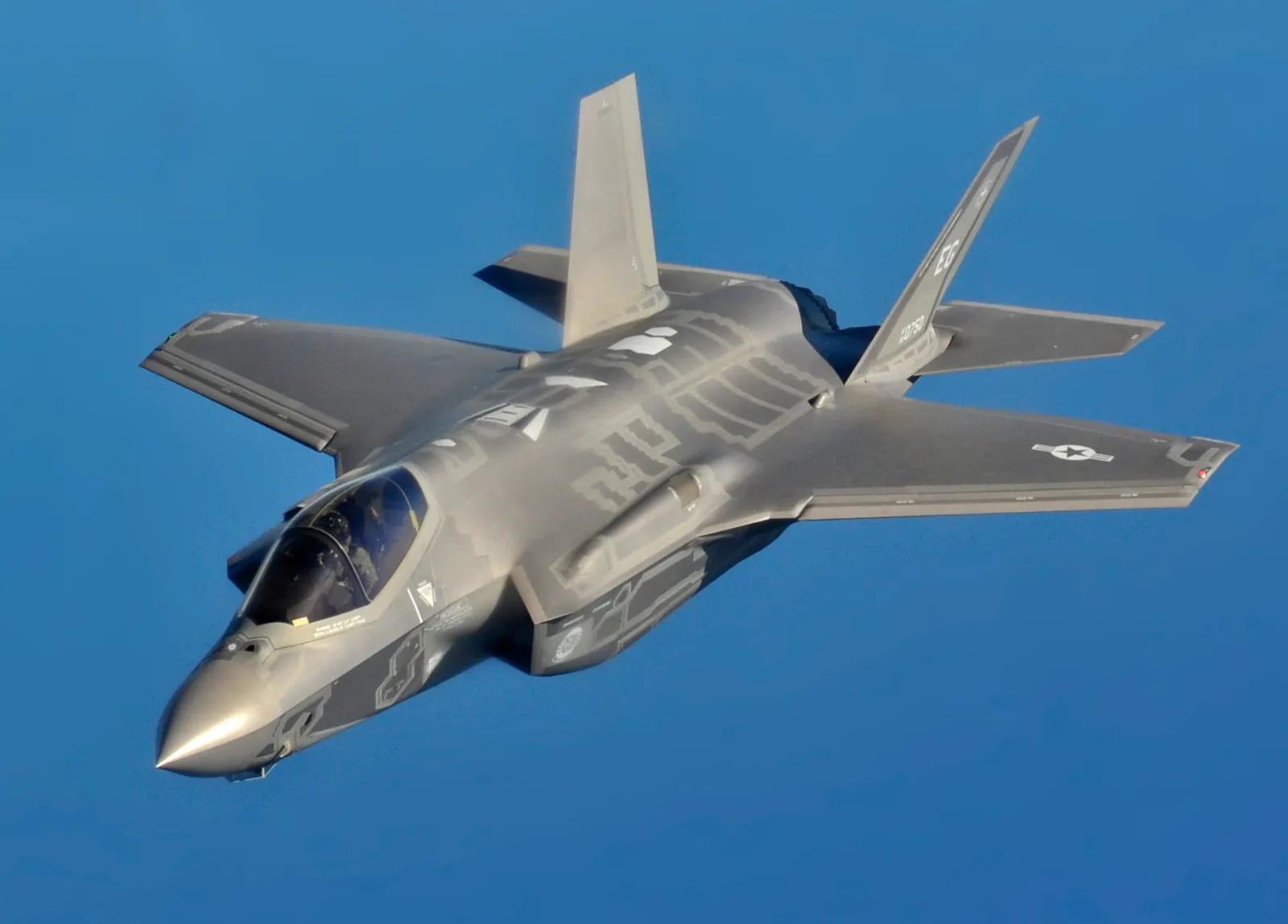

Two U.S. Air Force F-35As made the variant's first combat employment on April 30, 2019, striking a Daesh tunnel network and weapons cache at Wadi Ashai, Iraq, during Operation Inherent Resolve.
Role detailsAircraft & UAVs
F-35A Lightning II
Also known as
- F-35A
- Lightning II
- Joint Strike Fighter CTOL
- CTOL F-35
The F-35A Lightning II is the conventional takeoff and landing branch of the Joint Strike Fighter family, built for land-based air forces that need stealth strike, air-to-air, sensor-fusion, and suppression-of-enemy-air-defense missions. U.S. Air Force F-35As have directly documented combat use in Iraq against ISIS, in U.S. strikes on Houthi targets in Yemen, and in the June 2025 Operation Midnight Hammer strike package against Iranian nuclear sites.
Role in Conflicts

388th Fighter Wing reporting says F-35As from the 34th Fighter Squadron flew combat missions against Houthi targets during Operation Rough Rider, including strikes tied to air-defense, command-and-control, storage, surface-to-air missile, and ballistic-missile capabilities.
Role details- Side
- United States
During Operation Midnight Hammer on June 22, 2025, 388th Fighter Wing F-35As penetrated Iranian airspace ahead of B-2 bombers, suppressed enemy air defenses, attacked surface-to-air missile sites, and guarded the strike package's exit.
Profile / Specs
Profile
- Origin
- United States
- Built by
- Lockheed Martin
- Type
- Conventional takeoff and landing stealth multirole fighter
- Service note
- 2010s-present
- Designer
- Lockheed Martin, with Northrop Grumman and BAE Systems as major program partners
- Designed
- Joint Strike Fighter program selection in 2001; first F-35A flight in 2006
- Produced
- 2000s-present
- Developed from
- Lockheed Martin X-35
Specifications
- Crew
- 1
- Role
- Conventional takeoff and landing stealth multirole fighter
- Powerplant
- One Pratt & Whitney F135-PW-100 turbofan
- Thrust
- 43,000 lb class
- Length
- 51 ft / 15.7 m
- Wingspan
- 35 ft / 10.7 m
- Height
- 14 ft / 4.38 m
- Maximum takeoff weight
- 70,000 lb class
- Internal fuel
- 18,498 lb in U.S. Air Force fact sheet; RAAF lists 8,278 kg
- Payload
- 18,000 lb / 8,160 kg class internal and external weapons load
- Maximum speed
- Mach 1.6, about 1,200 mph / 1,960 km/h
- Range
- More than 1,350 miles with internal fuel; RAAF lists 2,200 km
- Combat radius
- RAAF lists 1,093 km on internal fuel
- Ceiling
- Above 50,000 ft
- Sensors
- Integrated radar, Electro-Optical Targeting System, Distributed Aperture System, helmet-mounted display, and tactical data links
- Primary armament examples
- AIM-120 AMRAAM, AIM-9X Sidewinder, GBU-31 JDAM, laser-guided bombs, and internal 25 mm GAU-22/A cannon
CTOL Variant Profile
The F-35A is the land-based conventional takeoff and landing model, optimized around a 9 g maneuvering envelope, internal fuel and weapons carriage, and boom-and-receptacle aerial refueling used by the U.S. Air Force and many allied air forces.
Variant role
CTOL stealth fighter for strike, counter-air, electronic-warfare, reconnaissance, and coalition networked operations.
Public combat record
Official sources document F-35A combat employment in Iraq, Yemen-related Houthi strikes, and the 2025 Iran strike package.
Sensor focus
Integrated radar, EOTS, DAS, helmet display, and tactical data links support both weapon employment and broader strike-package awareness.
Variants
The F-35A is the land-based conventional takeoff and landing variant; the catalog also separates STOVL, carrier, Israeli, and family/component pages where those records have their own sourcing.
| Variant | Configuration | Designation notes |
|---|---|---|
 | Parent aircraft family | The wider F-35 family includes the F-35A conventional takeoff and landing aircraft, the F-35B STOVL aircraft, and the F-35C carrier aircraft. Sources: About the F-35 |
 | Short takeoff and vertical landing branch | The F-35B is the STOVL branch designed for expeditionary and shipboard operations rather than the F-35A's land-based CTOL role. Sources: About the F-35 |
 | Carrier branch | The F-35C is the catapult-launched carrier branch, distinct from the smaller, lighter F-35A used by the U.S. Air Force and many allied air forces. Sources: About the F-35 |
 | Israeli F-35A-derived configuration | The F-35I Adir is Israel's locally designated F-35A-derived service configuration with Israeli integration context covered on its own page. Sources: F-35A Lightning II Fact Sheet |
Air-To-Air Missiles
Australian and U.S. Air Force sources describe the F-35A as a multirole aircraft with internal and external weapons carriage; RAAF public specifications list the main air-to-air missile families carried by the aircraft.
| Carried item | Item type | Carriage evidence |
|---|---|---|
 | Beyond-visual-range air-to-air missile | The Royal Australian Air Force lists AIM-120 AMRAAM among F-35A weapons. Sources: RAAF F-35A Lightning II |
 | Short-range air-to-air missile | The Royal Australian Air Force lists AIM-9X Sidewinder among F-35A weapons. Sources: RAAF F-35A Lightning II |
Guided Bombs
The F-35A can carry mission-dependent internal and external munitions; public combat and operator sources identify JDAM-class guided bombs in F-35A use or carriage.
| Carried item | Item type | Carriage evidence |
|---|---|---|
 | GPS-guided bomb kit | The U.S. Air Force said the first F-35A combat employment used a Joint Direct Attack Munition against a Daesh tunnel network and weapons cache in Iraq. Sources: U.S. Air Force F-35As conduct first combat employment |
 | 2,000-pound JDAM-family guided bomb | RAAF public specifications list GBU-31 JDAM guided bombs among F-35A weapons. Sources: RAAF F-35A Lightning II |
Integrated Sensors
The F-35A's mission system depends on embedded sensors rather than external targeting pods for core targeting and awareness functions.
| Compatible item | Item type | Compatibility evidence |
|---|---|---|
 | Embedded electro-optical targeting system | The U.S. Air Force fact sheet identifies the internally mounted Electro-Optical Targeting System as part of the F-35 sensor package for precision targeting and long-range detection. Sources: F-35A Lightning II Fact Sheet |
Timeline
F-35A Lightning II Key Events
Lockheed Martin team selected for JSF
The U.S. Air Force fact sheet identifies the 2001 Joint Strike Fighter decision as the point when the Lockheed Martin team moved into system development and demonstration.
Sources: F-35A Lightning II Fact Sheet
Australia accepts first F-35A
The Royal Australian Air Force says Australia's first F-35A entered Australian service in 2018, with No. 3 Squadron operational in 2021.
Sources: RAAF F-35A Lightning II
First F-35A combat employment
Two U.S. Air Force F-35As struck a Daesh tunnel network and weapons cache in Iraq during Operation Inherent Resolve.
Sources: U.S. Air Force F-35As conduct first combat employment
F-35A combat missions over Yemen
The 388th Fighter Wing reported that 34th Fighter Squadron F-35As flew combat missions against Houthi targets during Operation Rough Rider.
Sources: Hill Airmen carry out historic F-35 deployment to CENTCOM
F-35As lead Midnight Hammer escort and SEAD
388th Fighter Wing F-35As helped open the route into Iran for B-2 bombers, suppressing air-defense threats and protecting the exit from Iranian airspace.
Sources: 388th FW Pilots, F-35s Paved the Way for Midnight Hammer Strike, Hill Airmen carry out historic F-35 deployment to CENTCOM
Media
Related Weapon Systems


Sources
F-35A Lightning II Fact SheetPublisher: U.S. Air Force | Note: Supports F-35A identity, CTOL role, prime contractor, development background, sensor suite, dimensions, thrust, range, payload, and general specifications. | Accessed: 2026-07-03RAAF F-35A Lightning IIPublisher: Royal Australian Air Force | Note: Supports allied F-35A operator context, specifications, weapons examples, and public capability summary. | Accessed: 2026-07-03About the F-35Publisher: Lockheed Martin F-35 | Note: Supports F-35 family, stealth, sensor-fusion, global operator, production, and manufacturer background. | Accessed: 2026-07-03U.S. Air Force F-35As conduct first combat employmentPublisher: U.S. Air Force | Note: Supports 2014 War Against the Islamic State direct conflict use: two U.S. Air Force F-35As struck a Daesh tunnel network and weapons cache at Wadi Ashai, Iraq, during Operation Inherent Resolve. | Accessed: 2026-07-03Hill Airmen carry out historic F-35 deployment to CENTCOMPublisher: 388th Fighter Wing | Note: Supports 2023 Red Sea Crisis direct conflict use by F-35As against Houthi targets during Operation Rough Rider and 2020 United States-Iran Conflict direct use by F-35s in the Operation Midnight Hammer strike package. | Accessed: 2026-07-03388th FW Pilots, F-35s Paved the Way for Midnight Hammer StrikePublisher: Lockheed Martin F-35 | Note: Supports 2020 United States-Iran Conflict direct conflict use: 388th Fighter Wing F-35A aircraft escorted B-2 bombers, suppressed air defenses, attacked surface-to-air missile sites, and guarded the exit during Operation Midnight Hammer. | Accessed: 2026-07-03F-35A flight (cropped).jpgPublisher: Wikimedia Commons | Note: Public-domain U.S. Air Force image used as the primary image. | Accessed: 2026-07-03F-35A Lightning II at Hill Air Force Base, Utah.jpgPublisher: Wikimedia Commons | Note: Public-domain U.S. Air Force image used in the gallery. | Accessed: 2026-07-03F-35A Lightning II flies above the Mojave Desert.jpgPublisher: Wikimedia Commons | Note: Public-domain U.S. Air Force image used in the gallery. | Accessed: 2026-07-03