U.S. Air Force, Marine Corps, and Navy OV-10A Broncos served in Vietnam as forward-air-control, observation, armed-reconnaissance, and light-attack aircraft, with Navy VAL-4 using the type for riverine and special-operations fire support.
OV-10 Bronco
- North American Rockwell OV-10 Bronco
- OV-10A Bronco
- OV-10D Bronco
- OV-10G+ Bronco
- Bronco
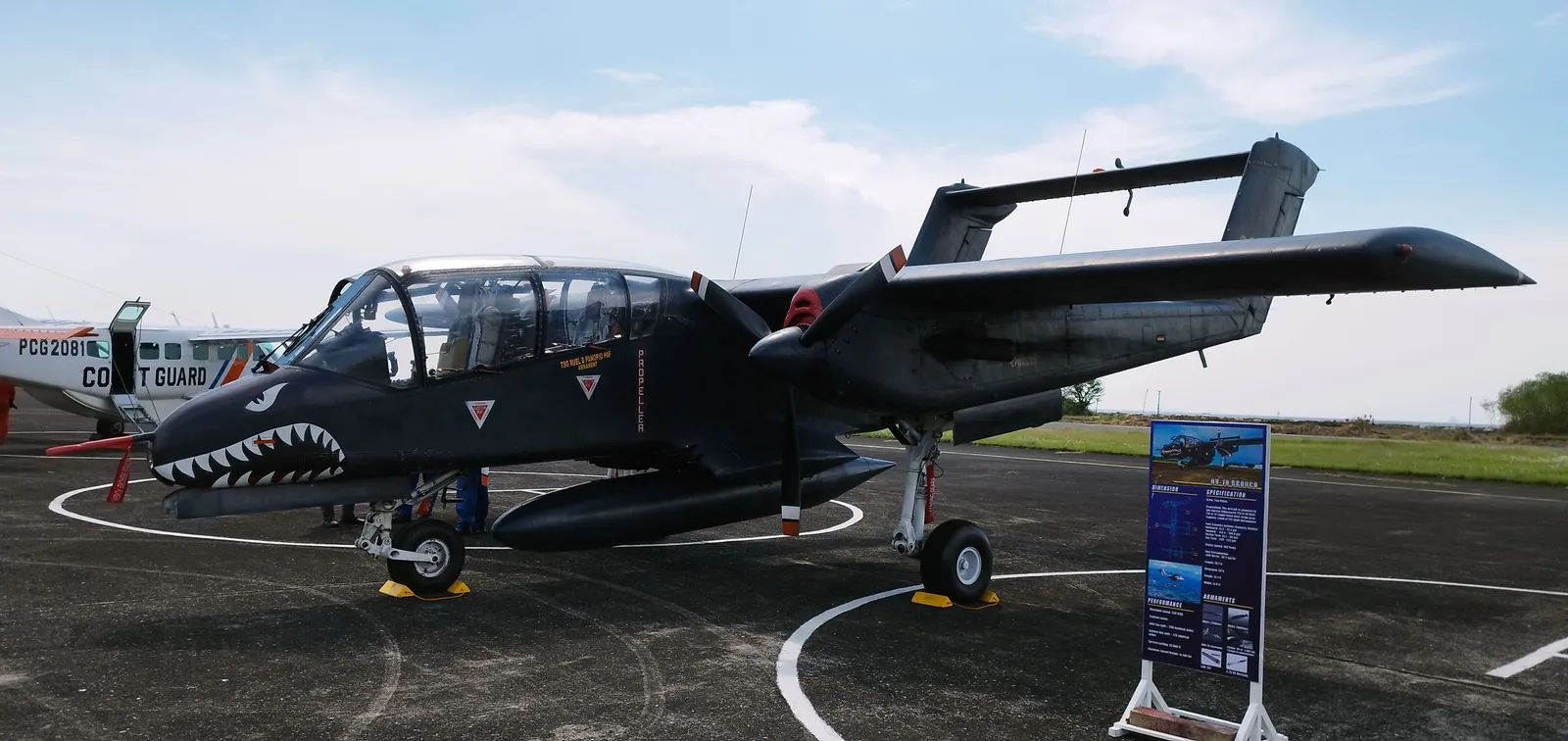
The OV-10 Bronco is a U.S.-designed twin-turboprop light attack and observation aircraft built around short-field counterinsurgency, forward air control, armed reconnaissance, and limited ground attack. It served with U.S. forces in Vietnam and Desert Storm, reappeared in a 2015 counter-ISIS light-attack trial, and remained useful to the Philippine Air Force at Marawi because it could deliver bombs in close support of troops fighting through dense urban terrain.
Role in Conflicts
U.S. Marine Corps OV-10 crews flew Desert Storm forward-air-control and observation missions over Kuwait; Marine accounts describe low-altitude OV-10 missions and the final U.S. combat losses of the type during the 1991 campaign.
Role detailsTwo modified OV-10G+ Broncos deployed to Iraq in 2015 for the Combat Dragon II counter-ISIS evaluation, flying 134 sorties and using APKWS guided rockets in direct support of U.S. and coalition special-operations and partner forces.
Philippine Air Force OV-10 Broncos were used by government forces during the 2017 Battle of Marawi for ground-attack bombing missions against IS-aligned militant targets and strongholds in dense urban terrain.
Mission Fit
The OV-10's combat record is tied less to speed than to persistence, cockpit visibility, short-field handling, and the ability to combine observation with immediate fire support.
| Feature | Reader note |
|---|---|
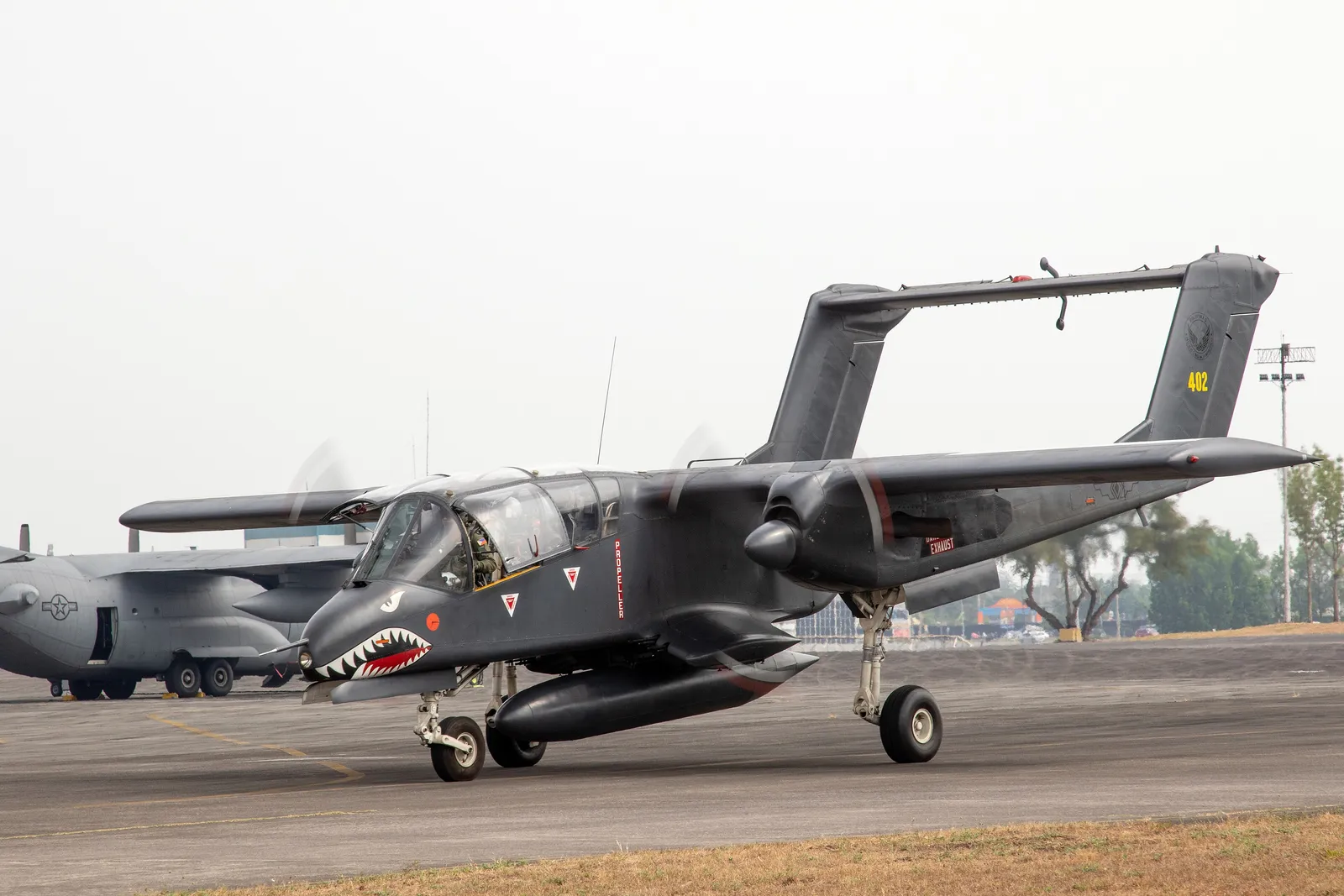
| Twin-turboprop layout | Two turboprops and a high-visibility tandem cockpit gave crews a stable platform for finding targets and directing strikes at lower speeds. |
| Forward-air-control role | Vietnam and Desert Storm accounts emphasize the aircraft's use as a controller and observer over contested ground rather than as a high-speed strike jet. |
| Light attack stores | Fixed machine guns and external stores let the aircraft move from marking or observing targets to suppressing or bombing them when the threat environment allowed. |
| Counterinsurgency persistence | The Philippine and 2015 U.S. examples show why older Broncos remained attractive where loiter time, austere operations, and close coordination mattered more than speed. |
Profile / Specs
Profile
- Origin
- United States
- Built by
- North American Rockwell
- Type
- Twin-turboprop light attack and observation aircraft
- Service note
- Cold War design with later Philippine counterinsurgency service and a 2015 U.S. light-attack combat trial
- Designer
- North American Aviation
- Designed
- 1960s
- Produced
- 1965-1986
- Number built
- 360
Specifications
- Crew
- Two
- Armament
- Four 7.62 mm M60C machine guns plus up to 3,600 lb of external stores on OV-10A references
- Engines
- Two Garrett-AiResearch T76 turboprops rated at 715 shaft horsepower each
- First flight
- 16 July 1965
- Maximum speed
- 281 mph
- Range
- 1,240 miles
- Mission endurance
- Boeing lists 5.5 hours of loiter time with a 150-gallon drop tank, or 2 hours of loiter at 50 nautical miles with a full ordnance load
- Service ceiling
- 26,000 ft
- Dimensions
- 40 ft wingspan; 41 ft 7 in length; 15 ft 1 in height
- Maximum weight
- 14,444 lb
- Stores stations
- Seven external store stations: four sponson stations, one centerline station, and two external wing stations
- Austere operations
- Rough-field landing gear, no ground equipment required for starting, and simple hand-tool maintenance in remote-area operations
Variants
The OV-10 family began with the OV-10A production aircraft, then split into export, night-observation, upgrade, and experimental light-attack configurations.
| Variant | Configuration | Designation notes |
|---|---|---|
| OV-10A | Original production light attack and observation aircraft | The baseline production model carried the Bronco's forward-air-control, observation, and light-attack mission set into Vietnam-era U.S. service. Sources: North American Rockwell OV-10A Bronco, The OV-10 - Marine Corps Gazette |
| OV-10C | Thai export version | Boeing identifies the OV-10C as the Thai service version; former Thai aircraft later became part of the Philippine Bronco fleet. Sources: Boeing Select Products in Boeing History, PH Air Force to get 4 more OV-10 bombers |
| OV-10B | West German target-towing version | Boeing lists West Germany's OV-10B among the international Bronco variants. |
| OV-10D | Night-observation and upgraded Marine Corps variant | The OV-10D night-observation system added FLIR, laser target marking, more powerful engines, fiberglass propellers, and other changes for greater range, performance, and survivability. Sources: Boeing Select Products in Boeing History, The OV-10 - Marine Corps Gazette |
| OV-10E | Venezuelan export version | Boeing lists Venezuela's OV-10E among the international Bronco variants. |
| OV-10F | Indonesian export version | Boeing lists Indonesia's OV-10F among the international Bronco variants. |
| OV-10G+ | Combat Dragon II light-attack evaluation aircraft | The OV-10G+ designation covered NASA-sourced, NAVAIR-modified Broncos with modern sensors, communications, and guided-rocket integration for the U.S. special-operations light-attack experiment that deployed against ISIS. Sources: The OV-10 Is Even Older Than the A-10 and It's Fighting ISIS Too, TWZ OV-10G+ ISIS Details |
| OV-10M | Philippine upgraded service-life-extension model | Philippine service included upgraded OV-10M aircraft alongside other Broncos used for counterinsurgency and bombing tasks. |
Carried Armament
The Bronco combined fixed machine guns with hardpoints for bombs, rockets, pods, or fuel, letting a small observation aircraft mark targets, suppress ground positions, or deliver light strike loads.
| Carried item | Item type | Carriage evidence |
|---|---|---|
![]() | Fixed 7.62 mm machine gun armament | OV-10A references list four M60C 7.62 mm machine guns as the aircraft's internal gun armament. Sources: North American Rockwell OV-10A Bronco, The OV-10 Is Even Older Than the A-10 and It's Fighting ISIS Too |
![]() | 500-pound bomb load | Reporting on Philippine Bronco operations described OV-10 aircraft using Mk 82 bombs, including in the Marawi air campaign. |
![]() | OV-10G+ guided rocket load | USNI and TWZ accounts of Combat Dragon II describe OV-10G+ Broncos firing 2.75-inch rockets fitted with APKWS laser-guidance kits during the 2015 Iraq deployment. |
Timeline
OV-10 Bronco Key Events
Production OV-10A ordered
The first production OV-10A was ordered in 1966 as the Bronco moved from light-armed-reconnaissance concept into U.S. service.
Sources: North American Rockwell OV-10A Bronco
Combat service begins in Vietnam
U.S. OV-10A Broncos entered Vietnam combat service as forward-air-control, observation, and light-attack aircraft.
Sources: North American Rockwell OV-10A Bronco, The OV-10 - Marine Corps Gazette
Marine Broncos fly in Desert Storm
U.S. Marine Corps OV-10 crews used the aircraft for battlefield observation and forward air control during the 1990 Gulf War.
Sources: The OV-10 - Marine Corps Gazette
Combat Dragon II trial over Iraq and Syria
Two modified OV-10G+ Broncos flew 134 sorties during an 82-day Iraq deployment for the Combat Dragon II counter-ISIS light-attack experiment.
Sources: Bronco 12 Cleared Hot, The OV-10 Is Even Older Than the A-10 and It's Fighting ISIS Too
Philippine Broncos strike Marawi targets
Philippine Air Force OV-10s attacked IS-aligned militant targets and strongholds during the 2017 Battle of Marawi.
Sources: PH Air Force to get 4 more OV-10 bombers, Philippines launches offensive in Marawi, with aim to end battle by weekend
Additional Broncos transferred to the Philippines
The United States transferred four more OV-10 aircraft sourced from Thailand to support the Philippine Air Force's remaining Bronco fleet.
Sources: PH Air Force to get 4 more OV-10 bombers
Related Weapon Systems