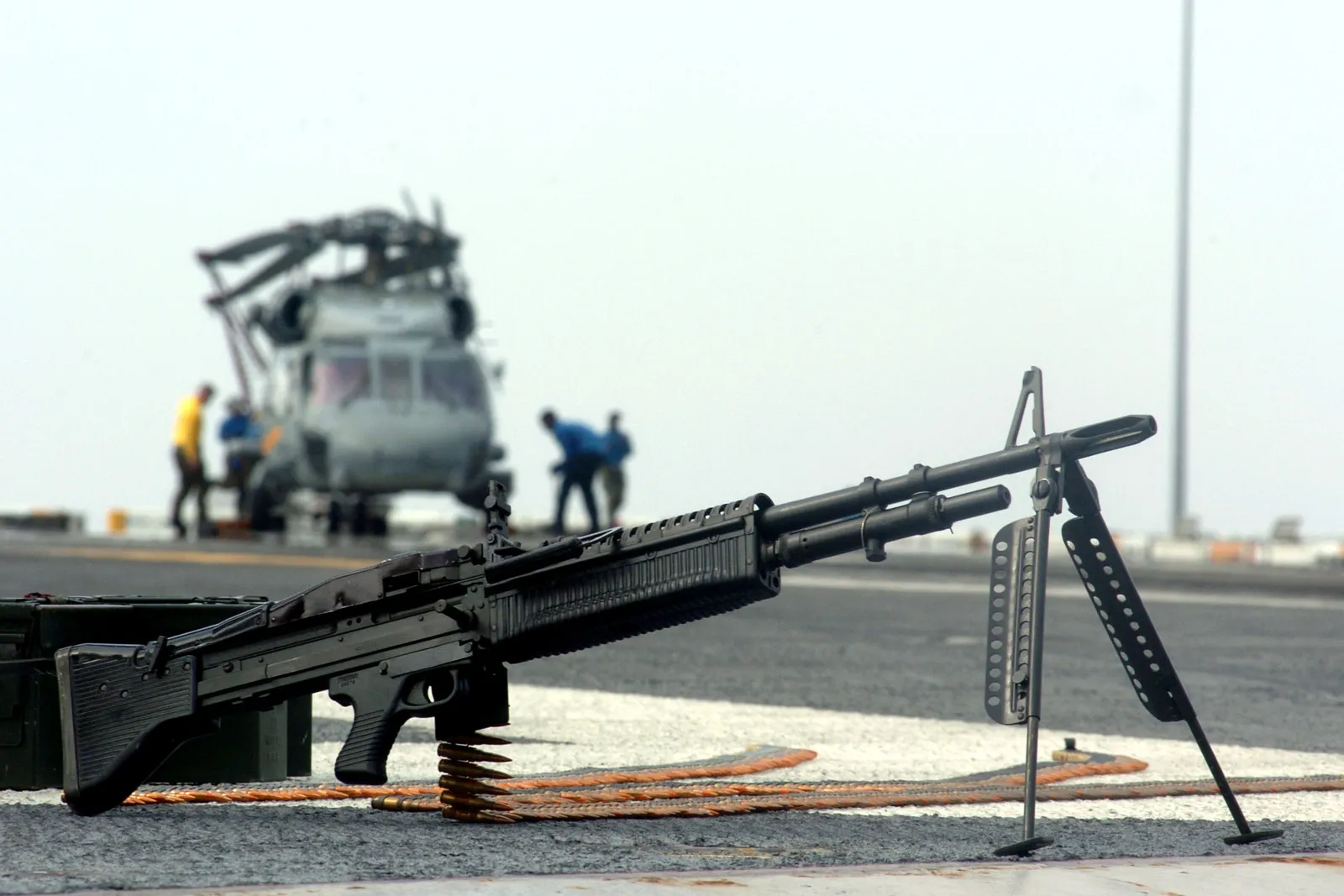
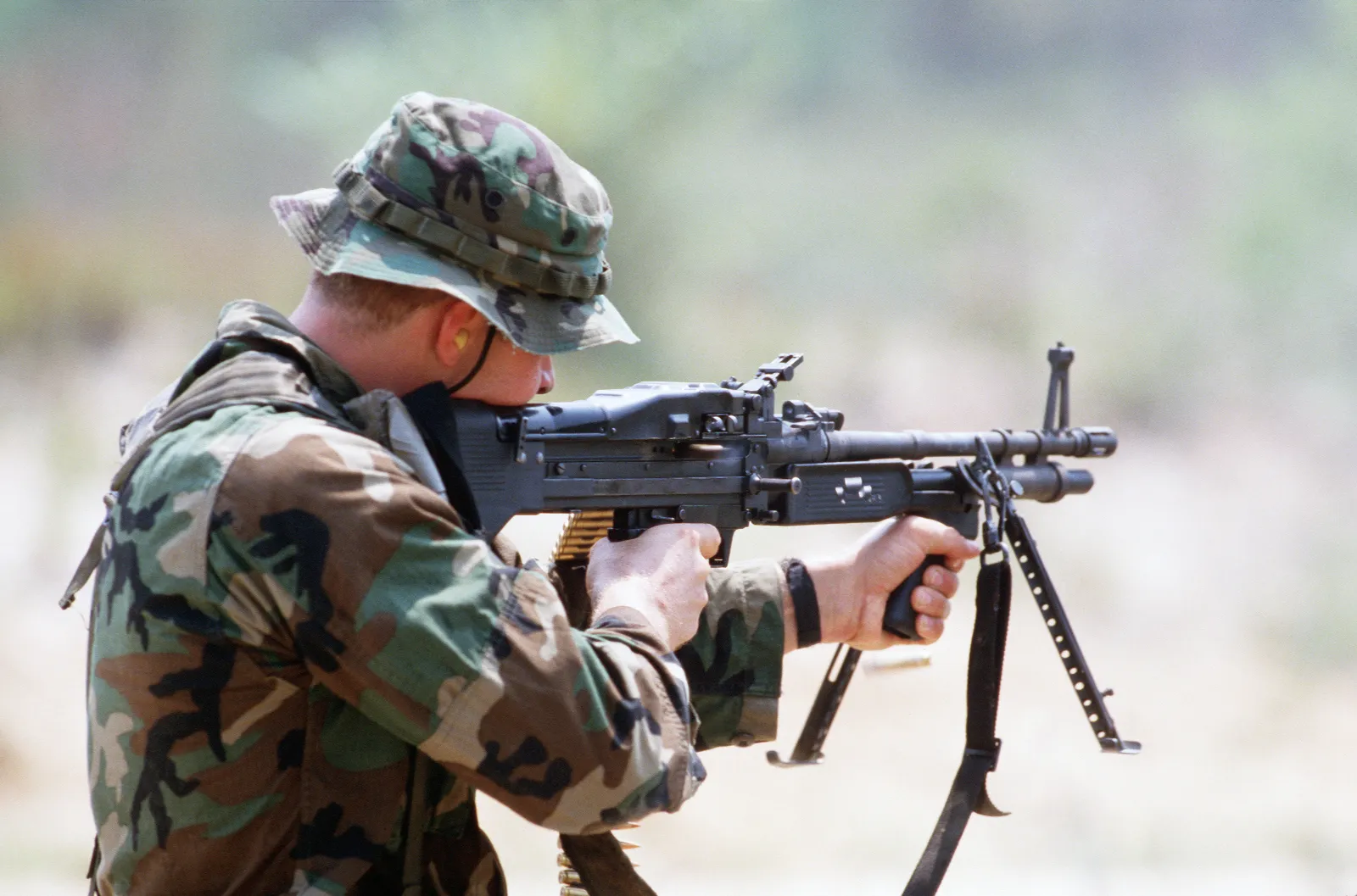
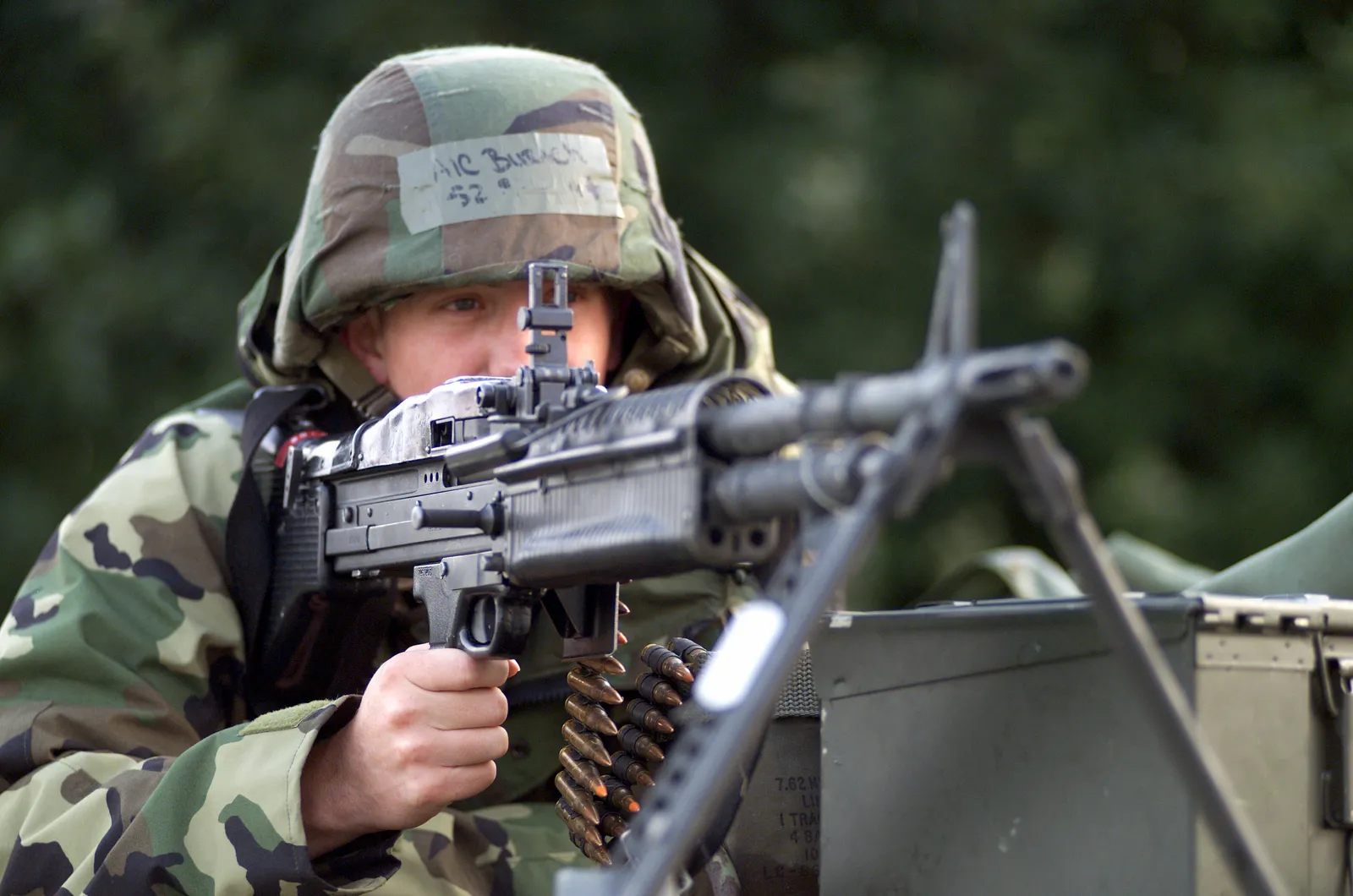
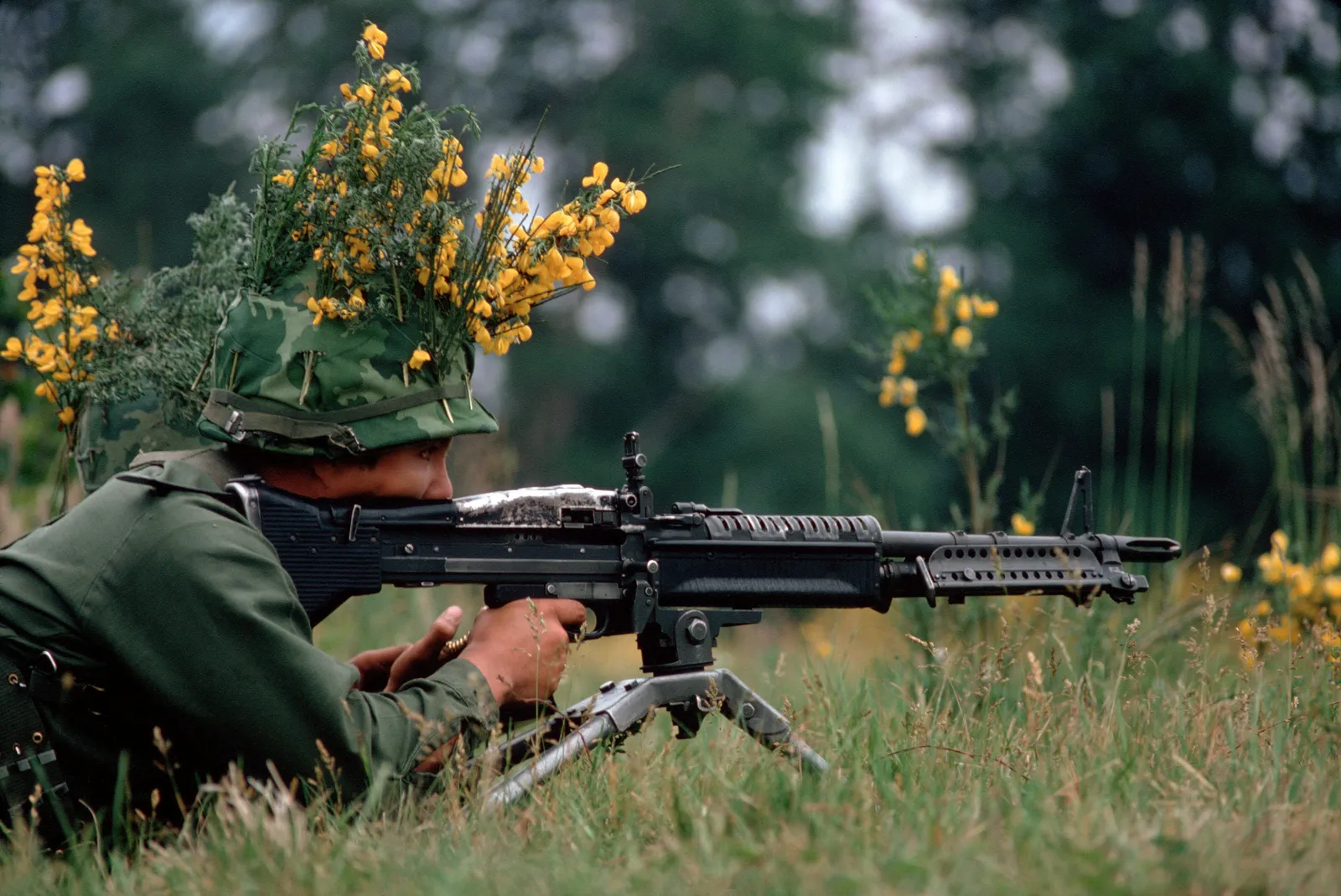
The M60 is a U.S.-origin 7.62x51 mm NATO belt-fed general-purpose machine gun built for ground, tripod, vehicle, and aircraft-mounted fire support. U.S. records document M60 use from Vietnam through Iraq and Afghanistan, while later conflict reporting shows legacy guns turning up with non-state armed groups in Nigeria, Colombia, and Haiti.
Infantry squad and patrol machine-gun fire support
U.S. Army personnel records for Medal of Honor recipient Don Sloat identify him as an M60 machine gunner in the Republic of Vietnam in 1969-1970, documenting the weapon's infantry fire-support role in the war.
A U.S. National Archives and DVIDS image record from Operation Desert Shield documents a soldier manning a 7.62 mm M60 machine gun, showing the weapon in U.S. force-protection and vehicle-security service during the 1990 Gulf War buildup.
A DVIDS/National Archives image record from Baghdad International Airport describes an M60 door gun on a U.S. Army UH-60 Black Hawk before a mission over Baghdad in support of Operation Iraqi Freedom.
DVIDS/National Archives records document M60 and M60D machine guns on U.S. force-protection patrols and CH-47 helicopter door-gunner positions at Bagram during Operation Enduring Freedom.
Boko Haram/JAS and ISWAP media showed rare M60 machine guns, including a reported example with Nigerian Army markings, indicating captured or diverted 7.62 mm belt-fed weapons reused for insurgent infantry fire support.
Colombian police reported seizing an M60 machine gun in a January 2023 arsenal they said belonged to Estado Mayor Central FARC dissidents, documenting the weapon as dissident-held fire-support equipment rather than confirmed battlefield firing.
UNODC told the Security Council in April 2024 that Haiti's gang attacks showed increased gang firepower and that UNODC had recorded use of higher-calibre weapons including the M60 machine gun.
Cold War-era design with continued M60-family production and upgrade support
Designer
U.S. Army small-arms development program
Designed
1950s; fielded in 1957
Produced
1957-present for M60-family production and upgrades
Specifications
Caliber
7.62x51 mm NATO
Operation
Gas-operated, air-cooled, disintegrating-link belt-fed weapon firing from an open bolt
Weight
23 lb (10.43 kg) for the baseline M60 in the U.S. Army operator manual
Length
43.5 in (1.1 m) overall for the baseline M60
Maximum effective range
1,100 m
Cyclic rate of fire
Approximately 550 rounds per minute for the baseline M60
Muzzle velocity
2,800 ft/s (853 m/s)
VariantsShowHide
M60-family designations cover the original infantry gun, vehicle and aircraft mounts, lighter infantry rebuilds, and modernized M60E4/Mk 43 and M60E6 production or conversion standards.
Variant
Configuration
Designation notes
M60D
Mounted door, vehicle, and naval gun
The mounted version uses spade grips and ring-sight features; U.S. Ordnance describes the enhanced M60D as a mounted M60E4/Mk 43 derivative for boats, vehicles, and helicopter door-gun positions.
The M60E3 reduced weight and moved to recognizable fore and aft pistol grips with a receiver-mounted bipod, but the redesign had reliability compromises.
Saco Defense developed the E4 retrofit package for Naval Special Warfare requirements, with deliveries beginning in late 1994 under the Navy Mk 43 Mod 0 designation.