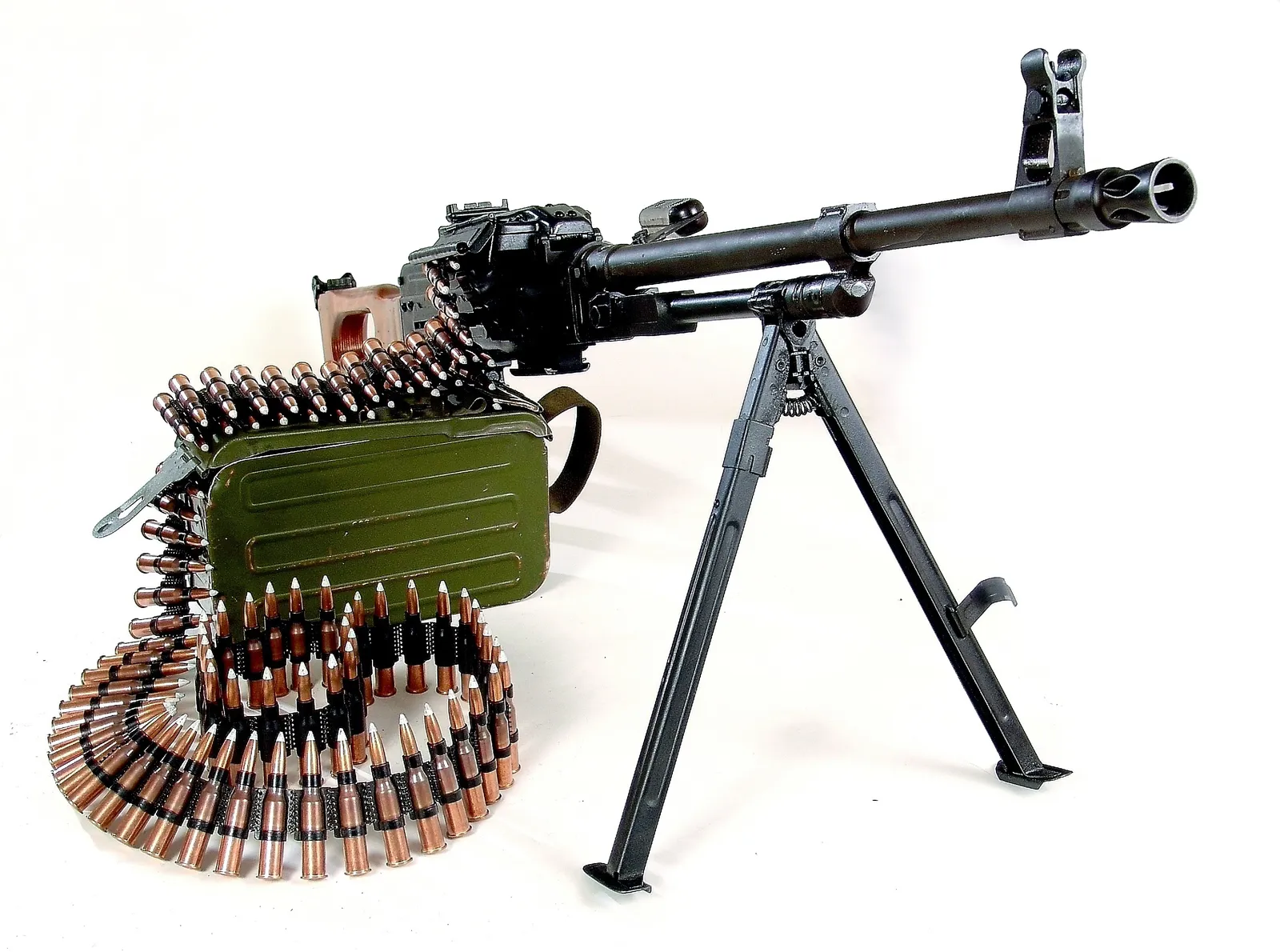


CAR documented PKM and PKT machine guns recovered from Russian-aligned armed formations in Donbas, while Ukrainian reporting and International Legion material documented PKM use by Ukraine's Defense Forces during the full-scale war.
Role detailsInfantry Weapons
PKM/PK
Also known as
- PK
- PKM
- PKS
- PKMS
- PKT
- PKTM
- PKB
- PKMB
- Pulemyot Kalashnikova
- Pulemyot Kalashnikova Modernizirovanny
- Kalashnikov PK
- Kalashnikov PKM
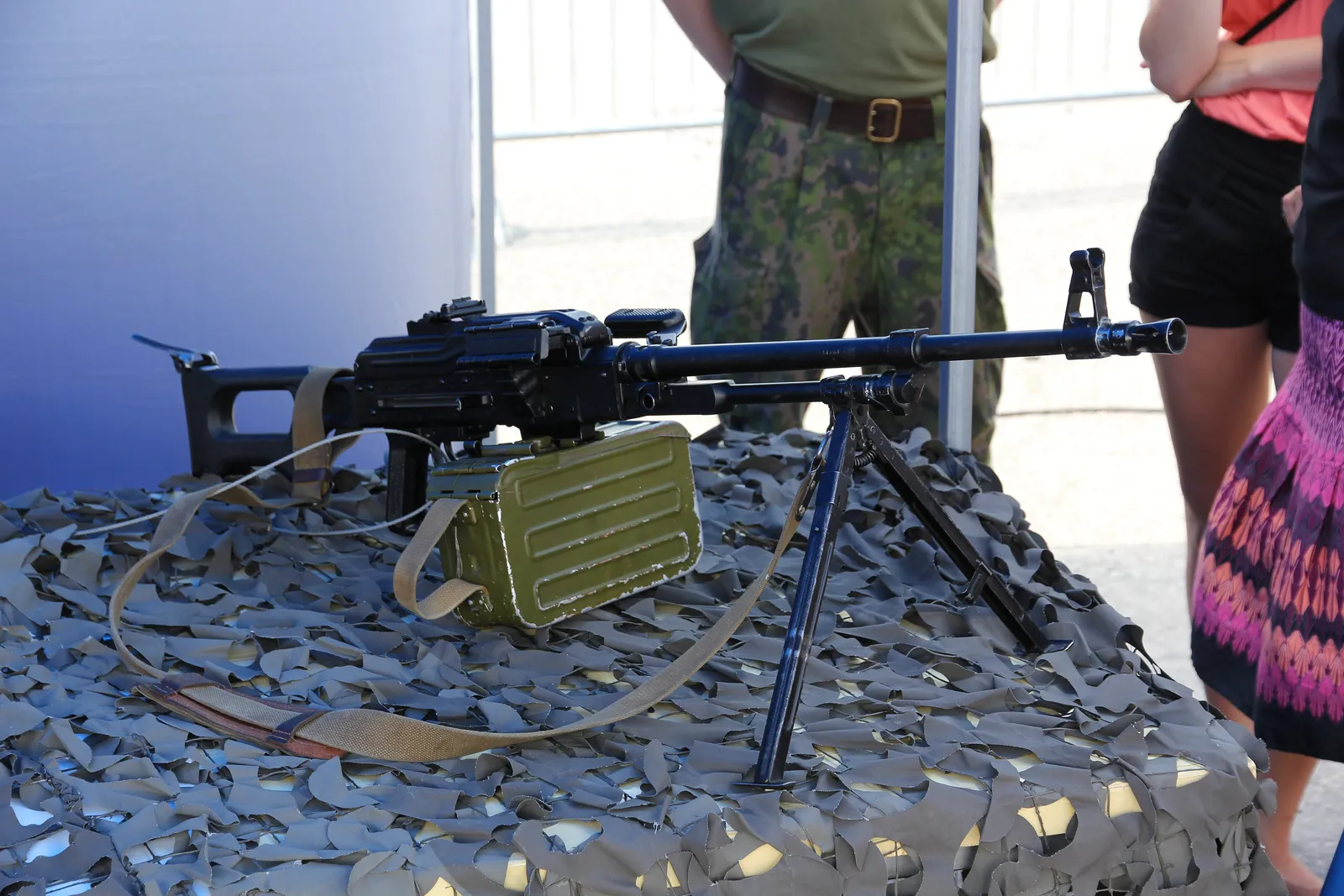
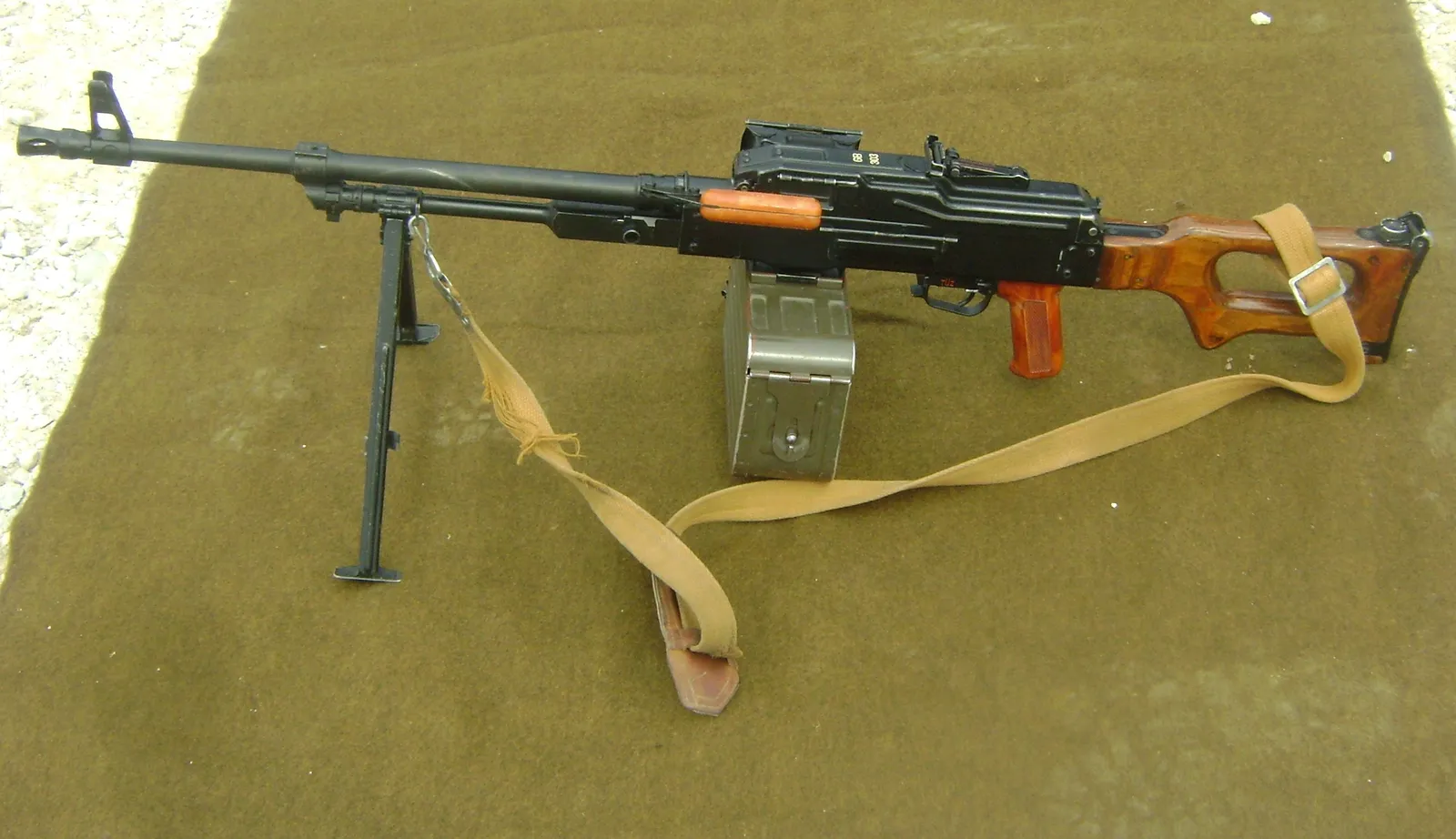
The PK and lighter PKM are Soviet-designed, belt-fed 7.62x54R general-purpose machine guns used from bipods, tripods, vehicles, remote weapon stations, and improvised mounts. Their low weight for the class, non-disintegrating belt feed, quick-change barrel concept, and wide licensed-production base make the family a recurring infantry fire-support weapon in recent conflicts, with documented rows here covering Ukraine, Yemen, Syria, Iraq, Mali, Lake Chad, Gaza, Afghanistan, and Turkey's conflict with the PKK.
Role in Conflicts

U.S. Navy reporting documented 49 PKM general-purpose machine guns and 39 spare barrels in a February 2016 dhow seizure assessed as likely bound for Houthi insurgents in Yemen.
Role details- Side
- Islamic State
- Role in conflict
- Infantry and mounted fire support

Conflict Armament Research documented 7.62x54R medium machine guns and PKM-family weapons recovered from Islamic State forces in Iraq and Syria.
Conflict Armament Research documented an Islamic State-held MG-M1/PKM-type 7.62x54R machine gun in Kobane in February 2015 and reported 2016 PKMS procurement under the Syrian Train and Equip Fund for armed opposition forces.
Role details- Role in conflict
- Small-unit infantry fire support
Boko Haram and ISWAP used PK/PKM general-purpose machine guns as small-unit fire-support weapons in the Lake Chad basin, with UN DPO/UNODA reporting local capture and illicit-market acquisition as typical sources for Boko Haram-held weapons.

AP documented Hamas fighters carrying Type 80 machine guns, a PKM-T80 copy, during the 2023 Israel-Hamas War.
Role details- Role in conflict
- Harassing fire against security bases
SETA's study of the PKK's 2015-2016 urban campaign describes PKK use of PKM machine guns for harassing fire against Turkish security-force bases, including a gendarmerie base in Diyarbakir after the April 2016 urban setbacks.
- Side
- Rebel and jihadist armed groups
- Role in conflict
- Truck-mounted extremist fire support
Small Arms Survey reporting on extremist-used arms in Mali from 2015 to 2022 identifies PKM-type general-purpose machine guns among the small arms used by al-Qaeda- and Islamic State-linked extremists, including on four-by-four trucks.


DVIDS described the PKM as heavily used by the Afghan National Army and SIGAR reported 600 PKM machine guns provided to the Afghan National Police in July-September 2018; U.S. Army, ISAF, and Imperial War Museums records also document Taliban PKM use and capture in Afghanistan.
Role details- Role in conflict
- Urban infantry fire support in Mosul

Photojournalist Gabriel Romero documented Iraqi soldiers firing PKM machine guns at Islamic State positions in Mosul's Al Thawra neighborhood on April 19, 2017.
Profile / Specs
Profile
- Origin
- Soviet Union
- Type
- 7.62 mm general-purpose machine gun
- Service note
- Introduced in the Cold War and still in widespread service
- Designer
- Mikhail Kalashnikov design team
- Designed
- Late 1950s to 1960s
- Produced
- 1960s-present, including licensed variants
- Developed into
- PKP Pecheneg
Specifications
- Caliber
- 7.62x54R
- Operation
- Gas-operated automatic fire
- Feed
- Non-disintegrating metal belts in 100-, 200-, or 250-round boxes
- Length
- 1,160 mm for the PKM identification-sheet example
- Unloaded weight
- 7.55 kg in the Small Arms Survey PKM example; 8.5 kg empty in Rosoboronexport's PKM data
- Barrel length
- 643 mm in the Small Arms Survey PKM example
- Muzzle velocity
- 825 m/s
- Rate of fire
- 600-800 rounds per minute cyclic; about 250 rounds per minute practical rate cited in the identification sheet
- Sighting range
- 1,500 m
Variants
The PK family uses a base gun plus mount-specific suffixes: PK for the bipod infantry gun, PKS/PKMS for tripod-mounted guns, PKT/PKMT for tank coaxial mounts, and PKB/PKMB for vehicle or pintle installations. The PKM modernization carried the same role split into lighter updated models.
| Variant | Configuration | Designation notes |
|---|---|---|
| PKS/PKMS | Tripod-mounted configuration | Small Arms Survey explains that PKMS designates a PKM on a tripod rather than a mechanically different gun. |
| PKT/PKMT | Vehicle coaxial gun | The PKT/PKMT branch omits the infantry stock, grip, and bipod for armored-vehicle mounts and is documented on multiple cataloged APC and scout-car platforms. Sources: Kalashnikov PK / PKM - Modern Firearms, PKT Russian 7.62mm General-Purpose Machine Gun |
| PKB/PKMB | Vehicle and pintle mount | Modern Firearms identifies the PKB branch as the armored-car or pintle-mounted version of the Kalashnikov gun family. |
 | Chinese and Iranian PKM-pattern copy | AP reporting on Hamas weapons identifies Type 80 machine guns and notes the Iranian PKM-T80 copy designation. Sources: Hamas fights with a patchwork of weapons built by Iran, China, Russia and North Korea |
 | Russian PKM-derived development | Modern Firearms describes the Pecheneg as a PKM modification with a heavier jacket-cooled barrel for sustained squad-level fire. Sources: Pecheneg - Modern Firearms |
| M84 | Yugoslav/Serbian close variant | Small Arms Survey lists the M84 among close PK variants, and Forgotten Weapons documents the Yugoslav M84 as a PKM-family machine gun. Sources: PK (& close variants) Weapons Identification Sheet, Yugoslav M84 PKM: History, Mechanics, and Disassembly |
Ammunition Fired
PK and PKM-family guns are documented as belt-fed weapons chambered for the rimmed 7.62x54R cartridge.
| Ammunition | Ammunition type | Firing evidence |
|---|---|---|
 | Rimmed full-power rifle cartridge | Small Arms Survey identifies the PK family as chambered for 7.62x54R and fed from non-disintegrating 100-, 200-, or 250-round metal belts. |
Carrier Platforms and Weapon Stations
The PKT/PKM family appears in armored-vehicle coaxial mounts, boat mounts, and remote weapon stations.
| Carrier | Carrier type | Carriage evidence |
|---|---|---|
 | High-speed assault boat | Army Recognition reported that the BK-10M can be fitted with two 7.62 mm Kalashnikov PKM general-purpose machine guns. Sources: BK-16 and BK-10 boats enhance Russia's Black Sea defense against unmanned threats |
 | 8x8 armored personnel carrier | Weaponsystems.net identifies the BTR-60PB variant as carrying a 7.62 mm PKT coaxial machine gun. Sources: BTR-60PB - Weaponsystems.net |
 | 8x8 armored personnel carrier | The BTR-3E armament list names a 7.62 mm PKT machine gun, and the upgraded combat module is documented with the KT-7.62 family as the coaxial gun fit. Sources: BTR-3E, PKT Russian 7.62mm General-Purpose Machine Gun |
 | Amphibious armored scout car | WeaponSystems.net identifies the BRDM-2 turret fit as a KPVT heavy machine gun with a coaxial 7.62 mm PKT. Sources: BRDM-2 Technical Data |
 | 8x8 armored personnel carrier | Weaponsystems.net lists the BTR-70 turret armament with a 7.62 mm PKT coaxial machine gun. Sources: BTR-70 - Weaponsystems.net |
 | 8x8 armored personnel carrier | Rosoboronexport identifies the BTR-80 armament fit as including a 7.62 mm PKT/PKTM coaxial machine gun. Sources: BTR-80 Armoured Personnel Carrier |
 | 8x8 armored personnel carrier | Rosoboronexport identifies the BTR-82A armament fit as including a 7.62 mm PKTM coaxial machine gun. Sources: BTR-82A Armoured Personnel Carrier |
 | Remote weapon station | Ukraine's Defence Ministry describes the Wolly remote-controlled station as designed for a 7.62 mm PKT machine gun. Sources: The Wolly remote-controlled weapon station has been approved for use in the Defence Forces |
Designation And Mounting Logic
The PK family is easiest to read as a common receiver and ammunition system adapted to the mount. The dismounted PK and PKM are the infantry guns, the S suffix marks tripod use, and the T branch covers vehicle coaxial installations.
| Designation | Mounting role | Reader-facing distinction |
|---|---|---|
| PK / PKM | Bipod infantry gun | Portable belt-fed fire support with a 100-round assault box or larger belt boxes. |
| PKS / PKMS | Tripod-mounted gun | The tripod changes the supported-fire setup rather than the underlying gun. |
| PKT / PKMT | Vehicle coaxial gun | Vehicle versions discard the shoulder stock, pistol grip, and bipod for solenoid or mount control in armored platforms. |
| PKB / PKMB | Vehicle or pintle mount | The vehicle branch adapts the Kalashnikov gun family for armored cars, door mounts, and similar installations. |
Timeline
PKM/PK Key Events
Soviet GPMG competition produces the PK design
Modern Firearms traces the Soviet requirement for a belt-fed 7.62x54R general-purpose machine gun to the 1950s and describes Kalashnikov's team entering the competition after Nikitin's design had reached advanced trials.
Sources: Kalashnikov PK / PKM - Modern Firearms
PK adopted
The Kalashnikov PK was adopted as the Soviet general-purpose machine gun, with infantry, tripod, tank, and vehicle-mount configurations.
Sources: Kalashnikov PK / PKM - Modern Firearms
PKM modernization appears
The PKM modernization lightened and updated the basic gun while retaining the same 7.62x54R belt-fed role, and the same suffix logic carried over into PKMS and PKMT forms.
Sources: Kalashnikov PK / PKM - Modern Firearms, PK (& close variants) Weapons Identification Sheet
Islamic State recoveries document PKM-family weapons
Conflict Armament Research documented 7.62x54R medium machine guns and PKM-family weapons recovered from Islamic State forces in Iraq and Syria.
Sources: Weapons of the Islamic State
PKMS procurement appears in Syrian opposition supply reporting
Conflict Armament Research reported U.S. contract procurement of PKMS machine guns for the Syrian Train and Equip Fund, tying the family to the Syrian opposition supply chain.
Sources: Weapons of the Islamic State
CAR documents PKM guns in Ukraine
Conflict Armament Research documented two 7.62x54R PKM medium machine guns in Severodonetsk during its Ukraine field investigations.
Sources: Weapons of the war in Ukraine
CAR documents a PKT on a BTR-80 in Ukraine
CAR documented a 7.62x54R PKT medium machine gun installed on a BTR-80 armored personnel carrier in Sartana.
Sources: Weapons of the war in Ukraine
Related Weapon Systems


Sources
PK (& close variants) Weapons Identification SheetPublisher: Small Arms Survey | Note: Supports PK/PKM identification, caliber, dimensions, weight, operating system, feed device, variants, and broad background. | Accessed: 2026-06-20Kalashnikov PK / PKM - Modern FirearmsPublisher: Modern Firearms | Note: Supports PK adoption background, PKM modernization timing, operating system, belt feed, and PK/PKS/PKT/PKB designation roles. | Accessed: 2026-06-30Pecheneg - Modern FirearmsPublisher: Modern Firearms | Note: Supports the PKP Pecheneg relationship by describing it as a PKM modification with a heavier jacket-cooled barrel for sustained fire. | Accessed: 2026-06-30Yugoslav M84 PKM: History, Mechanics, and DisassemblyPublisher: Forgotten Weapons | Note: Supports the M84 close-variant context and the selected M84/PKM video metadata. | Accessed: 2026-06-30BTR-3EPublisher: National Defence University of Ukraine | Note: Supports the BTR-3E armament list that identifies the 7.62 mm PKT machine gun used on the vehicle. | Accessed: 2026-06-28BRDM-2 Technical DataPublisher: WeaponSystems.net | Note: Supports the BRDM-2's coaxial 7.62 mm PKT machine gun mount alongside the KPVT. | Accessed: 2026-06-28PKMPublisher: Rosoboronexport | Note: Supports current PKM export specifications, including caliber, ammunition, cyclic rate, sighting range, empty weight, and belt capacity. | Accessed: 2026-06-20Small Arms Production in RussiaPublisher: Saferworld | Note: Supports Russian small-arms production background, Kovrov-area Kalashnikov machine-gun production, and listed PKM-family products. | Accessed: 2026-06-20BK-16 and BK-10 boats enhance Russia's Black Sea defense against unmanned threatsPublisher: Army Recognition | Note: Supports the BK-10M family carriage relationship reported by Army Recognition: BK-10M can be fitted with two 7.62 mm Kalashnikov PKM general-purpose machine guns. | Accessed: 2026-06-27BTR-80 Armoured Personnel CarrierPublisher: Rosoboronexport | Note: Supports the BTR-80 relationship by identifying the vehicle's 7.62 mm PKT/PKTM coaxial machine gun armament. | Accessed: 2026-06-27BTR-82A Armoured Personnel CarrierPublisher: Rosoboronexport | Note: Supports the BTR-82A relationship by identifying the vehicle's 7.62 mm PKTM coaxial machine gun armament. | Accessed: 2026-06-27BTR-70 - Weaponsystems.netPublisher: Weaponsystems.net | Note: Supports the BTR-70's coaxial 7.62 mm PKT machine gun armament. | Accessed: 2026-06-28The Wolly remote-controlled weapon station has been approved for use in the Defence ForcesPublisher: Ministry of Defence of Ukraine | Note: Supports the Wolly relationship by describing the remote station as designed for a 7.62 mm PKT machine gun. | Accessed: 2026-06-27Ukraine Debuts Murena Feed System to Power Heavy Machine Guns and Combat RobotsPublisher: UNITED24 Media | Note: 2014 Russia-Ukraine War: PKM was used by Ukraine's Defense Forces as a belt-fed weapon. | Accessed: 2026-06-20Polish Volunteer Found His Honor in Ranks of Ukraine's Armed ForcesPublisher: Defense Express | Note: 2014 Russia-Ukraine War: PKM was used by a Polish volunteer serving in Ukraine's International Legion. | Accessed: 2026-06-20Third Illicit Arms Shipment in Recent Weeks Seized in Arabian SeaPublisher: U.S. Navy | Note: 2014 Yemen Civil War: U.S. naval reporting documented PKM general-purpose machine guns in a shipment assessed as likely transferred to Houthi-Saleh forces in Yemen; treated here as interdicted supply, not confirmed battlefield use. | Accessed: 2026-06-20Weapons of the Islamic StatePublisher: Conflict Armament Research | Note: 2014 War Against the Islamic State: PKM-family and 7.62x54R medium machine guns were used by Islamic State forces in Iraq and Syria. 2011 Syrian Civil War: documents an Islamic State-held MG-M1/PKM-type 7.62x54R machine gun in Kobane, Syria, and identifies PKMS machine guns procured for the Syrian Train and Equip Fund in 2016. | Accessed: 2026-06-30Weapons of the war in UkrainePublisher: Conflict Armament Research | Note: 2014 Russia-Ukraine War: CAR documented two 7.62x54R PKM machine guns and a 7.62x54R PKT installed on a BTR-80 during Ukraine field investigations in 2018 and 2019. | Accessed: 2026-06-30Weapons and Ammunition Dynamics in the Lake Chad BasinPublisher: United Nations Department of Peace Operations and United Nations Office for Disarmament Affairs / Lake Chad Basin Commission | Note: 2009 Boko Haram Insurgency: PK/PKM general-purpose machine guns were used by Boko Haram and ISWAP as part of their small-arms and light-weapons holdings, with local capture and illicit-market acquisition noted as typical supply paths. | Accessed: 2026-06-21Hamas fights with a patchwork of weapons built by Iran, China, Russia and North KoreaPublisher: Associated Press | Note: 2023 Israel-Hamas War: Hamas fighters were seen carrying Type 80 machine guns, a PKM-T80 copy, during the 2023 Israel-Hamas War. | Accessed: 2026-06-20When Strategy Collapses: The PKK's Urban Terrorist CampaignPublisher: SETA Foundation | Note: 1984 Kurdish-Turkish Conflict: PKM machine guns were used by the PKK for harassing fire against Turkish security-force bases during the 2015-2016 campaign. | Accessed: 2026-06-22Continuity and Change: Extremist-used Arms in MaliPublisher: Small Arms Survey | Note: 2012 Mali War: PKM-type general-purpose machine guns were used by al-Qaeda- and Islamic State-linked extremists in Mali from 2015 to 2022. | Accessed: 2026-06-22Quarterly Report to the United States Congress, October 30, 2018Publisher: Special Inspector General for Afghanistan Reconstruction | Note: 2001 War in Afghanistan: 600 PKM machine guns were supplied to the Afghan National Police during July-September 2018. | Accessed: 2026-06-224th Battalion, 1st SFAB Conducts Foreign Weapons TrainingPublisher: Defense Visual Information Distribution Service | Note: 2001 War in Afghanistan: the PKM was fielded by the Afghan National Army, which DVIDS described as heavily using the weapon during U.S. advise-and-assist preparations. | Accessed: 2026-06-22Imperial War Museums PKMPublisher: Imperial War Museums | Note: 2001 War in Afghanistan: catalogs a PKM used by the Taliban in Afghanistan and captured by 1st Battalion, The Royal Anglian Regiment during Operation Silicon on April 29-30, 2007. | Accessed: 2026-07-05U.S. Army Deh Chopan OperationPublisher: U.S. Army | Note: 2001 War in Afghanistan: documents insurgents using PKM machine-gun fire against Afghan and coalition forces in Zabul province in October 2011. | Accessed: 2026-07-05ISAF September 2012 Operational UpdatePublisher: International Security Assistance Force / DVIDS | Note: 2001 War in Afghanistan: documents Taliban insurgents using PKM machine-gun fire during an attack in Ghazni province in September 2012. | Accessed: 2026-07-05The Liberation of Mosul: A Hard Fought FreedomPublisher: Social Documentary Network | Note: 2013 War in Iraq: PKM machine guns were fired by Iraqi soldiers at Islamic State positions in Mosul on April 19, 2017. | Accessed: 2026-06-22File:PK machine gun.jpgPublisher: Wikimedia Commons | Note: Supports image provenance and licensing; the file page identifies the image as a PKM machine gun and lists CC0 public-domain dedication. | Accessed: 2026-06-20File:7,62 KK PKM.JPGPublisher: Wikimedia Commons | Note: Supports image provenance for a public-domain PKM machine-gun image used in the gallery. | Accessed: 2026-06-20File:PKM of Hungarian Army.JPGPublisher: Wikimedia Commons | Note: Supports image provenance for a public-domain PKM machine-gun image used in the gallery. | Accessed: 2026-06-20PKT Russian 7.62mm General-Purpose Machine GunPublisher: ODIN | Note: Supports the PKT family description as a vehicle-mounted coaxial machine gun used on armored platforms. | Accessed: 2026-06-28BTR-60PB - Weaponsystems.netPublisher: Weaponsystems.net | Note: Supports the BTR-60PB variant's coaxial PKT armament on the BTR-60 family page. | Accessed: 2026-06-28