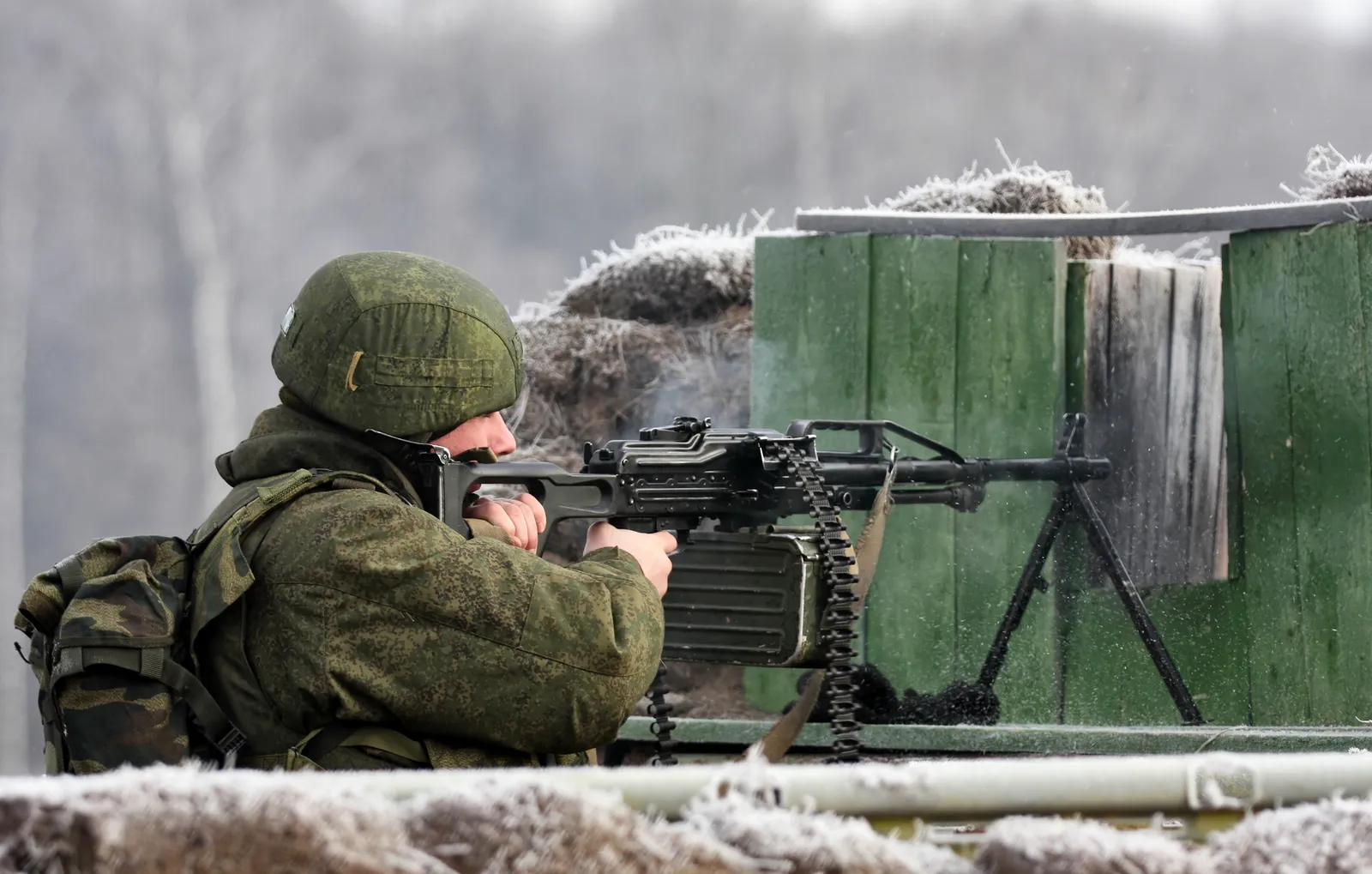


The Russian-origin PKP Pecheneg appears in the 2014 Russia-Ukraine War on both sides: reporting on the Donbas conflict listed it among Russian light machine guns used by separatist forces, and Getty/Anadolu documented a Ukrainian soldier using one during training near Chasiv Yar in August 2023.
Role detailsInfantry Weapons
PKP Pecheneg
Also known as
- Pecheneg PKP
- Pecheneg
- 6P41
- 6P41N
- PKP Pecheneg-N
- Pecheneg-N
- Pecheneg-SP
- 6P69
- 7.62mm Pecheneg MG
- 6P41 Pecheneg
- Pulemyot Pecheneg
- Pulemet Pecheneg
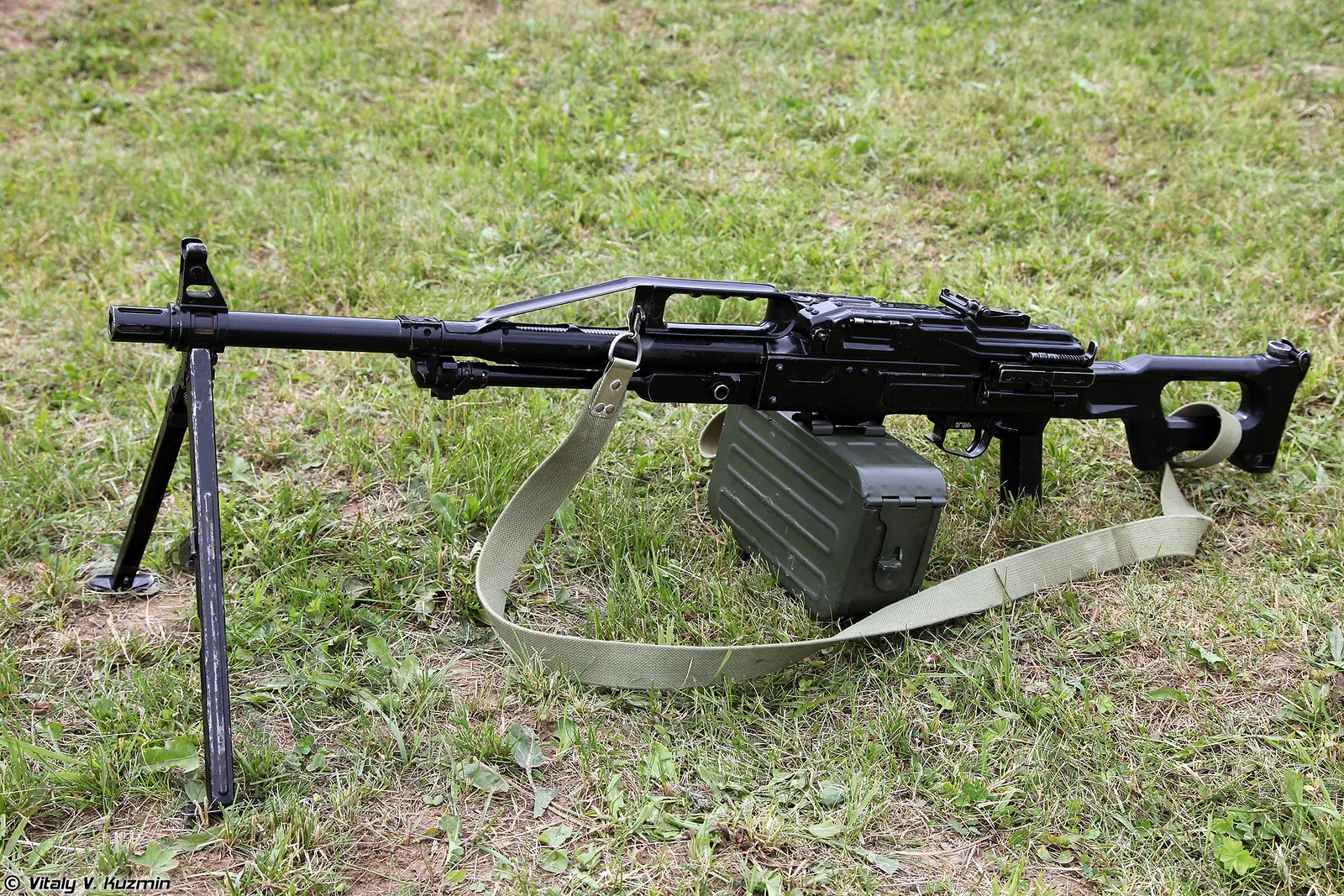
The PKP Pecheneg is a Russian 7.62x54mmR belt-fed general-purpose machine gun developed from the PKM to solve sustained-fire problems with a heavier, jacket-cooled barrel, forced-air cooling, a mirage-shielding carry handle, and a forward bipod. Russian sources place production at Kovrov in 1999 and service acceptance in 2001, with later documented use by Russian forces, Syrian special forces, Russian-backed separatists, and Ukrainian troops, plus naval mounting on Russian patrol and assault craft.
Role in Conflicts

Oryx documented Syrian special forces using PKP Pecheneg light machine guns during a September 2015 offensive around Harasta, near Damascus, and reported earlier deliveries for those units.
Role details- Side
- Russia and South Ossetian forces
- Role in conflict
- Infantry machine-gun fire support
Army Recognition reported Russian military use of the PKP Pecheneg during the 2008 armed conflict in South Ossetia, placing the weapon with the Russian and South Ossetian side of the Russo-Georgian War.
- Side
- Russia
- Role in conflict
- Special-forces machine-gun fire support
Modern Firearms says initial Pecheneg deliveries went to Russian Spetsnaz units operating in Chechnya, and Russian reporting describes early deliveries to army and police units involved in counterterrorist operations there.
Operators and Documented Use
Military forces documented with the PKP Pecheneg include Russian forces in Chechnya and South Ossetia, Russian-backed separatist forces in eastern Ukraine, Ukrainian forces with documented examples, and Syrian special forces. These are documented examples, not a complete global operator list.
| Force or side | Documented context | What the sourcing supports |
|---|---|---|
| Russian Spetsnaz and security forces | Modern Firearms describes initial Pecheneg deliveries to Russian Spetsnaz units operating in Chechnya, while Russian reporting describes early deliveries to army and police units involved in counterterrorist operations there. | 1999 Second Chechen War conflict-use context. |
| Russian and South Ossetian forces | Army Recognition reported Russian military use of the Pecheneg during the 2008 South Ossetia conflict. | 2008 Russo-Georgian War conflict-use context. |
| Russian-backed separatist forces | Reporting on eastern Ukraine listed PKP Pecheneg light machine guns among weapons used by separatist forces. | 2014 Russia-Ukraine War conflict-use context. |
| Ukrainian Armed Forces | Getty/Anadolu photographed a Ukrainian soldier using a PKP Pecheneg near Chasiv Yar in August 2023. | 2014 Russia-Ukraine War conflict-use context. |
| Syrian special forces | Oryx documented PKP Pecheneg light machine guns with Syrian special forces during fighting around Harasta in 2015. | 2011 Syrian Civil War conflict-use context. |
History and Development
The PKP Pecheneg's history is best understood as a Russian attempt to improve the PKM family for longer automatic-fire strings without asking the gun team to swap barrels as often. Russian reporting places TsNIITochMash development work in the 1990s, production at Kovrov from 1999, early deliveries to units operating in Chechnya, and formal acceptance as the 6P41 in 2001.
Later development focused on mission-specific handling rather than a new caliber. Public sources describe a shortened assault configuration in 2013 and the Pecheneg-SP/6P69 modernization in 2014 with optic rails, revised ergonomics, a removable bipod, and suppressor-related equipment.
Key Features
The key features of the PKP Pecheneg are its PKM-derived action, belt feed, 7.62x54mmR chambering, fixed heavy barrel, forced-air cooling jacket, mirage-shielding carry handle, and forward bipod layout.
- Designed for sustained fire. The Pecheneg keeps the PKM action and belt-feed logic but replaces the normal spare-barrel routine with a heavier jacket-cooled barrel intended to hold point of impact longer during automatic fire.
- Muzzle-driven cooling. Russian and reference descriptions explain that propellant gas flow at the muzzle creates an ejector effect, drawing cooler air through the barrel jacket during firing.
- Heat-mirage control. Rosgvardia describes the top handle as a heat-mirage shield that helps keep rising hot air from distorting the sight picture.
- Forward stability. Moving the bipod toward the muzzle improves stability and dispersion in sustained fire, but it also narrows the easy traverse arc unless the gunner shifts position.
- PKM commonality. Official Russian text describes up to 80 percent commonality with the PKM, which helped production, training, and logistics during the late-1990s transition.
- Modernized variants. The 6P41N adds night/optic mounting, while the Pecheneg-SP modernization adds rails, revised ergonomics, a detachable bipod, and suppressor-related equipment.
PKM Family Relationship
The Pecheneg is documented as a PKM-derived redesign rather than a separate ammunition family or wholly new operating system.
| Related entry | Relationship | Evidence |
|---|---|---|
 | PKM family redesign | Rosgvardia says the Pecheneg is a further modernization of the PK and shares up to 80 percent of its parts. |
Profile / Specs
Profile
- Origin
- Russia
- Built by
- TsNIITochMashDegtyaryov Plant
- Type
- 7.62 mm general-purpose machine gun
- Service note
- Developed in the 1990s and accepted into Russian service in 2001; documented from Chechnya and the Russo-Georgian War through Syria and the 2014 Russia-Ukraine War.
- Designer
- TsNIITochMash
- Designed
- 1990s
- Produced
- 1999-present
- Developed from
- PKM/PK
Specifications
- Caliber
- 7.62x54mmR
- Feed
- Belt-fed, commonly 100- or 200-round belt boxes
- Weight
- About 8.5 kg empty in Rosoboronexport export data; about 8.7 kg on bipod in other public references
- Length
- 1,155-1,200 mm depending on source and configuration
- Barrel length
- 658 mm
- Rate of fire
- Approximately 600-800 rounds per minute
- Muzzle velocity
- About 825 m/s
- Sighting range
- Up to 1,500 m in Rosgvardia specifications
- Operating system
- Gas-operated, full-automatic fire only
- Cooling
- Heavy non-quick-change barrel with jacket-assisted forced-air cooling
- Barrel endurance
- 25,000-round barrel lifespan in Rosoboronexport export data; Russian reference sources describe up to 600 rounds of continuous fire
- Operating temperature
- -50 C to +50 C in Rosoboronexport export data
Technical Specification Notes
Public references consistently identify the PKP Pecheneg as a gas-operated, belt-fed, full-automatic 7.62x54mmR general-purpose machine gun with an approximately 8.5-8.7 kg empty or bipod weight, a 658 mm barrel, about 600-800 rounds-per-minute cyclic rate, roughly 825 m/s muzzle velocity, and a sighting range up to 1,500 m.
Those figures should be read as representative public specifications because sources vary slightly by variant, optic mount, and accessory fit. Rosoboronexport export data lists a 25,000-round barrel lifespan and -50 C to +50 C operating-temperature range, while Russian reference sources emphasize the Pecheneg's ability to sustain long automatic-fire strings.
The most important technical distinction from the PKM is not the cartridge or action, but the Pecheneg's barrel and cooling system: it uses a heavier non-quick-change barrel with a jacket that draws air forward during firing.
Variants
Public sources use 6P41 as the standard Pecheneg service index, while 6P41N or Pecheneg-N identifies the night/optic-capable configuration and Pecheneg-SP or 6P69 identifies the later accessory-ready modernization.
| Variant | Configuration | Designation notes |
|---|---|---|
| 6P41N / PKP Pecheneg-N | Night/optic-capable configuration | Army Recognition lists Pecheneg-N/6P41N as the Pecheneg configuration fitted for night-sight or optic use. Sources: Pecheneg Pecheneg-N 6P41 |
| Short assault Pecheneg | Compact assault configuration | Rosgvardia and Army Recognition describe a shorter 2013 assault version intended for commandos and close-range fighting. Sources: Pulemet Pecheneg, Old 7.62mm PKM machine gun will be replaced by modern PKP Pecheneg in the Russian army |
| Pecheneg-SP / 6P69 | Modernized accessory-ready variant | Rosgvardia and Army Recognition describe the 2014 Pecheneg-SP/6P69 modernization with rails, revised ergonomics, a removable bipod, and suppressor-related equipment. Sources: Pulemet Pecheneg, Old 7.62mm PKM machine gun will be replaced by modern PKP Pecheneg in the Russian army |
Ammunition Fired
The PKP Pecheneg is documented as a belt-fed machine gun chambered for 7.62x54mmR ammunition.
| Ammunition | Ammunition type | Firing evidence |
|---|---|---|
 | Rimmed full-power rifle cartridge | Modern Firearms identifies the Pecheneg as a standard 7.62x54R PKM-derived machine gun, supporting this ammunition relationship. Sources: Pecheneg |
Documented Mounting Platforms
Russian naval and defense references describe Pecheneg-family 7.62 mm guns as armament options on selected Kalashnikov/Rybinsk assault craft.
| Carrier | Carrier type | Carriage evidence |
|---|---|---|
 | High-speed patrol and anti-sabotage boat | KCHF.RU describes Project 03160 Raptor boats with two stern bracket mounts, each carrying a 7.62 mm 6P41 Pecheneg machine gun. |
 | High-speed assault and landing craft | RussianShips.info lists the BK-16 Project 02510 armament fit with four single 7.62 mm 6P41 Pecheneg machine guns. |
 | High-speed assault boat family | Army Recognition reports that the BK-10M can be fitted with a Pecheneg 7.62 mm general-purpose machine gun. Sources: BK-16 and BK-10 boats enhance Russia's Black Sea defense against unmanned threats |
Comparison With Modern General-Purpose Machine Guns
The Pecheneg compares most directly with other belt-fed general-purpose machine guns, especially the Soviet/Russian PKM family and NATO 7.62x51mm designs such as the FN MAG/M240 and M60 families. Its main design tradeoff is accepting a heavier fixed barrel and forward bipod to improve sustained-fire behavior, while keeping much of the PKM mechanism and the same 7.62x54mmR ammunition.
| Weapon family | How it compares with PKP Pecheneg | Reader takeaway |
|---|---|---|
| The PKM is lighter in common public specifications and uses the traditional quick-change barrel approach; the Pecheneg keeps high parts commonality but adds a heavier jacket-cooled barrel, forward bipod, and mirage-control features. | Pecheneg is a sustained-fire redesign of a familiar PKM architecture, not a clean-sheet replacement. |
 | The FN MAG/M240 family uses 7.62x51mm NATO ammunition and is widely adapted to infantry, tripod, vehicle, aircraft, naval, and boat mounts; public MAG data emphasizes broad mounting flexibility and a higher listed cyclic-rate range than the Pecheneg. | FN MAG/M240 is the NATO benchmark for mount flexibility; Pecheneg is optimized around Russian PKM-family logistics and sustained dismounted fire. |
 | The baseline M60 is an older U.S. 7.62x51mm NATO general-purpose machine gun with a conventional air-cooled barrel system; its U.S. Army manual lists a heavier baseline weight than the Pecheneg and a lower approximate cyclic rate. | M60 fills the same general-purpose role, but the Pecheneg reflects a later Russian answer to PKM heat and dispersion problems. |
Timeline
PKP Pecheneg Key Events
TsNIITochMash begins Pecheneg development work
Russian design work focused on the PKM's heat-balance and point-of-impact problems during sustained fire, leading to a heavier barrel, jacket cooling, and a revised bipod arrangement.
Sources: Russian PKP Pecheneg 6P41 gunfire is twice more efficient than PKM
Production and Chechnya deliveries start
Russian and specialist sources describe production beginning at Kovrov and initial deliveries to army, police, and Spetsnaz units involved in operations in Chechnya.
Sources: Russian PKP Pecheneg 6P41 gunfire is twice more efficient than PKM, Pecheneg, Pulemet Pecheneg
Accepted under the 6P41 index
The Pecheneg entered Russian service as the 6P41, supplementing rather than fully replacing the PKM family in infantry and special-purpose roles.
Sources: Russian PKP Pecheneg 6P41 gunfire is twice more efficient than PKM
Reported in the Russo-Georgian War
Army Recognition reported Russian military use of the Pecheneg during the 2008 armed conflict in South Ossetia.
Sources: Russian PKP Pecheneg 6P41 gunfire is twice more efficient than PKM
Shortened assault variant appears
A compact assault configuration for commandos and close-range work was shown in Russia, with a lighter and shorter package than the standard gun.
Sources: Pulemet Pecheneg, Old 7.62mm PKM machine gun will be replaced by modern PKP Pecheneg in the Russian army
Pecheneg-SP variant is shown
TsNIITochMash revealed the Pecheneg-SP/6P69 modernization with optic rails, revised ergonomics, a quick-detachable bipod, suppressor provision, and other accessory updates.
Sources: Pulemet Pecheneg, Old 7.62mm PKM machine gun will be replaced by modern PKP Pecheneg in the Russian army
Documented with Syrian special forces
Oryx identified PKP Pecheneg light machine guns with Syrian special forces during fighting around Harasta, near Damascus.
Sources: Syrian Special Forces spotted with British Accuracy International AWM sniper rifles
Documented in Ukrainian hands near Chasiv Yar
Getty/Anadolu photographed a Ukrainian soldier using a PKP Pecheneg machine gun during training in Donetsk Oblast during the 2014 Russia-Ukraine War.
Sources: Military training of Ukrainian Army in Donetsk Oblast
Related Weapon Systems


Sources
Landing craft Type BK-16 Project 02510Publisher: RussianShips.info | Note: Supports the BK-16 Project 02510's reported 4x1 7.62 mm 6P41 Pecheneg armament fit and the mounted-platform relationship. | Accessed: 2026-06-30BK-16 and BK-10 boats enhance Russia's Black Sea defense against unmanned threatsPublisher: Army Recognition | Note: Supports the BK-10M family carriage relationship reported by Army Recognition: BK-10M can also be fitted with a Pecheneg 7.62 mm general-purpose machine gun. | Accessed: 2026-06-30KCHF.RU: Project 03160 / Raptor ClassPublisher: KCHF.RU | Note: Supports the Project 03160 Raptor-class patrol boat relationship by describing two stern bracket mounts for 7.62 mm 6P41 Pecheneg machine guns. | Accessed: 2026-06-30PechenegPublisher: Modern Firearms | Note: Supports system background, PKM-derived design, caliber, weight, barrel length, feed, rate of fire, cooling details, forward bipod tradeoffs, sustained-fire design facts, and 1999 Second Chechen War direct conflict-use context by describing initial deliveries to Russian Spetsnaz units operating in Chechnya. | Accessed: 2026-06-30Pecheneg Pecheneg-N 6P41Publisher: Army Recognition | Note: Supports Russian origin, TsNIITochMash design/manufacturing context, role, variants, and technical specifications. | Accessed: 2026-06-30Pulemet PechenegPublisher: Rosgvardia | Note: Official Russian arsenal page supporting developer/manufacturer context, late-1990s fielding, technical specifications, cooling description, mirage-shielding handle, 2013 assault variant, and 2014 Pecheneg-SP modernization. | Accessed: 2026-06-307.62mm Pecheneg MGPublisher: Rosoboronexport | Note: Official export product page supporting Pecheneg designation, caliber, cartridge, belt capacities, rate of fire, empty weight, barrel lifespan, sighting range, muzzle velocity, and operating-temperature data. | Accessed: 2026-06-30Russian PKP Pecheneg 6P41 gunfire is twice more efficient than PKMPublisher: Army Recognition | Note: Supports development chronology, 1995 design work, 1999 production start, 2001 6P41 service acceptance, sustained-fire/barrel endurance context, 1999 Second Chechen War direct conflict-use context through early deliveries to army and police units in Chechnya, and 2008 Russo-Georgian War direct conflict-use context by reporting Russian military use during the South Ossetia conflict. | Accessed: 2026-06-30Old 7.62mm PKM machine gun will be replaced by modern PKP Pecheneg in the Russian armyPublisher: Army Recognition | Note: Supports Pecheneg-SP modernization details, shortened 2013 variant context, accessory updates, and Russian replacement/supplement role alongside the PKM family. | Accessed: 2026-06-30PK (& close variants) Weapons Identification SheetPublisher: Small Arms Survey | Note: Supports comparison context for the PK/PKM family, including caliber, dimensions, weight, operating system, feed device, and variants. | Accessed: 2026-06-27FN MAGPublisher: FN Herstal | Note: Supports comparison context for the FN MAG/M240 family, including manufacturer background, caliber, and use from ground, tripod, vehicle, aircraft, ship, and boat mountings. | Accessed: 2026-06-27MAG 58Publisher: Royal Australian Navy | Note: Supports comparison context for the FN MAG/MAG 58, including gas operation, belt feed, rate of fire, and effective range in the light support role. | Accessed: 2026-06-27TM 9-1005-224-10 Operator's Manual for Machine Gun, 7.62-mm, M60Publisher: Headquarters, Department of the Army | Note: Supports comparison context for the baseline M60, including operating description, weight, length, range, cyclic rate, and muzzle velocity. | Accessed: 2026-06-27These Are The Weapons That Russia Is Pouring Into Eastern UkrainePublisher: Business Insider | Note: Supports 2014 Russia-Ukraine War direct conflict-use context by reporting PKP Pecheneg light machine guns used by separatist forces in eastern Ukraine. | Accessed: 2026-06-20Military training of Ukrainian Army in Donetsk OblastPublisher: Getty Images / Anadolu | Note: Documents a Ukrainian soldier using a PKP Pecheneg machine gun near Chasiv Yar during the 2014 Russia-Ukraine War in August 2023; used only as a conflict-use source, not as site imagery. | Accessed: 2026-06-20Syrian Special Forces spotted with British Accuracy International AWM sniper riflesPublisher: Oryx | Note: Supports 2011 Syrian Civil War direct conflict-use context by documenting PKP Pecheneg light machine guns used by Syrian special forces around Harasta in September 2015. | Accessed: 2026-06-20File:PKP Pecheneg - 51AirborneRegiment01.jpgPublisher: Wikimedia Commons | Note: Image provenance and licensing source; Commons lists Vitaly V. Kuzmin as author and Creative Commons Attribution-Share Alike 4.0 International licensing with VRT permission. | Accessed: 2026-06-30File:PKP Pecheneg.jpgPublisher: Wikimedia Commons | Note: Image provenance and licensing source for an additional gallery image; Commons lists Vitaly V. Kuzmin as author and Creative Commons Attribution-Share Alike licensing. | Accessed: 2026-06-30