Category catalog

Infantry Weapons Weapon Systems

Portable weapons used by soldiers and small units.

This category covers portable weapons carried or operated by soldiers and small units, from rifles to anti-armor missiles.

The catalog is useful for comparing shoulder-fired weapons, individual small arms, guidance types, origins, and the roles these systems fill at close range.

197 weapon systems

Category

Infantry Weapons

Portable weapons used by soldiers and small units.

150/197
Marlin Model 1917 aircraft machine gun, .30-06 aircraft and mounted machine gun, Infantry WeaponsFirst World WarMarlin Model 1917 aircraft machine gun.30-06 aircraft and mounted machine gunSide: Allied and Associated PowersBuilt: Marlin-Rockwell / United StatesThe Marlin Model 1917 aircraft machine gun was a Marlin-Rockwell redesign of the Colt-Browning M1895 pattern for synchronized aircraft and mounted use. Museum and U.S. military-history sources tie Marlin M1917/M1918 guns to American DH-4 and SPAD aircraft in First World War service, while technical references document Carl Gustav Swebelius's straight-piston conversion, .30-06 chambering, 7MG/8MG designation path, and Model 1918 synchronization changes.
GAU-18/A machine gun, .50 caliber helicopter machine gun, Infantry Weapons2014 War Against the Islamic State, 2001 War in AfghanistanGAU-18/A machine gun.50 caliber helicopter machine gunSide: Anti-ISIS coalition and partner forcesUnited States, NATO, and Afghan government forcesBuilt: Browning / U.S. military contractors / United StatesThe GAU-18/A is a U.S. .50-caliber helicopter machine gun in the Browning M2/M3 family, used as door and window armament on Air Force rescue helicopters. DVIDS and Air Force-linked imagery place it on HH-60G Pave Hawk combat-search-and-rescue missions over Afghanistan and Iraq, while FN Herstal's EMGS material shows HH-60W compatibility for continued rescue-helicopter integration.
GAU-21, .50-caliber machine gun, Infantry Weapons2001 War in Afghanistan, 2003 Iraq WarGAU-21.50-caliber machine gunSide: United States, NATO, and Afghan government forcesUnited States and coalition forcesBuilt: FN Herstal / BelgiumThe GAU-21 is the U.S. Navy designation for FN Herstal's M3M .50-caliber machine gun, a high-rate, open-bolt aircraft gun for rotary-wing mounts. NAVAIR's 2004 contract notice framed it as a common Navy and Marine Corps assault-support weapon system, and DVIDS imagery documents Marine GAU-21/A use from CH-53 and UH-1Y helicopters in Afghanistan and Iraq.
PGW Timberwolf, .338 Lapua Magnum bolt-action sniper rifle, Infantry Weapons2014 Yemen Civil WarPGW Timberwolf.338 Lapua Magnum bolt-action sniper rifleSide: Houthi-aligned forcesYemeni government and Saudi-led coalition forcesBuilt: PGW Defence Technologies / CanadaThe PGW Timberwolf, known in Canadian service as the C14 Medium Range Sniper Weapon System, is a Canadian .338 Lapua Magnum bolt-action rifle built for long-range precision fire. Canada ordered the 8.6 mm system from PGW in 2005 to replace the C3A1, and later announced C21 replacement rifles in 2022. The Yemen conflict record centers on imagery-based reporting of Timberwolf rifles with Houthi-aligned forces and Yemeni government or proxy forces.
AK-12, 5.45 mm assault rifle, Infantry Weapons2014 Russia-Ukraine WarAK-125.45 mm assault rifleSide: RussiaUkraineBuilt: Kalashnikov Concern / RussiaThe AK-12 is a Russian 5.45x39 mm assault rifle from Kalashnikov Concern, adopted from the Ratnik small-arms program as the 6P70-family successor to older 5.45 mm Kalashnikov rifles. It combines a long-stroke gas action with a more stable optics rail, accessory mounting, adjustable folding stock, and revised controls; combat feedback from the 2014 Russia-Ukraine War drove the 2023-pattern update and later short AK-12K production.
AK-74M, 5.45 mm assault rifle, Infantry Weapons2014 Russia-Ukraine War, 2011 Syrian Civil War +1 moreAK-74M5.45 mm assault rifleSide: RussiaIslamic State and jihadist groupsIslamic StateBuilt: Kalashnikov Concern / RussiaThe AK-74M is the modernized Russian production model of the AK-74 family, chambered for 5.45x39 mm ammunition with black polymer furniture and a left-folding stock. It is documented as a baseline rifle for Russian regular units in Ukraine, while Amnesty International and Conflict Armament Research also recorded AK-74M examples in Islamic State weapons holdings in Iraq and Syria.
Heckler & Koch G36, 5.56 mm assault rifle, Infantry Weapons2006 Criminal Violence in Mexico, 2013 War in Iraq +1 moreHeckler & Koch G365.56 mm assault rifleSide: Mexican government and security forcesIraqi government and coalition forcesYemeni government and Saudi-led coalition forcesAQAP and Ansar al-Sharia militantsBuilt: Heckler & Koch / Saudi Military Industries Corporation / Germany; Saudi Arabia under licenseThe Heckler & Koch G36 is a German 5.56 mm assault rifle built around a reinforced-polymer receiver, indirect gas operation, a rotating bolt head, folding stock, and modular rifle, carbine, compact, and export configurations. Its cataloged conflict record spans Mexican police firing during the 2014 Iguala operation, German support to Kurdish Peshmerga forces fighting Islamic State in Iraq, and Saudi-licensed rifles diverted from Hadi-aligned forces into militant hands in Yemen.
K2 assault rifle, 5.56 mm assault rifle, Infantry Weapons2009 Boko Haram InsurgencyK2 assault rifle5.56 mm assault rifleSide: Boko Haram and ISWAPBuilt: Daewoo Precision Industries / SNT Motiv / South KoreaThe K2 is South Korea's 5.56 mm service rifle, developed by Daewoo and later carried into SNT Motiv's small-arms line. Adopted in 1984, it became the standard rifle for nearly all Republic of Korea troops and later spawned K2A, K2C, and K2C1 upgrades. ARS also documents export to Nigeria, and Jamestown shows the rifle in ISWAP media from the Lake Chad conflict.
Steyr AUG rifle, 5.56 mm bullpup assault rifle family, Infantry WeaponsEast Timor, 1999-2013, 2001 War in Afghanistan +2 moreSteyr AUG rifle5.56 mm bullpup assault rifle familySide: INTERFET and UN peacekeeping forcesUnited States, NATO, and Afghan government forcesOpposition and anti-government forcesYemeni government and Saudi-led coalition forcesBuilt: Steyr-Daimler-Puch AG / Steyr Arms GmbH / Thales Australia / Austria / AustraliaThe Steyr AUG is an Austrian-origin bullpup assault-rifle family built around a compact layout, quick-change barrels, rotary-bolt gas operation, and transparent synthetic magazines. Catalog evidence now follows both the Austrian AUG/StG 77 line and Australian F88/EF88 derivatives, with direct conflict documentation from East Timor peacekeeping, Afghanistan, Syrian opposition supply channels, and coalition-linked flows in Yemen.
AR-15-pattern rifle, 5.56 mm self-loading rifle platform, Infantry Weapons2014 Russia-Ukraine War, 2017 Battle of Marawi +2 moreAR-15-pattern rifle5.56 mm self-loading rifle platformSide: UkraineIS-aligned militantsFARC dissident groupsArmed gangsBuilt: ArmaLite / Colt / Various manufacturers / United States and multiple countriesThe AR-15-pattern rifle is a lightweight, modular self-loading rifle family derived from the ArmaLite and Colt AR-15 lineage. Cataloged conflict evidence ranges from AR-type rifles captured from IS-aligned fighters in Marawi to U.S. and Ukrainian AR-style rifles supplied or fielded during the Russia-Ukraine War.
Arsenal AR-M9 / AR-M9F, 5.56 x 45 mm Kalashnikov-pattern assault rifle, Infantry Weapons2014 Yemen Civil WarArsenal AR-M9 / AR-M9F5.56 x 45 mm Kalashnikov-pattern assault rifleSide: Yemeni government and Saudi-led coalition forcesBuilt: Arsenal JSCo / BulgariaThe Arsenal AR-M9 and folding-stock AR-M9F are Bulgarian 5.56 x 45 mm Kalashnikov-pattern assault rifles built by Arsenal JSCo for export and military users. Open-source arms researchers documented fixed-stock AR-M9 rifles with UAE-trained pro-government Yemeni resistance fighters at Al-Anad Air Base and an AR-M9F with a Sudanese coalition soldier in Yemen, placing the family inside Gulf-backed coalition equipment flows during the 2014 Yemen Civil War.
IWI Negev NG5 light machine gun, 5.56×45mm NATO light machine gun, Infantry Weapons2001 War in Afghanistan, 2006 Lebanon War +1 moreIWI Negev NG5 light machine gun5.56×45mm NATO light machine gunSide: United States, NATO, and Afghan government forcesIsraelBuilt: Israel Weapon Industries / IsraelThe IWI Negev NG5 is Israel's 5.56 NATO light machine gun, part of IWI's belt-fed Negev family and built around open-bolt selective fire with belt, drum, and STANAG magazine feeding. IWI's current series page groups it with the 7.62 NATO NG7 and special-forces variants, while source-backed service examples include Israeli wartime imagery and Georgian ISAF use in Afghanistan.
Zastava M21 assault rifle, 5.56x45 mm NATO assault rifle, Infantry Weapons2009 Boko Haram Insurgency, 2016 Anglophone CrisisZastava M21 assault rifle5.56x45 mm NATO assault rifleSide: Boko Haram and ISWAPAnglophone separatist armed groupsBuilt: Zastava Arms / SerbiaThe Zastava M21 is a Serbian 5.56x45 mm NATO assault rifle derived from the Kalashnikov operating system and produced by Zastava Arms. In this catalog, its strongest conflict evidence is Cameroon-linked: Boko Haram and ISWAP material showed M21s in Lake Chad basin insurgent hands, while Amnesty International documented M21s with armed separatist groups during the 2016 Anglophone Crisis.
FN Minimi light machine gun, 5.56x45mm NATO light machine gun, Infantry Weapons2017 Battle of Marawi, 2014 War Against the Islamic State +2 moreFN Minimi light machine gun5.56x45mm NATO light machine gunSide: IS-aligned militantsAnti-ISIS coalition and partner forcesUnited States, NATO, and Afghan government forcesYemeni government and Saudi-led coalition forcesBuilt: FN Herstal / FN America / Belgium / United StatesThe FN Minimi is a Belgian belt-fed light machine gun developed by Fabrique Nationale for squad automatic fire, with 5.56 mm NATO models widely fielded as national variants such as the U.S. M249, Canadian C9, and Australian F89. In the 2014 Yemen Civil War, Amnesty International reported Belgian Minimis deployed by The Giants Brigades, tying the weapon to UAE-backed coalition-aligned ground forces around the Hodeidah offensive.
FN FAL, 7.62 mm battle rifle, Infantry Weapons2009 Boko Haram Insurgency, 2017 Battle of Marawi +3 moreFN FAL7.62 mm battle rifleSide: Boko Haram and ISWAPIS-aligned militantsArmed gangsIslamic StateArgentinaUnited KingdomBuilt: FN Herstal / Various manufacturers / Belgium; licensed production in multiple countriesThe FN FAL is a Belgian 7.62 x 51 mm NATO battle rifle designed at Fabrique Nationale after World War II and adopted or license-produced across many Cold War armies. The cataloged record spans state service, licensed Commonwealth and Argentine derivatives, and later illicit or captured rifles documented in conflicts from the Falklands to Marawi, Boko Haram operations, Haiti, and the Islamic State fight.
M14, 7.62 mm battle rifle, Infantry Weapons1955 Vietnam War, 2003 Iraq War +3 moreM147.62 mm battle rifleSide: United States and South VietnamUnited States and coalition forcesUnited States, NATO, and Afghan government forcesBoko Haram and ISWAPIS-aligned militantsBuilt: Springfield Armory / Winchester / Harrington & Richardson / Thompson-Ramo-Wooldridge / United StatesThe M14 is a U.S.-origin 7.62x51 mm NATO battle rifle developed from the M1 Garand lineage and fielded by U.S. and Marine Corps forces in Vietnam before later marksman variants kept the family in service. Direct conflict evidence in this entry ranges from Vietnam-era Marine small-unit use to M21 and M14 EBR employment in Iraq and Afghanistan and recovered insurgent rifles in Nigeria and Marawi.
MPT-76 rifle, 7.62 mm battle rifle, Infantry Weapons1984 Kurdish-Turkish Conflict, 2011 Syrian Civil WarMPT-76 rifle7.62 mm battle rifleSide: TurkeyBuilt: MKE, Sarsilmaz, Kalekalip / TurkeyThe MPT-76 is a Turkish 7.62x51 mm NATO battle rifle developed for the Turkish Armed Forces and security services as a domestic infantry weapon. Cataloged use is tied to Turkish forces in Operation Olive Branch in Syria and Operation Claw against PKK positions in northern Iraq, while manufacturer and defense-industry sources document the rifle's 600 m effective range, 20-round magazine, rail-equipped modular layout, and same-family KNT-76 marksman variant.
HK21 general-purpose machine gun, 7.62 mm general-purpose machine gun, Infantry Weapons2009 Boko Haram InsurgencyHK21 general-purpose machine gun7.62 mm general-purpose machine gunSide: Boko Haram and ISWAPBuilt: Heckler & Koch / West Germany / GermanyThe HK21 is a Heckler & Koch belt-fed 7.62x51 mm NATO general-purpose machine gun derived from the G3 rifle family. In the 2009 Boko Haram Insurgency, Nigerian military reporting and ISWAP media analysis document HK21-pattern guns among weapons recovered from, or displayed by, Boko Haram and ISWAP forces, making it a small-unit fire-support weapon in Lake Chad conflict coverage.
M60 general-purpose machine gun, 7.62 mm general-purpose machine gun, Infantry Weapons1955 Vietnam War, 1990 Gulf War +5 moreM60 general-purpose machine gun7.62 mm general-purpose machine gunSide: United States and South VietnamCoalition forcesUnited States and coalition forcesUnited States, NATO, and Afghan government forcesBoko Haram and ISWAPFARC dissident groupsArmed gangsBuilt: Saco Defense / Maremont / U.S. Ordnance / United StatesThe M60 is a U.S.-origin 7.62x51 mm NATO belt-fed general-purpose machine gun built for ground, tripod, vehicle, and aircraft-mounted fire support. U.S. records document M60 use from Vietnam through Iraq and Afghanistan, while later conflict reporting shows legacy guns turning up with non-state armed groups in Nigeria, Colombia, and Haiti.
PKM/PK, 7.62 mm general-purpose machine gun, Infantry Weapons2014 Russia-Ukraine War, 2014 Yemen Civil War +8 morePKM/PK7.62 mm general-purpose machine gunSide: RussiaUkraineHouthi-aligned forcesIslamic StateOpposition and anti-government forcesIslamic State and jihadist groupsBoko Haram and ISWAPHamas and Gaza-based armed groupsKurdistan Workers' Party (PKK)Rebel and jihadist armed groupsUnited States, NATO, and Afghan government forcesTaliban and allied militantsIraqi government and coalition forcesBuilt: Kovrov Mechanical Plant / Various manufacturers / Soviet Union, Russia, and licensed-production countriesThe PK and lighter PKM are Soviet-designed, belt-fed 7.62x54R general-purpose machine guns used from bipods, tripods, vehicles, remote weapon stations, and improvised mounts. Their low weight for the class, non-disintegrating belt feed, quick-change barrel concept, and wide licensed-production base make the family a recurring infantry fire-support weapon in recent conflicts, with documented rows here covering Ukraine, Yemen, Syria, Iraq, Mali, Lake Chad, Gaza, Afghanistan, and Turkey's conflict with the PKK.
PKP Pecheneg, 7.62 mm general-purpose machine gun, Infantry Weapons2014 Russia-Ukraine War, 2011 Syrian Civil War +2 morePKP Pecheneg7.62 mm general-purpose machine gunSide: RussiaUkraineSyrian government and alliesRussia and South Ossetian forcesBuilt: TsNIITochMash / Degtyaryov Plant / RussiaThe PKP Pecheneg is a Russian 7.62x54mmR belt-fed general-purpose machine gun developed from the PKM to solve sustained-fire problems with a heavier, jacket-cooled barrel, forced-air cooling, a mirage-shielding carry handle, and a forward bipod. Russian sources place production at Kovrov in 1999 and service acceptance in 2001, with later documented use by Russian forces, Syrian special forces, Russian-backed separatists, and Ukrainian troops, plus naval mounting on Russian patrol and assault craft.
M134 Minigun, 7.62 mm minigun, Infantry Weapons1955 Vietnam WarM134 Minigun7.62 mm minigunSide: United States and South VietnamBuilt: General Electric / Dillon Aero / United StatesThe M134 Minigun is a U.S.-origin 7.62x51 mm electrically driven six-barrel rotary machine gun developed by General Electric and fielded on helicopter and gunship armament subsystems during the Vietnam War. Later GAU-17/A and M134D-family installations kept the same high-density fire concept on helicopters, boats, vehicles, and rescue-aircraft mounts, including FN Herstal's HH-60W external mounted gun system compatibility.
Heckler & Koch G3, 7.62 mm select-fire battle rifle, Infantry Weapons2009 Boko Haram Insurgency, 2023 Sudan War +2 moreHeckler & Koch G37.62 mm select-fire battle rifleSide: Boko Haram and ISWAPRapid Support ForcesYemeni government and Saudi-led coalition forcesState Administration Council and allied forcesPeople's Defense Forces and ethnic armed organizationsBuilt: Heckler & Koch / Various manufacturers / Germany; licensed production in multiple countries including Saudi Arabia, Turkey, Pakistan, Iran, Norway, Portugal, Sweden, Greece, Mexico, Brazil, and MyanmarThe Heckler & Koch G3 is a roller-delayed 7.62 x 51 mm NATO battle rifle developed in West Germany from the CETME rifle family. Its long service life and licensed production have left G3-pattern rifles in multiple conflict arsenals, including documented Boko Haram small-arms holdings in the Lake Chad basin, RSF-linked evidence in Sudan, Saudi-linked G3 rifles reported in Yemen, and G3/BA64 rifles still circulating in Myanmar's post-2021 war.
IWI Negev NG7 general-purpose machine gun, 7.62×51mm NATO general-purpose machine gun, Infantry Weapons2023 Israel-Hamas WarIWI Negev NG7 general-purpose machine gun7.62×51mm NATO general-purpose machine gunSide: IsraelBuilt: Israel Weapon Industries (IWI) / IsraelThe IWI Negev NG7 is Israel Weapon Industries' 7.62×51mm NATO general-purpose machine gun, introduced in 2012 and built for belt-fed infantry fire support with semi-automatic mode and assault-drum compatibility. The family now includes shorter special-forces and lightweight ULMG configurations, India ordered 16,479 Negev 7.62 mm guns in 2020, and IDF imagery documents NG7 use in the 2023 Israel-Hamas War.
Type 80/PKM-T80 general-purpose machine gun, 7.62×54mmR general-purpose machine gun, Infantry Weapons2010 Armed Insurgencies in Greater Upper Nile, 2014 War Against the Islamic State +1 moreType 80/PKM-T80 general-purpose machine gun7.62×54mmR general-purpose machine gunSide: Anti-government militia forcesIslamic StateHamas and Gaza-based armed groupsBuilt: Norinco / ChinaThe Type 80 is a Chinese PKM-pattern, belt-fed 7.62×54mmR general-purpose machine gun also encountered under M80 and PKM-T80 designations. Direct conflict evidence spans Small Arms Survey documentation of Type 80 guns with South Sudanese anti-government militias in 2011, Conflict Armament Research records of Chinese M80 guns captured from Islamic State forces in Syria in 2014, and AP reporting on Type 80 or PKM-T80 weapons with Hamas fighters in Gaza.
AK-103 assault rifle, 7.62x39 mm assault rifle, Infantry Weapons2009 Boko Haram InsurgencyAK-103 assault rifle7.62x39 mm assault rifleSide: Boko Haram and ISWAPBuilt: Kalashnikov Concern / RussiaThe AK-103 is a Russian AK-100-series assault rifle that keeps the AK-74M-style polymer folding-stock layout while returning to 7.62x39 mm ammunition for export and security-service users. The cataloged conflict evidence is narrower than its global service history: Nigerian court reporting ties AK-103 rifles to an intercepted 2026 Boko Haram supply case, not confirmed battlefield firing.
Beryl M762 assault rifle, 7.62x39 mm selective-fire assault rifle, Infantry Weapons2009 Boko Haram InsurgencyBeryl M762 assault rifle7.62x39 mm selective-fire assault rifleSide: Nigerian government and allied forcesBuilt: Fabryka Broni "Lucznik" - Radom / Defence Industries Corporation of Nigeria / Poland; NigeriaThe Beryl M762 is Fabryka Broni Radom's 7.62x39 mm export Beryl variant, built around standard AK-pattern magazines and a three-mode fire selector. Nigeria received early batches in 2015, later sent the rifle to the Air Force as well as army units, and signed a 2018 technology-transfer memorandum with DICON for local production planning.
AKKS rifle, 7.62x39mm assault rifle, Infantry Weapons2011 Sinai Insurgency, 2011 Syrian Civil WarAKKS rifle7.62x39mm assault rifleSide: Islamic State Sinai ProvinceIslamic State and jihadist groupsBuilt: Arsenal JSCo / BulgariaThe AKKS is the folding-stock Bulgarian AKK, a milled-receiver AK/AKS-47-pattern assault rifle from Arsenal's Kazanlak production lineage. Its conflict record is narrow and evidence-based: sources identify Bulgarian AKKS rifles in Islamic State captured-materiel contexts in Kobane in 2015 and the Sinai insurgency in 2017, not as proof of broad routine battlefield issue.
AKM, 7.62x39mm assault rifle, Infantry Weapons2023 Israel-Hamas War, 2014 Russia-Ukraine War +5 moreAKM7.62x39mm assault rifleSide: Hamas and Gaza-based armed groupsRussiaUkraineIslamic StateIslamic State and jihadist groupsHouthi-aligned forcesBoko Haram and ISWAPTaliban and allied militantsBuilt: Izhevsk Machine-Building Plant / Various manufacturers / Soviet Union / licensed producersThe AKM is the stamped-receiver modernization of the Soviet Kalashnikov assault rifle, chambered for 7.62x39mm and built around a long-stroke gas piston and rotating bolt. Adopted in 1959, it reduced production burden compared with earlier milled-receiver AK rifles and became a widely licensed baseline for later 7.62mm Kalashnikov-pattern weapons. CAR and ARES field documentation continues to place AKM and AKM-pattern rifles in modern conflict stocks, from Islamic State recoveries in Iraq and Syria to Taliban captures in Afghanistan.
AK-103-2 assault rifle, 7.62x39mm assault rifle variant, Infantry Weapons2009 Boko Haram InsurgencyAK-103-2 assault rifle7.62x39mm assault rifle variantSide: Boko Haram and ISWAPBuilt: Izhevsk Machine-Building Plant / Kalashnikov Concern / RussiaThe AK-103-2 is the three-round-burst export variant of the Russian AK-103, a 7.62x39mm AK-100-series rifle derived from the AK-74M layout but chambered for the older AKM cartridge. In the 2009 Boko Haram Insurgency context, available open-source evidence is limited: the specific AK-103-2 identification comes from visual reporting of Boko Haram militants around Lake Chad, while separate Nigerian court reporting documents alleged AK-103 rifle trafficking from Diffa toward a Boko Haram recipient.
Type 56 assault rifle, 7.62x39mm Kalashnikov-pattern assault rifle, Infantry Weapons2009 Boko Haram InsurgencyType 56 assault rifle7.62x39mm Kalashnikov-pattern assault rifleSide: Boko Haram and ISWAPBuilt: Chinese state arms factories / Norinco / ChinaThe Type 56 is China's 7.62x39mm Kalashnikov-pattern assault rifle family, adopted in 1956, built in very large numbers, and exported widely through state, surplus, and illicit channels. Its early rifles followed the Soviet AK-47 with milled receivers, later production used AKM-style stamped receivers under the same designation, and many examples are recognizable by a permanently attached folding spike bayonet. In the 2009 Boko Haram Insurgency, Small Arms Survey and Stimson reporting link Chinese Type 56 rifles to weapons seized from Boko Haram members and to materiel captured during the 2016 Bosso camp attack in Niger.
Type 56-1 assault rifle, 7.62x39mm under-folding-stock assault rifle, Infantry Weapons2009 Boko Haram Insurgency, 2014 Yemen Civil WarType 56-1 assault rifle7.62x39mm under-folding-stock assault rifleSide: Boko Haram and ISWAPHouthi-aligned forcesBuilt: Chinese state arms factories / Norinco / ChinaThe Type 56-1 is the under-folding-stock member of China's Type 56 Kalashnikov-pattern rifle family, chambered for 7.62x39mm ammunition and built for compact carriage by infantry and irregular forces. Modern Firearms and museum records identify it as a Chinese Type 56-family rifle made by state arms factories and NORINCO, while field and interdiction reporting links Type 56-1 rifles to Boko Haram seizures in Niger and Iran-backed supply channels for Houthi-aligned forces in Yemen.
FN MAG general-purpose machine gun, 7.62x51mm NATO general-purpose machine gun, Infantry Weapons2009 Boko Haram Insurgency, 2014 War Against the Islamic State +1 moreFN MAG general-purpose machine gun7.62x51mm NATO general-purpose machine gunSide: Boko Haram and ISWAPAnti-ISIS coalition and partner forcesUnited States, NATO, and Afghan government forcesBuilt: FN Herstal / FN America / Royal Small Arms Factory / Belgium / United States / United KingdomThe FN MAG is FN Herstal's Belgian 7.62x51mm NATO belt-fed general-purpose machine gun family, fielded from infantry bipods, tripods, vehicles, aircraft, ships, and boats. The catalog record connects the MAG and its M240/L7A2/MAG 58 designations to directly sourced conflict evidence: surrendered Boko Haram-held stocks in Nigeria, coalition base-defense training during Operation Inherent Resolve, and Afghan special-operations weapons training during the War in Afghanistan.
MG 34, 7.92 mm general-purpose machine gun, Infantry WeaponsSecond World War, 1955 Vietnam WarMG 347.92 mm general-purpose machine gunSide: Axis PowersNorth Vietnam and Viet CongBuilt: Waffenwerke Brunn / Nazi Germany / German-occupied CzechoslovakiaThe MG 34 was a German 7.92 mm general-purpose machine gun developed in the early 1930s and adopted as a standard infantry weapon before the Second World War. U.S. War Department manuals treated it as Germany's original standard dual-purpose machine gun, usable from bipods, tripods, antiaircraft mounts, and armored-vehicle installations; a 1968 Fleet Marine Force Pacific guide also listed the German MG 34 among enemy weapons captured in South Vietnam.
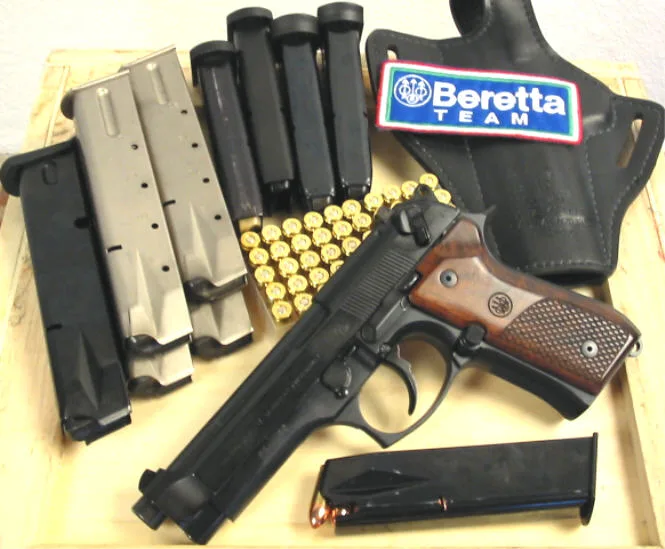
Beretta 92 pistol, 9x19 mm semi-automatic service pistol, Infantry Weapons1990 Gulf War, 2003 Iraq WarBeretta 92 pistol9x19 mm semi-automatic service pistolSide: Coalition forcesUnited States and coalition forcesBuilt: Beretta / Italy / United StatesThe Beretta 92 is a 9x19 mm, double-action/single-action pistol family built around an open-slide, recoil-operated locked-breech design. The U.S. military M9 designation made the 92FS-family pistol a standard sidearm after the 1985 procurement award, with conflict records here documenting M-9 pistols in Desert Storm boarding-team context and M9 pistols in close-range fighting during the April 2003 Baghdad Thunder Runs.
Browning Hi-Power pistol, 9x19 mm single-action semi-automatic pistol, Infantry Weapons2014 War Against the Islamic StateBrowning Hi-Power pistol9x19 mm single-action semi-automatic pistolSide: Islamic StateBuilt: FN Herstal / Belgium / Canada / IndiaThe Browning Hi-Power is a 9x19 mm single-action semi-automatic pistol designed by John Browning and completed by Dieudonne Saive at FN. Adopted by Belgium in 1935 as the P35, it became a standard service pistol for British airborne users and NATO forces and was the first successful 9 mm single-action automatic pistol with a double-stack magazine.
FMK-3 submachine gun, 9x19 mm submachine gun, Infantry Weapons1982 Falklands WarFMK-3 submachine gun9x19 mm submachine gunSide: ArgentinaBuilt: Fabricaciones Militares / ArgentinaThe FMK-3 is an Argentine 9x19 mm submachine gun developed by Fabricaciones Militares in the mid-1970s for military and security users. Its compact layout combines blowback, open-bolt operation with a telescoping bolt, magazine-in-grip feed, grip safety, and retractable wire stock; direct museum and specialist sources connect PA3 DM/FMK-3 examples to Argentine use in the 1982 Falklands War.
Mossberg 590 Shotgun, 12-gauge pump-action shotgun, Infantry Weapons2014 War Against the Islamic StateMossberg 590 Shotgun12-gauge pump-action shotgunSide: Anti-ISIS coalition and partner forcesBuilt: O.F. Mossberg & Sons / United StatesThe Mossberg 590 is O.F. Mossberg & Sons' U.S.-built pump-action shotgun line for military, law-enforcement, and defensive use. The 590A1 variant is the military-oriented branch of the family, with Mossberg listing MIL-SPEC 3443G compliance, a heavy-walled barrel, metal trigger guard and safety, a clean-out magazine tube, and Parkerized finish; DVIDS imagery documents U.S. Marines firing and handling 590A1 shotguns in Iraq during Operation Inherent Resolve.
Remington M870, 12-gauge pump-action shotgun, Infantry Weapons1955 Vietnam War, 1990 Gulf War +1 moreRemington M87012-gauge pump-action shotgunSide: United States and South VietnamCoalition forcesUnited States, NATO, and Afghan government forcesBuilt: Remington Firearms (RemArms) / United StatesThe Remington M870 is the military and police designation context for the Remington Model 870, a U.S. pump-action shotgun introduced in 1950. Sourced records document Vietnam-era U.S. combat-shotgun service, Desert Storm boarding-team use, and an Operation Enduring Freedom presence at Kandahar, while manufacturer and agency sources also show the same family in breaching and less-lethal 12-gauge roles.
6P50-2 Kord machine gun, 12.7 mm heavy machine gun, Infantry Weapons6P50-2 Kord machine gun12.7 mm heavy machine gunSide: UnknownBuilt: V.A. Degtyarev Plant / RussiaThe 6P50-2 Kord is a Russian 12.7 mm heavy machine gun designation in the Kord family, manufactured by V.A. Degtyarev Plant. The Kord family was developed as a Russian replacement for the Soviet NSV after the main NSV production base was outside Russia, and Rosoboronexport lists the weapon with 12.7x108 mm ammunition, a 2,000 m sighting range, 10,000-round barrel life, and 32.5 kg weight. RussianShips.info identifies the 6P50-2 aboard IC16MII boats P-834 and P-835.
DShK, 12.7 mm heavy machine gun, Infantry Weapons2014 Russia-Ukraine War, 2023 Israel-Hamas War +11 moreDShK12.7 mm heavy machine gunSide: UkraineHamas and Gaza-based armed groupsHouthi-aligned forcesYemeni government and Saudi-led coalition forcesBoko Haram and ISWAPGovernment of National AccordMalian government and international forcesRebel and jihadist armed groupsRapid Support ForcesSudanese Armed ForcesAnti-ISIS coalition and partner forcesIslamic StateTaliban and allied militantsUnited States, NATO, and Afghan government forcesIraqi government and coalition forcesSyrian government and alliesOpposition and anti-government forcesSyrian Democratic Forces and coalition partnersIslamic State and jihadist groupsNorth Vietnam and Viet CongAfghan resistance forcesBuilt: Tula Ordnance Factory / Soviet state arsenals / Soviet UnionThe DShK is a Soviet 12.7 mm heavy machine gun designed by Vasily Degtyaryov and refined with Georgy Shpagin's belt-feed system. Built for anti-aircraft, anti-vehicle, and infantry support roles, the DShK/DShKM family spans Vietnam War helicopter defense, Soviet-Afghan War ambushes, modern technicals, and Ukrainian mobile counter-UAV teams using vintage heavy machine guns against slow Russian drones.
DShKM heavy machine gun, 12.7 mm heavy machine gun, Infantry Weapons1955 Vietnam War, 1979 Soviet-Afghan War +4 moreDShKM heavy machine gun12.7 mm heavy machine gunSide: North Vietnam and Viet CongAfghan resistance forcesIslamic State and jihadist groupsIslamic StateUkraineBuilt: Tula Ordnance Factory / Soviet state arsenals / Soviet UnionThe DShKM is the Soviet postwar Model 38/46 modernization of the DShK 12.7 mm heavy machine gun, retaining the DShK family's anti-aircraft, infantry-support, and vehicle-mount roles while replacing the earlier feed system. Sources document the DShK-1938/46 in Vietnam War anti-aircraft use, DShK-M capture and employment in the Soviet-Afghan War, DShK-M use by Ukrainian defenders, and DShK/DShKM variants in Islamic State's Iraq-and-Syria arsenal.
NSV, 12.7 mm heavy machine gun, Infantry Weapons2009 Boko Haram Insurgency, 2003 Iraq War +2 moreNSV12.7 mm heavy machine gunSide: Boko Haram and ISWAPIraqi government and security forcesUnited States, NATO, and Afghan government forcesRussiaUkraineBuilt: West Kazakhstan Machine-Building Company / Soviet Union / KazakhstanThe NSV Utes is a Soviet 12.7x108 mm heavy machine gun designed by Nikitin, Sokolov, and Volkov as a lighter replacement for the DShK family. It can be used from a tripod, vehicle mount, or remote station against light armor, firing points, personnel, and low-flying aerial targets, and it remains relevant through post-Soviet service and licensed derivative production.
Type 77 heavy machine gun, 12.7 mm heavy machine gun, Infantry Weapons2014 Yemen Civil War, 2012 M23 RebellionType 77 heavy machine gun12.7 mm heavy machine gunSide: Yemeni government and Saudi-led coalition forcesHouthi-aligned forcesM23 rebel movementBuilt: Hunan Ordnance Zijiang Machinery / ChinaThe Type 77 is a Chinese 12.7x108 mm heavy machine gun developed as a lighter crew-served replacement for the Type 54/DShK. Its Type 85 successor kept the anti-aircraft and ground-support role with improved handling, and the catalog treats Yemen and M23 evidence as Type 77-family use when sources name Type 77, Type 85, or W85 variants rather than a single confirmed model.
W85 heavy machine gun, 12.7 mm heavy machine gun, Infantry Weapons2009 Boko Haram Insurgency, 2014 Russia-Ukraine War +3 moreW85 heavy machine gun12.7 mm heavy machine gunSide: Boko Haram and ISWAPUkraineSyrian Democratic Forces and coalition partnersIraqi government and coalition forcesMalian government and international forcesBuilt: Norinco / ChinaThe W85 is a Chinese 12.7x108 mm heavy machine gun associated with Norinco export channels and the QJC-88 vehicle-mounted variant. It is lighter than many older DShK-pattern heavy machine guns and can be used from tripod, pintle, vehicle, or improvised pickup mounts. Conflict reporting documents W85-family guns with ISWAP-linked forces in Nigeria, Ukrainian mobile anti-drone teams, YPG/SDF improvised armor in Syria, Iraqi PMU militias, and Wagner-linked imagery from Mali, while sources caution that export paths and quantities are often unclear.
Zastava M02 Coyote, 12.7 mm heavy machine gun, Infantry Weapons2009 Boko Haram Insurgency, 2011 Syrian Civil War +2 moreZastava M02 Coyote12.7 mm heavy machine gunSide: Boko Haram and ISWAPOpposition and anti-government forcesJihadist armed groupsYemeni government and Saudi-led coalition forcesBuilt: Zastava Arms / SerbiaThe Zastava M02 Coyote is a Serbian 12.7 mm heavy machine gun that adapts Zastava's licensed M87/NSV-pattern gun to a cradle and tripod for infantry fire support. Official Zastava material lists both 12.7x108 mm and 12.7x99 mm offerings, while conflict documentation places M02 Coyotes with Syrian opposition fighters, armed groups in the Sahel, seizure reporting linked to Boko Haram, and UAE-allied militias in Yemen.
KPV, 14.5 mm heavy machine gun, Infantry Weapons2009 Boko Haram Insurgency, 1990 Gulf War +3 moreKPV14.5 mm heavy machine gunSide: Boko Haram and ISWAPIraqUkraineSyrian Democratic Forces and coalition partnersYemeni government and Saudi-led coalition forcesBuilt: V. A. Degtyarev Plant (ZiD) / Soviet Union / RussiaThe KPV is a Soviet 14.5x114 mm heavy machine gun designed by Semyon Vladimirov and produced at the V. A. Degtyarev Plant. Its high-energy cartridge made it useful against light armor, field positions, small craft, and low-flying aircraft, so the family spread from the original infantry gun into KPVT vehicle guns, ZPU anti-aircraft mounts, and modern improvised or vehicle-mounted roles documented from Iraq and Yemen to the 2014 Russia-Ukraine War.
DBA-117 (AG17) automatic grenade launcher, 30 mm automatic grenade launcher, Infantry Weapons2014 Russia-Ukraine WarDBA-117 (AG17) automatic grenade launcher30 mm automatic grenade launcherSide: UkraineBuilt: Design Bureau "Artillery Armament" / UkraineThe DBA-117 (AG17), also cataloged as KBA-117 or KBA-17, is a Ukrainian 30 mm automatic grenade launcher adapted for remotely operated combat modules. Official product material places it on BM Grom, Shkval, BM-3 Shturm, Katran-M, and BM-7 Parus modules, while Ukrainian vehicle references identify it on BTR-3 and BTR-4 family weapon stations.
QLZ-87 automatic grenade launcher, 35 mm automatic grenade launcher, Infantry Weapons2001 War in Afghanistan, 1991 Somali Civil War +5 moreQLZ-87 automatic grenade launcher35 mm automatic grenade launcherSide: Taliban and allied militantsFederal Government of Somalia and allied forcesBoko Haram and ISWAPSudanese Armed ForcesSPLM-N and allied rebelsOpposition and anti-government forcesIslamic State and jihadist groupsSeleka and ex-Seleka factionsIraqi government and coalition forcesBuilt: Norinco / ChinaThe QLZ-87 is a Chinese 35x32 mm automatic grenade launcher built for portable infantry fire support, with light bipod and heavier tripod configurations fed by drum magazines. Its cataloged conflict record is strongest where photographs or arms-monitoring reports identify specific examples: AMISOM weapons in Somalia, SPLM-N captures in Sudan, opposition and Islamic State appearances in Syria, Séléka stocks in CAR, Kurdish weapons in Iraq, a Boko Haram capture in Niger, and a Taliban capture in Afghanistan.
40 mm automatic grenade launcher, 40 mm automatic grenade launcher, Infantry Weapons2001 War in Afghanistan, 2003 Iraq War +2 more40 mm automatic grenade launcher40 mm automatic grenade launcherSide: United States, NATO, and Afghan government forcesUnited States and coalition forcesAnti-ISIS coalition and partner forcesUkraineBuilt: General Dynamics Ordnance and Tactical Systems / U.S. Ordnance / ST Engineering / Heckler & Koch / MKE, Sarsilmaz, Kalekalip / Various manufacturers / Multiple countriesThe 40 mm automatic grenade launcher class covers belt-fed crew-served grenade machine guns such as the U.S. Mk 19 Mod 3, ST Engineering 40AGL Mk2, Heckler & Koch GMG, and Spain's LAG 40 family. Direct reporting documents Mk 19 use by U.S. forces in Afghanistan and Iraq, coalition partner training against Islamic State, and Ukrainian frontline employment in the Russia-Ukraine War.
Balkan 40 mm automatic grenade launcher, 40 mm automatic grenade launcher, Infantry Weapons2014 Russia-Ukraine WarBalkan 40 mm automatic grenade launcher40 mm automatic grenade launcherSide: RussiaUkraineBuilt: Tecmash Concern / FSUE GNPP Pribor / RussiaThe Balkan 40 mm automatic grenade launcher, also known as AGS-40 or 6G27, is a Russian tripod-mounted automatic grenade launcher developed by TsKIB SOO and Pribor/Tecmash to replace older 30 mm AGS-family systems. It uses 40 mm 7P39 caseless ammunition, a 20-round drum, and a seated tripod layout, giving Russian infantry a heavier grenade-launcher round with a reported 2,500 m maximum range.
GP-25 Kostyor, 40 mm under-barrel grenade launcher, Infantry Weapons2014 Russia-Ukraine War, 2011 Syrian Civil WarGP-25 Kostyor40 mm under-barrel grenade launcherSide: RussiaUkraineSyrian government and alliesBuilt: TOZ / Soviet UnionThe GP-25 Kostyor is a Soviet 40 mm muzzle-loaded under-barrel grenade launcher developed by TsKIB SOO and produced by TOZ for Kalashnikov-pattern rifles. It fires VOG-25-family caseless grenades from a single-shot rifled tube, became the baseline GP-series launcher later followed by the GP-30 and GP-34, and has direct conflict documentation in Ukraine and Syrian government service.
GP-34 underbarrel grenade launcher, 40 mm underbarrel grenade launcher, Infantry Weapons2014 Russia-Ukraine WarGP-34 underbarrel grenade launcher40 mm underbarrel grenade launcherSide: RussiaBuilt: Izhevsk Machine-Building Plant / Kalashnikov Concern / RussiaThe GP-34 is a Russian 40 mm GP-series underbarrel grenade launcher, GRAU index 6G34, developed by Izhmash / Kalashnikov Concern as a later GP-25 and GP-30 family member. It fires VOG-25-family rounds from a single-shot muzzle-loaded tube, fits modern Kalashnikov rifles such as the AK-74M and AK-103, and has direct 2014 Russia-Ukraine War evidence from a 2015 seizure document and 2026 Russian reporting.
RBG-6, 40x46 mm six-shot revolving grenade launcher, Infantry Weapons2011 Syrian Civil WarRBG-640x46 mm six-shot revolving grenade launcherSide: Opposition and anti-government forcesBuilt: M Adler D / CroatiaThe RBG-6 is a Croatian 40x46 mm shoulder-fired revolving grenade launcher from M Adler D, built around a semi-automatic gas-operated action, a six-round cylinder, and low-velocity grenade ammunition for infantry fire support. Direct Syria reporting documented RBG-6 launchers among opposition weapons flows, while official Croatian export and manufacturer pages describe the weapon's squad-firepower role, sighting arrangement, barrel versions, and ammunition family.
SPG-9, 73 mm tripod-mounted recoilless gun, Infantry Weapons2014 Russia-Ukraine War, 2011 Syrian Civil War +3 moreSPG-973 mm tripod-mounted recoilless gunSide: UkraineOpposition and anti-government forcesHezbollahBoko Haram and ISWAPal-Shabaab and affiliated insurgentsBuilt: Soviet state arsenals / Arsenal JSCo / Romarm / Soviet Union / Bulgaria / RomaniaThe SPG-9 is a Soviet 73 mm tripod-mounted recoilless gun, known in some references as Kopye, that fires rocket-assisted HEAT and HE-fragmentation projectiles from a crew-served launcher. Accepted into Soviet service in 1962 and exported widely, it was designed as an anti-armor weapon but still appears in conflicts as a flexible direct- and indirect-fire support system.
B-10 recoilless rifle, 82 mm smoothbore recoilless rifle, Infantry Weapons1991 Somali Civil WarB-10 recoilless rifle82 mm smoothbore recoilless rifleSide: al-Shabaab and affiliated insurgentsBuilt: Tulamashzavod / Norinco / Soviet Union / ChinaThe B-10 recoilless rifle is a Soviet 82 mm smoothbore recoilless rifle introduced in 1954 and built around a wheeled, tripod-firing carriage. WeaponSystems.net identifies Chinese Type 65, Type 65-1, Type 78, and East German RG82 family copies, while Human Rights Watch and a 2024 UN report document Somali insurgent use decades after Soviet production ended.
105 mm M1974 FMK-1 recoilless rifle, 105 mm recoilless rifle, Infantry Weapons1982 Falklands War105 mm M1974 FMK-1 recoilless rifle105 mm recoilless rifleSide: ArgentinaBuilt: Fabricaciones Militares / ArgentinaThe 105 mm M1974 FMK-1 is the later standard in Argentina's Czekalski recoilless-rifle family, a heavy smoothbore infantry-support weapon with optical sights, an FAP/FN FAL spotting rifle, and a two-wheel adjustable carriage. Falklands War evidence directly documents the closely related Modelo 1968 Czekalski in Argentine service, while the M1974 designation is best supported as the improved FMK-1 ammunition and export-era standard.
M40 106 mm recoilless rifle, 106 mm crew-served recoilless rifle, Infantry Weapons1955 Vietnam War, 2001 War in Afghanistan +4 moreM40 106 mm recoilless rifle106 mm crew-served recoilless rifleSide: United States and South VietnamUnited States, NATO, and Afghan government forcesNational Transitional Council and rebel forcesRebel and jihadist armed groupsOpposition and anti-government forcesIranBuilt: Watervliet Arsenal / United StatesThe M40 106 mm recoilless rifle is a U.S.-origin crew-served direct-fire weapon built around a 105 mm-class round but commonly identified by its 106 mm designation. It served on ground carriages and vehicle mounts such as the M50 Ontos, remained useful for anti-armor and bunker work after newer missiles appeared, and is documented in conflicts from Vietnam to Libya, Mali, Syria, and Afghanistan.
120mm L2 BAT, 120 mm recoilless anti-tank rifle, Infantry WeaponsIndonesian Confrontation 1962-1966120mm L2 BAT120 mm recoilless anti-tank rifleSide: Malaysia and Commonwealth forcesBuilt: Royal Ordnance / United KingdomThe 120mm L2 BAT was the British Battalion Anti-Tank recoilless rifle, a heavy towed 120 mm HESH-firing weapon introduced in 1953 as a postwar infantry anti-armor system. Its same-family L4 MOBAT, L7 CONBAT, and L6 WOMBAT variants traded the shielded L2 carriage for lighter or better-sighted configurations; Australian War Memorial records place an L4 MOBAT/BAT gun with Commonwealth forces in Malacca during the Indonesian Confrontation.
Type 86P hand grenade, All-plastic defensive fragmentation hand grenade, Infantry Weapons2003 Iraq War, 2009 Boko Haram Insurgency +1 moreType 86P hand grenadeAll-plastic defensive fragmentation hand grenadeSide: Iraqi insurgent and militia forcesBoko Haram and ISWAPOpposition and anti-government forcesBuilt: Chinese state ordnance industry / ChinaThe Type 86P, also described in Chinese as the 86式全塑无柄手榴弹, is a Chinese all-plastic fragmentation hand grenade standardized in 1986 with an ovoid body, striker-release delay fuze, and about 1,600 embedded steel balls. Technical references disagree on the explosive fill, while conflict reporting documents the type in Iraq weapons caches, Boko Haram-captured materiel in northeast Nigeria, and opposition-area Syrian arms-market listings.
AM-50 Sayyad .50-caliber anti-materiel rifle, Anti-materiel rifle, Infantry Weapons2011 Syrian Civil War, 2013 War in Iraq +2 moreAM-50 Sayyad .50-caliber anti-materiel rifleAnti-materiel rifleSide: Syrian government and alliesIslamic State and jihadist groupsIraqi government and coalition forcesHouthi-aligned forcesHamas and Gaza-based armed groupsBuilt: Defense Industries Organization (Individual Combat Industries Group) / IranThe AM-50 Sayyad is an Iranian 12.7x99 mm anti-materiel rifle derived from the Steyr HS .50 pattern after a mid-2000s HS .50 sale to Iran. It is a single-shot bolt-action weapon produced by DIO/ICIG and documented with Iraqi government forces, Syrian war militias, Houthi fighters in Yemen, and Hamas-linked fighters in Gaza.
TC/6 anti-tank mine, Anti-tank blast mine, Infantry Weapons1979 Soviet-Afghan War, 2023 Israel-Hamas WarTC/6 anti-tank mineAnti-tank blast mineSide: Afghan resistance forcesHamas and Gaza-based armed groupsBuilt: Tecnovar Italiana SpA / ItalyThe TC/6 is Tecnovar Italiana's Italian plastic-bodied, minimum-metal anti-tank blast mine. It uses a pressure-fired air-pressure fuze designed to resist shock and overpressure clearance techniques, can be laid manually or mechanically, and sourced conflict records place it with Afghan resistance forces during the Soviet-Afghan War and in Hamas weapons-cache reporting during the 2023 Israel-Hamas War.
TM-62, Anti-tank blast mine, Infantry Weapons2014 Russia-Ukraine War, 2014 Yemen Civil War +3 moreTM-62Anti-tank blast mineSide: RussiaUkraineHouthi-aligned forcesLibyan National ArmyArmenia / ArtsakhSyrian government and alliesBuilt: Soviet and Russian state arsenals / Soviet Union / RussiaThe TM-62 is a Soviet family of circular anti-tank blast mines built around a central fuze well and a large high-explosive charge. Metal, plastic, wooden, and low-metal case variants appear in mine-action reporting, and the TM-62M/TM-62P3 are documented in current conflicts including Ukraine, Syria, Yemen, Libya, and Nagorno-Karabakh.
SPIKE anti-tank guided-missile family, Anti-tank guided missile family, Infantry Weapons2023 Israel-Hamas War, 2014 Gaza War +8 moreSPIKE anti-tank guided-missile familyAnti-tank guided missile familySide: IsraelUnited States and coalition forcesUnited States, NATO, and Afghan government forcesAzerbaijanUnited StatesBuilt: Rafael Advanced Defense Systems / IsraelRafael's SPIKE family is a combat-proven electro-optical guided-missile line whose long-range NLOS branch is also known as Tamuz in Israeli service and Exactor in British service. The family spans infantry, vehicle, aircraft, and naval launchers, from compact short-range variants to Spike NLOS, which reaches 32 km from land or 50 km from the air and has documented use by Israeli, British, Azerbaijani, and U.S. forces.
AMULET anti-tank guided missile system, Anti-tank guided missile system, Infantry Weapons2014 Russia-Ukraine WarAMULET anti-tank guided missile systemAnti-tank guided missile systemSide: UkraineBuilt: State Kyiv Design Bureau Luch / UkraineThe AMULET is a Ukrainian vehicle-mounted anti-tank guided missile system from State Kyiv Design Bureau Luch. It combines a remotely controlled combat module, thermal imaging, a rotating two-rail launcher, and RK-2-series 130 mm or 152 mm missiles for vehicle-borne precision anti-armor fires; Ukraine later fielded a HMMWV-mounted installation during the 2014 Russia-Ukraine War.
PMN-1/2/4, Antipersonnel blast mine family, Infantry Weapons2014 Russia-Ukraine War, 2014 Second Libyan Civil War +2 morePMN-1/2/4Antipersonnel blast mine familySide: RussiaLibyan National ArmyArmenia / ArtsakhCambodiaBuilt: Soviet and Russian state arsenals / Soviet Union / RussiaThe PMN-1/2/4 family covers Soviet and Russian pressure-activated antipersonnel blast mines used to deny foot movement and injure personnel at close range. PMN-1 and PMN-2 are Soviet designs, while PMN-4 is a later Russian circular plastic-cased mine; conflict-use records now connect PMN-family mines to Ukraine, Libya, Nagorno-Karabakh-related minefields, and disputed PMN-2 incidents along the Thailand-Cambodia border.
AK-74, Assault rifle, Infantry Weapons2009 Boko Haram Insurgency, 1984 Kurdish-Turkish Conflict +5 moreAK-74Assault rifleSide: Boko Haram and ISWAPKurdistan Workers' Party (PKK)AzerbaijanRussiaUkraineSoviet Union and Afghan government forcesSyrian government and alliesIslamic State and jihadist groupsIslamic StateBuilt: Izhevsk Machine-Building Plant / Kalashnikov Concern / Soviet Union / RussiaThe AK-74 is a Soviet 5.45x39 mm assault rifle family built around a lighter small-caliber cartridge, 30-round magazines, and the familiar Kalashnikov operating pattern. Public conflict evidence spans its Soviet-Afghan combat debut, continuing 2014 Russia-Ukraine War service on both sides, Syrian Civil War AK-74M and AKS-74U use, Islamic State possession, ISWAP imagery, PKK raid footage, and Azerbaijani AK-74M fielding around Hadrut.
BRG55 assault rifle, Assault rifle, Infantry Weapons2023 Sudan WarBRG55 assault rifleAssault rifleSide: Rapid Support ForcesBuilt: BRG Defence (Burgu Metal) / TurkeyThe BRG55 is a Turkish 5.56x45 mm assault rifle from BRG Defence/Burgu Metal. Official BRG material describes it as an AR-pattern infantry rifle using a short-stroke gas-piston or pusher-rod operating system, 30-round magazine feed, adjustable stock, foldable sights, and aluminum, polymer, and alloy-steel construction. Amnesty International and a later UN annex documented BRG55 rifles with Rapid Support Forces personnel in Darfur during the 2023 Sudan War.
M16 rifle, Assault rifle, Infantry Weapons1955 Vietnam War, 2017 Battle of Marawi +5 moreM16 rifleAssault rifleSide: United States and South VietnamPhilippine government forcesIsraelAnti-ISIS coalition and partner forcesIraqi government and coalition forcesFARC dissident groupsUnited States, NATO, and Afghan government forcesBuilt: Colt / United StatesThe M16 is a U.S.-origin 5.56x45mm assault-rifle family that evolved from 1955 Vietnam War service into the M16A1, M16A2 and M16A4 lineage. Current Army and FN references describe the M16A4 as a gas-operated, shoulder-fired, 20-inch-barrel rifle with rail and optics compatibility, while conflict-specific sources document continued use from Marawi and Afghanistan to Israeli wartime response teams, Iraqi partner-force training and Colombian FARC dissident seizures.
Browning Automatic Rifle, Automatic rifle / light machine gun, Infantry Weapons1955 Vietnam War, 2017 Battle of MarawiBrowning Automatic RifleAutomatic rifle / light machine gunSide: United States and South VietnamNorth Vietnam and Viet CongIS-aligned militantsBuilt: Winchester Repeating Arms / Colt / Marlin-Rockwell / United StatesThe Browning Automatic Rifle was a U.S. .30-06 automatic rifle designed by John M. Browning for mobile infantry fire and later used as a squad automatic weapon. Cataloged conflict evidence places legacy BARs in the 1955 Vietnam War through ARVN, Montagnard, and Viet Cong use, and in the 2017 Battle of Marawi as captured IS-aligned militant materiel.
Machine gun, Automatic small arm / crew-served firearm, Infantry Weapons2016 Colombian FARC Dissident Conflict, 2023 Israel-Hamas War +1 moreMachine gunAutomatic small arm / crew-served firearmSide: FARC dissident groupsHamas and Gaza-based armed groupsHezbollahBuilt: Various manufacturers / Multiple countriesMachine guns are automatic small arms built for sustained rapid fire, with roles spanning light squad automatic weapons, medium or general-purpose guns, and heavy crew-served weapons. This broad catalog entry tracks source-backed machine-gun use, possession, or capture in recent conflicts while treating model-specific facts such as M60, Type 80/PKM-T80, M240, and M2 details as examples rather than universal traits.
Beretta BM59 rifle, Battle rifle, Infantry Weapons1982 Falklands War, 2022 Haitian Gang ConflictBeretta BM59 rifleBattle rifleSide: ArgentinaArmed gangsBuilt: Beretta / PT Pindad / Defence Industries Corporation of Nigeria / Italy / Indonesia / NigeriaThe Beretta BM59 is an Italian selective-fire battle rifle that converted the M1 Garand architecture into a 7.62x51mm NATO, detachable-magazine service rifle. Beretta built the core Italian family, while licensed or locally produced patterns appeared in Indonesia and Nigeria. Direct conflict-use sourcing ties BM59-family rifles to Argentine small arms in the 1982 Falklands War and to criminal-gang firearms in Haiti's current gang conflict.
UAG-40 automatic grenade launcher, Belt-fed 40 mm automatic grenade launcher, Infantry Weapons2014 Russia-Ukraine War, 2009 Boko Haram InsurgencyUAG-40 automatic grenade launcherBelt-fed 40 mm automatic grenade launcherSide: UkraineNigerian government and allied forcesBoko Haram and ISWAPBuilt: Kuznya na Rybalskomu / UkraineThe UAG-40 is a Ukrainian belt-fed automatic grenade launcher chambered for 40 x 53SR mm high-velocity ammunition. Developed and manufactured by Kuznya na Rybalskomu, it emphasizes low weight for a crew-served launcher; public sources document UAG-40s supplied to Ukraine's Defense Forces after 2022 and a captured example displayed by Boko Haram after an April 2016 ambush in Nigeria.
7.62 mm machine gun, Belt-fed general-purpose / vehicle-mounted 7.62 mm machine gun class, Infantry Weapons7.62 mm machine gunBelt-fed general-purpose / vehicle-mounted 7.62 mm machine gun classSide: UnknownBuilt: Various manufacturers / Multiple countriesFull-power 7.62 mm belt-fed machine guns appear in ground, tripod, coaxial, pintle, door-gun, vessel, and remote-weapon-station roles rather than as one fixed model. Documented relationships here connect generic 7.62 mm machine-gun fits with FN MAG/M240, PK/PKM, M60, MG3, L7A2, C6/C6A1, and platform records where sources identify the exact mounting or family context.
12.7 mm heavy machine gun, Belt-fed, crew-served heavy machine gun class, Infantry Weapons12.7 mm heavy machine gunBelt-fed, crew-served heavy machine gun classSide: UnknownBuilt: FN Herstal, CANiK, and other licensed producers / United States / Belgium / Turkey / other licensed production countriesThe 12.7 mm heavy machine gun class covers the Browning M2 lineage and compatible .50-caliber variants such as the M2A1, M2HB-QCB, and CANiK M2 QCB. U.S. Army Reserve Cold Steel materials show the M2 trained on mounted military platforms including the HMMWV, while Army, Marine, and manufacturer sources place the family on tripods, vehicles, boats, aircraft, and remote weapon stations.
PGW LRT-3, Bolt-action .50 BMG anti-materiel rifle, Infantry Weapons2014 Russia-Ukraine War, 2014 Yemen Civil WarPGW LRT-3Bolt-action .50 BMG anti-materiel rifleSide: UkraineHouthi-aligned forcesBuilt: PGW Defence Technologies / CanadaThe PGW LRT-3 is a Canadian bolt-action .50 BMG anti-materiel rifle built by PGW Defence Technologies for long-range precision fire against hard and soft targets. Sources link the rifle to Ukrainian sniper service in the 2014 Russia-Ukraine War and to Houthi-aligned forces in Yemen through an ARES-documented battlefield-capture trail, rather than through a documented direct export to the Houthi movement.
.308-caliber precision rifle, Bolt-action or semi-automatic precision rifle class, Infantry Weapons2022 Haitian Gang Conflict.308-caliber precision rifleBolt-action or semi-automatic precision rifle classSide: Armed gangsBuilt: Various manufacturers / United States / Various.308-caliber precision rifles are scoped small arms chambered in .308 Winchester, 7.62x51mm NATO, or closely related .30-caliber service cartridges, depending on the model and markings. The class spans law-enforcement, military, sporting, and long-range precision roles. In the 2022 Haitian Gang Conflict entry, the sourcing supports illicit trafficking of .308 rifles into Haiti and gang-linked demand for higher-powered rifles, but it does not identify a specific model or prove a documented firing incident.
M24 sniper rifle, Bolt-action sniper rifle, Infantry Weapons2003 Iraq War, 2013 War in Iraq +1 moreM24 sniper rifleBolt-action sniper rifleSide: United States and coalition forcesIraqi government and coalition forcesUnited States, NATO, and Afghan government forcesBuilt: Remington Arms / United StatesThe M24 sniper rifle is the U.S. Army's Remington Model 700-based Sniper Weapon System, a 7.62x51mm NATO bolt-action rifle package built around a long-action receiver, day optic, bipod, and support accessories. Official imagery and reporting place M24 rifles in Iraq War security and sniper-training roles, while Afghan National Army records show the system supporting coalition-backed overwatch and marksmanship training in Helmand province.
M2010 Enhanced Sniper Rifle, Bolt-action sniper rifle, Infantry Weapons2001 War in Afghanistan, 2014 War Against the Islamic StateM2010 Enhanced Sniper RifleBolt-action sniper rifleSide: United States, NATO, and Afghan government forcesAnti-ISIS coalition and partner forcesBuilt: Remington Arms / United StatesThe M2010 Enhanced Sniper Rifle is the U.S. Army's .300 Winchester Magnum rebuild of the M24 Sniper Weapon System, developed to give sniper teams longer reach in Afghanistan's mountainous terrain. Remington converted the long-action M24 into a suppressed, magazine-fed precision rifle with a folding adjustable chassis, extended-range optic, night-sight compatibility, and a 1,200-meter effective range; later imagery from 2014 Operation Inherent Resolve shows the rifle still serving in U.S. patrol overwatch in northeast Syria.
OZM-72, Bounding antipersonnel fragmentation mine, Infantry Weapons2014 Russia-Ukraine War, 2014 Yemen Civil War +3 moreOZM-72Bounding antipersonnel fragmentation mineSide: RussiaHouthi-aligned forcesSyrian government and alliesLibyan National ArmyArmenia and Nagorno-Karabakh ArmeniansBuilt: Factory 583 / Soviet state arsenals / Soviet Union / RussiaThe OZM-72 is a Soviet-designed bounding antipersonnel fragmentation mine that ejects upward before detonation and scatters fragments around the burst point. Human Rights Watch and Landmine Monitor reporting document the mine in modern clearance and conflict-use cases in Ukraine, Yemen, Syria, Libya, and Nagorno-Karabakh, making it a persistent explosive-ordnance hazard rather than only a Cold War stockpile item.
IWI Tavor/X95 rifle family, Bullpup assault rifle family, Infantry Weapons2014 Russia-Ukraine War, 2023 Israel-Hamas War +1 moreIWI Tavor/X95 rifle familyBullpup assault rifle familySide: UkraineIsraelHamas and Gaza-based armed groupsBoko Haram and ISWAPBuilt: Israel Weapon Industries (IWI) / IsraelThe IWI Tavor/X95 rifle family is Israel's compact bullpup service-rifle line, centered on the original TAR-21 and the later Micro-Tavor X95. IWI US describes the X95 as a multi-caliber, multi-length service carbine, while conflict evidence ties the family to Israeli use in Gaza, Ukrainian Fort-22-series rifles in the Russia-Ukraine War, and captured or diverted rifles in ISWAP media.
M4/M4A1 carbine, Carbine, Infantry Weapons2023 Israel-Hamas War, 2017 Battle of Marawi +5 moreM4/M4A1 carbineCarbineSide: IsraelPhilippine government forcesUnited States and coalition forcesAnti-ISIS coalition and partner forcesUkraineUnited States, NATO, and Afghan government forcesIraqi government and coalition forcesBuilt: Colt / United StatesThe M4/M4A1 carbine is a U.S.-origin 5.56mm service-rifle family built around a shorter M16 lineage, a collapsible stock, and modular accessory mounting. Conflict-specific evidence documents M4-family use by U.S. forces in Iraq and Afghanistan, coalition and Iraqi partner forces during anti-ISIS operations, Philippine Marines at Marawi, Israeli wartime replenishment, and Ukrainian special-operations transition from Soviet-pattern rifles during the 2014 Russia-Ukraine War.
Hunting rifle, Civilian shoulder-fired rifle, Infantry Weapons2009 Boko Haram Insurgency, 2012 Central African Republic Civil WarHunting rifleCivilian shoulder-fired rifleSide: Nigerian government and allied forcesAnti-balaka militiasBuilt: Various manufacturers / VariousHunting rifles are civilian shoulder-fired rifles that enter conflict records as a weapon class rather than a standardized military model. The catalog evidence ties them to community security and militia use: UNIDIR documents craft-produced hunting rifles among CJTF/Yan Gora and Hunters/Charmers in northeast Nigeria, while Conflict Armament Research identifies hunting rifles among anti-balaka militia weapons in the Central African Republic.
Arbel computerized fire-control weapon system, Computerized small-arms fire-control system, Infantry Weapons2023 Israel-Hamas WarArbel computerized fire-control weapon systemComputerized small-arms fire-control systemSide: IsraelBuilt: Israel Weapon Industries (IWI) / IsraelArbel is IWI's battery-powered computerized fire-control upgrade for rifles and light machine guns, built to time follow-up shots as the weapon settles back on target. IWI launched it publicly in April 2024 after combat-use reporting from Gaza, and later company and Israeli reporting framed the system as a low-cost infantry answer to small drones.
M67 90 mm recoilless rifle, Crew-served 90 mm recoilless rifle, Infantry Weapons1955 Vietnam War, 1982 Falklands War +2 moreM67 90 mm recoilless rifleCrew-served 90 mm recoilless rifleSide: United States and South VietnamArgentinaUnited States, NATO, and Afghan government forcesIS-aligned militantsBuilt: U.S. government production / Kia Motors / United States; South KoreaThe M67 is a U.S.-origin 90 mm recoilless rifle built as a crew-served direct-fire weapon for infantry anti-armor, bunker, and antipersonnel missions. Its record spans Australian and U.S. service in Vietnam, U.S. reissue in Afghanistan, Argentine fielding in the Falklands War, South Korean KM67 production, and later 90-RR reporting in the 2017 Battle of Marawi.
.30-Caliber Machine Gun, Crew-served medium machine gun, Infantry Weapons1968 Moro Conflict, 2017 Battle of Marawi.30-Caliber Machine GunCrew-served medium machine gunSide: Moro rebel movementsIS-aligned militantsBuilt: Unknown / Various manufacturers / Unknown for the recovered weapons; representative Browning M1919-family guns were built in the United States and allied production linesThe .30-caliber machine gun entry covers model-unspecified crew-served automatic weapons recovered from IS-linked militant contexts in Mindanao. Philippine reporting documented one gun among weapons cleared from Marawi's former Main Battle Area after the 2017 Battle of Marawi, and a later Philippine Army-sourced report listed one .30 caliber machine gun recovered after a 2022 clash with Dawlah Islamiya-Maute Group members in Maguing, Lanao del Sur. The public sources did not identify whether either weapon was a Browning M1919-family gun or another .30-caliber pattern.
SplHGR-80 hand grenade, Defensive fragmentation hand grenade, Infantry Weapons2009 Boko Haram InsurgencySplHGR-80 hand grenadeDefensive fragmentation hand grenadeSide: Boko Haram and ISWAPBuilt: Dynamit Nobel Wien / AustriaThe SplHGR-80 is an Austrian defensive fragmentation hand grenade documented with a plastic body, striker-release fuze, 75 g of plasticized PETN, about 4,000 steel balls, and an alternate EHG designation. In this catalog it appears as insurgent-held or recovered materiel in the 2009 Boko Haram Insurgency, based on Lake Chad basin reporting rather than a single named combat use.
MON-100, Directional anti-personnel fragmentation mine, Infantry Weapons2014 Russia-Ukraine War, 2014 Second Libyan Civil WarMON-100Directional anti-personnel fragmentation mineSide: RussiaLibyan National ArmyBuilt: Soviet and Russian state arsenals / USSR / RussiaThe MON-100 is a Soviet/Russian directional anti-personnel fragmentation mine in the larger end of the MON family. Technical references describe a circular metal-bodied, stake- or fixture-mounted mine with a 2 kg TNT charge, roughly 400 steel fragments, and command or tripwire-capable initiation. Monitoring groups identify MON-100 use by Russian forces in the 2014 Russia-Ukraine War and by Russian mercenaries around Tripoli during the 2014 Second Libyan Civil War.
MON-series anti-personnel mine, Directional fragmentation anti-personnel mine family, Infantry Weapons2014 Russia-Ukraine War, 2014 Second Libyan Civil War +1 moreMON-series anti-personnel mineDirectional fragmentation anti-personnel mine familySide: RussiaLibyan National ArmyArmenia / ArtsakhBuilt: Soviet state arsenals / Russian defense industry / Soviet Union / RussiaThe MON series is a Soviet/Russian family of directional fragmentation anti-personnel mines, including MON-50, MON-90, MON-100, and MON-200 patterns that project preformed fragments across a defined sector. Monitoring groups identify the family in Russian mine warfare in Ukraine and in Russian-linked Tripoli minefields in Libya, while the Nagorno-Karabakh record is narrower and rests on postwar MON-50 clearance reporting.
MON-50, Directional fragmentation antipersonnel mine, Infantry Weapons2014 Russia-Ukraine War, 2014 Second Libyan Civil WarMON-50Directional fragmentation antipersonnel mineSide: RussiaLibyan National ArmyBuilt: Soviet / Russian defense industry / Soviet Union / Russia / BulgariaThe MON-50 is a Soviet directional fragmentation antipersonnel mine broadly comparable in role to the M18 Claymore, with a plastic body, folding legs, and a forward fragmentation pattern. It can be command-detonated or configured with tripwire and other fuzing, making it a compact infantry obstacle and ambush munition. Direct monitoring sources document MON-50 use by Russian or Russian-aligned forces in eastern Ukraine, the full-scale Russia-Ukraine War, and the 2019-2020 Tripoli fighting in Libya.
MON-90, Directional fragmentation antipersonnel mine, Infantry Weapons2014 Russia-Ukraine War, 2014 Second Libyan Civil WarMON-90Directional fragmentation antipersonnel mineSide: RussiaLibyan National ArmyBuilt: Soviet / Russian defense industry / Soviet Union / Russia / BulgariaThe MON-90 is a Soviet-designed directional fragmentation antipersonnel mine and the 90 m member of the MON family between the smaller MON-50 and larger MON-100. Technical references describe a plastic-bodied, tree-spike-mounted mine with about 2,000 steel fragments, two M-10 threaded fuze wells, and command or tripwire initiation depending on setup. Direct monitoring sources place MON-90 mines in Russian use in Ukraine after the 2022 invasion and in Russian-linked Tripoli mine contamination during the Second Libyan Civil War.
M80 Zolja, Disposable 64 mm anti-tank rocket launcher, Infantry Weapons2014 Russia-Ukraine War, 2001 Insurgency in Macedonia +1 moreM80 ZoljaDisposable 64 mm anti-tank rocket launcherSide: UkraineEthnic Albanian insurgentsBoko Haram and ISWAPBuilt: Sloboda Cacak / Yugoimport SDPR / Yugoslavia / Serbia / North MacedoniaThe M80 Zolja is a Yugoslav-origin, single-shot 64 mm shoulder-fired anti-tank rocket launcher built around a disposable tube and HEAT rocket. Official Serbian export material presents the RBR M80 as a light infantry weapon for close-range engagements against armored vehicles and fortified positions, while conflict reporting documents Zolja-type weapons in the 2001 Insurgency in Macedonia, Boko Haram materiel evidence, and North Macedonian transfers to Ukraine.
Instalaza C-90 / C90-CR, Disposable 90 mm shoulder-fired rocket launcher, Infantry Weapons2014 Yemen Civil War, 2014 Russia-Ukraine WarInstalaza C-90 / C90-CRDisposable 90 mm shoulder-fired rocket launcherSide: Houthi-aligned forcesUkraineBuilt: Instalaza S.A. / SpainThe Instalaza C-90 / C90-CR is a Spanish disposable 90 mm shoulder-fired rocket launcher family built around single-use tubes, integrated 2x optics, and mission-specific anti-tank, dual-purpose, smoke, and anti-bunker munitions. Open-source conflict records tie the system to captured C-90 series launchers in Yemen and to Spain's 2022 military aid for Ukraine, where C90 launchers were documented in Ukrainian hands.
RPG-18, Disposable anti-tank rocket launcher, Infantry Weapons1979 Soviet-Afghan War, 1994 First Chechen War +2 moreRPG-18Disposable anti-tank rocket launcherSide: Soviet Union and Afghan government forcesChechen separatist forcesUkraineIslamic StateBuilt: Bazalt / Soviet UnionThe RPG-18 Mukha is a Soviet disposable, shoulder-fired anti-tank rocket launcher built around a telescoping launch tube and a 64 mm PG-18 HEAT rocket. It gave infantry a light short-range anti-armor weapon before later RPG-22 and RPG-26 successors, and conflict sources document the type from Afghanistan and Grozny to Ukrainian use as a carried launcher and improvised FPV-drone payload.
RPG-26, Disposable anti-tank rocket launcher, Infantry Weapons2014 Russia-Ukraine War, 2011 Syrian Civil War +1 moreRPG-26Disposable anti-tank rocket launcherSide: RussiaSyrian government and alliesHouthi-aligned forcesBuilt: Bazalt / RussiaThe RPG-26 Aglen is a Soviet/Russian disposable 72.5 mm anti-tank rocket launcher developed at Soviet army request in 1980 and adopted around 1985. It uses a rigid fiberglass tube and a single PG-26 HEAT rocket, and open-source reporting has documented RPG-26 or RPG-26-family launchers in Ukraine, Syria, and Yemen while technical references tie the design to the earlier RPG-22, the larger RPG-27, and the thermobaric RShG-2.
RPG-27 Tavolga, Disposable anti-tank rocket launcher, Infantry Weapons2014 Russia-Ukraine War, 2014 Yemen Civil War +1 moreRPG-27 TavolgaDisposable anti-tank rocket launcherSide: RussiaHouthi-aligned forcesJalisco New Generation Cartel and other organized criminal groupsBuilt: Bazalt / Soviet Union / RussiaThe RPG-27 Tavolga is a Soviet/Russian disposable 105 mm anti-tank rocket launcher built around a tandem HEAT warhead for defeating ERA-protected armor and field fortifications. It is heavier than earlier RPG-26-class disposable launchers but remains portable by one soldier, and open reporting has documented the launcher in Donbas attacks, Yemen arms-transfer seizures, and Mexico's 2015 Jalisco helicopter shootdown.
RPG-30, Disposable anti-tank rocket-propelled grenade launcher, Infantry Weapons2014 Russia-Ukraine WarRPG-30Disposable anti-tank rocket-propelled grenade launcherSide: RussiaUkraineBuilt: Bazalt / RussiaThe RPG-30 Kryuk is a Russian disposable shoulder-fired anti-tank launcher built around a two-projectile attack: a small precursor round is fired just ahead of the 105 mm PG-30 tandem HEAT rocket to draw an active protection response before the main warhead arrives. In Ukraine it has appeared primarily as a Russian infantry anti-armor weapon, with captured examples also documented in Ukrainian hands.
MATADOR, Disposable shoulder-fired anti-armor recoilless weapon, Infantry Weapons2008 Gaza War, 2014 Russia-Ukraine War +1 moreMATADORDisposable shoulder-fired anti-armor recoilless weaponSide: IsraelUkraineBuilt: Dynamit Nobel Defence / ST Engineering / Germany / SingaporeMATADOR, also marketed in the RGW 90 family, is a 90 mm disposable shoulder-fired recoilless weapon developed with Singaporean, German, and Israeli participation for anti-armor, breaching, and anti-structure missions. Singapore's version emphasized confined-space firing, a HEAT/HESH selectable effect, and wall-breaching performance for built-up areas, while Dynamit Nobel Defence's RGW 90 line includes dual-mode, anti-structure, long-range multipurpose, smoke, illumination, and training variants. The system is documented in Singapore service, in Israeli Matador WB use during the 2008 Gaza War, in German-funded RGW 90 deliveries to Ukraine, and in Israeli use during urban fighting in Gaza after October 2023.
RPG-22, Disposable shoulder-fired anti-tank rocket launcher, Infantry Weapons1979 Soviet-Afghan War, 2011 Syrian Civil War +2 moreRPG-22Disposable shoulder-fired anti-tank rocket launcherSide: Soviet Union and Afghan government forcesAfghan resistance forcesIslamic State and jihadist groupsIslamic StateRussiaUkraineBuilt: Bazalt / VMZ Sopot / Soviet Union / Russia / BulgariaThe RPG-22 Netto is a Soviet disposable anti-tank rocket launcher developed as a larger-caliber successor to the RPG-18, firing a 72.5 mm HEAT rocket from a telescoping aluminum-and-fiberglass tube. Open-source documentation places it in Soviet-Afghan War service, Islamic State inventories in Syria and Iraq, and both Ukrainian and Russian-linked hands during the Russia-Ukraine War.
M136 AT4, Disposable shoulder-fired light anti-armor recoilless weapon, Infantry Weapons2014 Russia-Ukraine War, 2003 Iraq War +3 moreM136 AT4Disposable shoulder-fired light anti-armor recoilless weaponSide: UkraineUnited States and coalition forcesAnti-ISIS coalition and partner forcesUnited States, NATO, and Afghan government forcesCoalition forcesBuilt: FFV Ordnance / Saab Bofors Dynamics / Alliant Techsystems / Sweden / United StatesThe M136 AT4 is the U.S. designation for an Americanized Saab AT4, a single-shot 84 mm shoulder-fired anti-armor weapon issued as a disposable launch tube. It gives infantry a lightweight close-range option against light armor, bunkers, gun positions, and buildings, while the wider AT4CS family adds confined-space variants for different target effects. Ukraine has received AT-4 systems through U.S. security assistance during the 2014 Russia-Ukraine War.
RPO-A Shmel, Disposable shoulder-fired thermobaric rocket launcher, Infantry Weapons1979 Soviet-Afghan War, 1994 First Chechen War +4 moreRPO-A ShmelDisposable shoulder-fired thermobaric rocket launcherSide: Soviet Union and Afghan government forcesRussiaSyrian government and alliesOpposition and anti-government forcesHamas and Gaza-based armed groupsBuilt: KBP Instrument Design Bureau / RussiaThe RPO-A Shmel is a Soviet-designed, Russian-produced 93 mm disposable rocket flamethrower built around a thermobaric fuel-air explosive round. Adopted in 1988 after mid-1980s development, it became a close-assault weapon for caves, bunkers, buildings, and fortified urban positions, with documented appearances from Afghanistan and Chechnya through Syria, Ukraine, and Gaza.
Smith & Wesson Victory Model revolver, Double-action revolver, Infantry Weapons2021 Myanmar Civil WarSmith & Wesson Victory Model revolverDouble-action revolverSide: State Administration Council and allied forcesBuilt: Smith & Wesson / United StatesThe Smith & Wesson Victory Model revolver was the wartime Military & Police K-frame revolver built in .38 Special for U.S. contracts and .38 S&W/.38-200 for British and Commonwealth use, with V-prefix serial numbers, parkerized finish, smooth walnut grips, and lanyard fittings distinguishing it from standard commercial Model 10 production.
Door-breaching explosive charge, Explosive breaching charge, Infantry Weapons2001 War in Afghanistan, 2003 Iraq War +1 moreDoor-breaching explosive chargeExplosive breaching chargeSide: United States, NATO, and Afghan government forcesUnited States and coalition forcesIsraelBuilt: Various manufacturers / MultipleA door-breaching explosive charge is a portable combat-engineering entry device used by assault teams and sappers to defeat doors, locks, hardware, walls, or light obstacles with a controlled blast. Military training sources describe task-specific charge patterns such as donut, linear, silhouette, and water-impulse charges, while conflict reporting documents explosive entry use in Afghanistan, Iraq, and Gaza urban operations.
Landmine, Explosive ground mine, Infantry Weapons2014 Russia-Ukraine War, 2023 Israel-Hamas War +6 moreLandmineExplosive ground mineSide: RussiaUkraineHamas and Gaza-based armed groupsHouthi-aligned forcesLibyan National ArmyKurdistan Workers' Party (PKK)Rebel and jihadist armed groupsCambodiaTaliban and allied militantsBuilt: Various manufacturers / MultipleLandmines are ground-emplaced explosive munitions triggered by a person's or vehicle's presence, proximity, or contact, with battlefield roles ranging from route denial and obstacle protection to remote minefield laying. This class page covers conventional anti-personnel and anti-vehicle mines, scatterable mines, directional fragmentation mines, and improvised victim-activated mines where sources directly document conflict use.
M134D Minigun, Externally powered 7.62 mm rotary machine gun, Infantry Weapons2003 Iraq War, 2001 War in Afghanistan +1 moreM134D MinigunExternally powered 7.62 mm rotary machine gunSide: United States and coalition forcesUnited States, NATO, and Afghan government forcesPhilippine government forcesBuilt: Dillon Aero / United StatesThe M134D Minigun is Dillon Aero's modernized six-barrel 7.62x51 mm NATO rotary machine gun for helicopter, vehicle, maritime, and fixed-position mounts. Publicly documented conflict context ranges from U.S. Special Forces vehicle use in Iraq and an Australian CH-47D installation at Kandahar Airfield to U.S.-supplied Philippine Marine Corps guns prioritized for troops fighting in Marawi.
AKMS, Folding-stock 7.62x39mm assault rifle, Infantry Weapons2014 Russia-Ukraine War, 2011 Syrian Civil WarAKMSFolding-stock 7.62x39mm assault rifleSide: RussiaIslamic State and jihadist groupsBuilt: Izhevsk Machine-Building Plant / Various manufacturers / Soviet Union / licensed producersThe AKMS is the under-folding-stock member of the Soviet AKM assault-rifle family, retaining the stamped receiver, long-stroke gas system, select-fire controls, and 7.62x39mm chambering while shortening the rifle for airborne troops, vehicle crews, and compact carry. Conflict Armament Research and ARES documentation places AKMS-family rifles in Islamic State stocks around Kobane and in a 2022 Ukrainian police seizure from an alleged Russian saboteur, showing how older Kalashnikov-pattern rifles remain visible in modern war.
Fragmentation hand grenade, Fragmentation hand grenade, Infantry Weapons2014 Russia-Ukraine War, 2023 Israel-Hamas War +5 moreFragmentation hand grenadeFragmentation hand grenadeSide: UkraineRussiaHamas and Gaza-based armed groupsPhilippine government forcesBoko Haram and ISWAPFARC dissident groupsKurdistan Workers' Party (PKK)Islamic State Sinai ProvinceBuilt: Various manufacturers / Multiple countriesFragmentation hand grenades are short-delay anti-personnel explosives built to scatter high-velocity fragments across close range. The U.S. M67 provides a modern benchmark for the class, while documented conflict use ranges from Hamas shelter assaults and Philippine urban clearing at Marawi to F1-type grenade payloads dropped from Mavic-style drones in the Russia-Ukraine War.
20mm GIAT M693 autocannon, French 20 mm autocannon chambered for 20x139mm NATO rounds, Infantry Weapons20mm GIAT M693 autocannonFrench 20 mm autocannon chambered for 20x139mm NATO roundsSide: UnknownBuilt: GIAT Industries / Nexter / FranceThe GIAT M693 is a French 20 mm autocannon family developed for armored-vehicle, anti-aircraft, and naval mount applications. Specialist references trace the gun to the earlier M621 mechanism but a larger 20x139 mm NATO cartridge, dual-belt feed, and about 900 rounds per minute. The catalog keeps it as a relationship-only component page because public sources most clearly document the M693 through host platforms and derivatives: AMX-10P vehicles, naval 20F2 mounts, Narwhal 20B turrets, and the South African GI2 production variant.
20mm GIAT M621 autocannon, French 20x102 mm gas-operated autocannon, Infantry Weapons20mm GIAT M621 autocannonFrench 20x102 mm gas-operated autocannonSide: UnknownBuilt: GIAT Industries / KNDS France / FranceThe GIAT M621, now marketed by KNDS France as the 20M621, is a compact French 20x102 mm autocannon used as the gun core for light vehicle, helicopter, aircraft-pod, and naval mounts. Official KNDS material describes it as a gas-operated cannon with electrical priming, 250 daN recoil, 49 kg weapon weight, and integration across SH20, NC621, THL20, Narwhal, P20, and ARX20 mount families.
Smoke hand grenade, Hand-thrown smoke grenade, Infantry Weapons2014 Russia-Ukraine War, 2017 Battle of Marawi +1 moreSmoke hand grenadeHand-thrown smoke grenadeSide: UkrainePhilippine government forcesIsraelBuilt: Pine Bluff Arsenal / United StatesThe smoke hand grenade record centers on the U.S. M18 colored smoke grenade and related M83 TA smoke hand grenade, hand-thrown pyrotechnic munitions used for signaling, landing-zone or target marking, and short-duration screening. Army data lists green, yellow, red, and violet M18 variants, 50-to-90-second smoke duration, and a 30-meter throw range; DoD aid reporting also documents M18 smoke hand grenades among Presidential Drawdown Authority assistance for Ukraine.
Handgun/pistol, Handheld small arm / sidearm, Infantry Weapons2016 Colombian FARC Dissident Conflict, 2022 Haitian Gang Conflict +1 moreHandgun/pistolHandheld small arm / sidearmSide: FARC dissident groupsArmed gangsSudanese Armed ForcesRapid Support ForcesBuilt: Various manufacturers / Multiple countriesHandguns and pistols are compact small arms designed for one-handed or close-range use, including semi-automatic pistols fed from magazines and revolvers fed from rotating cylinders. Conflict sources sometimes identify only model-unspecified pistols or handguns, including FARC dissident seizures in Colombia, gang arsenals in Haiti, and handgun use by warring forces in Sudan.
BGM-71 TOW, Heavy anti-tank guided missile, Infantry Weapons1955 Vietnam War, 1990 Gulf War +7 moreBGM-71 TOWHeavy anti-tank guided missileSide: United States and South VietnamCoalition forcesUnited States and coalition forcesUnited States, NATO, and Afghan government forcesUkraineOpposition and anti-government forcesHouthi-aligned forcesAnti-ISIS coalition and partner forcesIslamic StateIraqi government and coalition forcesBuilt: Hughes Aircraft Company / Raytheon / United StatesThe BGM-71 TOW is a U.S. heavy anti-tank guided missile built around tube launch, optical tracking, and command guidance through a wire or later radio-frequency link. Developed by Hughes and now produced and upgraded by Raytheon, the family spans dismounted launchers, HMMWVs, Bradley and Stryker vehicles, light armored vehicles, and helicopters. Its record runs from helicopter launches in the Vietnam War through Gulf War, Iraq, Afghanistan, Syria, Yemen, and Ukrainian service or transfer evidence.
Magnetic or sticky anti-vehicle bomb, Improvised explosive device, Infantry Weapons2003 Iraq War, 2001 War in Afghanistan +1 moreMagnetic or sticky anti-vehicle bombImprovised explosive deviceSide: Iraqi insurgent and militia forcesTaliban and allied militantsHamas and Gaza-based armed groupsBuilt: Improvised / Locally Fabricated / Varies by userMagnetic or sticky anti-vehicle bombs are close-placement explosive devices fixed to a vehicle with magnets, adhesive, or direct manual placement so the blast occurs against the hull, chassis, or wheel area. The modern conflict record is strongest for improvised sticky IEDs used against vehicles in Iraq, Afghanistan, and Gaza, while the older British No. 74 sticky bomb shows the same attachment concept in a purpose-built anti-tank grenade.
Radio-controlled improvised explosive device, Improvised explosive device, Infantry Weapons2003 Iraq War, 2001 War in Afghanistan +1 moreRadio-controlled improvised explosive deviceImprovised explosive deviceSide: Iraqi insurgent and militia forcesTaliban and allied militantsHouthi-aligned forcesBuilt: Local fabrication by armed groups / VariousA radio-controlled improvised explosive device is an improvised bomb initiated by a radio or similar remote command link rather than direct victim contact. The type appears across insurgent roadside-bomb campaigns, with documented U.S. Army counter-RCIED responses in Iraq and Afghanistan and CAR reporting on Houthi-aligned RCIEDs recovered in Yemen.
Tunnel-Entrance Booby-Trap Improvised Explosive Device, Improvised explosive device, Infantry Weapons2023 Israel-Hamas WarTunnel-Entrance Booby-Trap Improvised Explosive DeviceImprovised explosive deviceSide: Hamas and Gaza-based armed groupsBuilt: Hamas / Gaza StripHamas tunnel-entrance booby-trap IEDs in Gaza use explosives at shafts, entrances, or tunnel approaches to make underground access points dangerous choke points during the 2023 Israel-Hamas War. IDF, Reuters, Modern War Institute, and U.S. Army sources describe booby-trapped shafts, embedded IEDs, blast doors, and robotic or engineering checks as part of the tunnel-clearance hazard set.
Anti-materiel rifle, Large-caliber anti-materiel rifle, Infantry Weapons2023 Sudan WarAnti-materiel rifleLarge-caliber anti-materiel rifleSide: Sudanese Armed ForcesRapid Support ForcesBuilt: Various manufacturers / Multiple countriesAnti-materiel rifles are large-caliber rifles designed to disable vehicles, weapons, sensors, and other materiel from long range. The family traces back to World War I anti-tank rifles and modernized with Barrett's 1982 Model 82A1, the first shoulder-fired semi-automatic .50 BMG rifle. In the 2023 Sudan War, Amnesty International reported Chinese-made rifles used by both sides, including in Darfur.
9M133 Kornet, Laser beam-riding anti-tank guided missile system, Infantry Weapons2014 Russia-Ukraine War, 2011 Syrian Civil War +7 more9M133 KornetLaser beam-riding anti-tank guided missile systemSide: RussiaUkraineSyrian government and alliesOpposition and anti-government forcesHezbollah and allied Lebanese forcesAnti-ISIS coalition and partner forcesIraqi government and coalition forcesHamas and Gaza-based armed groupsHezbollahIslamic State Sinai ProvinceHouthi-aligned forcesBuilt: KBP Instrument Design Bureau / RussiaThe 9M133 Kornet is a Russian heavy anti-tank guided missile system using laser beam-riding guidance and tandem HEAT or thermobaric warheads. Developed by KBP as a portable, vehicle-integrated, and self-propelled ATGM family, it appears in recent conflicts as a Russian-origin anti-armor weapon documented with state forces and non-state armed groups, including captured launchers and destroyed 9P163M-1 Kornet-T vehicles in Ukraine.
Dehlaviyeh anti-tank guided missile, Laser-guided anti-tank guided missile, Infantry Weapons2014 Yemen Civil War, 2014 War Against the Islamic State +1 moreDehlaviyeh anti-tank guided missileLaser-guided anti-tank guided missileSide: Houthi-aligned forcesAnti-ISIS coalition and partner forcesIraqi government and coalition forcesBuilt: Iranian defense industry / IranThe Dehlaviyeh, also transliterated Dehlavieh, is an Iranian laser-guided anti-armor missile family introduced through a Defense Ministry production line in July 2012 and derived from the Russian Kornet design lineage. Public conflict evidence ties Dehlavieh 9M133-type guided weapons to Popular Mobilization Unit militia arsenals in Iraq and to maritime interdictions of Dehlaviyeh-family launchers or missiles moving from Iran toward Houthi-aligned forces in Yemen, where the record supports transfer and supply-chain context rather than confirmed battlefield firing.
Craft-produced firearm, Locally fabricated small arm, Infantry Weapons2009 Boko Haram InsurgencyCraft-produced firearmLocally fabricated small armSide: Boko Haram and ISWAPNigerian government and allied forcesBuilt: Local craft producers, blacksmiths, and clandestine workshops / NigeriaCraft-produced firearms in Nigeria are locally fabricated small arms made outside formal industrial production, ranging from muzzle-loading Dane guns and break-action shotguns to self-loading pistols, sub-machine guns, and AK- or G3-style rifle copies. Small Arms Survey documented craft-produced weapons in a Boko Haram cache captured in 2018, and UNIDIR reports their wider use by community-security actors in northeast Nigeria during the 2009 Boko Haram Insurgency.
MILAN, Man-portable anti-tank guided missile, Infantry Weapons1978 Chadian-Libyan Conflict, 1982 Falklands War +5 moreMILANMan-portable anti-tank guided missileSide: ChadUnited KingdomCoalition forcesNational Transitional Council and rebel forcesIraqi government and coalition forcesIslamic State and jihadist groupsUkraineBuilt: Euromissile / MBDA / France / GermanyMILAN is a Franco-German, wire-guided anti-tank guided missile built around a reusable launch post and disposable missile round. Designed for infantry anti-armor teams, the SACLOS system requires the operator to keep the sight on target while guidance commands travel through a wire link. Its long service record spans Cold War export use, truck-mounted Chadian firepower in 1987, German-supplied Peshmerga launchers in Iraq, Islamic State use documented at Kobane, and French deliveries to Ukraine after Russia's 2022 full-scale invasion.
9K111 Fagot, Man-portable anti-tank guided missile system, Infantry Weapons2023 Israel-Hamas War, 2020 Nagorno-Karabakh Conflict +2 more9K111 FagotMan-portable anti-tank guided missile systemSide: Hamas and Gaza-based armed groupsArmenia / ArtsakhRussiaUkraineOpposition and anti-government forcesBuilt: KBP Instrument Design Bureau / Soviet UnionThe 9K111 Fagot, known to NATO as the AT-4 Spigot, is a Soviet man-portable SACLOS wire-guided anti-tank missile system built around the 9P135 tripod launcher and 9M111 missile family. Its reusable launcher, later 9P135M compatibility with the 9M113 Konkurs, and 2 to 2.5 km range kept it relevant for legacy users, with documented appearances from Ukraine to Gaza and Karabakh.
9K115 Metis, Man-portable anti-tank guided missile system, Infantry Weapons2014 Russia-Ukraine War, 2014 Yemen Civil War +2 more9K115 MetisMan-portable anti-tank guided missile systemSide: RussiaUkraineHouthi-aligned forcesOpposition and anti-government forcesHezbollah and allied Lebanese forcesBuilt: KBP Instrument Design Bureau / Soviet Union / RussiaThe 9K115 Metis is a Soviet/Russian man-portable, wire-guided anti-tank guided missile family developed for company-level infantry anti-armor fire. The original AT-7 Saxhorn used a lightweight launcher and 94 mm missile for short-range engagements, while the Metis-M and Metis-M1 upgrades moved to larger 130 mm missiles with tandem HEAT and thermobaric options. Its documented conflict use spans Russian and Ukrainian Metis-M fielding in Ukraine, Houthi use in Yemen, Syrian rebel use, and Hezbollah's anti-tank missile threat in the 2006 Lebanon War.
FGM-148 Javelin, Man-portable anti-tank guided missile system, Infantry Weapons2003 Iraq War, 2001 War in Afghanistan +3 moreFGM-148 JavelinMan-portable anti-tank guided missile systemSide: United States and coalition forcesUnited States, NATO, and Afghan government forcesUkraineAnti-ISIS coalition and partner forcesGovernment of National AccordLibyan National ArmyBuilt: Raytheon / Lockheed Martin / United StatesThe FGM-148 Javelin is an American fire-and-forget anti-tank guided missile system built around a reusable command launch unit and a disposable missile tube. Developed from the Army's AAWS-M / Tank Breaker lineage, it entered U.S. service in 1996 and remains notable for top-attack and direct-fire modes, an imaging-infrared seeker, vehicle-launch integration, and documented combat use from Iraq and Afghanistan to Ukraine.
Skif/Stugna-P, Man-portable anti-tank guided missile system, Infantry Weapons2014 Russia-Ukraine WarSkif/Stugna-PMan-portable anti-tank guided missile systemSide: UkraineBuilt: State Kyiv Design Bureau Luch / UkraineSkif, known in Ukrainian service as Stugna-P, is a Ukrainian laser-beam-riding anti-tank guided missile system from State Kyiv Design Bureau Luch. The tripod launcher, guidance unit, thermal imager, and remote-control panel let crews fire from covered positions up to 50 m from the launcher, while RK-2-series 130 mm and 152 mm missiles give infantry and mobile teams a long-range anti-armor weapon in the 2014 Russia-Ukraine War.
TS-50 anti-personnel mine, Minimum-metal blast anti-personnel mine, Infantry Weapons1979 Soviet-Afghan War, 1980 Iran-Iraq War +3 moreTS-50 anti-personnel mineMinimum-metal blast anti-personnel mineSide: Afghan resistance forcesIraqArmenia and Nagorno-Karabakh ArmeniansAzerbaijanSyrian government and alliesRussiaBuilt: Tecnovar Italiana SpA / ItalyThe TS-50 is an Italian minimum-metal blast anti-personnel mine built around a small pressure-actuated plastic body and pneumatic fuze. The record covers the Italian TS/50 baseline and closely documented T/79 and YM-1 copy designations, with conflict-use evidence from Afghanistan, Iraqi Kurdistan, Nagorno-Karabakh, Syria, and the Russia-Ukraine War's Donbas supply trail.
47 remaining