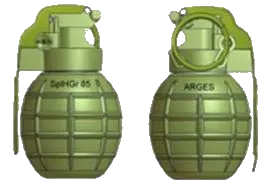

IPIS lists SplHGR-80 hand grenades among materiel in service with, or recovered from, Boko Haram factions; the report does not identify a specific attack, recovery site, or factional custody chain.
Infantry Weapons
SplHGR-80 hand grenade
Also known as
- SplHGR-80
- Spl HGr 80
- Spl-HGr-80
- EHG
- EHG explosive hand grenade
The SplHGR-80 is an Austrian defensive fragmentation hand grenade documented with a plastic body, striker-release fuze, 75 g of plasticized PETN, about 4,000 steel balls, and an alternate EHG designation. In this catalog it appears as insurgent-held or recovered materiel in the 2009 Boko Haram Insurgency, based on Lake Chad basin reporting rather than a single named combat use.
Role in Conflicts
Profile / Specs
Profile
- Origin
- Austria
- Built by
- Dynamit Nobel Wien
- Type
- Defensive fragmentation hand grenade
- Service note
- Late Cold War design documented in post-2015 insurgent materiel reporting
- Designer
- Unknown
- Designed
- By 1980
- Unit cost
- Not publicly reported
- Produced
- 1980s
- Number built
- Not publicly reported
Specifications
- Length
- 115 mm
- Diameter
- 60 mm
- Weight
- 585 g
- Filler
- 75 g plasticized PETN
- Fuze
- Striker release, 4 to 5 second delay
- Construction
- Plastic grenade body with five stepped ridges
- Fragmentation
- Approximately 4,000 steel balls embedded in the plastic body
- Markings
- No known markings
- Effects
- 10 m lethal radius and 100 m safety radius
Austrian Grenade Context
The identification guide places Spl HGr 80 among a compact Austrian defensive-grenade family. The same reference lists an alternate EHG designation for this model and gives enough data to compare it with nearby Austrian entries.
| Model | Documented detail | Reader value |
|---|---|---|
| Spl HGr 80 | 115 mm long, 60 mm in diameter, 585 g, 75 g plasticized PETN, five stepped ridges, approximately 4,000 steel balls, no known markings. | The cataloged model. |
| Spl HGr 84 | Later Austrian defensive grenade with a 61 mm diameter and 96 g filler. | Shows the next recorded step in the same source set. |
 | Austrian defensive grenade listed alongside the Spl HGr family in identification literature. | Useful for quick comparison with another Austrian grenade entry already in the catalog. |
Variants
Identification references list Spl HGr 80 alongside later Austrian Spl HGr-family defensive grenades. EHG is an alternate designation for Spl HGr 80, not a separate variant.
| Variant | Configuration | Designation notes |
|---|---|---|
| Spl HGr 84 | Adjacent Austrian defensive grenade | Identification references list a 115 mm, 61 mm, 490 g defensive grenade with 96 g plasticized PETN and ARGES body markings. Sources: Hand and Rifle Grenades - Worldwide Identification Guide |
| Spl HGr 85 | Adjacent Austrian defensive grenade | The guide lists Spl HGr 85 as a shorter 96 mm defensive model with 50 g plasticized-PETN filler, about 3,500 steel balls, and a 10 m danger radius. Sources: Hand and Rifle Grenades - Worldwide Identification Guide |
Timeline
SplHGR-80 hand grenade Key Events
US identification guide documents the model
Hand and Rifle Grenades - Worldwide Identification Guide records Spl HGr 80 as an Austrian defensive grenade with a plastic body, a striker-release fuze, 75 g of plasticized PETN, and about 4,000 steel balls.
Sources: Hand and Rifle Grenades - Worldwide Identification Guide
Lake Chad basin reporting notes insurgent-held examples
The Management of Lethal Materiel in Conflict Settings lists SplHGR-80 hand grenades among materiel in service with, or recovered from, Boko Haram factions.
Sources: The Management of Lethal Materiel in Conflict Settings
Related Weapon Systems


Sources
The Management of Lethal Materiel in Conflict SettingsPublisher: International Peace Information Service / Small Arms Survey | Note: 2009 Boko Haram Insurgency source listing SplHGR-80 hand grenades among materiel in service with, or recovered from, Boko Haram factions; supports that the grenade was used by or recovered from insurgent forces, while not identifying a specific attack. | Accessed: 2026-07-04Hand and Rifle Grenades - Worldwide Identification GuidePublisher: US Army Foreign Science and Technology Center / Defense Intelligence Agency, hosted by Bulletpicker | Note: Supports Spl HGr 80 identification, Austrian origin, defensive hand-grenade type, EHG alternate designation, dimensions, weight, filler, fuze delay, construction, fragmentation, markings, effects data, and nearby Spl HGr 84 and Spl HGr 85 family context. | Accessed: 2026-07-04Identificacion & Rastreo de ExplosivosPublisher: Scribd mirror | Note: Secondary explosives-identification reference used only for the Dynamit Nobel manufacturer attribution for the Austrian Spl HGr 80 entry, which the catalog normalizes to the existing Dynamit Nobel Wien builder profile; core specifications are corroborated by the US identification guide. | Accessed: 2026-07-04Military Small Arms and Light Weapons Production in Western EuropePublisher: Small Arms Survey | Note: Supports background on Austrian hand-grenade and military-explosives producers, including Arges/Ulbricht and Dynamit Nobel Wien. | Accessed: 2026-07-04ARGES SPLHGR 85 imagePublisher: Wikimedia Commons | Note: Image provenance for a CC0 image of the closely related ARGES SPLHGR 85; exact Spl HGr 80 imagery appears in a US identification-guide PDF, but no standalone rights-clear exact image URL was confirmed. | Accessed: 2026-07-04