

During the 2014 Russia-Ukraine War, CTC described Ukrainian and Russian Mavic-type quadcopters dropping hand grenades, with larger payloads typically using fragmentation grenades such as the F1.
Role detailsInfantry Weapons
Fragmentation hand grenade
Also known as
- frag grenade
- fragmentation grenade
- hand grenade
- M67 fragmentation grenade
- F1 grenade
- Mills bomb
- No. 36 grenade
Fragmentation hand grenades are short-delay anti-personnel explosives built to scatter high-velocity fragments across close range. The U.S. M67 provides a modern benchmark for the class, while documented conflict use ranges from Hamas shelter assaults and Philippine urban clearing at Marawi to F1-type grenade payloads dropped from Mavic-style drones in the Russia-Ukraine War.
Role in Conflicts

During the 2023 Israel-Hamas War, fragmentation hand grenades were used by Hamas militants in the October 7 attack on southern Israel, including shelter assaults near Re'im.
Role details- Side
- Philippine government forces

During the 2017 Battle of Marawi, Philippine government troops used hand grenades while trying to flush out remaining IS-aligned militants from a basement in the main battle area.

During the 2009 Boko Haram Insurgency, Nigerian troops reported recovering 36 hand grenades from Boko Haram hideouts around Gawa and Boskoro villages in Borno State in January 2019, indicating insurgent fielding of hand-thrown explosive ordnance.

During the 2016 Colombian FARC Dissident Conflict, AP reported coordinated attacks in southwest Colombia that involved grenades against police stations and security forces, showing direct insurgent use.
During the 1984 Kurdish-Turkish Conflict, AP reported that PKK-linked attackers hurled hand grenades at Turkish security forces in the 2024 attack on TUSAS, showing direct PKK grenade use.
During the 2011 Sinai Insurgency, AP reported militants in North Sinai lobbing grenades and trading gunfire during the El-Arish church and bank attack, showing insurgent use.
How the M67 pattern behaves
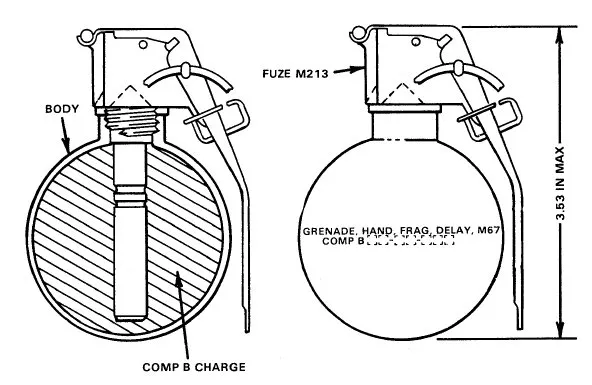
The Army's M67 pattern is the cleanest modern reference point for a fragmentation hand grenade: it is meant for close combat, not room clearing, and U.S. training material still treats it as the open-terrain option.
| Topic | Source-backed detail | Reader value |
|---|---|---|
| Role | The Army says the M67 is used to supplement small arms fire against enemies in close combat. | Explains why the weapon is a short-range infantry aid. |
| Body and fill | The grenade body is a 2.5-inch diameter steel sphere with about 5.5 ounces of Composition B. | Shows the compact, fragmenting shell that gives the grenade its effect. |
| Delay | The M213 fuze gives the Soldier 4.0 to 5.5 seconds after release of the safety lever. | Shows the narrow throw-and-seek-cover window built into the design. |
| Training counterpart | The Army's training-grenade page says the M69 practice hand grenade and M228 practice fuze replicate the M67 in training. | Reveals the practice system used to train safe handling without live fragmentation. |
| Terrain rule | Army reporting on the M111 says Soldiers use the M67 in open terrain, but choose the M111 in enclosed or restricted terrain. | Shows the grenade's current niche alongside newer blast-overpressure options. |
Profile / Specs
Profile
- Origin
- Multiple countries
- Built by
- Various manufacturers
- Type
- Fragmentation hand grenade
- Service note
- Modern; documented in 2017-2026 U.S. training and procurement reporting
- Unit cost
- About $21.96 per grenade in FY2017 Army ITEF procurement data.
Specifications
- Role
- Supplements small arms fire in close combat
- Body
- 2.5-inch diameter steel sphere
- Fill
- About 5.5 ounces of Composition B
- Delay
- M213 fuze gives 4.0 to 5.5 seconds after release of the safety lever
- Lethal radius
- 5 meters
- Casualty radius
- Up to 15 meters
- Fragment reach
- As far as 230 meters
Representative fragmentation-grenade patterns
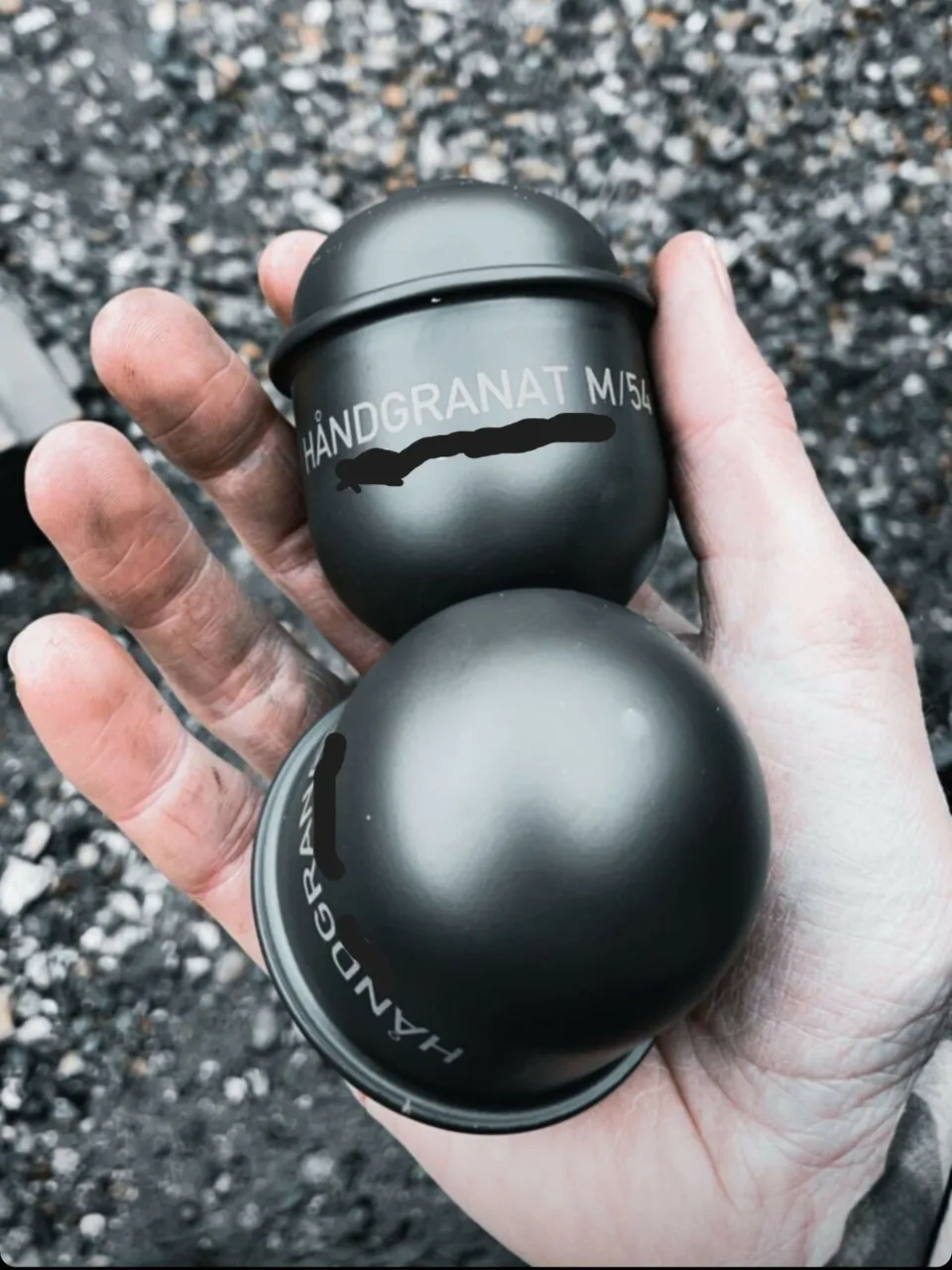
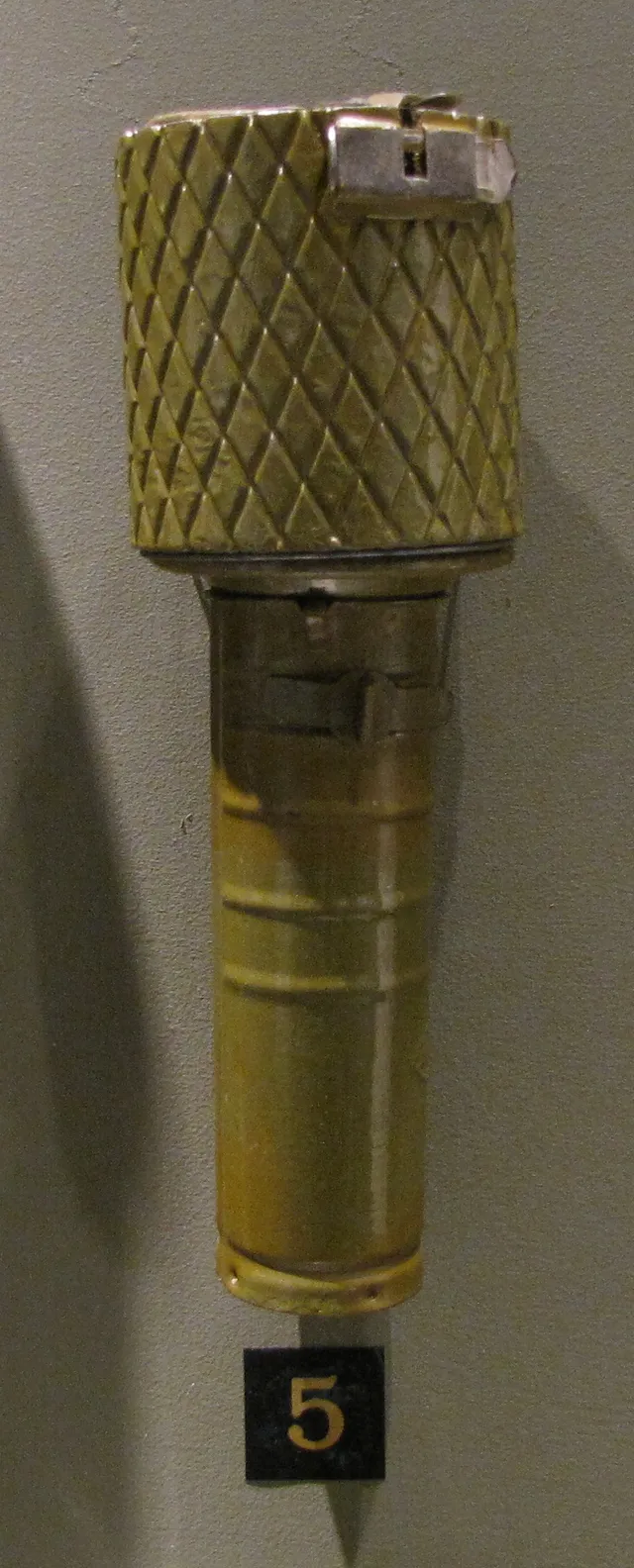
Fragmentation hand grenades are a broad equipment class rather than a single national model. The record therefore uses representative patterns to separate modern benchmark data, historical lineage, and current improvised carriage.
| Pattern | Documented detail | Why it matters |
|---|---|---|
| M67 | U.S. Army material describes a 2.5-inch steel-sphere grenade with Composition B fill and an M213 delay fuze. | Gives the page a precise modern benchmark for size, fill, delay, and expected fragmentation effects. |
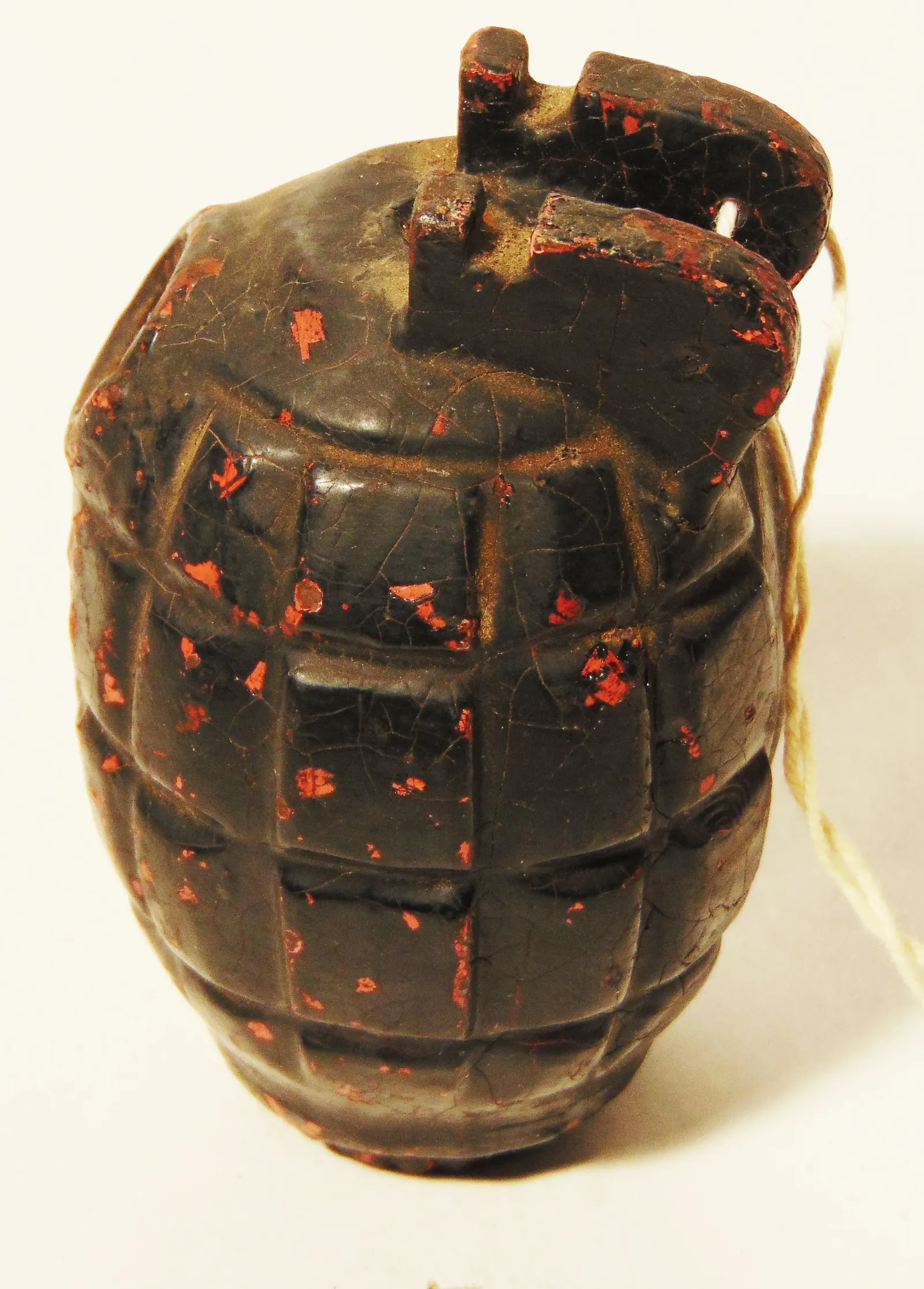
| Mills bomb | The National Army Museum describes the No. 5 Mills bomb as a 1915 British grenade with a grooved cast-iron body, central striker, hand lever, and pin. | Connects the modern class to a long-running British hand-grenade pattern represented by later Mills-family imagery in the gallery. |
| F1-type drone payload | CTC identifies the F1 as the typical larger fragmentation hand grenade used from Mavic-type drop drones in Ukraine. | Shows how legacy hand grenades reappear as improvised UAV payloads in current conflict. |
Drone Carriers
Open-source conflict reporting connects fragmentation hand grenades to commercial quadcopters used as improvised drop platforms.
| Carrier | Carrier type | Carriage evidence |
|---|---|---|
 | Commercial multirotor UAV | The CTC article identifies fragmentation hand grenades as the typical larger grenade carried by Mavic drop drones, with the F1 named as the example. Sources: Moving Targets: Implications of the Russo-Ukrainian War for Drone Terrorism |
 | Commercial quadcopter UAV | Defense One identified DJI Phantom-series quadcopters among the commercial drones Hamas used to drop grenades during the attack. Sources: Defense One Gaza drone war |
Timeline
Fragmentation hand grenade Key Events
Marine Corps documents M67 effects
The Marine Corps reported a 5-meter lethal radius, casualties out to 15 meters, and fragment dispersal as far as 230 meters during grenade training at Camp Lejeune.
Sources: Frag out; Marines participate in grenade assault course
Marines keep live M67 training current
Marine Corps video coverage from Camp Blaz said Marines were maintaining proficiency in employing the M67 hand grenade safely and effectively.
Sources: Camp Blaz and CLC-34 Marines conduct first grenade range on Camp Blaz Skaggs UTC
Army keeps the M67 as the open-terrain grenade
The Army said the M67 remains the fragmentation choice for open terrain while the M111 serves enclosed and restricted spaces.
Sources: Army approves M111, first new lethal hand grenade since 1968
Media
Fragmentation hand grenade Videos
Related Weapon Systems


Sources
Britannica GrenadePublisher: Encyclopaedia Britannica | Note: Supports general fragmentation grenade background, timed delay, casing fragmentation, typical weight, and close-range anti-personnel use. | Accessed: 2026-06-20Moving Targets: Implications of the Russo-Ukrainian War for Drone TerrorismPublisher: Combating Terrorism Center at West Point | Note: During the 2014 Russia-Ukraine War, Ukrainian and Russian Mavic-type quadcopters used hand-grenade payloads, and the source names the F1 as a larger fragmentation hand grenade used in drone drops. | Accessed: 2026-07-01Defense One Gaza drone warPublisher: Defense One | Note: In the 2023 Israel-Hamas War, Hamas used small commercial drones to drop grenades and configured DJI Phantom drones to avoid electronic countermeasures. | Accessed: 2026-06-20AP Hamas grenade articlePublisher: AP News | Note: During the 2023 Israel-Hamas War, grenades were used by Hamas militants in the October 7 attack on southern Israel. | Accessed: 2026-06-20Times of Israel Oct. 7 grenade videoPublisher: The Times of Israel | Note: During the 2023 Israel-Hamas War, grenades were used by Hamas militants in the October 7 bomb-shelter assault near Re'im. | Accessed: 2026-06-20Inside enemy tunnels and the concrete jungle of MarawiPublisher: GMA News Online | Note: Supports 2017 Battle of Marawi direct use: hand grenades were used by Philippine government troops trying to flush out IS-aligned militants from a basement in the main battle area. | Accessed: 2026-06-21Army raids kill 6 Boko Haram militants in NE NigeriaPublisher: Anadolu Ajansi | Note: Supports 2009 Boko Haram Insurgency direct-use: hand grenades were fielded by Boko Haram militants and recovered from their Boskoro hideout in Borno State in January 2019. | Accessed: 2026-06-21AP Colombia grenade attacksPublisher: AP News | Note: During the 2016 Colombian FARC Dissident Conflict, grenades were used by FARC dissident groups in coordinated attacks in southwest Colombia against police stations and security forces. | Accessed: 2026-06-22AP PKK grenade attackPublisher: AP News | Note: During the 1984 Kurdish-Turkish Conflict, hand grenades were used by PKK-linked attackers in the 2024 attack on TUSAS in Ankara. | Accessed: 2026-06-22AP Sinai grenade assaultPublisher: AP News | Note: During the 2011 Sinai Insurgency, grenades were used by militants in the El-Arish church and bank assault in North Sinai. | Accessed: 2026-06-22File:M67 grenade.jpgPublisher: Wikimedia Commons | Note: Image provenance and licensing source for the primary grenade photograph, a U.S. Army drawing released in the public domain. | Accessed: 2026-06-20File:M54 Fragmentation Grenade without fuze or firing lug.jpgPublisher: Wikimedia Commons | Note: Image provenance and licensing source for the M54 fragmentation grenade photograph, licensed under CC BY-SA 4.0. | Accessed: 2026-06-20File:Soviet RGD-33 hand grenade with fragmentation jacket.jpgPublisher: Wikimedia Commons | Note: Image provenance and licensing source for the RGD-33 fragmentation-jacket photograph, released into the public domain by the photographer. | Accessed: 2026-06-20File:British Mills no 36 hand grenade adapted for training.jpgPublisher: Wikimedia Commons | Note: Image provenance and CC BY-SA 4.0 licensing source for a British Mills No. 36 hand grenade adapted for training. | Accessed: 2026-06-21National Army Museum Mills Bomb No 5Publisher: National Army Museum | Note: Supports the No. 5 Mills bomb as a British hand-grenade pattern with grooved cast-iron body, central striker, lever, and pin. | Accessed: 2026-07-01PM CCS Lethal Hand GrenadesPublisher: U.S. Army | Note: Supports the M67 close-combat role, 2.5-inch steel-sphere body, Composition B fill, M213 fuze delay, and fragment distribution. | Accessed: 2026-06-27PM CCS 2017 Portfolio BookPublisher: U.S. Army | Note: Supports the FY2017 Army ITEF M67 procurement line that priced the grenade at $21.96 each and the M69 practice grenade / M228 fuze training relationship. | Accessed: 2026-06-27Frag out; Marines participate in grenade assault coursePublisher: U.S. Marine Corps | Note: Supports the M67 lethal radius, casualty radius, fragment dispersion, and live grenade-training context at Camp Lejeune. | Accessed: 2026-06-27Camp Blaz and CLC-34 Marines conduct first grenade range on Camp Blaz Skaggs UTCPublisher: DVIDS / U.S. Marine Corps | Note: Supports 2025 live M67 grenade-range training in Guam and the Marines' stated goal of maintaining proficiency. | Accessed: 2026-06-27Army approves M111, first new lethal hand grenade since 1968Publisher: U.S. Army | Note: Supports the 2026 Army contrast between the M67 in open terrain and the M111 in enclosed or restricted spaces. | Accessed: 2026-06-27