Infantry Weapons

Smoke hand grenade

Also known as
  • M18 smoke grenade
  • M18 colored smoke grenade
  • M18 smoke hand grenade
  • M83 smoke hand grenade
  • M83 TA practice smoke hand grenade
  • G940
  • G945
  • G950
  • G955

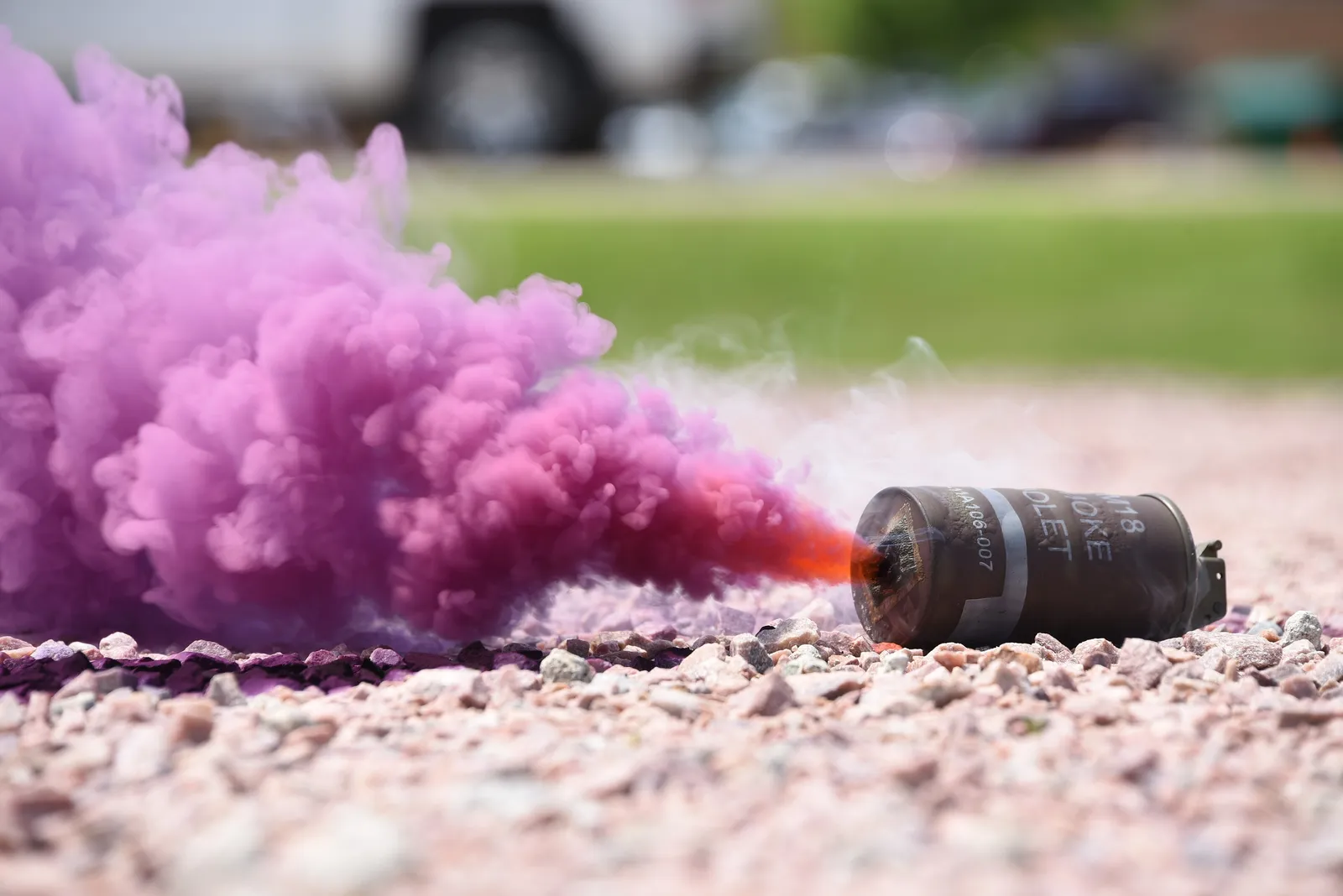
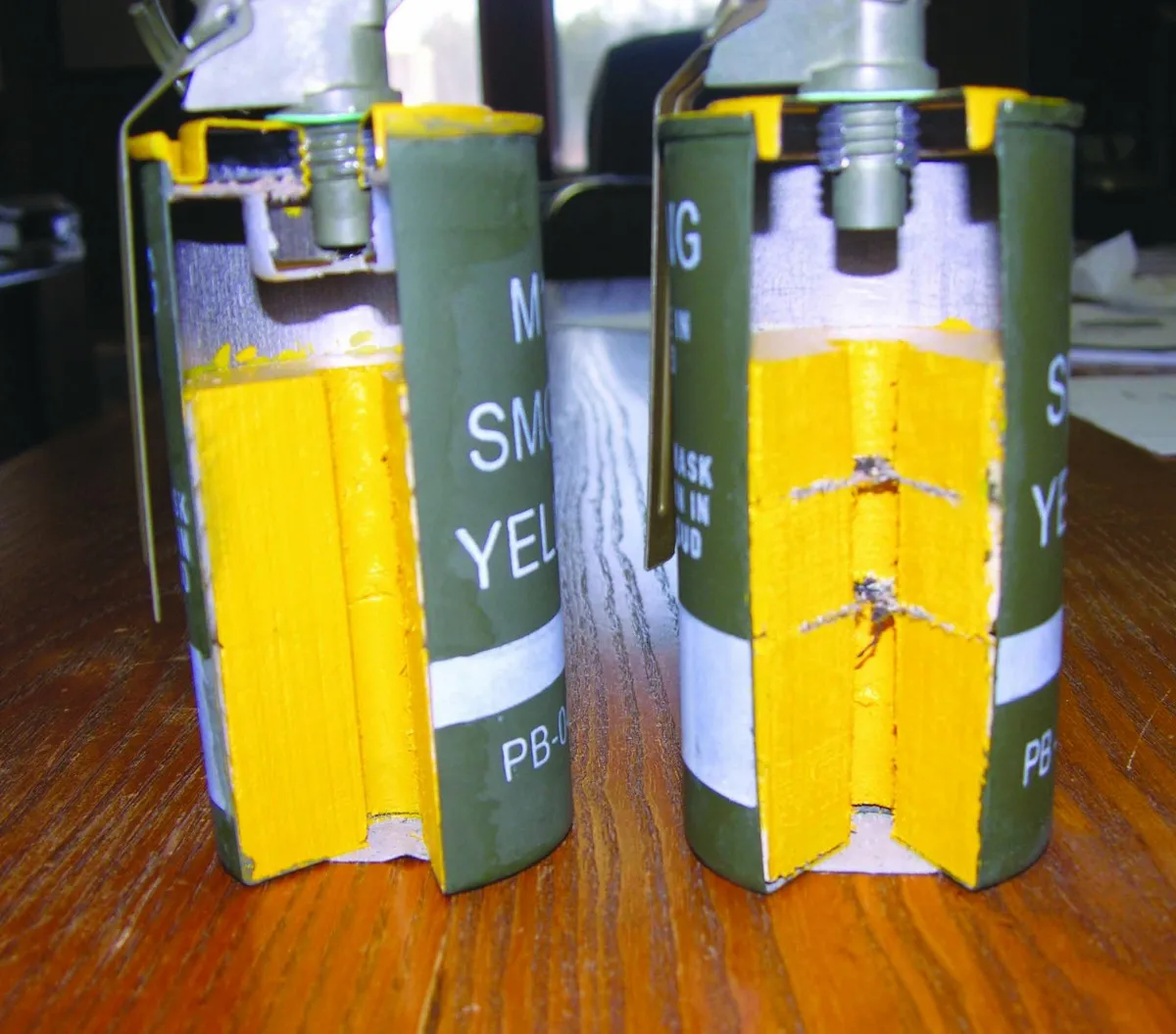
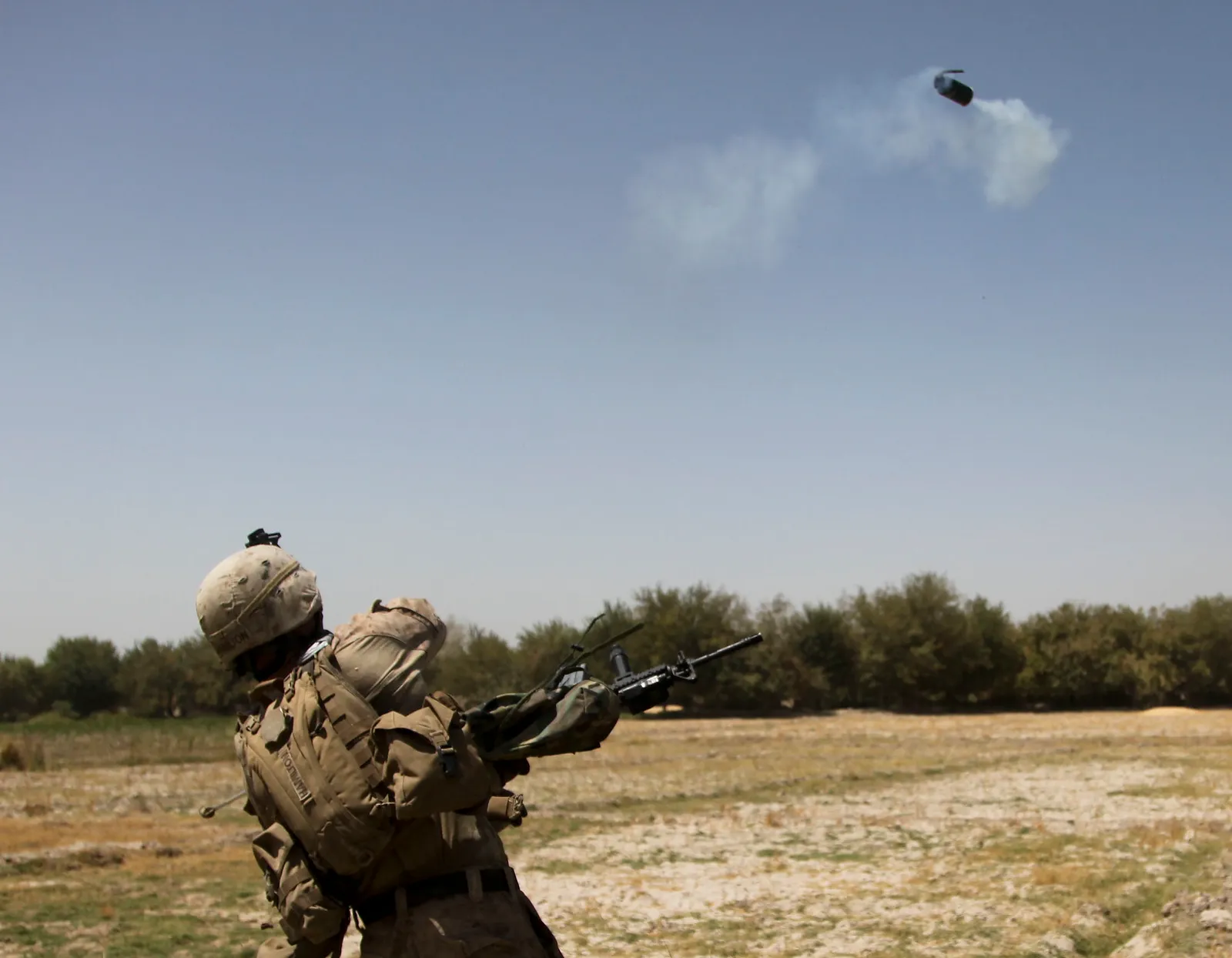
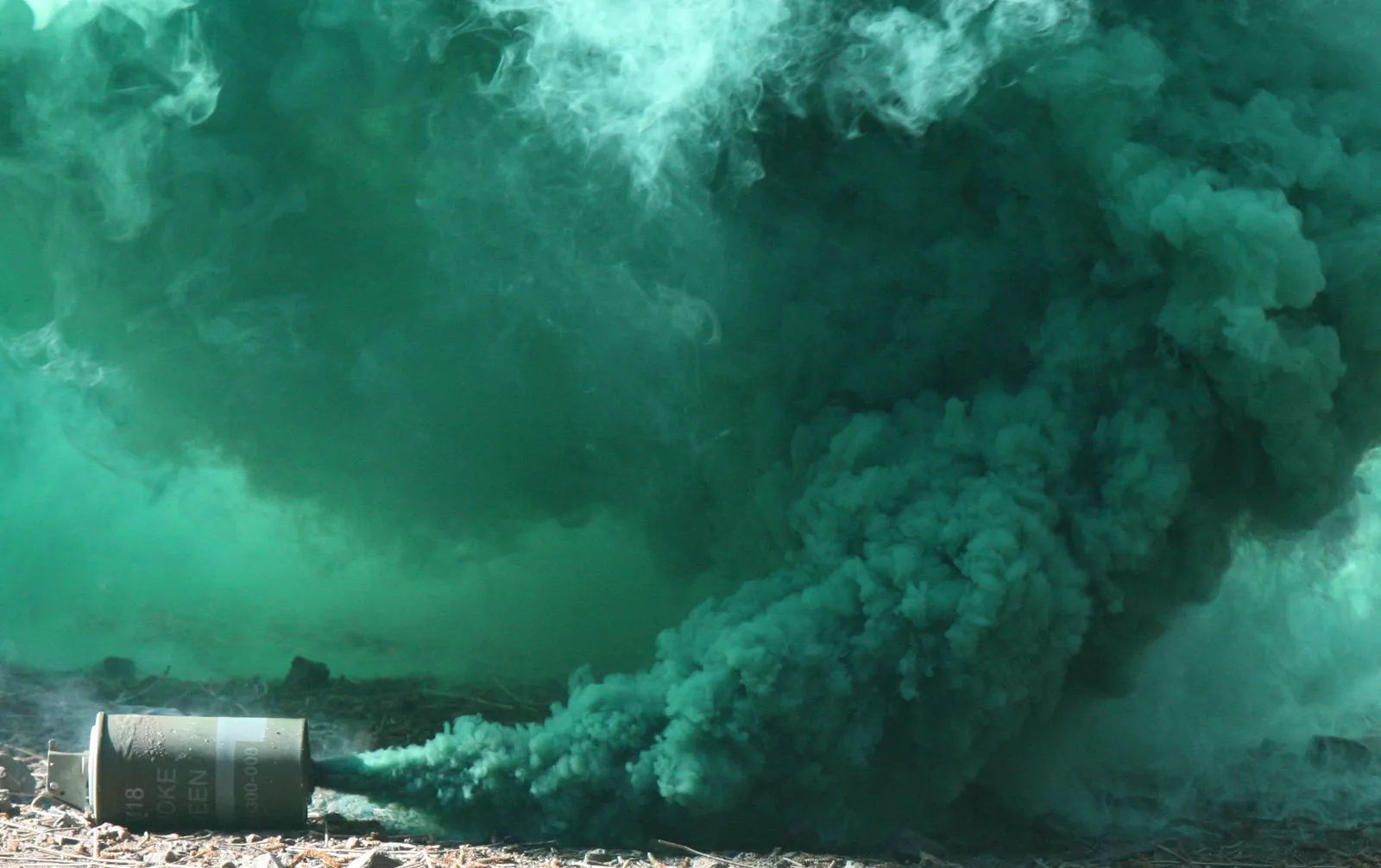
The smoke hand grenade record centers on the U.S. M18 colored smoke grenade and related M83 TA smoke hand grenade, hand-thrown pyrotechnic munitions used for signaling, landing-zone or target marking, and short-duration screening. Army data lists green, yellow, red, and violet M18 variants, 50-to-90-second smoke duration, and a 30-meter throw range; DoD aid reporting also documents M18 smoke hand grenades among Presidential Drawdown Authority assistance for Ukraine.

Role in Conflicts

U.S. DoD aid reporting lists multiple M18 smoke hand grenade and colored smoke hand grenade items under Presidential Drawdown Authority military assistance for Ukraine, documenting transfer of the grenades to Ukraine rather than a specific battlefield use event.

Role details
Side
Philippine government forces

Australian Army Research Centre lessons from Marawi describe CS/tear-gas grenades used by AFP infantry for hostage-sensitive room clearing and tunnel or ratline flushing, and separately note smoke grenades as the desired obscurant for movement under sniper observation; the source does not identify M18 stocks.

Profile / Specs

Profile

Origin
United States
Type
Hand-thrown smoke grenade
Service note
World War II–present
Designed
1943
Unit cost
About $55 per grenade in FY 2008 Army procurement data for the M18 green smoke grenade.
Produced
1943–present
Number built
At least 3,888,502 M18 grenades by June 2019; Army reporting also recorded a four-millionth M18 no-failure production milestone in April 2018.

Specifications

M18 smoke colors
Green, yellow, red, and violet
M18 smoke duration
50 to 90 seconds
M83 smoke duration
55 to 90 seconds
Throw range
About 30 meters
Uses
Ground-to-ground or ground-to-air signaling, target or landing-zone marking, and small-unit screening
M83 fill
TA smoke mixture
Variants

This entry covers the U.S. M18 colored smoke hand grenade family and the closely related M83 TA smoke hand grenade documented on the current Army smoke-grenade product page.

VariantConfigurationDesignation notes
M18 green smoke grenadeColored smoke and signaling grenade

The Army product page lists green as one of the four M18 smoke colors, and DoD Ukraine aid reporting separately lists Green Smoke M18 (G940) drawdown items.

Sources: Army Smoke Grenades, U.S. DoD IATI Ukraine smoke hand grenade drawdowns

M18 yellow smoke grenadeColored smoke and signaling grenade

The Army product page lists yellow as an M18 smoke color, and DoD Ukraine aid reporting separately lists Grenade, Hand, Smoke, Yellow, M18 (G945) drawdown items.

Sources: Army Smoke Grenades, U.S. DoD IATI Ukraine smoke hand grenade drawdowns

M18 red smoke grenadeColored smoke and signaling grenade

The Army product page lists red as an M18 smoke color, and DoD Ukraine aid reporting separately lists M18 red smoke hand grenade and M18 Smoke Grenade (RED) G950 items.

Sources: Army Smoke Grenades, U.S. DoD IATI Ukraine smoke hand grenade drawdowns

M18 violet smoke grenadeColored smoke and signaling grenade

The Army product page lists violet as an M18 smoke color, and DoD Ukraine aid reporting separately lists violet M18 (G955) drawdown items.

Sources: Army Smoke Grenades, U.S. DoD IATI Ukraine smoke hand grenade drawdowns

Timeline

Smoke hand grenade Key Events

  1. M18 replaces the M16

    Army historical catalog material places the M18 colored smoke grenade in production on 16 November 1943, replacing the earlier M16 family and noting the first violet M18s that day.

    Sources: M18 colored smoke grenade history

  2. 1.5 million M18/M83 grenades without a failure

    Pine Bluff Arsenal reported its 1.5 millionth M18/M83 smoke grenade without a failure in late March 2007, highlighting the family’s reliability record.

    Sources: Pine Bluff Arsenal smoke grenade production

  3. Three million M18 grenades without a failure

    Army reporting said the arsenal produced its three millionth M18 colored smoke grenade without a failure on 2 July 2014.

    Sources: Three million M18 grenades produced without a failure

  4. Army reports four millionth M18 no-failure milestone

    Pine Bluff Arsenal reported on 9 August 2018 that its Directorate of Ammunition Operations had produced the four millionth M18 colored smoke grenade without a lot-acceptance failure in April.

    Sources: PBA reaches 4 mil grenade mark without failure

  5. More than 3.8 million M18 grenades produced

    By June 2019, Army reporting put Pine Bluff Arsenal production at 3,888,502 M18 grenades and credited the 2006 starter patch with improving reliability.

    Sources: Pine Bluff Arsenal 2019 smoke grenade production milestone

M18 And M83 Smoke Grenade Notes

The Army product page separates the M18 colored smoke hand grenade from the M83 TA smoke hand grenade, while Pine Bluff Arsenal reporting documents the production and reliability history behind the family.

TopicSource-backed detail
M18 colorsGreen, yellow, red, and violet are the documented M18 smoke colors.
M18 rolesGround-to-ground or ground-to-air signaling, target or landing-zone marking, and screening unit movement.
M18 duration and throwAbout 50 to 90 seconds of smoke and a roughly 30-meter throw by an average soldier.
M83 roleWhite TA-mixture smoke for small-unit screening and signaling, with a 55-to-90-second emission duration.
Production scalePine Bluff Arsenal reported 1.5 million consecutive M18/M83 grenades without a failure in 2007, a four-millionth M18 no-failure milestone in April 2018, and 3,888,502 M18 grenades by June 2019.
Cost contextFY 2008 Army procurement data listed the green M18 at about $55 per grenade; procurement-year prices vary by lot and color.
Media
Related Weapon Systems
Cartridge, 105 mm, Smoke, WP, M60, 105 mm white-phosphorus smoke artillery cartridge, MunitionsMunitionsCartridge, 105 mm, Smoke, WP, M60105 mm white-phosphorus smoke artillery cartridgeThe Cartridge, 105 mm, Smoke, WP, M60 is a U.S. semi-fixed 105 mm white-phosphorus smoke cartridge family for 105 mm howitzers. Army ammunition data sheets describe the M60 series as a screening round with a cast-WP projectile filler, a seven-increment M67 propelling charge, and model differences centered on burster construction and fuze compatibility. Army rigging and ordnance-identification references also list the family by DODIC C454 and C477.
M150 155 mm hexachloroethane smoke projectile, 155 mm HC smoke projectile, ArtilleryArtilleryM150 155 mm hexachloroethane smoke projectile155 mm HC smoke projectileThe M150 is an Israeli 155 mm hexachloroethane smoke projectile from Elbit Systems, built for screening, obscuration, and spotting without white phosphorus. Elbit's product sheet lists five HC smoke canisters, about three minutes of effect, and a NATO NSN, while ARES traces the design to the M483A1 carrier projectile and compares it with M825-series white-phosphorus smoke rounds. Open-source investigations identify M150 rounds in Gaza during the May 2021 escalation and the 2023 Israel-Hamas War.
Rifle grenades, Rifle-launched grenade family, Infantry WeaponsInfantry WeaponsRifle grenadesRifle-launched grenade familyRifle grenades are a broad family of grenades projected from service rifles by rod, cup, spigot, muzzle-device, bullet-trap, or shoot-through launch methods. World War I examples extended infantry grenade reach with explosive, smoke, signal, message, and emerging anti-tank payloads, while postwar HEAT designs such as the British No. 94 Energa and U.S. M31 used shaped charges for short-range anti-armor fire. The cataloged conflict record spans rifle-launched use, recovered ammunition, and modern reuse of rifle-grenade munitions as drone payloads in Myanmar and Ukraine.
120 mm smoke ammunition, 120 mm smoke ammunition for rifled gun-mortars, MunitionsMunitions120 mm smoke ammunition120 mm smoke ammunition for rifled gun-mortars120 mm smoke ammunition is a mortar and gun-mortar ammunition class used to build short-duration obscurant screens rather than to deliver direct explosive effects. Forecast International lists smoke among the 120 mm ammunition types fired by the 2A60 Nona rifled ordnance on the 2S23 Nona-SVK, while Army Recognition describes the tracked 2S9 Nona as firing smoke rounds in its indirect-fire role. Modern 120 mm smoke products from STV GROUP, Nammo, and Hirtenberger show the class spanning visible and infrared screening, red-phosphorus payloads, white-phosphorus smoke, and other smoke fills depending on the round.

Sources