
IPIS lists the Austrian SHG-60 hand grenade among materiel in service with, or recovered from, Boko Haram factions; the report treats the list as cumulative and does not distinguish JAS from ISWAP holdings.
Munitions
SHG-60 hand grenade
Also known as
- SHG 60
- SHG 60 DNW
- SHG 60 DNW Def
- SHG 60 DNW Defensiva
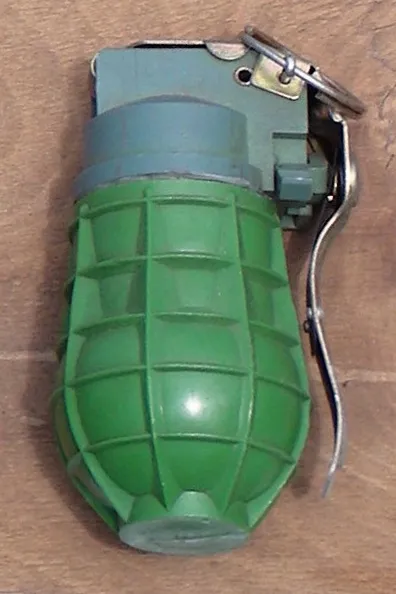
The SHG-60 is an Austrian defensive fragmentation hand grenade associated with the DNW/Dynamit Nobel Wien marking, with a two-piece plastic body, four stepped ridges, and about 4,000 steel-ball fragments around a plasticized-PETN filler. Identification literature records its fuze and effects, while later IPIS reporting places SHG-60 grenades among Boko Haram-faction materiel in the Lake Chad basin.
Role in Conflicts
Profile / Specs
Profile
- Origin
- Austria
- Built by
- Dynamit Nobel Wien
- Type
- Defensive fragmentation hand grenade
- Service note
- Documented in 1994 identification literature and 2021 Boko Haram materiel reporting
Specifications
- Type
- Hand-thrown defensive fragmentation grenade
- Dimensions
- 115 mm long and 60 mm in diameter
- Weight
- 575 g
- Filler
- Plasticized PETN
- Fuze
- Striker-release fuze with 4 to 5 second delay
- Construction
- Two-piece plastic body with four stepped ridges and plastic fuze body
- Fragmentation
- About 4,000 steel balls, each about 2.5 mm in diameter, surrounding the explosive
- Markings
- Olive-green grenade and fuze bodies
- Effects
- Lethal radius of about 10 m
- Design note
- Wave shaper present to optimize fragment dispersion
Identification Notes
The SHG-60 record rests on two compact evidence lanes: a 1994 identification guide for physical characteristics and a 2021 Lake Chad basin materiel report for conflict context.
Fragmentation body
The guide describes a two-piece plastic body with four stepped ridges and about 4,000 embedded 2.5 mm steel balls.
Source: Hand and Rifle Grenades - Worldwide Identification Guide
Fuze and filler
The same guide lists plasticized PETN filler, a striker-release fuze, and a 4 to 5 second fuze delay.
Source: Hand and Rifle Grenades - Worldwide Identification Guide
Designation caution
DIA lists SHG 60 separately from SHG; a Spanish explosives-identification mirror uses the SHG 60 DNW Defensiva label for data that resembles DIA's separate SHG entry, so this record keeps the explicit SHG 60 specifications as primary.
Sources: Hand and Rifle Grenades - Worldwide Identification Guide; Identificacion & Rastreo de Explosivos
Nearby Austrian entry
The guide lists the SHG 60 separately from other Austrian defensive grenades, including the SplHGR-80 hand grenade, which has its own catalog record.
Source: Hand and Rifle Grenades - Worldwide Identification Guide
Conflict record
IPIS lists SHG-60 hand grenades among materiel in service with or recovered from Boko Haram factions without separating JAS and ISWAP holdings.
Source: The Management of Lethal Materiel in Conflict Settings
Timeline
SHG-60 hand grenade Key Events
Identification guide documents the grenade
A Defense Intelligence Agency identification guide records the SHG-60 as an Austrian defensive fragmentation hand grenade and gives its dimensions, filler, fuze delay, construction, fragmentation, markings, and effects.
Sources: Hand and Rifle Grenades - Worldwide Identification Guide
Boko Haram materiel reporting names the SHG-60
An IPIS report lists SHG-60 hand grenades among materiel in service with or recovered from Boko Haram factions in the Lake Chad basin.
Sources: The Management of Lethal Materiel in Conflict Settings
Related Weapon Systems


Sources
Hand and Rifle Grenades - Worldwide Identification GuidePublisher: Defense Intelligence Agency | Note: Supports SHG-60 Austrian origin, defensive hand-grenade type, dimensions, weight, plasticized-PETN filler, fuze delay, construction, fragmentation, markings, lethal-radius, wave-shaper details, and its placement alongside other Austrian defensive hand grenades. | Accessed: 2026-07-01The Management of Lethal Materiel in Conflict SettingsPublisher: International Peace Information Service / Small Arms Survey | Note: For 2009 Boko Haram Insurgency, lists SHG-60 hand grenades as materiel in service with or recovered from Boko Haram factions, supporting that SHG-60 grenades were fielded by Boko Haram and ISWAP-side forces. | Accessed: 2026-07-01MANUFACTURES - O R D N A N C E . I N F OPublisher: Ordnance.info | Note: Supports DNW as the Dynamit Nobel Wien marking and helps interpret the SHG-60 DNW designation used in identification literature. | Accessed: 2026-07-01Identificacion & Rastreo de ExplosivosPublisher: PDFCoffee mirror | Note: Supplemental mirror used to document the SHG 60 DNW Defensiva designation and a conflicting 580 g / 62 mm / 4,500-fragment spec cluster; the DIA guide remains the main source for the explicit SHG 60 specifications. | Accessed: 2026-07-01URG-86 hand grenade representative imagePublisher: Wikimedia Commons | Note: Supports representative hand-grenade image provenance; no clean reusable SHG-60-specific image was used. | Accessed: 2026-07-01