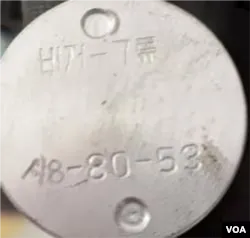

In the 2009 Boko Haram Insurgency, the F-7 HE FRAG RPG round is listed among materiel in service with, or recovered from, Boko Haram factions; the source does not distinguish whether the specific examples were held by JAS or ISWAP.
Munitions
North Korean F-7 rocket-propelled-grenade projectile
Also known as
- F-7
- F-7 HE fragmentation RPG round
- F-7 HE FRAG RPG round
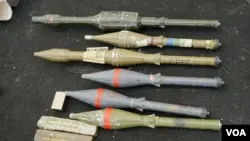
The North Korean F-7 is a 40 mm HE-fragmentation RPG round for RPG-7-pattern launchers. Small Arms Survey identifies it by its gray warhead, sustainer motor, and Korean markings, while conflict reporting has tied it to Boko Haram-linked materiel and to Hamas use in the 2023 Israel-Hamas War, including reuse of its motor section in improvised anti-tank rockets.
Role in Conflicts

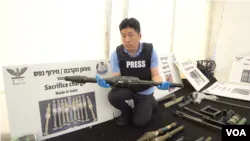
In the 2023 Israel-Hamas War, Hamas fighters were reported to have used F-7 rounds during the October 7 attack; VOA and South Korean intelligence reporting later tied recovered F-7 components to Hamas use and to rocket-motor reuse in improvised anti-tank RPGs.
Role detailsProfile / Specs
Profile
- Origin
- North Korea
- Built by
- North Korean state arms industry
- Type
- 40 mm HE-fragmentation RPG round
- Service note
- Contemporary North Korean RPG ammunition documented from 2023 onward.
- Unit cost
- Not publicly documented
Specifications
- Caliber
- 40 mm
- Warhead
- HE-fragmentation
- Launcher family
- RPG-7-pattern launchers
- Identification
- Gray warhead and sustainer motor with a red band and Korean markings
- Pattern
- RPG-7 pattern round
Identification Notes
The guide's most useful clues are physical rather than narrative: a gray warhead, a sustainer motor, a red band, and Korean markings.
| Feature | Documented detail |
|---|---|
| Pattern | RPG-7 pattern round |
| Warhead | 40 mm HE-fragmentation |
| Markings | Gray warhead and sustainer motor with a red band and Korean markings |
| Conflict trail | Listed in Boko Haram materiel reporting, tied by AP to Hamas use on October 7, and later corroborated in VOA and South Korean intelligence reporting on recovered F-7 components and motor reuse in Gaza |
Sources: Small Arms Survey North Korean recognition guide; The Management of Lethal Materiel in Conflict Settings; AP Hamas used North Korean F-7; VOA Israel-Hamas F-7 report; VOA F-7 motor reuse report; Yonhap NIS F-7 confirmation; VOA English NIS F-7 confirmation.
Launch Platforms
Small Arms Survey places the F-7 in the RPG-7-pattern family, so the launcher relationship is best read as a compatibility match rather than a separate system.
| Compatible item | Item type | Compatibility evidence |
|---|---|---|
 | RPG-7 family launcher | The recognition guide classifies the F-7 as an RPG-7-pattern round, placing it in the RPG-7 launcher family. |
Timeline
North Korean F-7 rocket-propelled-grenade projectile Key Events
Small Arms Survey documents the F-7
The North Korean recognition guide identifies the F-7 as a 40 mm HE-fragmentation RPG round and notes its gray warhead, sustainer motor, and Korean markings.
Sources: Small Arms Survey North Korean recognition guide
Hamas uses F-7 rounds in the Oct. 7 attack
AP and VOA reporting tied seized weapons and Hamas imagery to North Korean F-7 rounds used during the attack on Israel.
Sources: AP Hamas used North Korean F-7, VOA Israel-Hamas F-7 report
VOA reports rocket-motor reuse in Gaza
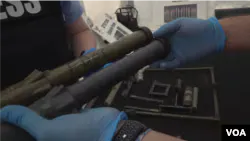
VOA reported that Hamas repurposed F-7 rocket motors into improvised anti-tank rockets, showing the round's motor section as a donor component rather than only a complete munition.
Sources: VOA F-7 motor reuse report
South Korean intelligence confirms the F-7 assessment
Yonhap and VOA reported that South Korea's National Intelligence Service agreed with VOA's assessment that Hamas used North Korean F-7 RPG components, while withholding transfer-volume details.
Sources: Yonhap NIS F-7 confirmation, VOA English NIS F-7 confirmation
Media
North Korean F-7 rocket-propelled-grenade projectile Videos
North Korean F-7 rocket-propelled-grenade projectile Images
Related Weapon Systems


Sources
The Management of Lethal Materiel in Conflict SettingsPublisher: International Peace Information Service / S4 Initiative | Note: 2009 Boko Haram Insurgency: used by or recovered from Boko Haram factions; Table 3 lists the North Korean F-7 HE FRAG RPG round among materiel in service with, or recovered from, Boko Haram factions. | Accessed: 2026-06-21Small Arms Survey North Korean recognition guidePublisher: Small Arms Survey | Note: Identifies the North Korean F-7 RPG round, its 40 mm caliber, HE-fragmentation warhead, RPG-7 pattern, and distinctive markings. | Accessed: 2026-06-20AP Hamas used North Korean F-7Publisher: Associated Press | Note: 2023 Israel-Hamas War: used by Hamas during the Oct. 7 attack; AP analysis tied seized weapons and Hamas imagery to North Korean F-7 rounds. | Accessed: 2026-06-20VOA Israel-Hamas F-7 reportPublisher: Voice of America | Note: 2023 Israel-Hamas War: used by Hamas in reporting on the Oct. 7 attack; VOA-hosted photos documented seized F-7 rounds and supported image provenance. | Accessed: 2026-06-20VOA F-7 motor reuse reportPublisher: Voice of America | Note: 2023 Israel-Hamas War: used by Hamas when VOA reported that Hamas repurposed F-7 rocket motors; VOA-hosted images document the recovered weapons and support image provenance. | Accessed: 2026-06-20Yonhap NIS F-7 confirmationPublisher: Yonhap News Agency | Note: 2023 Israel-Hamas War: South Korea's National Intelligence Service said its assessment matched VOA reporting that Hamas used North Korean F-7 RPG components and released a photo of a disassembled F-7 part. | Accessed: 2026-07-01VOA English NIS F-7 confirmationPublisher: Voice of America | Note: 2023 Israel-Hamas War: reports South Korean intelligence confirmation of VOA Korean Service photos showing North Korean F-7 RPGs with Korean markings used by Hamas, and summarizes Israeli reporting on recovered F-7 motors reused in improvised anti-tank RPGs. | Accessed: 2026-07-01