Conflict catalog
2009 Boko Haram Insurgency: Weapons and Equipment
Insurgency centered in northeast Nigeria and the Lake Chad basin, pitting Nigerian and allied regional forces against Boko Haram factions and Islamic State West Africa Province.
The 2009 Boko Haram Insurgency is a long-running jihadist conflict that began in northeast Nigeria in 2009 and expanded across the Lake Chad basin. Since 2015, the catalog context is shaped by Nigerian and regional counter-insurgency operations, the rise of ISWAP as a distinct faction, insurgent raids on military positions, captured state equipment, improvised explosive devices, and air and ground operations by Nigerian and allied forces.
This catalog tracks weapon systems directly documented in the 2009 Boko Haram Insurgency since 2015.
Entries focus on sourced battlefield use, captured equipment, and improvised systems connected to Boko Haram and ISWAP operations.
102 weapon systemsConflict Actors
Nigerian government and allied forces / Boko Haram and ISWAP

Boko Haram and ISWAP
83 weapon systems in this catalog
Context
- Status
- Published catalog
- Location
- Northeast Nigeria and the Lake Chad basin
- Countries
- Nigeria, Cameroon, Chad, Niger
- Regions
- Borno, Yobe, Adamawa, Far North Cameroon, Diffa, Lake Chad
- Domains
- land, air, UAV, mine warfare, counter-insurgency, border clashes, improvised weapons
The equipment catalog should prioritize directly sourced post-2015 use because the conflict involves both formal state inventories and insurgent capture, diversion, and improvisation. Government and allied forces use aircraft, armored vehicles, artillery, small arms, and protected mobility in counter-insurgency operations. Boko Haram and ISWAP equipment evidence often appears through captured materiel, weapons recovered after raids, improvised explosive devices, technicals, small arms, heavy machine guns, mortars, rockets, and adapted artillery or armored systems.
Map
Northeast Nigeria and the Lake Chad basin
Map data from OpenStreetMap contributors.
Timeline
Key Events
Insurgency begins after the July 2009 uprising
The conflict began after Nigerian security forces confronted Boko Haram and the group's founder, Mohammed Yusuf, was killed in custody, turning the movement into an armed insurgency.
Sources: UNIDIR armed constellation report
Chibok schoolgirls abducted
Boko Haram's abduction of schoolgirls from Chibok in Borno State became an international marker of the group's mass-kidnapping campaign and its reach beyond direct attacks on security forces.
Sources: ICRC Lake Chad basin case study
African Union authorizes a regional force
The African Union Peace and Security Council authorized deployment of the Multinational Joint Task Force, built around Lake Chad Basin Commission states and Benin, to counter Boko Haram.
Sources: African Union MNJTF operational documents, EPON MNJTF report
Boko Haram pledges allegiance to the Islamic State
Abubakar Shekau pledged allegiance to the Islamic State in March 2015, after which the movement became linked to the Islamic State's West Africa Province label.
Sources: UNIDIR armed constellation report
ISWAP split hardens the factional conflict
Islamic State recognition of Abu Musab al-Barnawi and Shekau's refusal to accept replacement produced a durable split between ISWAP and Shekau-aligned Boko Haram factions.
Sources: UNIDIR armed constellation report, International Crisis Group JAS-ISWAP briefing
Shekau dies during ISWAP offensive in Sambisa
ISWAP attacked Shekau-aligned forces in the Sambisa Forest area in 2021; Shekau's death changed factional alignments but did not end the insurgency.
Sources: International Crisis Group JAS-ISWAP briefing, UNIDIR armed constellation report
MNJTF mandate renewed amid persistent threats
The African Union renewed the MNJTF mandate as regional forces continued operations against Boko Haram and ISWAP while facing capability, coordination, and resourcing constraints.
Sources: EPON MNJTF report
Phases
Uprising and regionalization
Boko Haram shifted from a Nigerian insurgency into a regional threat affecting northeastern Nigeria and border areas around Lake Chad.
Regional counter-offensive and Islamic State alignment
Nigeria, Cameroon, Chad, Niger, and Benin moved toward a coordinated MNJTF framework while Boko Haram pledged allegiance to the Islamic State and faced pressure from regional operations.
Boko Haram-ISWAP split
The insurgent side fractured between ISWAP and Shekau-aligned Boko Haram, with both factions conducting attacks, using improvised explosives, and exploiting difficult terrain around Lake Chad and Sambisa.
Post-Shekau factional insurgency
After Shekau's death, ISWAP and remaining Boko Haram factions continued to challenge Nigerian and regional forces through raids, ambushes, taxation networks, improvised explosives, and attacks on military positions.
External Support
Regional military cooperation is central to the conflict. The Multinational Joint Task Force brings together Lake Chad Basin Commission states and Benin under an African Union-authorized framework, with Nigeria, Cameroon, Chad, and Niger as core operational actors. Outside support and supplier context should be treated case by case in weapon entries, because equipment can enter the conflict through official procurement, regional force contributions, battlefield capture, illicit trafficking, or diversion from state stockpiles.
Images


Weapons
2009 Boko Haram Insurgency Weapon Systems
Category
Aircraft & UAVs
Crewed aircraft, drones, and loitering munitions.


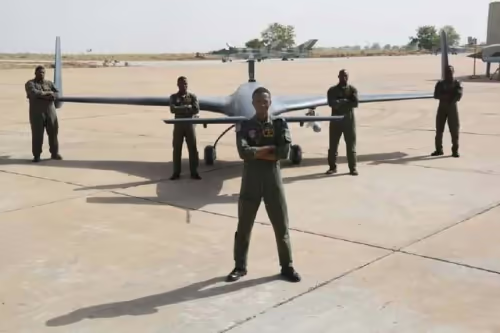


2 remaining
Category
Air Defense
Systems that contest aircraft, missiles, helicopters, and drones.

Category
Armored Vehicles
Troop carriers, infantry fighting vehicles, and protected mobility.


11 remaining
Category
Artillery
Tube artillery, rocket artillery, and long-range ground fires.


3 remaining
Category
Infantry Weapons
Portable weapons used by soldiers and small units.


30 remaining
Category
Munitions
Standalone missiles, bombs, rockets, torpedoes, and guided or unguided explosive payloads.


12 remaining
Category
Support Equipment
Transport, logistics, recovery, command, engineering, and other enabling equipment.

Category
Tanks
Heavy armor built around direct fire, protection, and battlefield shock.


News
Latest 2009 Boko Haram Insurgency News

Nigeria Approves $618 Million Borrowing for Attack Jets and Ammunition
2009 Boko Haram InsurgencyM-346AW-109Nigeria approved borrowing about $618 million to buy six Italian-made M-346 attack jets and ammunition, extending an air-force modernization drive that also includes AW-109 helicopters.Sources: Reuters, Nigerian Air Force
Conflict Sources
The conflict remains active and factional. Weapon entries should attach only directly sourced, post-2015 conflict-use claims and should distinguish Nigerian or allied force use from Boko Haram, JAS, or ISWAP use when sources make that distinction.
- Boko Haram: Mapping an Evolving Armed ConstellationPublisher: UNIDIR | Note: Supports conflict background, the 2015 Islamic State pledge, factional evolution, and post-2016 Boko Haram/ISWAP structure. | Accessed: 2026-06-21
- The Multinational Joint Task Force and the fight against Boko HaramPublisher: Norwegian Institute of International Affairs / EPON | Note: Supports MNJTF mandate, AU authorization, regional force configuration, and continuing regional counter-insurgency context. | Accessed: 2026-06-21
- Experts Meeting on MNJTF operational documentsPublisher: African Union Peace and Security Department | Note: Supports the February 2015 operational planning for the MNJTF, its Lake Chad Basin Commission participants, Benin, and regional command arrangements. | Accessed: 2026-06-21
- Weapon Supplies Fueling Terrorism in the Lake Chad CrisisPublisher: Conflict Armament Research | Note: Supports weapon-context claims about documented weapons and ammunition seized from Boko Haram and ISWAP-linked groups around Lake Chad. | Accessed: 2026-06-21
- Weapons and Ammunition Dynamics in the Lake Chad BasinPublisher: United Nations Department of Peace Operations and United Nations Office for Disarmament Affairs via ReliefWeb | Note: Supports Lake Chad basin weapons-and-ammunition dynamics and the need to distinguish state, regional, diverted, and illicit sources. | Accessed: 2026-06-21
- JAS vs. ISWAP: The War of the Boko Haram SplintersPublisher: International Crisis Group | Note: Supports source-backed caveats about insurgent factional rivalry after the Boko Haram-ISWAP split and after Shekau's death. | Accessed: 2026-06-21
- Destroyed MT-LB of Nigerian ArmyPublisher: Wikimedia Commons | Note: Image provenance and licensing page for the destroyed Nigerian Army MT-LB image. | Accessed: 2026-06-21
- Islamist insurgency in Nigeria.svgPublisher: Wikimedia Commons | Note: Image provenance and licensing page for the open-license insurgency map. | Accessed: 2026-06-21

