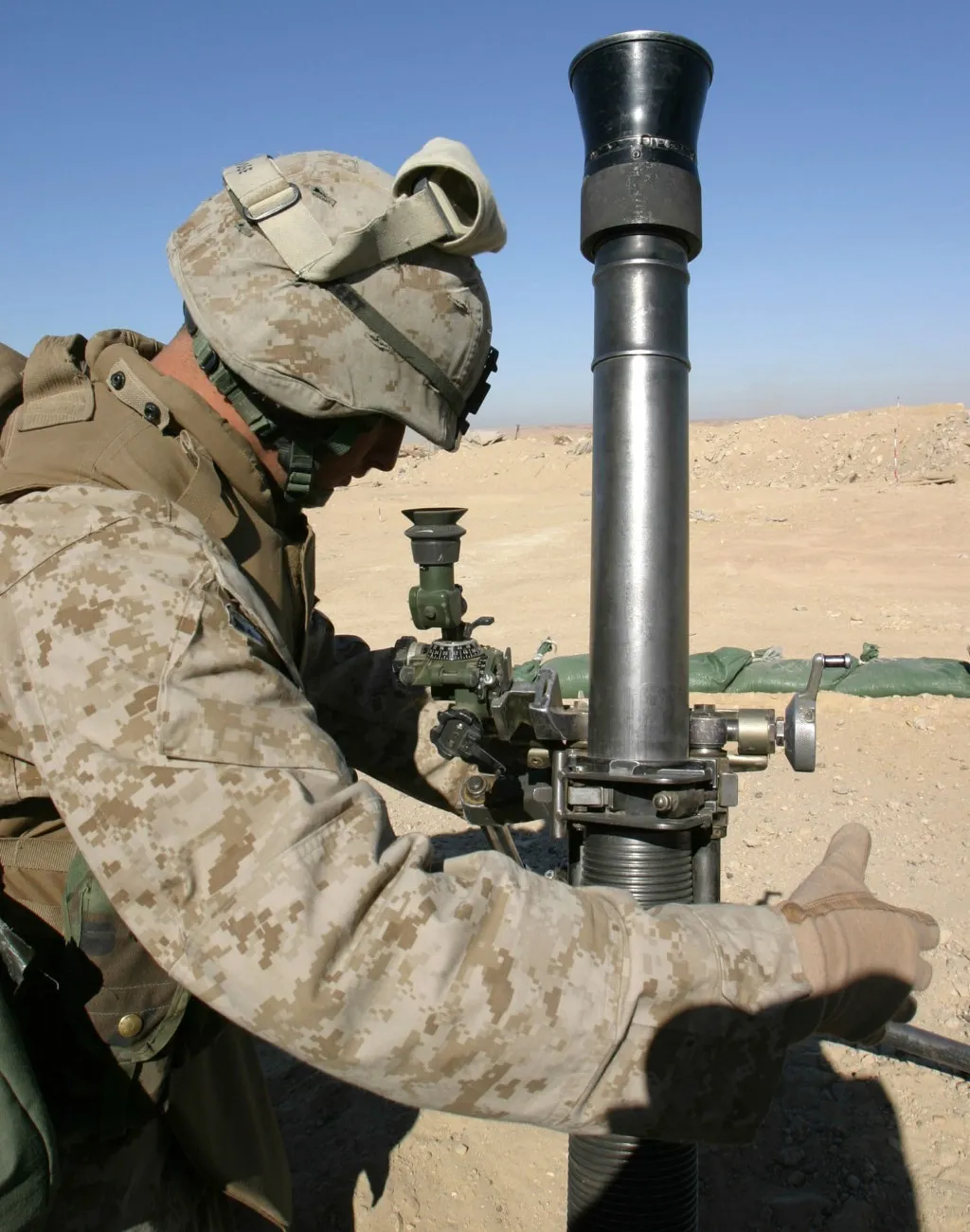

Nigerian Army and MNJTF reports cited by local media documented Boko Haram/ISWAP fighters losing 81 mm mortar tubes, bombs, and an 81 mm mortar during 2020 and 2022 operations in Borno and the Lake Chad basin; the sources do not identify a specific model.
Artillery
81/82 mm mortar
Also known as
- Mortar launcher, 81mm
- 81 mm mortar
- 82 mm mortar
- 81mm mortar
- 82mm mortar
- 81 mm mortar launcher
- 81mm mortar launcher
- medium mortar
- M252
- M252A1
- L16A2
- F2
- 2B14
- 2B24
- L16A2 81 mm mortar
- M252 81 mm mortar
- M252A1 81 mm mortar
- F2 81 mm mortar
- 2B14 Podnos
- 2B24 82 mm mortar
The 81/82 mm mortar family covers the modern crew-served, muzzle-loaded, smoothbore indirect-fire class descended from the Stokes mortar lineage and still fielded worldwide in variant-specific forms. This is a family-level page: 81 mm L16/M252/M252A1/F2-type systems and 82 mm Soviet/Russian-pattern systems such as 2B14 and 2B24 share a medium-mortar battlefield role but are not interchangeable hardware. Conflict rows stay at the caliber or named-system level supported by the source, including Boko Haram/ISWAP recovered 81 mm equipment, Iraqi M252 training under Operation Inherent Resolve, U.S. Marine M252 use and Afghan Border Police 82 mm sustainment in Afghanistan, PKK 81/82 mm mortar use where no single model is identified, and Chadian 82 mm mortar training before operations in Mali.
Role in Conflicts

CJTF-OIR imagery documented an Iraqi 73rd Brigade, 16th Division soldier training with an M252 81 mm mortar at Camp Taji in June 2015 as part of coalition building-partner-capacity work against ISIL.
Role details

Task Force Southwest imagery documented U.S. Marines fielding an M252 81 mm mortar at Camp Shorab in May 2018 during a fire mission supporting Afghan National Defense and Security Forces operations in Helmand Province; the FY 2016 ASFF request also funded sustainment for Afghan Border Police 82 mm mortars used on patrol and border control checkpoint missions.
Role detailsSETA's 1984 Kurdish-Turkish Conflict analysis says the PKK used Russian-made 82 mm mortars against security facilities in mountainous regions and also used 81 mm mortar tools; the report does not identify a single factory model.

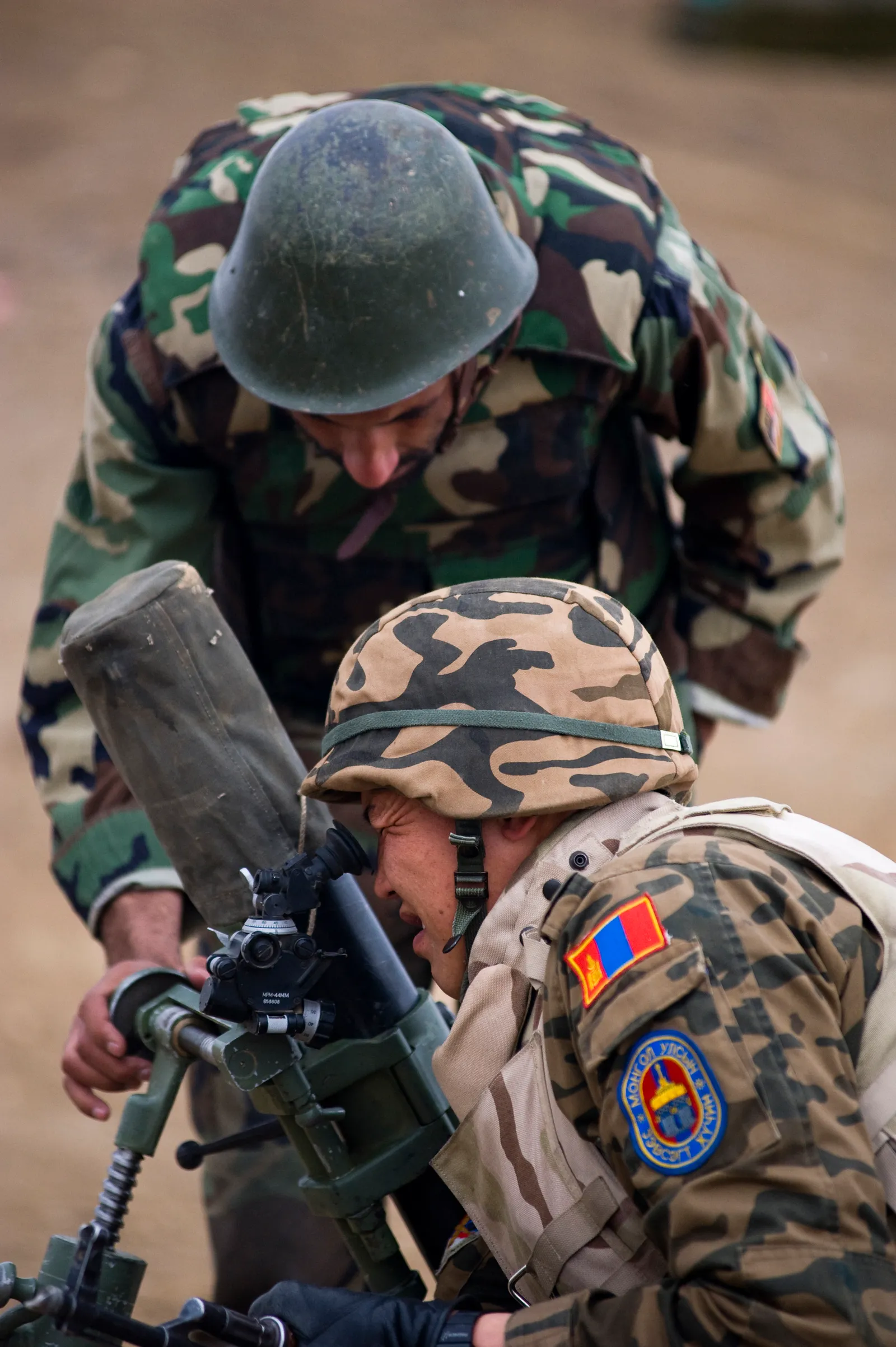
The French Ministry of Armed Forces reported that French instructors trained Chadian soldiers on 82 mm mortars in late 2021 before those troops were projected for operations in Mali; the source supports contingent-level fielding but does not document a specific firing incident.
Profile / Specs
Profile
- Origin
- Multiple countries
- Built by
- Various manufacturers
- Type
- 81/82 mm crew-served medium mortar
- Service note
- Modern service; representative 81 mm and 82 mm designs remain in worldwide use
- Designer
- Multiple national ordnance design bureaus
- Designed
- Early 20th century onward; representative modern 81 mm and 82 mm systems are postwar designs
- Unit cost
- Varies by model, manufacturer, and ammunition package
- Produced
- Varies by model and producer
- Number built
- Unknown; produced by many national arsenals and defense manufacturers
Specifications
- Caliber
- 81 mm / 82 mm
- Configuration
- Smoothbore, muzzle-loaded, high-angle mortar with tube, bipod, baseplate, and sight
- Crew
- Usually 3-5 depending on model and service
- 81 mm representative range
- About 5,650 m for the British L16A2, 200-4,900 m for the Australian F2, and about 5.6-5.8 km for representative M252A1-family systems
- 81 mm representative weight
- About 35.3 kg for the L16A2, 36.6 kg for the F2, and 74.9 lb in firing position for the U.S. M252A1
- 81 mm representative rate of fire
- About 15 rounds per minute sustained for the L16A2; FM 23-90 lists the M252 at 15 rounds per minute sustained and 30 rounds per minute maximum for two minutes
- 81 mm representative details
- L16A2 barrel length 1,280 mm and muzzle velocity 225 m/s; M252A1 elevation 800-1515 mils
- 82 mm representative range
- 4,270 m for the 2B14 Podnos and up to 6,000 m for the 2B24 with the 3-O-26 bomb
- 82 mm representative weight
- 41.88 kg in firing position for the 2B14 Podnos and 45 kg action weight for the 2B24
- 82 mm representative rate of fire
- 24-30 rounds per minute maximum on the 2B14 Podnos and at least 20 rounds per minute for the 2B24
- Ammunition
- High-explosive, smoke, illumination, practice, and related mortar bombs
Class Boundaries
This entry is a family-level mortar page, not a claim that every 81 mm and 82 mm system is interchangeable. The sources support a shared medium-mortar role: crew-served, muzzle-loaded, smoothbore launchers firing fin-stabilized bombs at high angles, with model-specific weights, ranges, crews, and ammunition packages.
81 mm examples
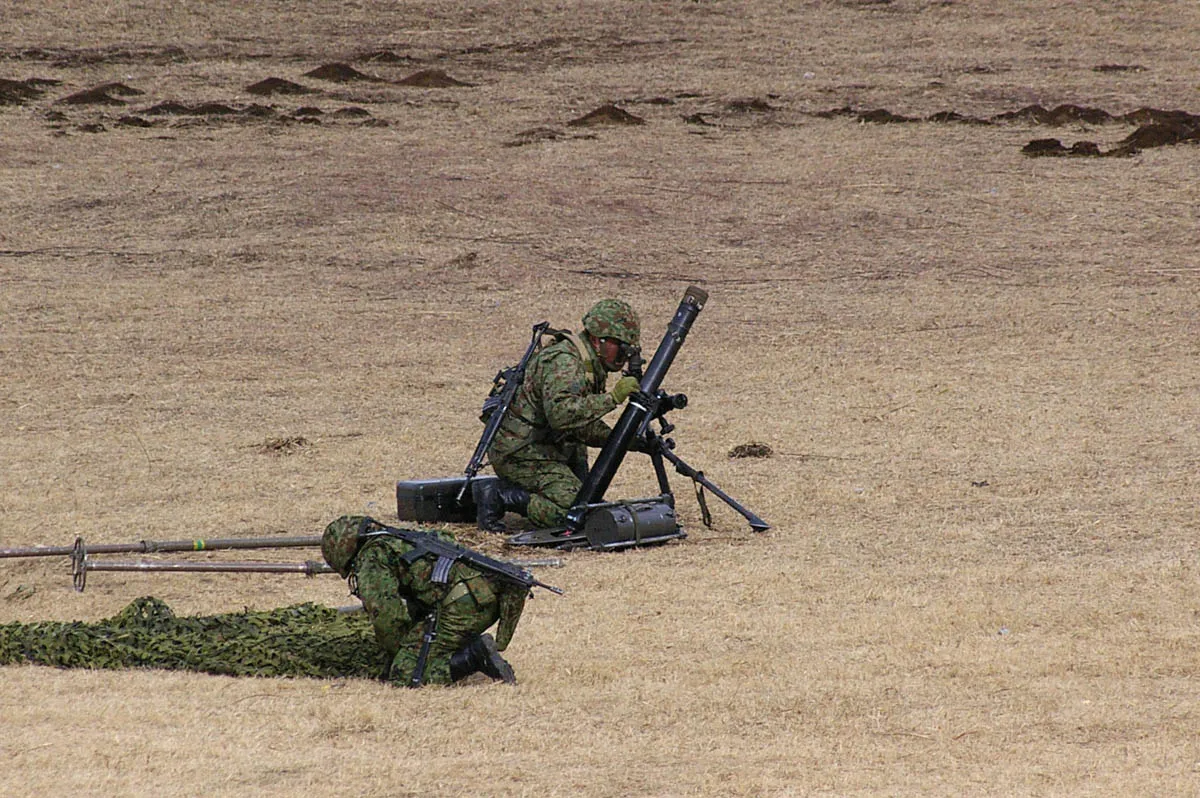
British L16A2, Australian F2, and U.S. M252/M252A1 lines represent the NATO/Commonwealth 81 mm branch, with official sources giving about 5.65 km maximum range for the L16A2, 200-4,900 m for the F2, and a lighter M252A1 fielding path.
82 mm examples
Soviet-pattern 2B14, Russian 2B24, and Yugoslav/Serbian M69-family systems represent the 82 mm branch, with source-backed differences in range, crew, weight, and national production.
Conflict evidence
Conflict rows stay at the caliber or family level when sources document 81 mm or 82 mm mortar use without naming a single factory model.
Variants
The page treats 81 mm NATO/Commonwealth-pattern and 82 mm Soviet-pattern mortars as a battlefield class. The rows below are representative branches and examples; model-specific differences remain in the notes instead of implying that 81 mm and 82 mm launchers are interchangeable.
| Variant | Configuration | Designation notes |
|---|---|---|
| L16 / L16A1 / L16A2 81 mm mortar | British and Commonwealth 81 mm mortar family | IWM records the L16 entering British service in 1965/6, while the British Army lists the L16A2 as its current 81 mm battlegroup-level indirect-fire weapon. Sources: 81mm Mortar L16A1, 81mm Mortar |
| F2 81 mm mortar | Australian 81 mm mortar | The Australian Army describes the F2 as a crew-served indirect-fire weapon that can be man-portable or deployed by helicopters, wheeled vehicles, and armored personnel-carrier mortar vehicles. Sources: 81 millimetre F2 mortar |
| M252 81 mm mortar | U.S. legacy 81 mm mortar system | Elbit Systems of America lists the M252 81 mm legacy mortar weapon system among the 60 mm, 81 mm, and 120 mm mortar systems covered by its U.S. Army contract. |
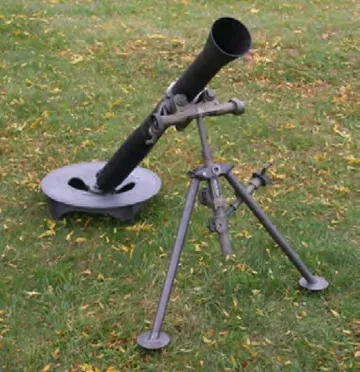
| M252A1 81 mm mortar | Lightweight U.S. 81 mm mortar system | The U.S. Army describes the M252A1 as a lighter 81 mm mortar system first delivered to Fort Bragg in November 2014, with CPE AE listing a 74.9 lb firing-position weight. Sources: Picatinny lightens Soldiers' load, 81mm M252A1 |
| 81 mm mortar launcher branch | 81 mm crew-served medium mortar class | This branch covers L16, M252, M252A1, F2, and comparable modern 81 mm systems when sources identify caliber or family rather than a single factory model. Sources: 81mm Mortar, 81mm M252A1, Picatinny lightens Soldiers' load, 81 millimetre F2 mortar |
 | 82 mm portable smoothbore mortar class | The linked 82 mm launcher page covers BM/PM-series, 2B14, 2B24, and national 82 mm derivatives as a narrower catalog class. Sources: 82mm 2B14 Podnos, Rosoboronexport 2B24 Mortar |
| 2B24 82 mm mortar | Modern Russian 82 mm mortar | Rosoboronexport lists the 2B24 as an 82 mm mortar with a five-person crew, 45 kg action weight, and 100-6,000 m range with the 3-O-26 mortar bomb. Sources: Rosoboronexport 2B24 Mortar |
Carrier Platforms
Rheinmetall describes Bulldog variants as 81 mm mortar carriers.
| Carrier | Carrier type | Carriage evidence |
|---|---|---|
 | Tracked armoured personnel carrier | Rheinmetall says Bulldog variants are in service as 81 mm mortar carriers; this relationship belongs to the 81 mm branch of the wider 81/82 mm mortar family. Sources: Bulldog - Armoured Personnel Carrier |
Ammunition Fired
This 81/82 mm mortar family is documented as firing matching 81 mm and 82 mm mortar bombs from standard smoothbore mortar systems.
| Ammunition | Ammunition type | Firing evidence |
|---|---|---|
 | 81 mm mortar bomb | The British Army identifies the 81 mm mortar as firing high explosive, smoke, and illuminating rounds, and U.S. Army ammunition references identify the M821 and M889 81 mm cartridges as designed for the M252 81 mm mortar system. Sources: 81mm Mortar, M821/M889 81mm HE Mortar Cartridges, Mortar Ammunition |
 | 82 mm mortar bomb | Commercial and reference sources describe 82 mm mortar bombs as intended for firing from 82 mm smoothbore mortar systems, and the 82 mm mortar class is documented as using unguided fin-stabilized 82 mm mortar bombs. Sources: Mortar Bomb 82mm HE, 82mm HE ER Mortar Bomb |
Timeline
81/82 mm mortar Key Events
Stokes mortar lineage emerges
Britannica describes the Stokes mortar as the progenitor of most present-day mortars, providing the broad historical anchor for the 81/82 mm family.
Sources: Britannica Mortar Weapon
L16 81 mm mortar enters British service
The British Army identifies the L16A2 81 mm mortar as its current battlegroup-level indirect fire weapon and lists the standard 81 mm service characteristics used here as a representative modern 81 mm baseline.
Sources: 81mm Mortar
First lightweight M252A1 systems delivered
A U.S. Army Picatinny article says the first lightweight M252A1 81 mm mortar systems were delivered to Fort Bragg in November 2014.
Sources: Picatinny lightens Soldiers' load
Iraqi 73rd Brigade trains on M252 at Camp Taji
CJTF-OIR imagery documented an Iraqi 73rd Brigade soldier practicing with an M252 81 mm mortar during building-partner-capacity training at Camp Taji.
Sources: Iraqi army 73rd Brigade range and weapons training, 2014 Operation Inherent Resolve
Task Force Southwest fields M252 at Camp Shorab
Task Force Southwest Marines aligned an M252 81 mm mortar system at Camp Shorab during a fire mission supporting Afghan National Defense and Security Forces operations in Helmand Province.
Sources: Camp Shorab, Afghanistan - U.S. Marines with M252 81mm mortar system
2B24 deliveries continue in Russia
Rostec reported that Central Research Institute Burevestnik supplied a batch of 2B24 82 mm mortars to the Russian Ministry of Defense, showing the continuing production line for the 82 mm family.
Sources: Rostec has Fielded a New Batch of the 2B24 Light Mortars
Media

Related Weapon Systems


Sources
81mm MortarPublisher: British Army | Note: Supports 81 mm mortar background and representative L16A2 specifications, including role, weight, ammunition types, and maximum range. | Accessed: 2026-07-0481mm Mortar L16A1Publisher: Imperial War Museums | Note: Supports L16/L16A1 service-history context, including 1965/6 British service introduction, replacement of the Ordnance ML 3-inch mortar, and 1965 production date for the museum object. | Accessed: 2026-07-0481 millimetre F2 mortarPublisher: Australian Army | Note: Supports representative F2 81 mm mortar background and specifications, including crew-served indirect-fire role, man-portable and vehicle/helicopter deployment context, 36.6 kg weight, and 200-4,900 m range. | Accessed: 2026-07-0481mm M252A1Publisher: Capability Program Executive Ammunition & Energetics | Note: Supports representative M252A1 81 mm mortar specifications, including lightweight-system context, firing-position weight, component weights, elevation limits, range, and compatibility with 81 mm mortar ammunition. | Accessed: 2026-07-04Picatinny lightens Soldiers' loadPublisher: U.S. Army | Note: Supports M252A1 fielding and lightweight-system context, including first delivery to Fort Bragg in November 2014, the reduction from the legacy M252 weight, and representative M252A1 component layout. | Accessed: 2026-07-04U.S. Army Contract for Mortar Weapon SystemsPublisher: Elbit Systems of America | Note: Supports manufacturer context for representative 81 mm mortar weapon systems, including M252 and M252A1 production under a U.S. Army contract. | Accessed: 2026-07-04Britannica Mortar WeaponPublisher: Britannica | Note: Supports the broad historical origin of the modern mortar family through the Stokes mortar lineage. | Accessed: 2026-07-04Canadian Army 81 mm MortarPublisher: Government of Canada | Note: Supports general 81 mm mortar construction and employment background, including smooth-bore construction and indirect-fire use from cover. | Accessed: 2026-07-04M821/M889 81mm HE Mortar CartridgesPublisher: Federation of American Scientists | Note: Supports 81 mm mortar ammunition background and the M821/M889 cartridges as designed for the M252 81 mm mortar system. | Accessed: 2026-07-04Mortar AmmunitionPublisher: U.S. Army | Note: Supports 81 mm mortar ammunition background and cartridge-family context for mortars and associated ammunition products. | Accessed: 2026-07-04FM 23-90 W CH 1 MORTARSPublisher: U.S. Marine Corps | Note: Supports the M252-family mortar as a system that fires 81 mm ammunition, including standard mortar bombs, and representative M252 rate-of-fire figures. | Accessed: 2026-07-04U.S. Central Command Video Gallery | Official VideosPublisher: U.S. Central Command | Note: Supports official 81 mm mortar-system use alongside compatible 81 mm ammunition. | Accessed: 2026-07-0482mm 2B14 PodnosPublisher: Weaponsystems.net | Note: Supports representative 82 mm mortar background, caliber, crew, weight, range, rate of fire, and portability specifications for the 2B14 Podnos. | Accessed: 2026-07-04B'Haram: troops capture gun trucks, ammunitions in clearance operationPublisher: The Nation | Note: Supports 2009 Boko Haram Insurgency direct use: an 81 mm mortar tube and 81 mm mortar bombs were fielded by Boko Haram fighters and captured by Nigerian troops in Borno State in January 2020. | Accessed: 2026-07-04MNJTF Clearance Operations in the Lake Chad BasinPublisher: Zagazola Makama | Note: Supports 2009 Boko Haram Insurgency direct use: an 81 mm mortar was fielded by Boko Haram/ISWAP elements and recovered by MNJTF troops during June 2022 Lake Chad basin clearance operations. | Accessed: 2026-07-04Iraqi army 73rd Brigade range and weapons training, 2014 Operation Inherent ResolvePublisher: Defense Visual Information Distribution Service | Note: Supports 2014 War Against the Islamic State direct conflict use under Operation Inherent Resolve: an M252 81 mm mortar system was fielded by Iraqi 73rd Brigade soldiers during CJTF-OIR building-partner-capacity weapons training at Camp Taji in June 2015. | Accessed: 2026-07-04Camp Shorab, Afghanistan - U.S. Marines with M252 81mm mortar systemPublisher: NARA and DVIDS Public Domain Archive | Note: Supports 2001 War in Afghanistan direct use: an M252 81 mm mortar system was fielded by U.S. Marines with Task Force Southwest during a May 2018 fire mission supporting Afghan National Defense and Security Forces in Helmand Province. | Accessed: 2026-07-04When Strategy Collapses: The PKK's Urban Terrorist CampaignPublisher: SETA | Note: Supports 1984 Kurdish-Turkish Conflict direct use: the PKK used Russian-made 82 mm mortars against security facilities in mountainous regions, and the same source says the PKK used 81 mm mortar tools; the report does not identify a single model. | Accessed: 2026-07-04Contrasting Statements From TSK and PKK on Mortar ExchangePublisher: bianet | Note: Supports 1984 Kurdish-Turkish Conflict direct use: Turkish Armed Forces and PKK statements described a mortar exchange in Dağlıca, with TSK saying PKK forces fired three mortars; the report does not identify the caliber. | Accessed: 2026-07-04EFG - Formation des militaires tchadiens au mortier de 82 mm a NdjamenaPublisher: Ministere des Armees | Note: Supports 2012 Mali War direct fielding context: 82 mm mortars were fielded by Chadian National Army soldiers trained before being projected for operations in Mali; the source does not document a specific firing incident. | Accessed: 2026-07-04FY 2016 Afghanistan Security Forces Fund RequestPublisher: U.S. Army Financial Management and Comptroller | Note: Supports 2001 War in Afghanistan direct use: the FY 2016 ASFF request funded sustainment for Afghan Border Police 82 mm mortars used on patrols and border control checkpoints. | Accessed: 2026-07-04Bulldog - Armoured Personnel CarrierPublisher: Rheinmetall | Note: Supports the FV430 Bulldog relationship by identifying Bulldog variants as 81 mm mortar carriers. | Accessed: 2026-07-04M252 mortar.jpgPublisher: Wikimedia Commons | Note: Supports image provenance for the primary M252 81 mm mortar image; Commons identifies it as a public-domain U.S. Marine Corps work. | Accessed: 2026-07-04JGSDF 81mm Mortar L16(20080113).JPGPublisher: Wikimedia Commons | Note: Supports image provenance for an L16 81 mm mortar view; Commons identifies it as public domain by the copyright holder. | Accessed: 2026-07-04M252A1 81mm mortar.jpgPublisher: Wikimedia Commons | Note: Supports image provenance for an M252A1 81 mm mortar view; Commons identifies it as a public-domain U.S. Army work. | Accessed: 2026-07-0482mm mortar training imagePublisher: Wikimedia Commons | Note: Supports image provenance and public-domain U.S. Navy licensing for the 82 mm mortar gallery image. | Accessed: 2026-07-0481mm mortar rounds.pngPublisher: Wikimedia Commons | Note: Supports image provenance for 81 mm mortar ammunition line art; Commons identifies it as a public-domain U.S. Army work. | Accessed: 2026-07-04Rosoboronexport MortarsPublisher: Rosoboronexport | Note: Supports modern Russian 82 mm mortar portfolio context, including the 2B24 family listed in the mortars lineup. | Accessed: 2026-07-04Rosoboronexport 2B24 MortarPublisher: Rosoboronexport | Note: Supports official 2B24 role and specifications: 82 mm caliber, 45 kg action weight, five-person crew, 100-6,000 m range, at least 20 rounds per minute, traverse, elevation, and 30-second changeover. | Accessed: 2026-07-04Rostec has Fielded a New Batch of the 2B24 Light MortarsPublisher: Rostec | Note: Supports 2021-2022 production and delivery context for the Russian 2B24 82 mm mortar line. | Accessed: 2026-07-04Mortar Bomb 82mm HEPublisher: Agencija Alan | Note: Supports 82 mm HE mortar-bomb specifications and 82 mm smoothbore mortar compatibility. | Accessed: 2026-07-0482mm HE ER Mortar BombPublisher: CAT-UXO | Note: Supports 82 mm mortar-bomb background and compatibility context for the HE ER mortar bomb family. | Accessed: 2026-07-04