The National Air and Space Museum describes Egypt's 1973 air-defense network as including radar-equipped ZSU-23-4 self-propelled anti-aircraft artillery alongside Soviet-supplied SAM systems during the Yom Kippur War.
Air Defense
ZSU-23-4 Shilka
Also known as
- ZSU-23-4
- Shilka
- Zenitnaya Samokhodnaya Ustanovka 23-4
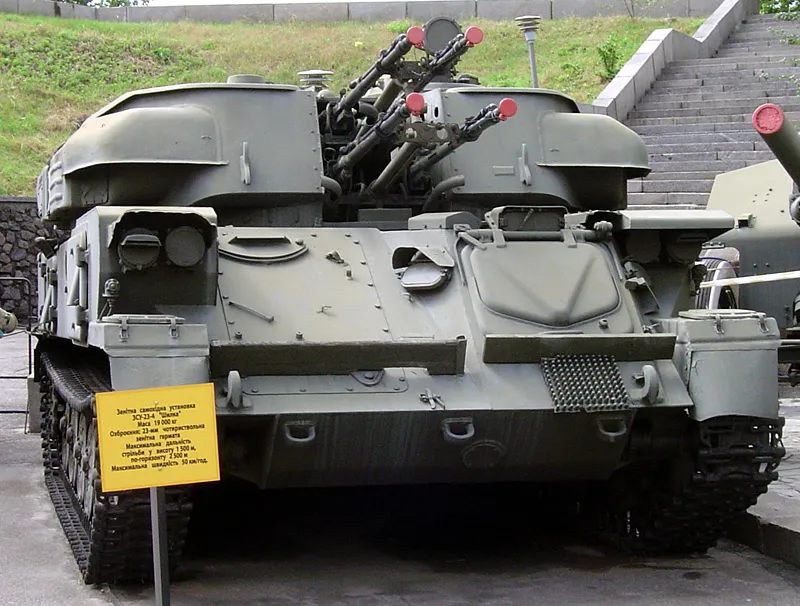
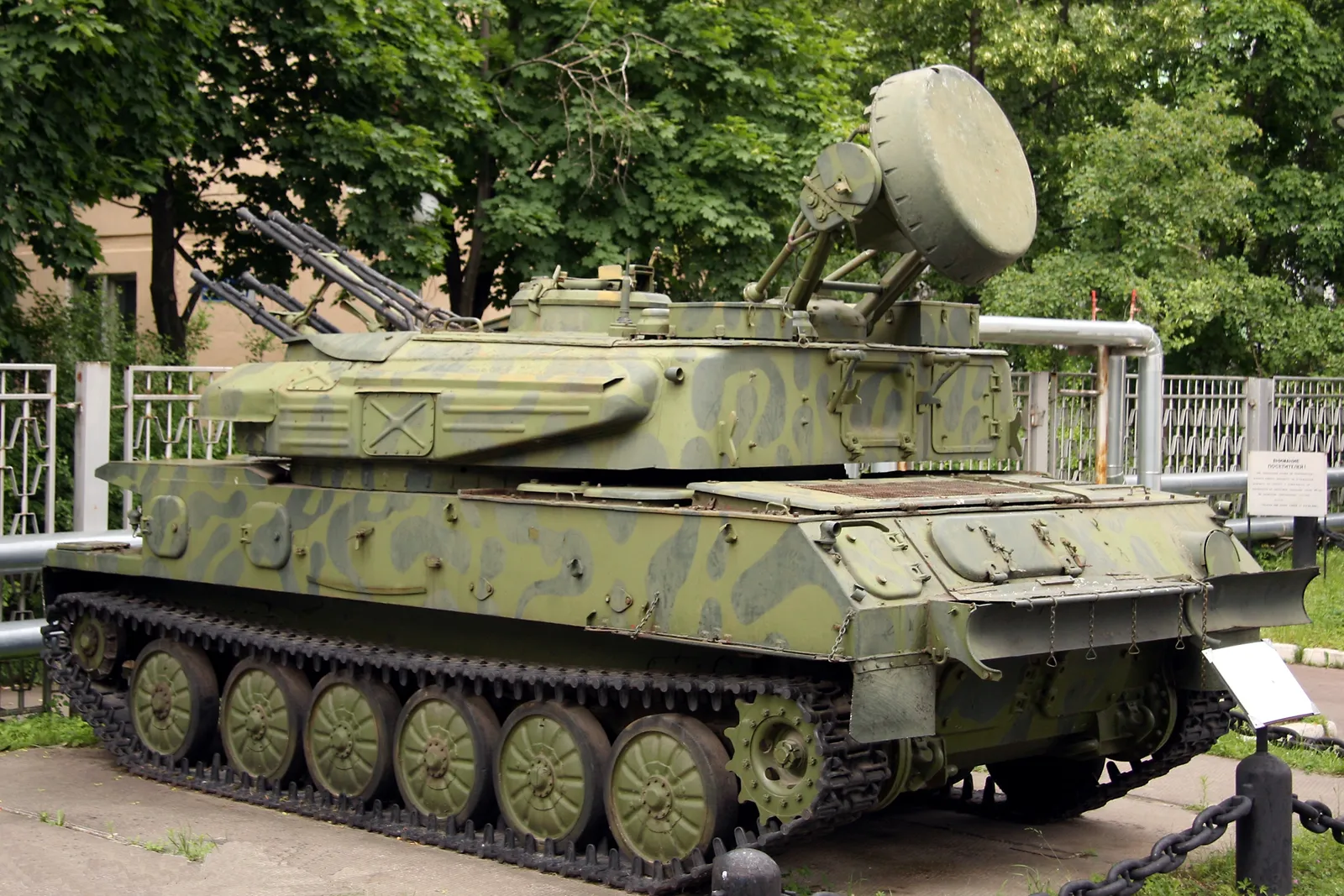
The ZSU-23-4 Shilka is a Soviet tracked self-propelled anti-aircraft gun built around a radar-directed turret with four 23 mm autocannons. Designed to accompany maneuver forces against low-flying aircraft and helicopters, it became a widely exported low-altitude air-defense system and remains visible in modern wars as both a short-range air-defense and direct-fire platform.
Role in Conflicts
- Side
- Iraq

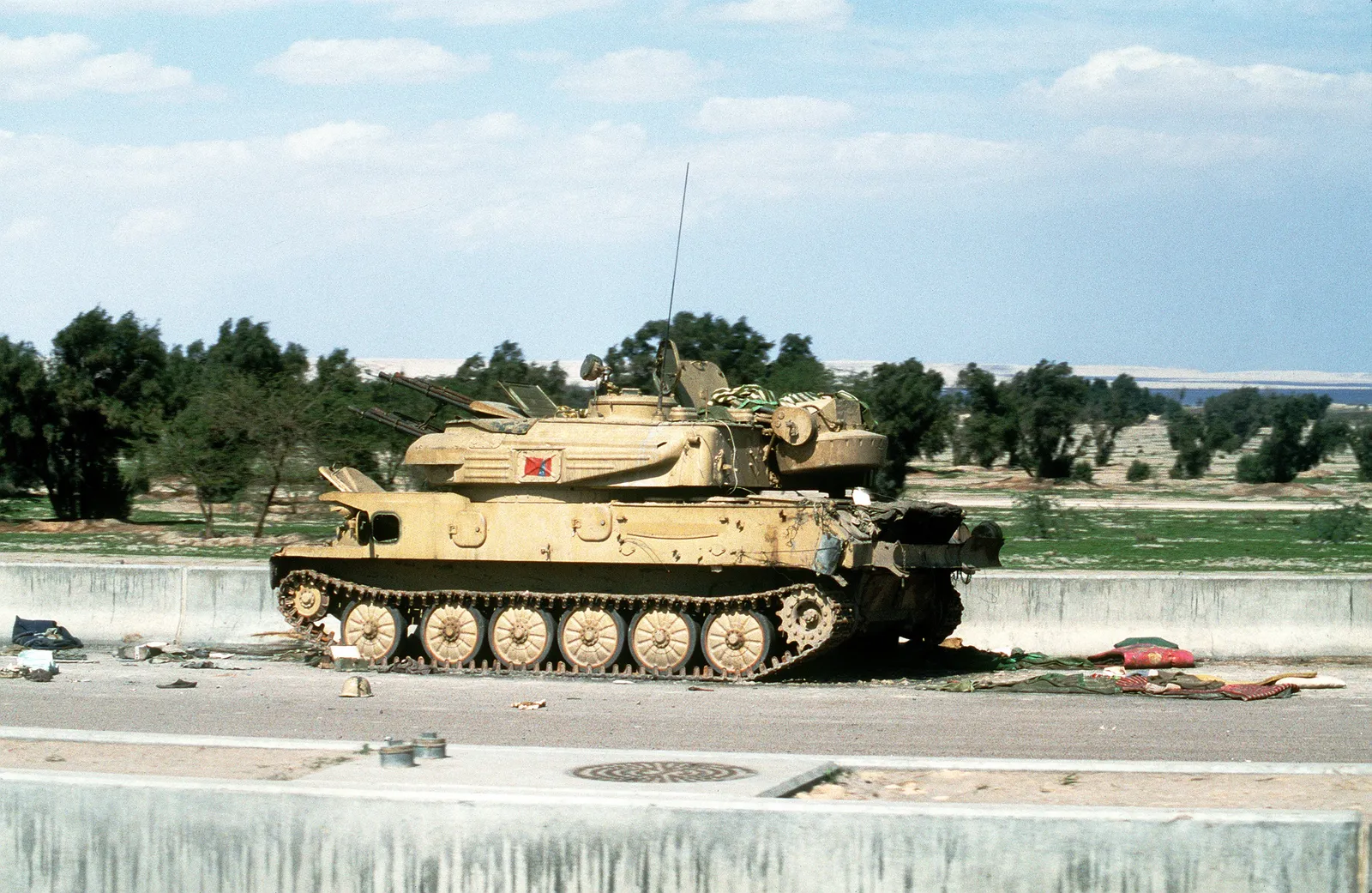
A U.S. Army museum article identifies a Shilka displayed at Rock Island Arsenal as an Iraqi Army vehicle that saw service during Operation Desert Storm and was found abandoned west of Kuwait City.
Role details

Open-source loss records document ZSU-23-4 Shilka self-propelled anti-aircraft guns in Russian and Ukrainian inventories during the full-scale invasion, including destroyed, damaged, abandoned, and captured vehicles.
Role details
Bellingcat documented the al-Bunyan al-Marsous opposition coalition employing at least one Shilka during the 2017 Manshiyah fighting in Daraa, after earlier open-source documentation of two Shilkas captured by opposition forces in Daraa in 2013.
Role details- Role in conflict
- Short-range air defense

Open-source loss records list eleven Armenian/Artsakh ZSU-23-4 Shilka self-propelled anti-aircraft guns destroyed, damaged, or captured during the 2020 Nagorno-Karabakh fighting, including one destroyed by a TB2.

Houthi-aligned forces were reported to have captured or possessed Shilka guns after taking Yemeni state military camps in 2014, placing the system in the Houthi-aligned equipment pool at the start of the 2014 Yemen Civil War.
Role details- Role in conflict
- Refurbished anti-insurgency fire support and base defense

Nigerian military officers reported that refurbished Shilka guns were deployed by Nigerian troops in the North-East anti-insurgency war against Boko Haram and ISWAP, while a separate security report cited an ISWAP claim that a Nigerian Shilka ZSU-23-4 was destroyed during a June 2019 attack on a forward operating base in Kareto, Borno.
Profile / Specs
Profile
- Origin
- Soviet Union
- Type
- Tracked self-propelled anti-aircraft gun
- Service note
- Cold War design still fielded in the 2014 Russia-Ukraine War
- Designer
- KBP Instrument Design Bureau
- Designed
- Late 1950s to early 1960s
- Unit cost
- Not publicly standardized
- Produced
- 1960s-1980s
- Number built
- About 6,500
Specifications
- Crew
- 4
- Armament
- Four 23 mm AZP-23 automatic cannons with 2,000 ready rounds on standard vehicles
- Effective range
- About 2.5 km against aerial targets with guns
- Fire control
- RPK-2/Gun Dish radar-directed fire-control system
- Weight
- About 20.5-21 tonnes combat load depending on source and variant
- Mobility
- Tracked chassis; about 50 km/h on road and about 450 km road range
- Protection
- Light welded steel armor, up to about 15 mm
Radar-Directed Quad 23 mm Layout
The Shilka combined a tracked chassis, a radar-directed turret, and four 23 mm automatic cannons so maneuver formations had a mobile low-altitude air-defense weapon instead of a static gun position.
| Element | Function | Reader note |
|---|---|---|
| Quad 23 mm cannon armament | High-volume fire against low-flying aircraft, helicopters, and close ground targets. | The standard vehicle carried four AZP-23 guns with 2,000 ready rounds. |
| RPK-2/Gun Dish radar | Target detection and fire-control support for the turret. | The radar-directed layout distinguished the Shilka from simpler towed 23 mm mounts. |
| Tracked chassis | Movement with armored and mechanized formations. | Road speed and range figures vary by source and variant, but the system was built for mobile short-range coverage. |
Sources: WeaponSystems.net ZSU-23-4 Shilka; National Defence University of Ukraine ZSU-23-4 Shilka; Tank Encyclopedia ZSU-23-4 Shilka.
Variants
The Shilka designation covers the original radar-directed ZSU-23-4 and later Soviet, Russian, and Ukrainian modernization paths that kept the same basic tracked quad-23 mm layout while changing fire-control, night-fighting, and missile-support equipment.
| Variant | Configuration | Designation notes |
|---|---|---|
| ZSU-23-4M / ZSU-23-4M3 | Soviet service upgrades | Modernized Soviet-era versions improved reliability and operating equipment while retaining the quad 23 mm gun armament. Sources: WeaponSystems.net ZSU-23-4 Shilka, Tank Encyclopedia ZSU-23-4 Shilka |
| ZSU-23-4M2 | Afghanistan-oriented fire-support adaptation | Often described as an Afghan-war adaptation that traded some radar-directed air-defense equipment for more practical ground-fire and night-fighting utility. Sources: Tank Encyclopedia ZSU-23-4 Shilka |
| ZSU-23-4M4 | Russian modernization package | Modernized branch associated with upgraded fire-control equipment and an option to add short-range surface-to-air missiles. Sources: WeaponSystems.net ZSU-23-4 Shilka, Tank Encyclopedia ZSU-23-4 Shilka |
| ZSU-23-4M-A1 Rokach | Ukrainian modernization | Ukrainian modernized Shilka configuration associated with updated radar, electro-optical equipment, and digitalized fire-control work. Sources: National Defence University of Ukraine ZSU-23-4 Shilka |
Timeline
ZSU-23-4 Shilka Key Events
Tracked quad-gun SPAAG enters Soviet development path
Open technical references place the Shilka's late-1950s and early-1960s development around a radar-directed tracked vehicle intended to replace older self-propelled anti-aircraft guns.
Sources: WeaponSystems.net ZSU-23-4 Shilka, Tank Encyclopedia ZSU-23-4 Shilka
Egypt fields radar-equipped Shilkas in the Yom Kippur War
The National Air and Space Museum identifies Egyptian ZSU-23-4s as part of the Soviet-supplied air-defense network surrounding the 1973 war.
Sources: Rescue Mission
Iraqi Shilka abandoned west of Kuwait City
A U.S. Army museum article identifies an Iraqi Army Shilka from Operation Desert Storm that was found abandoned west of Kuwait City.
Sources: RIA Self-Guided Tour: The Shiika
Bellingcat documents an opposition Shilka in Daraa
Bellingcat documented the al-Bunyan al-Marsous opposition coalition using at least one Shilka during the Battle for Manshiyah.
Sources: The Battle for Manshiyah: A Victory in 100 Pictures
Full-scale Ukraine war records show Shilkas on both sides
Oryx loss records document Russian and Ukrainian ZSU-23-4 vehicles destroyed, damaged, abandoned, or captured during the full-scale invasion.
Sources: Attack On Europe: Documenting Russian Equipment Losses During The Russian Invasion Of Ukraine, Attack On Europe: Documenting Ukrainian Equipment Losses During The Russian Invasion Of Ukraine
Modernization Paths
Later Shilka upgrades kept the compact quad-gun vehicle relevant by improving fire control, night operation, crew usability, and in some packages short-range missile integration.
| Path | Main change | Why it matters |
|---|---|---|
| Soviet M-series updates | Reliability and equipment improvements over the baseline ZSU-23-4. | These upgrades kept the original radar-directed gun system in service after early production. |
| ZSU-23-4M2 | Afghanistan-oriented adaptation emphasized practical ground-fire and night-fighting utility. | The variant reflects how the Shilka was used as direct-fire support as well as air defense. |
| ZSU-23-4M4 and M-A1 Rokach | Post-Soviet modernization packages added newer fire-control, optical, radar, or missile-related equipment. | Modernization explains why a 1960s gun system still appears in twenty-first-century inventories. |
Sources: WeaponSystems.net ZSU-23-4 Shilka; National Defence University of Ukraine ZSU-23-4 Shilka; Tank Encyclopedia ZSU-23-4 Shilka.
Related Weapon Systems


Sources
ZSU-23-4 Shilka Russian 23mm Self-Propelled Anti-Aircraft GunPublisher: ODIN - U.S. Army TRADOC | Note: Supports general background on the Shilka as a Russian/former Soviet self-propelled anti-aircraft gun still in service. | Accessed: 2026-06-20WeaponSystems.net ZSU-23-4 ShilkaPublisher: WeaponSystems.net | Note: Supports manufacturer, developer, production, armament, fire-control, crew, weight, mobility, protection, and variant details. | Accessed: 2026-06-20National Defence University of Ukraine ZSU-23-4 ShilkaPublisher: National Defence University of Ukraine | Note: Supports Ukrainian military reference data for manufacturer, crew, ammunition, firing range, speed, road range, and modernized Shilka context. | Accessed: 2026-06-20Tank Encyclopedia ZSU-23-4 ShilkaPublisher: Tank Encyclopedia | Note: Supports dimensions, crew, weight, powertrain, speed, range, and general Cold War service background. | Accessed: 2026-06-20Attack On Europe: Documenting Russian Equipment Losses During The Russian Invasion Of UkrainePublisher: Oryx | Note: Supports 2014 Russia-Ukraine War direct use; documents ZSU-23-4 Shilka self-propelled anti-aircraft guns used by Russian forces through visually recorded losses. | Accessed: 2026-06-20Attack On Europe: Documenting Ukrainian Equipment Losses During The Russian Invasion Of UkrainePublisher: Oryx | Note: Supports 2014 Russia-Ukraine War direct use; documents ZSU-23-4 Shilka self-propelled anti-aircraft guns used by Ukrainian forces through visually recorded losses. | Accessed: 2026-06-20The Fight For Nagorno-Karabakh: Documenting Losses On The Sides Of Armenia And AzerbaijanPublisher: Oryx | Note: Supports 2020 Nagorno-Karabakh Conflict direct use; documents ZSU-23-4 Shilka self-propelled anti-aircraft guns fielded by Armenia / Artsakh through visually recorded destroyed, damaged, and captured vehicles. | Accessed: 2026-06-20Research Center: 2014 Was Yemen's Bitter HarvestPublisher: Al Jazeera Arabic | Note: Supports 2014 Yemen Civil War direct use; reports Shilka guns captured by Houthi-aligned forces from Yemeni state military camps in 2014. | Accessed: 2026-06-20We Need Better Arms to Fight Boko Haram - Military CommandersPublisher: Punch Newspapers | Note: Supports 2009 Boko Haram Insurgency direct use; reports Shilka guns used by Nigerian troops deployed in the North-East anti-insurgency war and says Boko Haram recently stole one from the troops. | Accessed: 2026-06-21Armed Opposition Group Attacks - Borno State, NigeriaPublisher: SpearFish Security | Note: Supports 2009 Boko Haram Insurgency direct use; reports ISWAP claimed a Nigerian Shilka ZSU-23-4 was fielded at Kareto and destroyed during a June 2019 attack. | Accessed: 2026-06-21File:Zsu-23-4 shilka.jpgPublisher: Wikimedia Commons | Note: Image provenance and Creative Commons Attribution-Share Alike 3.0 licensing for the primary image. | Accessed: 2026-06-20File:ZSU-23-4 Shilka -03.jpgPublisher: Wikimedia Commons | Note: Image provenance and licensing context for the gallery image. | Accessed: 2026-06-20Rescue MissionPublisher: National Air and Space Museum | Note: Supports 1973 Yom Kippur War direct use; describes radar-equipped ZSU-23-4 self-propelled anti-aircraft artillery fielded by Egypt in its 1973 air-defense network. | Accessed: 2026-06-30RIA Self-Guided Tour: The ShiikaPublisher: U.S. Army | Note: Supports 1990 Gulf War direct use; identifies a Shilka fielded by the Iraqi Army during Operation Desert Storm and found abandoned west of Kuwait City. | Accessed: 2026-06-30The Battle for Manshiyah: A Victory in 100 PicturesPublisher: Bellingcat | Note: Supports 2011 Syrian Civil War direct use; documents the al-Bunyan al-Marsous opposition coalition employing at least one Shilka in the Manshiyah battle in Daraa. | Accessed: 2026-06-30Nine Years of War: Syrian Arab Army Armored Vehicle LossesPublisher: Bellingcat | Note: Supports 2011 Syrian Civil War direct use; documents two ZSU-23-4 Shilkas captured by opposition forces in Daraa governorate on December 16, 2013. | Accessed: 2026-07-05File:Iraqi ZSU-23-4 self-propelled 23mm anti-aircraft system.JPEGPublisher: Wikimedia Commons | Note: Image provenance and public-domain U.S. Navy/NARA context for the Gulf War gallery image. | Accessed: 2026-06-30