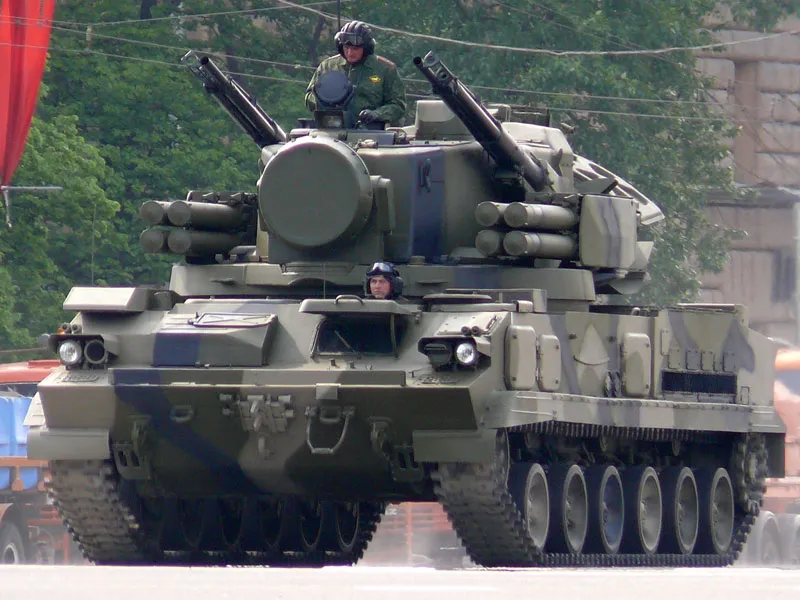


Russian 2K22M1 Tunguska systems have been visually documented as destroyed, damaged, abandoned, and captured during the full-scale invasion, with later reporting describing a December 2025 Ukrainian drone strike on a Russian 2S6. Defence24 also documents Ukrainian 2S6 Tunguska vehicles still in service, including a 2022 firing of a 9M311-series missile.
Role detailsAir Defense
2K22 Tunguska
Also known as
- 2S6 Tunguska
- 2S6M Tunguska-M
- 2S6M1 Tunguska-M1
- 9K22 Tunguska
- SA-19 Grison
- Tunguska-M
- Tunguska-M1
The 2K22 Tunguska is a Soviet-designed tracked short-range air defense system that combines twin 30 mm autocannons, 9M311-family surface-to-air missiles, search and tracking radars, and a protected self-propelled chassis. Built to cover maneuver formations against low-flying aircraft, helicopters, cruise missiles, and later unmanned threats, it appears in the 2014 Russia-Ukraine War on both Russian and Ukrainian sides, with Russian combat losses and Ukrainian missile firings documented in open sources.
Role in Conflicts
Profile / Specs
Profile
- Origin
- Soviet Union
- Built in
- Soviet UnionRussia
- Type
- Tracked self-propelled gun-missile air defense system
- Service note
- Entered Soviet service in the 1980s; still fielded by Russia and other operators
- Designer
- KBP Instrument Design Bureau
- Designed
- 1970s
- Produced
- 1970s-present
- Developed into
- Pantsir-S1
Specifications
- Crew
- 4
- Armament
- Two 30 mm 2A38/2A38M twin autocannons and up to eight 9M311 or 9M311M surface-to-air missiles
- Missile engagement envelope
- About 2.4-8 km slant range and 15-3,500 m altitude for 9M311-family missiles; ODIN lists the 2S6M1's 9M311-M1 missile range as 10 km
- Gun rate of fire
- About 1,950-5,000 rounds per minute combined, depending on source and variant
- Combat weight
- About 34,000 kg
- Mobility
- Tracked GM-352M-family chassis; about 65 km/h road speed and 500 km range
- Sensors
- Surveillance radar with about 18 km detection range and tracking radar with about 16 km tracking range
- Battery context
- Air Power Australia describes Tunguska batteries as typically deployed with PU-12M, PPRU-1M, or Ranzhir-series battery command posts
Variants
Open references usually separate the Tunguska family by combat-vehicle generation: the original 2K22/2S6, the 1990 Tunguska-M update, and the 2003 Tunguska-M1 update.
| Variant | Configuration | Designation notes |
|---|---|---|
| 2K22 / 2S6 Tunguska | Initial tracked gun-missile system | The baseline designation covers the original self-propelled system combining 9M311-series missiles with twin 30 mm 2A38 autocannons. Sources: 2S6 2S6M Tunguska 2K22 2K22M SA-19 Grison, Air Power Australia 2K22 Tunguska Overview |
| 2K22M / 2S6M Tunguska-M | 1990 Tunguska-M generation | Air Power Australia identifies 2K22M / 2S6M as the 1990 Tunguska-M generation, while Army Recognition describes the Tunguska-M as carrying eight ready-to-fire missiles. Sources: 2S6 2S6M Tunguska 2K22 2K22M SA-19 Grison, Air Power Australia 2K22 Tunguska Overview |
| 2K22M1 / 2S6M1 Tunguska-M1 | 2003 Tunguska-M1 generation | Air Power Australia places the 2K22M1 / 2S6M1 generation in 2003 and describes M1 changes aimed at cruise-missile and precision-guided-munition threats; ODIN identifies the M1 as using the GM-5975 chassis, improved fire control, and 9M311-M1 missiles. Sources: Air Power Australia 2K22 Tunguska Overview, ODIN 2S6M1 Tunguska-M1 |
Gun Armament
The Tunguska combines twin 30 mm autocannon with radar-guided missiles on one tracked chassis.
| Carried item | Item type | Carriage evidence |
|---|---|---|
 | Twin-barrel 30 mm autocannon | WeaponSystems.net states that the 2A38 was first introduced on the 2S6 Tunguska, which fields the twin-gun armament on the system. Sources: WeaponSystems.net 30mm 2A38 |
Carried Munitions
The 2K22 Tunguska is documented with ready-to-launch 9M311-series surface-to-air missiles.
| Carried item | Item type | Carriage evidence |
|---|---|---|
 | Surface-to-air missile | The 2K22 Tunguska carries ready-to-launch 9M311-series missiles, with sources describing up to eight ready rounds on the vehicle. Sources: Weaponsystems.net 9M311 |
Timeline
2K22 Tunguska Key Events
Soviet development starts
Army Recognition describes Tunguska development as beginning in 1970 to replace the ZSU-23-4 with a self-propelled air-defense system combining guns and missiles.
Sources: 2S6 2S6M Tunguska 2K22 2K22M SA-19 Grison
Tunguska-M generation appears
Air Power Australia identifies the 2K22M / 2S6M Tunguska-M generation as the 1990 successor to the initial 2K22 / 2S6 system.
Sources: Air Power Australia 2K22 Tunguska Overview
Tunguska-M1 generation enters the family
Air Power Australia places the 2K22M1 / 2S6M1 Tunguska-M1 generation in 2003, while ODIN describes the M1 as a further improved variant using the GM-5975 chassis, improved fire control, and 9M311-M1 missiles.
Sources: Air Power Australia 2K22 Tunguska Overview, ODIN 2S6M1 Tunguska-M1
Russia-Ukraine evidence expands to both sides
Oryx documented Russian 2K22M1 losses during the full-scale invasion, while Defence24 described Ukrainian 2S6 Tunguska vehicles still in use and firing a 9M311-series missile.
Sources: Attack On Europe: Documenting Russian Equipment Losses During The Russian Invasion Of Ukraine, Ukrainska Tunguska w akcji
Ukrainian drone strike reported against Russian Tunguska
UNITED24 Media reported footage of a Ukrainian drone-bomber attack on a Russian 2S6 Tunguska, adding another documented loss case to the system's Russia-Ukraine War record.
Sources: Ukraine Blows Apart Key Russian Tunguska Short-Range Air Defence
India announces a new Tunguska contract
India's Ministry of Defence announced contracts that included procurement of a Tunguska Air Defence Missile System package.
Sources: MoD inks Rs 858 crore contracts for Tunguska Air Defence Missile System
System Context
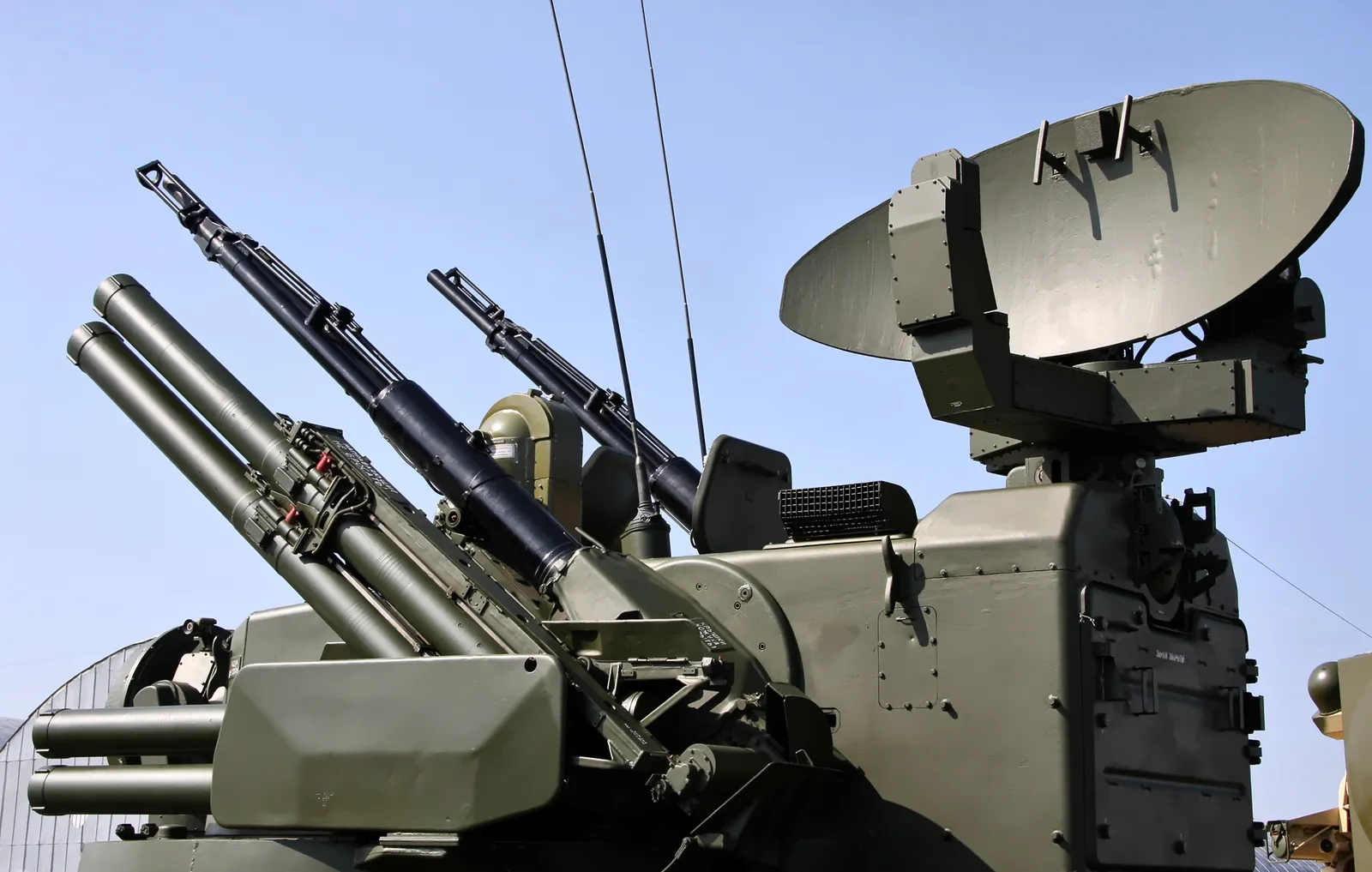
The Tunguska combines a protected tracked chassis, radar-directed 30 mm guns, and 9M311-family missiles, so the record separates family history, carried weapons, and conflict use instead of treating every designation as a separate weapon.
Family generations
Open references distinguish the initial 2K22/2S6, the 1990 Tunguska-M generation, and the 2003 Tunguska-M1 generation.
Sources: Air Power Australia 2K22 Tunguska Overview; ODIN 2S6M1 Tunguska-M1.
Carried weapons
The relationships section links the 30 mm 2A38 autocannon and 9M311 missile pages as carried armament without copying unsupported conflict context into those component records.
Sources: WeaponSystems.net 30mm 2A38; Weaponsystems.net 9M311.
Conflict evidence
The Russia-Ukraine War row is limited to direct evidence: Russian losses and strikes, plus Ukrainian Tunguska use reported with a 9M311-series missile firing.
Sources: Attack On Europe: Documenting Russian Equipment Losses During The Russian Invasion Of Ukraine; Ukrainska Tunguska w akcji; Ukraine Blows Apart Key Russian Tunguska Short-Range Air Defence.
Related Weapon Systems


Sources
2S6 2S6M Tunguska 2K22 2K22M SA-19 GrisonPublisher: Army Recognition | Note: Supports system background, role, variants, users, armament, radar, mobility, dimensions, and other specifications. | Accessed: 2026-06-20Weaponsystems.net 9M311Publisher: Weaponsystems.net | Note: Supports the Tunguska's carried 9M311-series missile family and launch relationship. | Accessed: 2026-06-23Joint-Stock Company Ulyanovsk Mechanical PlantPublisher: War & Sanctions | Note: Supports manufacturer context for Tunguska-M1 air defense systems and Ulyanovsk Mechanical Plant. | Accessed: 2026-06-20Attack On Europe: Documenting Russian Equipment Losses During The Russian Invasion Of UkrainePublisher: Oryx | Note: Supports 2014 Russia-Ukraine War use context through visually confirmed Russian 2K22M1 Tunguska losses. | Accessed: 2026-06-20Russian 2S6 Tunguska System Knocked Out as Ukraine Suppresses Short-Range Air DefensePublisher: Defense Express | Note: Supports 2014 Russia-Ukraine War conflict-use context for a Russian 2S6 Tunguska struck by Ukrainian drone-delivered munitions. | Accessed: 2026-06-202008 Moscow Victory Day Parade - 9K22 Tunguska.jpgPublisher: Wikimedia Commons | Note: Supports image provenance and licensing; Commons lists the file as CC BY 3.0. | Accessed: 2026-06-20WeaponSystems.net 30mm 2A38Publisher: WeaponSystems.net | Note: Supports the Tunguska's 2A38 gun armament and the fact that the 2A38 was first introduced on the 2S6 Tunguska. | Accessed: 2026-06-23Air Power Australia 2K22 Tunguska OverviewPublisher: Air Power Australia | Note: Supports Tunguska family designation structure, M/M1 chronology, radar and gun background, battery command-post context, and the later Pantsir line relationship. | Accessed: 2026-06-30ODIN 2S6M1 Tunguska-M1Publisher: U.S. Army TRADOC OE Data Integration Network | Note: Supports Tunguska-M1 variant context, GM-5975 chassis, improved fire-control system, and 9M311-M1 missile range. | Accessed: 2026-07-02Ukrainska Tunguska w akcjiPublisher: Defence24 | Note: Supports 2014 Russia-Ukraine War direct conflict-use context for Ukrainian 2S6 Tunguska systems, including footage described as a Ukrainian vehicle firing a 9M311-series missile. | Accessed: 2026-06-30Ukraine Blows Apart Key Russian Tunguska Short-Range Air DefencePublisher: UNITED24 Media | Note: Supports 2014 Russia-Ukraine War direct conflict-use context for a December 2025 Ukrainian drone strike reported against a Russian 2S6 Tunguska. | Accessed: 2026-07-02MoD inks Rs 858 crore contracts for Tunguska Air Defence Missile SystemPublisher: Press Information Bureau, Government of India | Note: Supports current operator and procurement context through India's 27 March 2026 contract announcement for a Tunguska Air Defence Missile System package. | Accessed: 2026-06-302S6M1 Tunguska-M1 SAM-system.jpgPublisher: Wikimedia Commons | Note: Supports image provenance and licensing for a Commons photograph of a Tunguska-M1 system at MAKS-2011; Commons lists the file under CC BY-SA 4.0. | Accessed: 2026-06-30