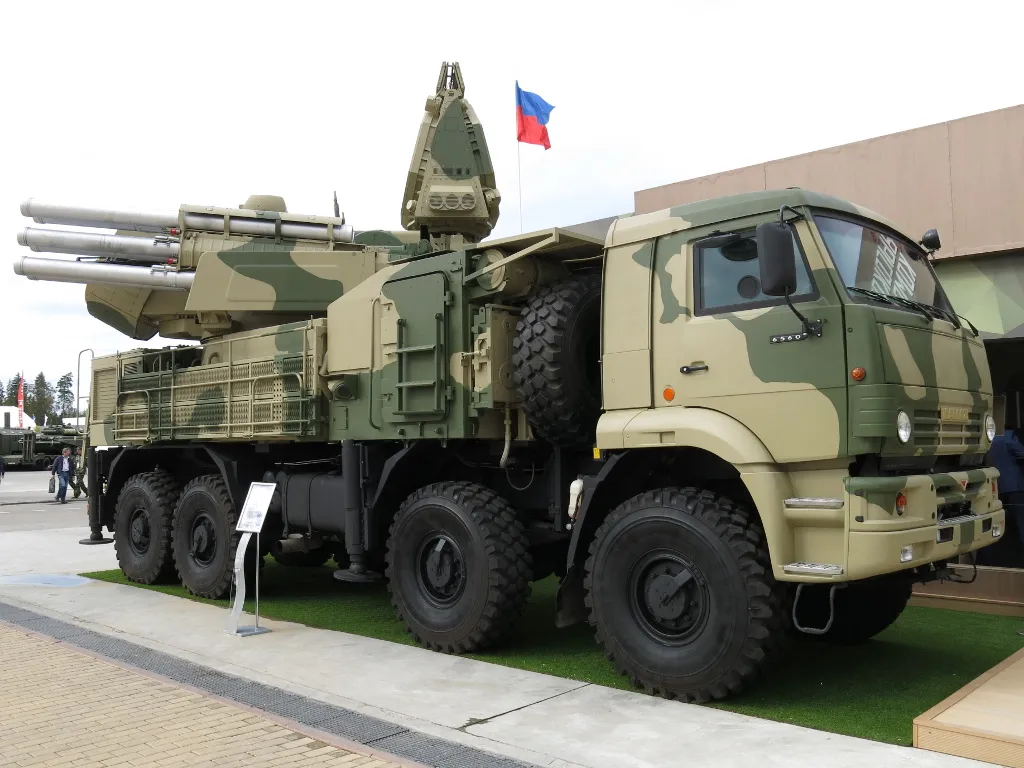


Documented in eastern Ukraine before the 2022 full-scale invasion and later fielded by Russian forces as a short-range air-defense missile-gun system; open-source loss records document destroyed, damaged, and captured Pantsir-S1 vehicles, and Ukrainian officials reported at least one captured system entering Ukrainian air-defense service.
Role detailsAir Defense
Pantsir-S1
Also known as
- SA-22 Greyhound
- Pantsir S-1
- Pantsyr
- 96K6 Pantsir-S1
- 72V6 combat vehicle
- Pantsir-S1E
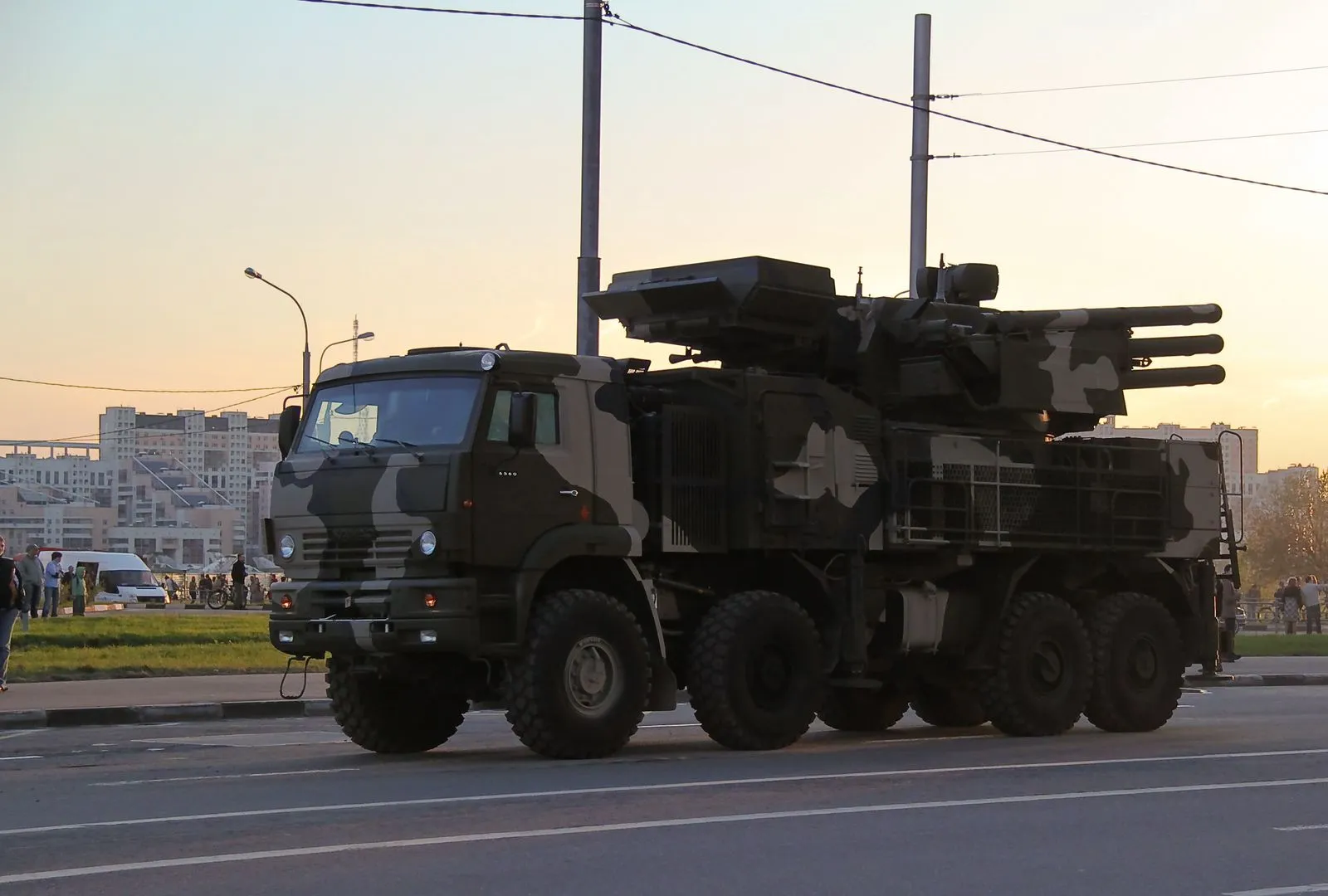
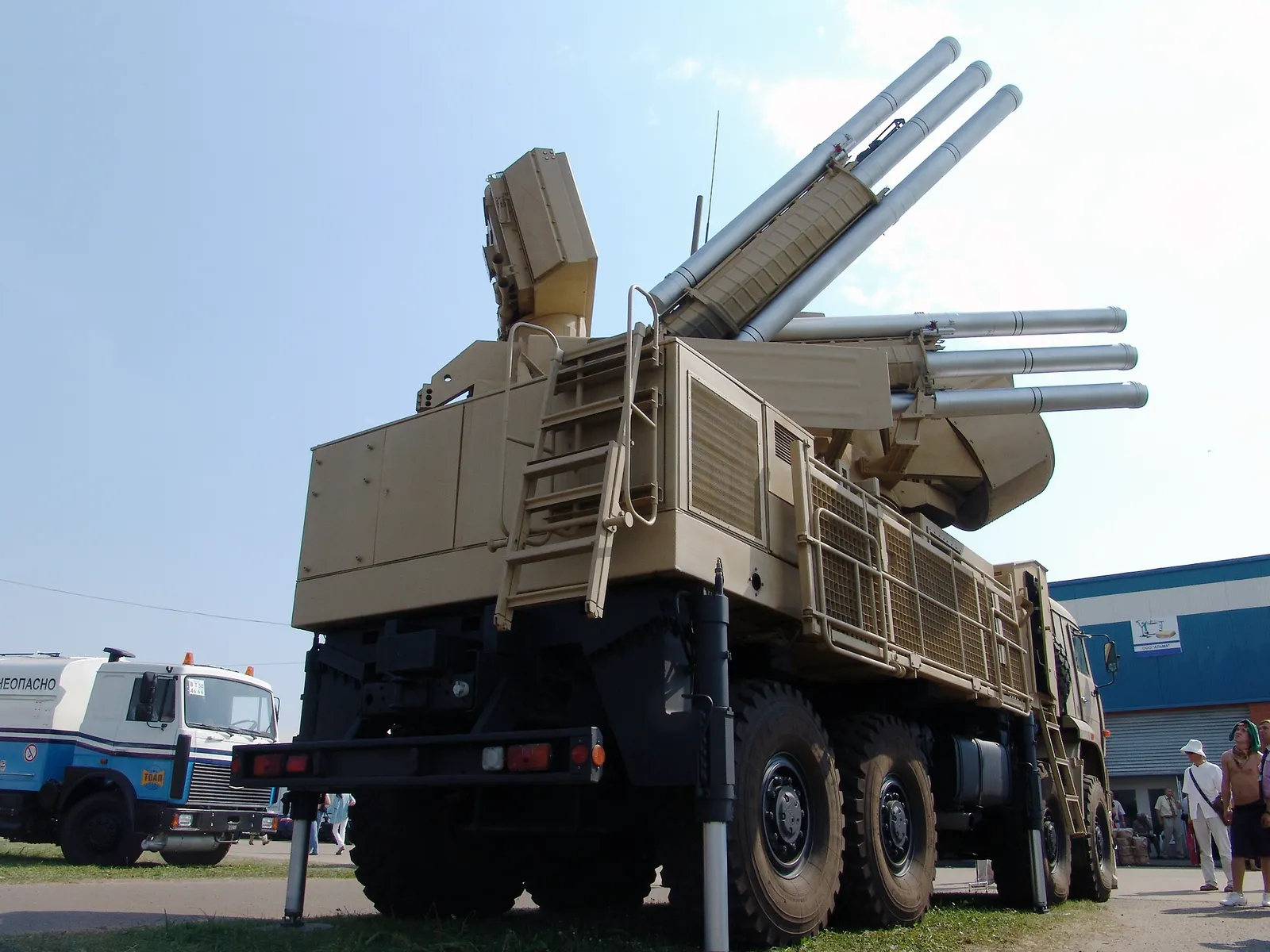
The Pantsir-S1 is a Russian mobile point-defense system that combines 57E6-family command-guided surface-to-air missiles, twin 30 mm 2A38M automatic cannon, target-acquisition radar, engagement radar, and electro-optical fire control on a wheeled combat vehicle. It is designed to protect military units, air-defense sites, infrastructure, and longer-range air-defense formations against aircraft, helicopters, cruise missiles, precision weapons, and UAVs, with documented or reported conflict relevance in Ukraine, Syria, Libya, Yemen, and Sudan.
Role in Conflicts

Fielded by Russian forces in Syria to defend Russian personnel and Syrian government forces, with the system documented in the war's air-defense and counter-UAV context. In the April 2018 U.S., UK, and French strike phase of the same war, Russian officials reported Pantsir-S1 use by Syrian air defenses; U.S. officials disputed the claimed intercepts and assessed Syrian surface-to-air missile fire as ineffective.
Role details
Fielded by Libyan National Army-aligned and Wagner-linked forces during the Tripoli offensive; New America documented Pantsir S1 crews and visually confirmed destroyed systems, while Oryx reported LNA Pantsir-S1 systems struck and captured around al-Watiya in 2020.

Deployed with UAE and coalition forces in Marib during the 2015 eastern-front buildup; Washington Institute reporting placed UAE Pantsir-S1 systems and Patriot batteries at the Safir forward operating base after the September 4 missile strike on coalition troops.
Role details
Reported in November 2023 as captured or escorted by non-government armed personnel in Sudan; Army Recognition linked the footage to the Rapid Support Forces but noted that the exact capture circumstances and custody chain remained unclear.
Conflict Use Notes
The Pantsir-S1 conflict record mixes direct fielding, visual loss evidence, official claims, and reported captures. Ukraine coverage now spans early-war imagery in eastern Ukraine, 2022-onward Russian losses, and at least one captured system reported in Ukrainian service.
Ukraine
ARES documented imagery and video evidence of 96K6 Pantsir-S1 systems in eastern Ukraine in 2015; later open-source records document Russian losses and captures during the full-scale invasion.
Syria
CSIS ties Russian Pantsir-S1 deployment to defense of Russian personnel and Syrian government forces, while 2018 missile-strike claims remain disputed by U.S. officials.
Libya, Yemen, Sudan
Separate reporting places Pantsir-S1 systems with LNA/Wagner-linked forces in Libya, UAE coalition forces in Yemen, and likely RSF custody in Sudan, with the Sudan capture chain still unclear.
Sources: Russian 96K6 Pantsir-S1 air defence system in Ukraine; Attack On Europe: Documenting Russian Equipment Losses During The Russian Invasion Of Ukraine; Captured Russian "Pantsir" fights for Ukraine, takes out first target; Pantsir S-1; Trump Dismisses Russia Claims Syria Successfully Shot Down US Missiles; Pentagon Officials Describe Syria Strikes; Analyzing Wagner Group Air Defense and Ground Maneuvers; Al-Watiya: From A Libyan Super Base To Turkish Air Base; The Escalating Northern Front in Yemen; Sudanese Rebels Capture Russian Pantsir-S1 Air Defense System.
Profile / Specs
Profile
- Origin
- Russia
- Built by
- KBP Instrument Design Bureau
- Type
- Self-propelled short-range surface-to-air missile and anti-aircraft gun system
- Service note
- 2000s-present
- Designer
- KBP Instrument Design Bureau
- Designed
- Development began in 1989
- Unit cost
- Not stated in official sources
- Produced
- 2000s-present
- Number built
- Not publicly confirmed
- Developed from
- 2K22 Tunguska
Specifications
- Role
- Point defense against aircraft, helicopters, cruise missiles, precision weapons, and UAVs
- NATO reporting name
- SA-22 Greyhound
- Missile armament
- 12 surface-to-air missiles
- Missile type
- 57E6-family two-stage radio-command-guided missiles
- Missile warhead
- 20 kg blast-fragmentation warhead on the 57E6 missile
- Gun armament
- Two twin-barrel 30 mm 2A38M automatic guns
- Target acquisition radar
- Detects and tracks up to 40 air targets
- Missile engagement range
- 1,200-20,000 m against aircraft-class targets
- Missile engagement altitude
- 15-15,000 m against aircraft-class targets
- Gun engagement range
- 200-4,000 m
- Gun engagement altitude
- 0-3,000 m
- Maximum target speed
- Up to 1,000 m/s for engaged targets
- Simultaneous engagements
- Up to four targets
- Response time
- 4-6 seconds, according to Ukrainian GUR War & Sanctions data
- Deployment time
- 3 minutes, according to Ukrainian GUR War & Sanctions data
Variants
Pantsir-S1 is the baseline land-based member of the family; later land variants change sensors, missile options, or engagement envelopes while retaining the missile-gun point-defense concept.
| Variant | Configuration | Designation notes |
|---|---|---|
| Pantsir-S1M | Improved export model | Rosoboronexport presents Pantsir-S1M with 57E6M-E, 57E6-E, and TKB-1055 missile options and a longer stated engagement envelope than the baseline S1 export page. Sources: "Pantsir-S1M" ADMGS |
 | Modernized Russian-service land variant | Army Recognition describes Pantsir-S2 as an improved Pantsir-S1 version with a new SOTS S-band search radar and longer stated missile reach. Sources: Army Recognition Pantsir-S2 |
| Pantsir-SM | Later longer-range development | CSIS identifies Pantsir-SM as a later Pantsir development with a longer-range engagement envelope than earlier S1-family systems. Sources: Pantsir S-1 |
Gun Armament
The baseline Pantsir-S1 combines missile launchers with twin 30 mm cannon for close-range engagements.
| Carried item | Item type | Carriage evidence |
|---|---|---|
 | Twin-barrel autocannon component | CSIS describes the baseline Pantsir system as carrying two 30 mm 2A38M cannons alongside up to twelve 57E6 missiles. Sources: Pantsir S-1 |
Ammunition Fired
The cannon side of the Pantsir-S1 uses the 2A38M family, with compatible 30x165 mm ammunition treated separately from the air-defense vehicle.
| Ammunition | Ammunition type | Firing evidence |
|---|---|---|
 | 30x165 mm autocannon ammunition family | CSIS identifies the Pantsir-S1 gun armament as two 30 mm 2A38M cannon, while Yugoimport documents HE-T and HEI-T 30x165 mm ammunition for 2A38M-family guns. Sources: Pantsir S-1, Yugoimport 30 mm x 165 HE-T/HEI-T |
Family And Armament Notes
Pantsir-S1 sits between the earlier Tunguska missile-gun concept and later Pantsir upgrades. The baseline vehicle is easiest to compare by its two weapon channels: radio-command missiles and twin 30 mm cannon.
| Lane | Documented point | Reader note |
|---|---|---|
| Design lineage | CSIS describes Pantsir development as beginning in 1989 as a successor to Tunguska. | The design lineage runs through 2K22 Tunguska, while Tunguska's own combat record remains separate. |
| Land variants | Rosoboronexport, CSIS, and Army Recognition separate S1M, S2, and SM upgrade paths by missile options, radar changes, or longer stated range. | S2 has separate detailed coverage; S1M and SM remain summarized designations here. |
| Cannon ammunition | CSIS identifies two 2A38M cannon on Pantsir-S1, and Yugoimport lists 30x165 mm HE-T/HEI-T ammunition for 2A38M-family guns. | The 30x165 mm family is treated as ammunition support, not as independent conflict use by the rounds. |
Sources: Pantsir S-1; "Pantsir-S1M" ADMGS; Army Recognition Pantsir-S2; Yugoimport 30 mm x 165 HE-T/HEI-T.
Timeline
Pantsir-S1 Key Events
Development begins
KBP Instrument Design Bureau began Pantsir development as a successor to the 2K22 Tunguska short-range air-defense system.
Sources: Pantsir S-1
Finalized design enters service
CSIS lists the finalized Pantsir design as entering service in 2003.
Sources: Pantsir S-1
Russian deployment to Syria
CSIS reports that Russia deployed Pantsir S-1 systems to Syria from 2013 to defend Russian personnel and Syrian government forces.
Sources: Pantsir S-1
Pantsir-S1 documented in eastern Ukraine
ARES assessed imagery from Shakhtersk and a later Lugansk video as evidence of Russian 96K6 Pantsir-S1 systems inside Ukraine during the early war period.
Sources: Russian 96K6 Pantsir-S1 air defence system in Ukraine
UAE systems deployed in Yemen
Washington Institute reporting placed UAE Pantsir-S1 systems with coalition forces in Marib after a September 4 missile strike against the Safir forward operating base.
Sources: The Escalating Northern Front in Yemen
Disputed Syrian missile-strike claims
Russian officials claimed Syrian Pantsir-S1 systems engaged U.S., UK, and French missiles during the April 2018 U.S., UK, and French strikes in the 2011 Syrian Civil War, while U.S. officials said Syrian surface-to-air missile fire was ineffective.
Sources: Trump Dismisses Russia Claims Syria Successfully Shot Down US Missiles, Pentagon Officials Describe Syria Strikes
Libya losses around al-Watiya
Open-source reporting documented LNA-aligned Pantsir-S1 systems struck or captured around al-Watiya air base during the Libyan Civil War.
Sources: Al-Watiya: From A Libyan Super Base To Turkish Air Base, Analyzing Wagner Group Air Defense and Ground Maneuvers
Captured system reported in Ukrainian service
Ukrainska Pravda reported Ukrainian claims that a captured Russian Pantsir-S1 had entered Ukrainian air-defense service and shot down its first target.
Sources: Captured Russian "Pantsir" fights for Ukraine, takes out first target
Sudan capture report
Army Recognition reported that video from Sudan showed a Pantsir-S1E with non-government armed personnel, most likely RSF-linked, while caveating the capture circumstances.
Sources: Sudanese Rebels Capture Russian Pantsir-S1 Air Defense System
Related Weapon Systems


Sources
"Pantsir-S1" ADMGSPublisher: Rosoboronexport | Note: Official export product page supporting system role, armament, engagement envelope, target handling, and background description. | Accessed: 2026-06-20Pantsir S-1Publisher: Center for Strategic and International Studies Missile Threat | Note: Supports manufacturer/design background, class, service context, general Pantsir-S1 specifications, and 2011 Syrian Civil War direct use because it says Pantsir S-1 was fielded by Russia in Syria to defend Russian soldiers and Syrian government forces. | Accessed: 2026-06-2072V6 combat vehicle of the Pantsir-S1 air defense systemPublisher: Defense Intelligence of Ukraine War & Sanctions | Note: Supports the 72V6 combat-vehicle designation, KBP main manufacturer/designer attribution, component context, response time, and deployment time; technical data is attributed to Ukrainian intelligence. | Accessed: 2026-06-24"Pantsir-S1M" ADMGSPublisher: Rosoboronexport | Note: Official export product page supporting Pantsir-S1M variant context, missile options, and increased engagement envelope. | Accessed: 2026-06-24Army Recognition Pantsir-S2Publisher: Army Recognition | Note: Supports Pantsir-S2 variant identity, its new SOTS S-band search radar, longer stated missile reach, and relationship to the earlier Pantsir-S1 configuration. | Accessed: 2026-06-30Yugoimport 30 mm x 165 HE-T/HEI-TPublisher: Yugoimport-SDPR | Note: Supports the relationship between 2A38M-family cannon and 30x165 mm HE-T/HEI-T ammunition, including compatibility and technical ammunition context. | Accessed: 2026-06-30Russian 96K6 Pantsir-S1 air defence system in UkrainePublisher: Armament Research Services | Note: Supports 2014 Russia-Ukraine War direct use because it documents photographic evidence of a 96K6 Pantsir-S1 in Shakhtersk and a later video from Lugansk during the early war period. | Accessed: 2026-07-02Attack On Europe: Documenting Russian Equipment Losses During The Russian Invasion Of UkrainePublisher: Oryx | Note: Supports 2014 Russia-Ukraine War direct use because Pantsir-S1 was fielded by Russian forces and visually documented as destroyed, damaged, and captured during the invasion. | Accessed: 2026-06-20Captured Russian "Pantsir" fights for Ukraine, takes out first targetPublisher: Ukrainska Pravda | Note: Supports 2014 Russia-Ukraine War direct use because a captured Pantsir-S1 was used by Ukrainian forces in air-defense service, citing Ukraine's Ministry of Defence and Air Force Command spokesman Yurii Ihnat. | Accessed: 2026-06-20The Escalating Northern Front in YemenPublisher: The Washington Institute for Near East Policy | Note: Supports 2014 Yemen Civil War direct use because it reports UAE Pantsir-S1 systems deployed with coalition forces at the Safir forward operating base in Marib after the September 2015 missile strike. | Accessed: 2026-06-30Sudanese Rebels Capture Russian Pantsir-S1 Air Defense SystemPublisher: Army Recognition | Note: Supports 2023 Sudan War direct use because it reports video evidence of a Pantsir-S1E air-defense system in likely Rapid Support Forces custody while noting uncertainty over the capture circumstances. | Accessed: 2026-06-30Analyzing Wagner Group Air Defense and Ground ManeuversPublisher: New America | Note: Supports 2014 Second Libyan Civil War direct use because Pantsir S1 batteries were fielded by Wagner Group and Libyan National Army-aligned forces during the Tripoli offensive, with multiple systems documented as damaged or destroyed. | Accessed: 2026-06-20Al-Watiya: From A Libyan Super Base To Turkish Air BasePublisher: Oryx | Note: Supports 2014 Second Libyan Civil War direct use because Pantsir-S1 systems were fielded by the Libyan National Army, struck by GNA forces, and captured around al-Watiya air base. | Accessed: 2026-06-22Trump Dismisses Russia Claims Syria Successfully Shot Down US MissilesPublisher: Voice of America | Note: Supports April 2018 U.S., UK, and French strikes in the 2011 Syrian Civil War direct use because VOA reports Russian Defense Ministry claims that Pantsir-S1 was used by Syrian air defenses and launched surface-to-air missiles during the U.S., UK, and French strikes; the same article records U.S. officials disputing the claimed intercepts. | Accessed: 2026-06-20Pentagon Officials Describe Syria StrikesPublisher: U.S. Department of Defense | Note: Supports background context for the April 2018 U.S., UK, and French strikes in the 2011 Syrian Civil War and the U.S. assessment that Syrian surface-to-air missile launches did not successfully engage coalition aircraft or missiles. | Accessed: 2026-06-20File:96K6 Pantsir S1.jpgPublisher: Wikimedia Commons | Note: Primary image provenance; Commons lists the photo as own work by Boevaya mashina under CC BY-SA 4.0. | Accessed: 2026-06-20File:Pantsir-S1 SAM on KamAZ-6560-chassis.jpgPublisher: Wikimedia Commons | Note: Gallery image provenance; Commons records a Pantsir-S1 on KamAZ-6560 chassis at MAKS 2007 by Vitaly V. Kuzmin under CC BY-SA licensing. | Accessed: 2026-06-20File:Pantsir-S1 SAM.jpgPublisher: Wikimedia Commons | Note: Gallery image provenance; Commons records the Pantsir-S1 photo under CC BY-SA 3.0 with Picasa review history. | Accessed: 2026-06-20