- Side
- Ukraine

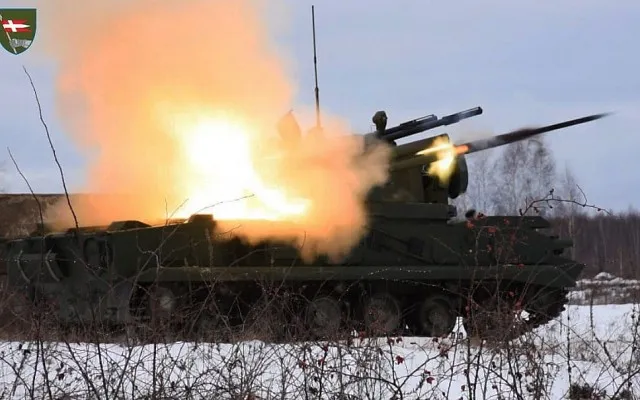
Defence24 reported an October 2022 video of a Ukrainian 2S6 Tunguska in service firing a 9M311-series missile during the war.
Role detailsThe 9M311 is a Soviet two-stage, radio-command guided surface-to-air missile family developed for the Tunguska gun-missile air-defense system and adapted for naval Kortik/Kashtan installations. Sources describe a detachable booster, an unpowered missile stage guided by radio commands, and a continuous-rod warhead. Open reporting also documents Ukrainian Tunguska use with a 9M311-series missile firing during the 2014 Russia-Ukraine War.
Defence24 reported an October 2022 video of a Ukrainian 2S6 Tunguska in service firing a 9M311-series missile during the war.
Role detailsThe family is usually separated by launch-system generation and export or naval suffixes: original Tunguska missiles, naval Kortik/Kashtan missiles, Tunguska-M updates, and the later M1 missile.
| Variant | Configuration | Designation notes |
|---|---|---|
| 9M311 | Original Tunguska missile | Weaponsystems.net identifies 9M311 as the original missile introduced with the 2S6 Tunguska in 1982. Sources: Weaponsystems.net 9M311 |
| 9M311-1 | Export designation | Weaponsystems.net lists 9M311-1 as the export model of the original missile. Sources: Weaponsystems.net 9M311 |
| 9M311K / 3M87 | Naval Kortik missile | Missilery.info describes the 9M311K missile in the Kortik system as unified with the 2K22 Tunguska missile, while Weaponsystems.net identifies 3M87 as the naval GRAU index. Sources: Missilery.info Kortik, Weaponsystems.net 9M311 |
| 9M311M / 3M88 | Tunguska-M update | Weaponsystems.net describes 9M311M as the Tunguska-M missile introduced in 1990 with pulsating tracking illuminators for better electronic-counter-countermeasure resistance. Sources: Weaponsystems.net 9M311 |
| 9M311-M1 / 9M311M1 | Tunguska-M1 and Kashtan-M missile | Weaponsystems.net and ODIN describe the M1 missile as a later 10 km-range update for Tunguska-M1, with a radio proximity fuse and improved tracking features. |
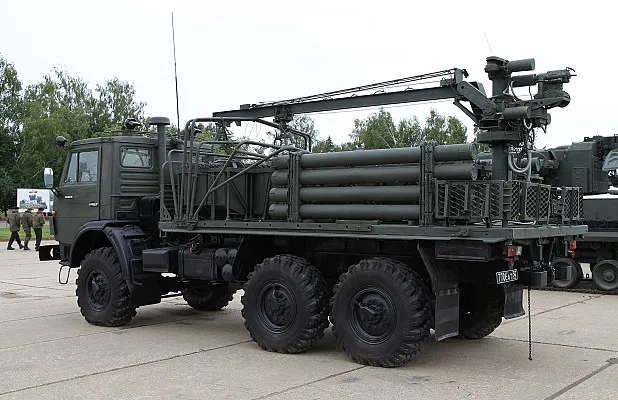
The 9M311 family is documented as the missile armament for the 2K22 Tunguska short-range air-defense system.
| Carrier | Carrier type | Carriage evidence |
|---|---|---|
 | Tracked self-propelled air-defense system | The 2K22 Tunguska carries ready-to-fire 9M311-series missiles, with the later Tunguska-M1 using the improved 9M311-M1 missile. |
The 9M311 family is best understood through its launch systems and guidance arrangement: the missile is fired from a transport-launch container, receives radio-command corrections from the host system, and relies on a booster that separates early in flight.
Missilery.info describes a bicaliber missile with a detachable 152 mm launch motor and a 76 mm missile stage that continues by inertia after booster separation.
Sources: Missilery.info 9M311; Weaponsystems.net 9M311.
The 2K22 Tunguska carries the 9M311 family as its missile armament, with Tunguska-M1 tied to the improved 9M311-M1 missile.
Sources: Weaponsystems.net 9M311; ODIN 2S6M1 Tunguska-M1.
The naval Kortik/Kashtan system used the 9M311K missile, described by Missilery.info as unified with the Tunguska missile and mounted in cylindrical shipboard launch containers.
Source: Missilery.info Kortik.
Weaponsystems.net places 9M311 service entry with the 2S6 Tunguska in 1982.
Missilery.info places the ZM87 Kortik system in service in 1989 and describes its 9M311K missile as unified with the 2K22 Tunguska missile.
Weaponsystems.net identifies 9M311M as the improved Tunguska-M missile introduced in 1990.
KBP, ODIN, and Weaponsystems.net describe the 2S6M1/Tunguska-M1 generation as using the improved 9M311-1M or 9M311-M1 missile with a 10 km range.
Defence24 reported footage of a Ukrainian 2S6 Tunguska firing a 9M311-series missile during the full-scale phase of the Russia-Ukraine War.