
A-29 Super Tucano
Represents Nigeria's U.S.-backed light-attack and ISR layer introduced to the counter-insurgency air campaign.
Aircraft & UAVs / Turboprop light attack and armed reconnaissance aircraftConflict side
Nigerian government and allied forces in the Boko Haram insurgency center on the Armed Forces of Nigeria, especially joint ground and air operations in the northeast, reinforced by Lake Chad regional partners and local auxiliary forces operating against Boko Haram and ISWAP.
26 weapon systemsNigerian government and allied forces is a conflict-scoped side anchored in Nigeria's counter-insurgency campaign against Boko Haram and Islamic State West Africa Province. The core force is the Armed Forces of the Federal Republic of Nigeria, with the Ministry of Defence, Defence Headquarters, Nigerian Army, Nigerian Air Force, Nigerian Navy, and other security agencies providing the state framework for operations in Borno, Yobe, Adamawa, and the wider Lake Chad basin.
The side is broader than the Nigerian military alone. It includes regional troops under the African Union-authorized Multinational Joint Task Force, Nigerian air and ground components operating under Operation Lafiya Dole and later Operation Hadin Kai, and local auxiliaries such as the Civilian Joint Task Force when they are described as supporting Nigerian security forces against insurgent groups.
The equipment profile is shaped by counter-insurgency rather than conventional front lines. Nigerian and allied forces rely on attack aircraft, armed helicopters, surveillance aircraft, armored personnel carriers, MRAPs, gun trucks, infantry weapons, and explosive-ordnance capability to protect towns, escort movements, raid insurgent camps, and respond to attacks on military positions.
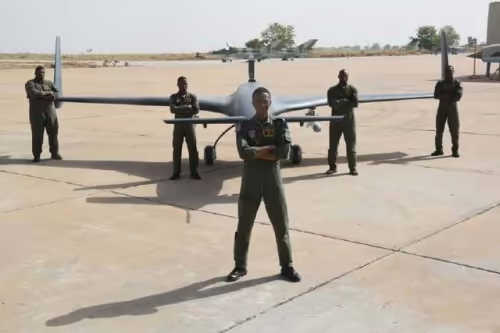
Air power is unusually prominent in the public record. Nigerian Air Force reporting places Alpha Jets, L-39ZA jets, Mi-35M helicopters, Super Puma helicopters, CH-3A unmanned aircraft, King Air platforms, ATR-42 ISR aircraft, and later A-29 Super Tucanos inside the northeast counter-insurgency environment. U.S. Africa Command described the A-29 package as a precision-strike and ISR capability intended to help Nigeria fight violent extremist organizations including ISWAP.
Regional cooperation is central because Boko Haram and ISWAP operate across border terrain around Lake Chad. The MNJTF links forces from Lake Chad basin states and Benin under an AU mandate to create safer conditions, reduce insurgent activity, and support stabilization in affected areas. Its structure makes this side a coalition-style mapping rather than a profile of only one national service.
The side also carries persistent sourcing and accountability limits. Equipment evidence often comes from official statements, donor releases, open-source imagery, captured materiel, and battlefield-loss reporting. Civilian harm allegations, child-recruitment history around allied local militia structures, and insurgent propaganda claims require careful attribution and should not be converted into weapon-specific custody claims without direct evidence in the weapon record.
Represents Nigeria's U.S.-backed light-attack and ISR layer introduced to the counter-insurgency air campaign.
Aircraft & UAVs / Turboprop light attack and armed reconnaissance aircraft
Highlights the older jet-attack fleet documented in Nigerian and Cameroonian strikes against Boko Haram targets.
Aircraft & UAVs / Twin-engine advanced trainer and light attack aircraft
Represents attack-helicopter fire support and armed escort capability in the northeast air task force.
Aircraft & UAVs / Attack helicopter and armed assault transport
Highlights protected mobility for Nigerian troops facing mines, ambushes, and IED-threat routes.
Armored Vehicles / 4x4 mine-resistant ambush-protected armored personnel carrier
Represents export armored vehicles documented with Nigerian forces and in insurgent capture narratives.
Armored Vehicles / 8x8 wheeled armored personnel carrier / infantry fighting vehicleNigeria's Ministry of Defence describes its role as enabling the Armed Forces of the Federal Republic of Nigeria to maintain mission-ready forces for national defence. The ministry's listed military components include Defence Headquarters, the Nigerian Army, the Nigerian Navy, and the Nigerian Air Force.
Defence Headquarters presents the Armed Forces as the national military institution that grew from Royal West African Frontier Force elements at independence. Its public strategic framing stresses jointness, collaboration, sovereignty protection, and a whole-of-government approach.
In the northeast insurgency, the visible operating framework is joint. Nigerian Air Force reporting repeatedly describes air task-force activity in support of ground troops, coordination with the Nigerian Army and other security agencies, and deployed aircraft assigned to Operation Lafiya Dole before the campaign was later known as Operation Hadin Kai.
The Multinational Joint Task Force gives this side its allied-force character. The MNJTF says its area of responsibility covers affected areas in Cameroon, Chad, Niger, and Nigeria, while its troop-contributing framework also includes Benin as a contingent.
EPON's assessment describes the MNJTF as an African Union-authorized regional security arrangement of the Lake Chad Basin Commission created in 2015 to address Boko Haram in the Lake Chad region. The mandate includes creating a safe and secure environment in areas affected by the insurgency, reducing attacks, and supporting stabilization.
The coalition layer matters for catalog mapping because equipment can appear through Nigerian national procurement, regional partner operations, donor-supported programs, battlefield losses, or captured state materiel. A weapon linked to this side should therefore be read as attached to the conflict-local coalition context unless the weapon record names a specific national operator.
Nigerian Air Force records show a mixed counter-insurgency air fleet. A 2020 service release listed Super Puma and Mi-35M helicopter fleets, Alpha Jets, L-39ZA jets, CH-3A UAVs, Beechcraft King Air aircraft, and ATR-42 ISR aircraft among platforms deployed to the Operation Lafiya Dole theatre.
The A-29 Super Tucano became a major later addition. U.S. Africa Command reported that Nigeria inducted the aircraft on August 31, 2021, and described the package as including training, sustainment, munitions, and Kainji Air Base infrastructure under a Foreign Military Sales program valued at almost $500 million.
Air operations are not a clean proof of battlefield effect on their own. Official Nigerian and partner statements support the presence and intended roles of aircraft, but individual strike outcomes, civilian-harm allegations, and insurgent propaganda about shootdowns or captures need separate event-level sourcing.
Ground-force equipment reflects a wide procurement base. Open reporting describes Nigerian acquisitions from Ukraine, Russia, China, Brazil through the United States, and other suppliers, with armored vehicles, helicopters, aircraft, and unmanned systems all connected to Nigeria's security campaigns.
Protected mobility is a recurring requirement because Boko Haram and ISWAP use ambushes, raids, mines, and improvised explosive devices against military positions and road movements. Linked catalog records therefore emphasize MRAPs, armored personnel carriers, infantry mobility vehicles, gun trucks, and recovered or captured armored systems.
Supply-chain claims should remain conservative. Sanctions on Russian defence firms, wartime constraints on Ukrainian exports, and shifting Chinese arms availability affect possible sustainment and future procurement, but they do not by themselves prove how a particular vehicle or weapon was used in the Boko Haram insurgency.
The Civilian Joint Task Force is part of the allied-force context when sources describe it as helping Nigerian security forces in northeast Nigeria. UNICEF identifies the CJTF as a local militia formed in 2013 to protect communities and assist the fight against insurgency.
That auxiliary layer is also one of the profile's main caveats. UNICEF reported that 894 children were released from CJTF ranks in May 2019, following a 2017 action plan to end and prevent child recruitment and use. This makes the CJTF relevant to the side's public profile but unsuitable as a simple synonym for the Nigerian state.
Human-rights reporting adds another caveat to Nigerian and allied operations. Amnesty International has documented serious abuses by Boko Haram and the Nigerian military in the northeast conflict, while recent reports continue to raise concerns over civilian harm from air operations. Side-level summaries should therefore distinguish operational capability from claims about lawful or effective conduct.
UNICEF identifies the CJTF as a local militia formed in 2013 to protect communities and help Nigerian security forces fight insurgency in northeast Nigeria.
The AU authorized the MNJTF as a Lake Chad Basin Commission regional security arrangement to address Boko Haram and create safer conditions in affected areas.
U.S. Africa Command reported that Nigeria inducted A-29 Super Tucanos under a package covering aircraft, training, sustainment, munitions, and Kainji Air Base infrastructure.
This canonical side maps a conflict-local coalition label, not a single order of battle. Weapon records should identify Nigerian, MNJTF, CJTF, or other allied custody only when their own sources support that narrower attribution.
Air and ground operations are documented as core capabilities, but strike effects and civilian-harm allegations require event-level sourcing and should not be inferred from platform presence alone.
Evidence is strongest for official force structure, MNJTF mandate, public air-platform deployments, and documented procurement categories. It is weaker for unit-level custody, insurgent capture timelines, auxiliary-force boundaries, strike effects, and civilian-harm claims; those require event-specific sourcing in weapon or usage records.
Category
Crewed aircraft, drones, and loitering munitions.


Category
Systems that contest aircraft, missiles, helicopters, and drones.
Category
Troop carriers, infantry fighting vehicles, and protected mobility.


Category
Portable weapons used by soldiers and small units.


Category
Standalone missiles, bombs, rockets, torpedoes, and guided or unguided explosive payloads.


