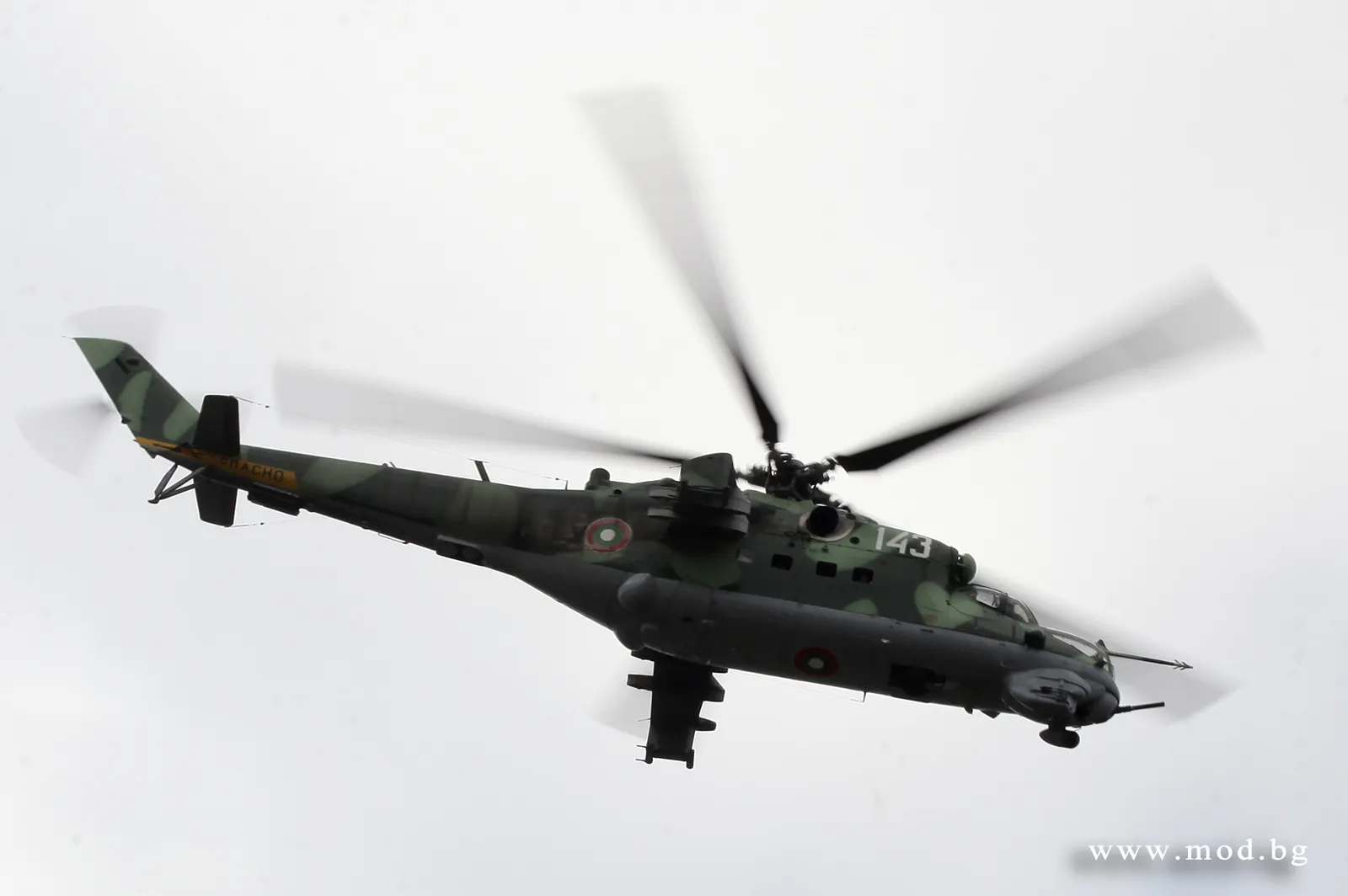


The Hind family appears from the Donbas phase through the full-scale invasion: Ukraine's Defence Ministry said unknown groups shot down two Ukrainian Mi-24s near Slovyansk on 2 May 2014, and Ukrainian Army Aviation later operated Mi-24 Hind attack helicopters including Czech-supplied Mi-24V/Mi-35 airframes and Polish-supplied Mi-24 helicopters. Reporting documents rocket-lobbing attacks in eastern Ukraine and later integration of U.S. Hydra 70 mm rockets, while Russian Mi-24P, Mi-24V/P/35M, and Mi-35M losses documented by Oryx confirm Russian-side fielding.
Role detailsAircraft & UAVs
Mi-24/Mi-35
Also known as
- Mi-24 Hind
- Mi-24A
- Mi-24D
- Mi-24V
- Mi-24P
- Mi-24P Hind-F
- Hind
- Hind-A
- Hind-D
- Hind-E
- Hind-F
- Mi-35
- Mi-35 Hind
- Mi-35M
- Mi-35P
- Mi-25
The Mi-24/Mi-35 Hind family combines an armored attack helicopter with a small troop compartment, letting operators use one airframe for close air support, anti-armor fires, armed escort, and limited assault transport. The Mi-35M branch is a Rostvertol-built modern combat-transport line, while older and upgraded Mi-24/Mi-35 aircraft remain documented in Ukraine, Syria, Mali, Iraq, Myanmar, and other conflicts.
Role in Conflicts

Russian VKS Mi-24/35 detachments operated from forward Syrian air bases in 2016 for close-air-support rotations tied to counter-ISIS operations; reporting also documented a Russian Mi-35M flying with an Mi-24P in support of loyalist forces near Palmyra before being shot down.
Role details

Mali fielded Mi-24/Mi-35 family attack helicopters during the ongoing war: DefenceWeb documented Mi-35M deliveries for Mali's counter-insurgency and terrorism effort, and Military Africa reported that a Malian Mi-24P later captured in northern Mali had been used to provide fire support to ground forces during clashes with insurgents.

The Nigerian Air Force fielded Mi-35M attack helicopters with the Operation LAFIYA DOLE Air Task Force in northeast Nigeria; official reporting placed Mi-35M crews among deployed platforms supporting the counter-insurgency campaign against Boko Haram and ISWAP, and 2019 reporting documented a Mi-35M lost while providing close air support to troops at Damasak.
- Side
- Azerbaijan

Azerbaijani forces fielded Mi-35M3 helicopters during the 2020 Nagorno-Karabakh fighting; IRSEM's account describes a rare appearance in which Azerbaijani Mi-35M3s fired rockets toward Nuyger on 6 October as ground forces pressed Armenian defenses in the Arax valley.

The Libyan National Army fielded Mi-35 attack helicopters during the 2014-2020 civil war; DefenceWeb reported that a LNA Mi-35 flying near Misrata on 12 April 2020 was apparently shot down by Government of National Accord forces.

Iraqi Army Aviation used Mi-35 gunships during the war against ISIS; The Aviationist reported Iraqi Army Mi-35 operations around Samarra, Fallujah, Ramadi, and Mosul, including video described as Mi-35 gunships attacking a convoy near Samarra in June 2014.
- Side
- State Administration Council and allied forces

In the 2021 Myanmar Civil War, Tearline identifies the Mi-35P as the most frequently used aircraft in civilian-targeting airstrikes by Myanmar military forces, and ABC News reported two Mi-35 attack helicopters firing S-5 rockets on the Let Yet Kone school.
- Side
- Ethiopia

Ethiopia fielded Mi-24 Hind helicopters during the Ogaden War; Pima Air & Space Museum identifies Ethiopian use against Somalia in 1977 as the Hind family's first combat employment.
- Side
- Soviet Union and Afghan government forces

Soviet Mi-24 Hinds became prominent during the 1979-1989 war in Afghanistan; Pima Air & Space Museum ties their battlefield reputation and resistance to ground fire to later U.S. Stinger aid to Afghan forces.

U.S. Air Force reporting described Afghan Air Corps Mi-35 crews flying armed escort and kinetic missions against Taliban forces under a joint advisory team during the 2001 War in Afghanistan.
Role detailsProfile / Specs
Profile
- Origin
- Soviet Union / Russia
- Type
- Attack helicopter and armed assault transport
- Service note
- Introduced in the early 1970s; still in service with post-Soviet and export operators
- Designer
- Mil Moscow Helicopter Plant
- Designed
- Late 1960s
- Unit cost
- Not consistently published for legacy and export variants
- Produced
- Mi-24 series from 1970; Mi-35 export and upgrade variants later
- Number built
- More than 2,600 Mi-24 family helicopters reported in open references
Specifications
- Crew and troops
- 2 crew with space for up to 8 troops on Mi-24D-style assault-transport variants
- Armament
- Variant-dependent gun or cannon armament plus rocket pods, anti-tank missiles, gun pods, or bomb loads on wing pylons
- Guided missiles
- Mi-24V/Mi-35 aircraft added Shturm-V equipment and 9M114 AT-6 Spiral anti-tank missiles in wingtip launch containers; Rosoboronexport lists 9M120-1 Ataka-type missiles with the Mi-35M
- Cargo compartment
- Czech tactical data describes a 2.83 m by 1.46 m by 1.2 m compartment behind the cockpit for personnel carriage
- Engines
- Two TV3-117 engines rated at 1,638 kW each in the Czech Mi-24 description; Pima lists two Isotov TV3-117 turbines on its Mi-24D exhibit
- Payload
- 2,400 kg listed by the Czech Ministry of Defence for Mi-24 tactical-technical data
- Speed
- 310 km/h high-speed cruise and 260 km/h typical cruise
- Range
- 750 km maximum flight distance; 160 km tactical operation range
- Maximum takeoff weight
- 12,500 kg
- Rotor
- Five-blade main rotor and three-blade anti-torque tail rotor
- Mi-35M maximum takeoff weight
- 11,500 kg listed by Rosoboronexport for the current Mi-35M export page
- Mi-35M speed and range
- 305 km/h maximum speed and 460 km flight range on internal fuel tanks
- Mi-35M payload and troops
- 1,500 kg maximum cabin payload, 2,400 kg external-sling payload, and seven transported troops
- Mi-35P export-page figures
- 335 km/h maximum speed, 450 km internal-fuel range, 4,500 m service ceiling, and seven transported troops
Attack-Transport Design Logic
The Hind family is unusual because the attack helicopter role is built around a small assault-transport fuselage rather than a pure two-seat gunship layout. Czech military data describes the Mi-24 as a close-support helicopter that can also transport personnel, while Pima Air & Space Museum frames the Mi-24D as a Soviet attempt to combine heavy gunship firepower with light assault-helicopter troop carriage.
Troop compartment
The Czech Ministry of Defence describes a rear compartment measuring 2.83 m long, 1.46 m wide, and 1.2 m high, with up to eight paratroopers able to fire through side-window openings.
Source: Mil Mi-24 - NATO code: HIND.
Stub wings
The same source states that the wings help unload the rotor at higher speed and provide four weapon stations plus wingtip missile mountings on relevant variants.
Weapon fits vary between Mi-24D, Mi-24V, Mi-24P, Mi-35M, and Mi-35P aircraft.
Combat emphasis
Pima notes that the troop-carrying concept proved less useful in combat than the heavily armed and armored gunship role, which drove the Hind family's battlefield reputation.
Source: Mil Mi-24D.
Mi-35M Combat-Transport Fit
The Mi-35M line keeps the Hind family's attack-and-transport split but packages it as a modern export combat-transport helicopter. Rosoboronexport describes it as an army-aviation aircraft for attacking armored and unarmored targets, personnel, command points, ground targets, and helicopters near the forward edge and in tactical depth while also performing reconnaissance, convoy cover, troop transport, casualty evacuation, and cargo movement. Russian Helicopters identifies Rostvertol as the plant producing Mi-35M military models.
Mission set
Guided and unguided weapons are paired with reconnaissance, escort, troop transport, evacuation, internal-cargo, and external-sling cargo roles.
Source: Mi-35M Product Page.
Export-page performance
Rosoboronexport lists 305 km/h maximum speed, 460 km internal-fuel range, and a 5,400 m service ceiling for Mi-35M.
Figures describe the current export listing, not every Mi-24/Mi-35 airframe.
Production plant
Russian Helicopters lists Rostvertol among its helicopter plants and names Mi-35M and Mi-28NE among its military models.
Source: Russian Helicopters structure page.
Fixed-Cannon Mi-24P Line
The Mi-24P branch matters because it changes the Hind's gun installation rather than the basic attack-transport concept. Open references identify the subtype as Hind-F, with Mi-35P used for export and later modernized examples.
Gun installation
A fixed twin-barrel 30 mm GSh-30K/GSh-30-2K cannon is mounted along the fuselage instead of the Mi-24V-style nose turret.
Source: Mil Mi-24P.
Designation split
WeaponSystems.net identifies Mi-24P as the Soviet Hind-F and Mi-35P as the export model; Rosoboronexport presents the current Mi-35P as a Mi-24-series combat-transport helicopter.
Sources: Mil Mi-24P; Mi-35P Product Page.
Modern export figures
Rosoboronexport lists the Mi-35P with two crew, 335 km/h maximum speed, 450 km flight range, 2,400 kg external-sling payload, and seven transported troops.
Figures apply to the current export page, not every legacy Mi-24P airframe.
Variants
Mi-24 is the Soviet domestic family label, while Mi-25 and Mi-35 labels are export and later modernized designations; armament, sensors, engines, and cockpit equipment vary by subtype and upgrade package.
| Variant | Configuration | Designation notes |
|---|---|---|
| Mi-24D | Early Hind-D attack and assault-transport model | The Czech Ministry of Defence describes the Mi-24D as a 1976 modified Mi-24A with a tandem cockpit, nose turret, and underwing weapon stations. Sources: Mil Mi-24 - NATO code: HIND |
| Mi-24V / Mi-35 | Shturm-capable export lineage | The Mi-24V added Shturm-V equipment and 9M114 AT-6 Spiral missiles; the Czech Ministry of Defence identifies Mi-35 as the export version of the Russian Mi-24V. Sources: Mil Mi-24 - NATO code: HIND, Mi-35 (Mi-24V) - Technical Specifications |
| Mi-24P | Fixed-cannon gunship variant | The Mi-24P, NATO Hind-F, replaced the Mi-24V's nose turret with a fixed twin-barrel 30 mm GSh-30K/GSh-30-2K cannon mounted along the fuselage; visually documented Russian losses in Ukraine show the subtype remained in operational service. Sources: Mil Mi-24P, List Of Aircraft Losses During The Russian Invasion Of Ukraine |
| Mi-35M | Modernized export and attack helicopter | Rosoboronexport lists the Mi-35M as a combat-transport helicopter with day-and-night attack, reconnaissance, escort, troop-transport, casualty-evacuation, and cargo missions; Russian Helicopters identifies Rostvertol as the production plant for Mi-35M military models. Sources: Mi-35M Product Page, Russian Helicopters structure page |
| Mi-35P | Modernized fixed-cannon export variant | Rosoboronexport presents the Mi-35P as a modernized combat-transport helicopter based on the Mi-24 series, with day-and-night reconnaissance and fire-support roles. Sources: Mi-35P Product Page, Mi-35P Combat-transport helicopter |
Carried Munitions
The Hind family carries different rocket and missile fits by variant, operator, and upgrade package.
| Launched item | Item type | Launch evidence |
|---|---|---|
 | Wire-guided anti-tank missile | Armatec lists the Mi-24 among helicopter launch platforms for the 9M14 Malyutka. Sources: Armatec 9M14 Malyutka |
 | Radio-command anti-tank guided missile | The Czech Ministry of Defence describes Mi-24V helicopters using 9M114 AT-6 Spiral anti-tank missiles from wingtip launch containers. Sources: Mil Mi-24 - NATO code: HIND |
 | Radio-command anti-tank guided missile | Rosoboronexport lists 9M120-1 Ataka-type missiles with the Mi-35M combat-transport helicopter. Sources: Mi-35M Product Page |
 | 80 mm air-launched rocket | WeaponSystems.net lists S-8 rockets in B-8V20 pods among Mi-24P armament options. Sources: Mil Mi-24P |
 | 57 mm air-launched rocket | WeaponSystems.net lists S-5 rockets in UV-16 or UV-32 pods among Mi-24P armament options. Sources: Mil Mi-24P |
 | 70 mm air-launched rocket | TWZ documented Ukrainian Mi-24 Hinds adapted to fire U.S.-supplied Hydra 70 mm rockets during the Russia-Ukraine War. Sources: Ukraine's Mi-24 Hinds Now Armed With U.S. 70mm Hydra Rockets |
Mounted Gun Armament
Gun installation is a major subtype marker across the Mi-24/Mi-35 family.
| Carried item | Item type | Carriage evidence |
|---|---|---|
 | 12.7 mm rotary nose gun | The Czech Ministry of Defence describes the Mi-24D nose turret as carrying a four-barrel 12.7 mm 9A624 machine gun with 1,470 rounds, while the same source distinguishes later Mi-24V equipment from the Mi-24D baseline. Sources: Mil Mi-24 - NATO code: HIND |
Timeline
Mi-24/Mi-35 Key Events
Mil develops an armed transport-gunship concept
Pima and Czech sources describe the Mi-24 as combining attack-helicopter firepower with a small assault-transport compartment, with design work beginning in the late 1960s.
Sources: Mil Mi-24D, Mil Mi-24 - NATO code: HIND
First combat use in the Ogaden War
Pima Air & Space Museum identifies Ethiopia's 1977 use against Somalia as the Hind family's first combat use.
Sources: Mil Mi-24D
Soviet-Afghan War exposure
Pima links the Hind's Western public profile to the Soviet occupation of Afghanistan and the difficulty Afghan forces initially had in downing Mi-24s.
Sources: Mil Mi-24D
Afghan Mi-35 crews fly combat missions
U.S. Air Force reporting described Afghan Air Corps Mi-35 crews conducting kinetic operations and armed escort missions against Taliban forces.
Sources: Airman leads joint Mi-35 attack helicopter adviser team for Afghan Air Corps
Ukrainian Mi-24s shot down near Slovyansk
Al Jazeera reported that Ukraine's Defence Ministry said two Mi-24 gunships were shot down by unknown groups during the Slovyansk operation, placing the Hind family in the conflict's early Donbas phase.
Sources: Ukraine helicopters shot down in Slovyansk
Ukraine receives and adapts Mi-24/Mi-35 airframes
Official Polish aid reporting lists Mi-24 helicopters for Ukraine, while defense reporting documented Czech-supplied Mi-24V/Mi-35 flights and Hydra 70 mm rocket integration.
Sources: Poland's aid to Ukraine, Mi-24V Gunship Helicopter Donated By Czech Republic Seen In Action Over Ukraine, Ukraine's Mi-24 Hinds Now Armed With U.S. 70mm Hydra Rockets
Related Weapon Systems


Sources
Mil Mi-24 - NATO code: HINDPublisher: Ministry of Defence & Armed Forces of the Czech Republic | Note: Supports Mi-24 tactical-technical data, role, weapons fit, rotor arrangement, cargo-compartment dimensions, engine figures, and performance figures. | Accessed: 2026-07-06Mi-35 (Mi-24V) - Technical SpecificationsPublisher: Ministry of Defence & Armed Forces of the Czech Republic | Note: Supports Mi-35 export-variant background and Rostvertol manufacturer context. | Accessed: 2026-06-20Armatec 9M14 MalyutkaPublisher: Armatec | Note: Supports the Mi-24 as a helicopter launch platform for the 9M14 Malyutka. | Accessed: 2026-06-28Mil Mi-24DPublisher: Pima Air & Space Museum | Note: Supports general Mi-24 design background, troop-carrying concept, service history, manufacturer, crew/troop capacity, baseline performance figures, first combat use by Ethiopia in the 1977 Ogaden War, and 1979 Soviet-Afghan War battlefield context. | Accessed: 2026-07-06Airman leads joint Mi-35 attack helicopter adviser team for Afghan Air CorpsPublisher: U.S. Air Force | Note: Supports 2001 War in Afghanistan direct use: Afghan Air Corps Mi-35 crews conducted armed escort and kinetic missions against Taliban forces under a U.S.-led advisory team. | Accessed: 2026-06-30Mi-35P Combat-transport helicopterPublisher: Rosoboronexport | Note: Official Rosoboronexport video used for Mi-35P export-variant context and selected YouTube media. | Accessed: 2026-06-30Mi-35M Product PagePublisher: Rosoboronexport | Note: Supports Mi-35M export-variant mission roles, weight, speed, range, payload, service ceiling, troop capacity, and Ataka ordered-with listing. | Accessed: 2026-07-06Russian Helicopters structure pagePublisher: Russian Helicopters | Note: Supports Rostvertol production-plant context for Mi-35M military helicopters within the Russian Helicopters holding structure. | Accessed: 2026-07-06Mi-35P Product PagePublisher: Rosoboronexport | Note: Supports Mi-35P export-variant role, Mi-24-series lineage, crew, speed, range, payload, troop-capacity, and self-protection-suite context. | Accessed: 2026-07-06Mil Mi-24PPublisher: WeaponSystems.net | Note: Supports Mi-24P/Hind-F designation context, Mi-35P export designation, fixed 30 mm GSh-30K/GSh-30-2K cannon description, and S-5/S-8 rocket carriage notes. | Accessed: 2026-07-02Poland's aid to UkrainePublisher: National Security Bureau of Poland | Note: Supports direct 2014 Russia-Ukraine War transfer context for Polish Mi-24 helicopters supplied to Ukraine. | Accessed: 2026-06-20Mi-24V Gunship Helicopter Donated By Czech Republic Seen In Action Over UkrainePublisher: The Aviationist | Note: Supports direct 2014 Russia-Ukraine War operational context for Czech-supplied Mi-24V/Mi-35 helicopters flying rocket attacks over eastern Ukraine. | Accessed: 2026-06-20Ukraine's Mi-24 Hinds Now Armed With U.S. 70mm Hydra RocketsPublisher: TWZ | Note: Supports direct 2014 Russia-Ukraine War context for Ukrainian Mi-24s using indirect rocket attacks and being adapted for U.S.-supplied Hydra 70 mm rockets. | Accessed: 2026-06-20List Of Aircraft Losses During The Russian Invasion Of UkrainePublisher: Oryx | Note: Supports direct 2014 Russia-Ukraine War fielding context for Russian Mi-24P, Mi-24V/P/35M, and Mi-35M attack helicopters through visually documented losses. | Accessed: 2026-06-20Ukraine helicopters shot down in SlovyanskPublisher: Al Jazeera | Note: Supports 2014 Russia-Ukraine War direct conflict-use context for two Ukrainian Mi-24 helicopters shot down near Slovyansk during the early Donbas phase. | Accessed: 2026-07-07Myanmar Witness Tabayin School Attack reportPublisher: Myanmar Witness / Centre for Information Resilience | Note: 2021 Myanmar Civil War: Myanmar Witness says Mi-35 helicopters were used in the 16 September 2022 Let Yet Kone school attack and verified S-5 rocket remnants at the scene. | Accessed: 2026-06-22Road to Damascus: The Russian Air Campaign in Syria, 2015 to 2018Publisher: RAND Corporation | Note: Supports 2011 Syrian Civil War use of Russian Mi-24/35 detachments from forward bases for close-air-support rotations in counter-ISIS operations. | Accessed: 2026-06-20Intense video shows the moment a Russian helicopter is downed by ISIS in SyriaPublisher: The Aviationist | Note: Supports direct 2011 Syrian Civil War operational context for a Russian Mi-35M flying with an Mi-24P in support of loyalist forces near Palmyra. | Accessed: 2026-06-20Mali receives additional Mi-35 attack helicoptersPublisher: DefenceWeb | Note: Supports direct 2012 Mali War fielding context for Mi-35M attack helicopters delivered to Mali's Air Force for counter-insurgency and terrorism efforts. | Accessed: 2026-06-20Mali loses Mil Mi-24P attack helicopter to rebelsPublisher: Military Africa | Note: Supports direct 2012 Mali War conflict-use context for a Malian Mi-24P used for fire support and later captured by the Azawad Liberation Front in northern Mali. | Accessed: 2026-06-20Counter-Insurgency: CAS Commends Air Task ForcePublisher: Nigerian Air Force | Note: Supports 2009 Boko Haram Insurgency direct use: Mi-35M helicopter fleets were fielded by the Nigerian Air Force Air Task Force for the counter-insurgency campaign against Boko Haram and ISWAP in northeast Nigeria. | Accessed: 2026-06-21Five crew killed in Nigeria Mi-35 helicopter crash near DamasakPublisher: The Defense Post | Note: Supports 2009 Boko Haram Insurgency direct use: Mi-35M attack helicopter used by the Nigerian Air Force for close air support to troops at Damasak during ongoing counterinsurgency operations. | Accessed: 2026-06-21RETEX - 44 Days Over Nagorno-KarabakhPublisher: Institut de recherche strategique de l'Ecole militaire | Note: Supports 2020 Nagorno-Karabakh Conflict use: Mi-35M3 helicopters fielded by Azerbaijan fired rockets toward Nuyger on 6 October 2020. | Accessed: 2026-06-20Libyan Mi-35 apparently shot downPublisher: DefenceWeb | Note: Supports 2014 Second Libyan Civil War direct use: Mi-35 attack helicopter fielded by the Libyan National Army and apparently shot down by Government of National Accord forces near Misrata on 12 April 2020. | Accessed: 2026-06-22Video shows Iraqi Mi-35 gunships attack and destroy ISIS terrorists convoyPublisher: The Aviationist | Note: Supports 2013 War in Iraq direct use: Mi-35 gunships used by Iraqi Army Aviation for operations against ISIS around Samarra, Fallujah, Ramadi, and Mosul. | Accessed: 2026-06-22Wings of Violence: Locating the Source and Method of Aerial Attacks on Civilians and Civil Infrastructure in North-Central MyanmarPublisher: Tearline / NGA | Note: Supports 2021 Myanmar Civil War direct use: in the 2021 Myanmar Civil War, the report says the Mi-35P was used by Myanmar military forces in civilian-targeting airstrikes. | Accessed: 2026-06-22Report provides more detailed account of a Myanmar junta helicopter attack on school that left at least six children deadPublisher: ABC News | Note: Supports 2021 Myanmar Civil War direct use: in the 2021 Myanmar Civil War, two Mi-35 attack helicopters fired S-5 rockets in the Let Yet Kone school attack. | Accessed: 2026-06-22Bulgarian Mi-24 Hind.jpgPublisher: Wikimedia Commons | Note: Supports primary image provenance; Wikimedia Commons lists a Bulgarian Ministry of Defence Flickr source reviewed as CC BY-SA 2.0. | Accessed: 2026-07-06Yellow Mil Mi-24 Hind side MW.JPGPublisher: Wikimedia Commons | Note: Supports gallery image provenance; Wikimedia Commons lists BrokenSphere as author and CC BY-SA 3.0/GFDL-compatible licensing for a Mi-24 display aircraft photograph. | Accessed: 2026-07-06Mi-35P Puspenerbad Indonesian ArmyPublisher: Wikimedia Commons | Note: Supports gallery image provenance; Wikimedia Commons lists an Indonesian Army Aviation Center source and public-domain Indonesian government licensing for a Mi-35P photograph. | Accessed: 2026-07-06Cypriot Mi-35 in August 2022Publisher: Wikimedia Commons | Note: Supports gallery image provenance; Wikimedia Commons lists Mosbatho as photographer and CC BY 4.0 licensing for a Cypriot Mi-35P photograph. | Accessed: 2026-07-06