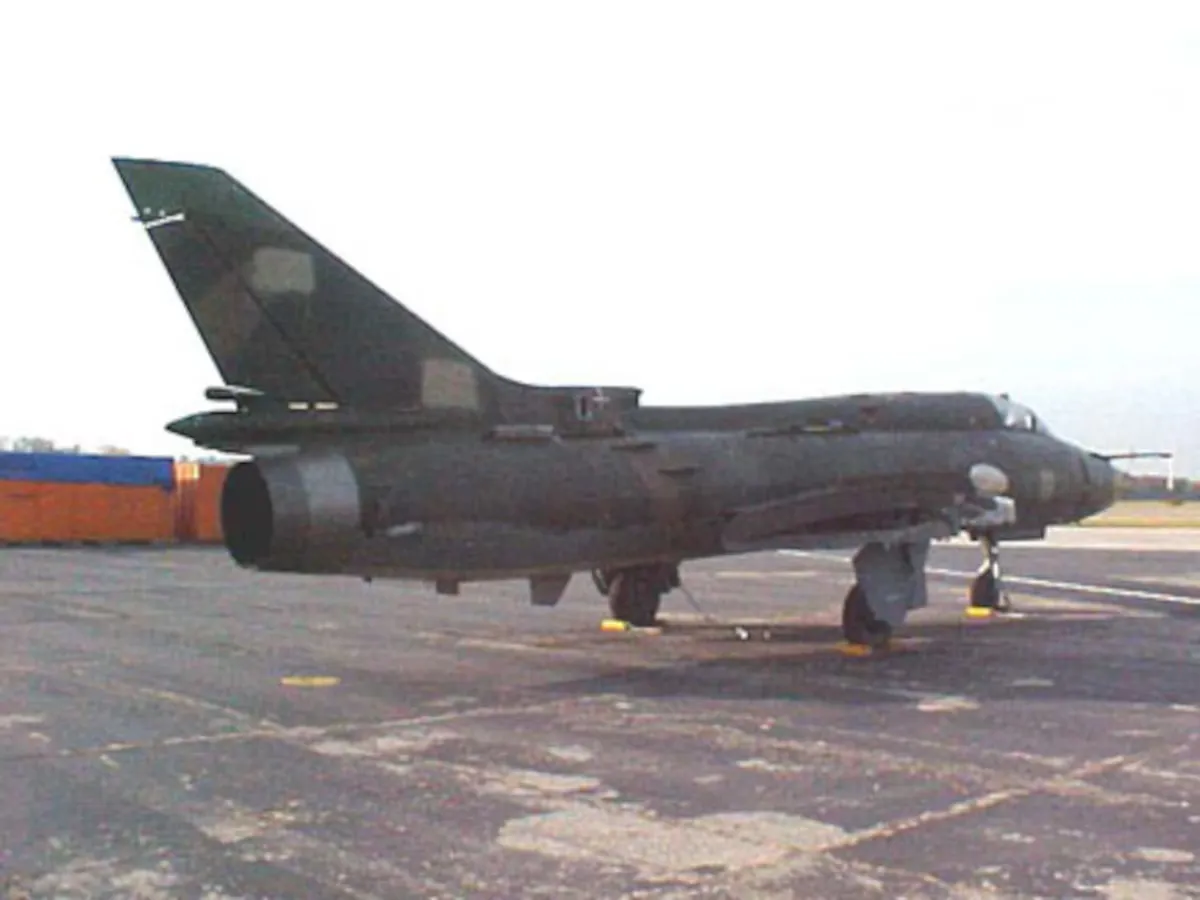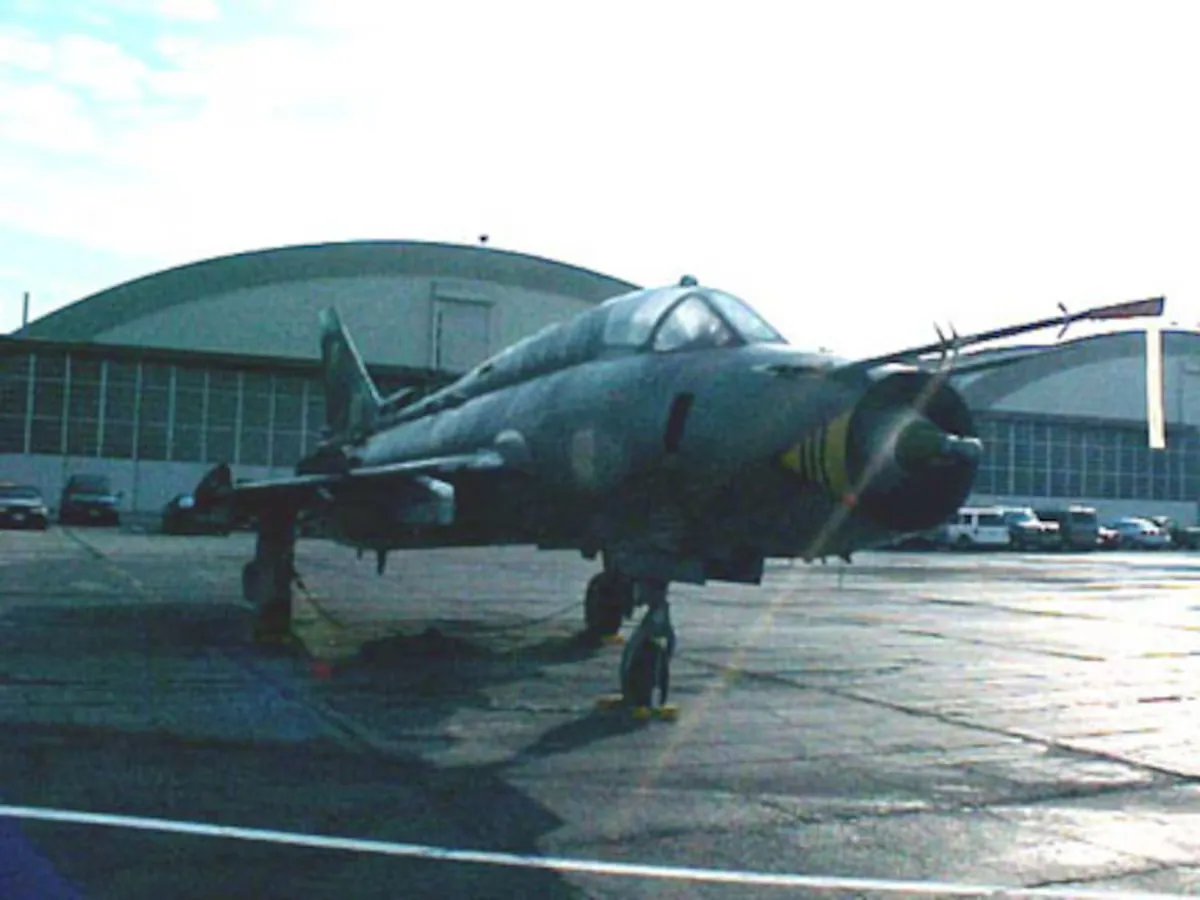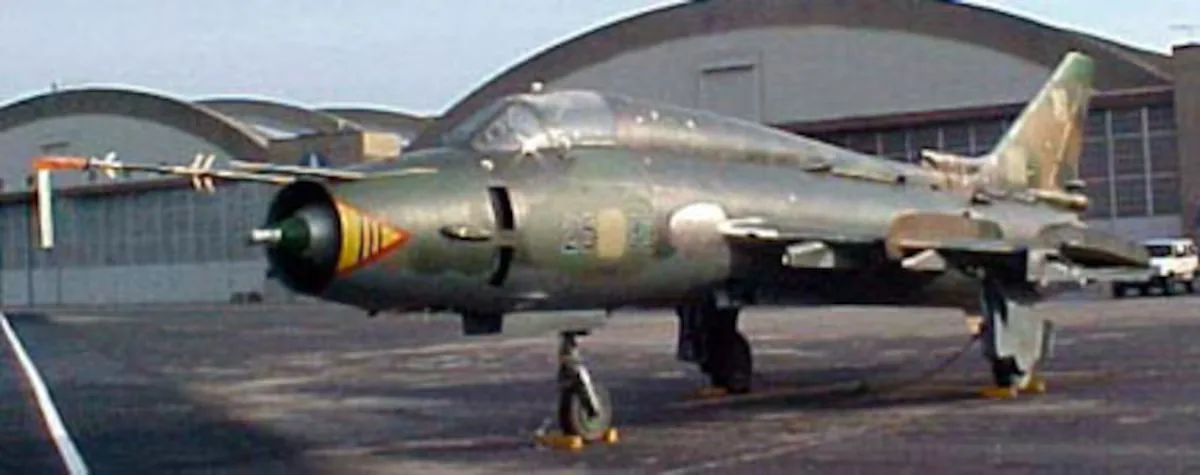
- Side
- EgyptSyria

Egyptian and Syrian Su-20/Fitter aircraft saw combat in the 1973 war; AirVectors describes Egyptian Su-20 losses and Syrian low-level strikes on Israeli targets with FAB bombs and RBK-250 cluster bombs.
The Su-17 Fitter is a Soviet variable-sweep wing fighter-bomber developed from the fixed-wing Su-7B and exported through the Su-20 and Su-22 lines. Designed for ground attack and bombing with rockets, bombs, missiles, gun pods, and 30 mm cannon armament, the family is documented in Soviet, Iraqi, and Syrian conflict use from Afghanistan to Syria.
Egyptian and Syrian Su-20/Fitter aircraft saw combat in the 1973 war; AirVectors describes Egyptian Su-20 losses and Syrian low-level strikes on Israeli targets with FAB bombs and RBK-250 cluster bombs.
Libyan Su-22s saw action in Chad during the 1980s; AirVectors specifically notes Fitter operations there before Libya withdrew the type from service in the 1990s.
Soviet forces used Su-17 Fitter aircraft in Afghanistan for fighter-bomber attacks against suspected mujahideen strongholds before air-assault operations; AirVectors also describes Su-17M3R reconnaissance and flare-dropping support during the war.
A declassified DIA assessment states that Iraqi Su-22/Fitter aircraft attacked Iranian troops with chemical weapons in August 1983 and that Su-17/22 Fitters were among Iraq's documented fixed-wing chemical-delivery systems during the war.
Syrian Su-20s and Su-22Ms saw combat against Israeli forces in southern Lebanon in 1982, while Su-22MR aircraft carrying KKR-series reconnaissance pods flew sorties over southern Lebanon.
Iraq still fielded Su-22 aircraft during Operation Desert Storm; an Air Force historical study lists four Iraqi Su-22s among the aircraft shot down by USAF pilots between January and March 1991.
Role detailsRussian Su-17M3 aircraft saw combat in the First Chechen War as the post-Soviet Russian air force was drawing the Fitter fleet down.
Peruvian Su-22M3 aircraft conducted dozens of sorties in the 1995 Cenepa border war, with AirVectors noting two losses to Ecuadorian Igla MANPADS.
Syrian government forces fielded the Su-22 export variant for ground-attack missions; CENTCOM reported a Syrian regime Su-22 dropping bombs near SDF fighters south of Tabqah on June 18, 2017, before a U.S. F/A-18E shot it down.
Role detailsThe Su-17 was the Soviet-service swing-wing Fitter line; Su-20 and Su-22 were export designations, with later marks adding updated engines, avionics, radars, weapons fits, and trainer or reconnaissance configurations.
| Variant | Configuration | Designation notes |
|---|---|---|
| Su-17M / Su-17M2 / Su-17M3 | Soviet strike variants | FAS lists the Su-17M, M2, and M3 among the main production modifications of the variable-sweep Fitter family. Sources: Su-17, -20, -22 Fitter |
| Su-17M4 | Late Soviet attack variant | FAS identifies the Su-17M4 as a later low-altitude subsonic bomber modification within the Su-17 line. Sources: Su-17, -20, -22 Fitter |
| Su-20 | Export designation | FAS describes the Su-20 as an export designation for the Su-17 family, distinguishable with the Su-22 by a deeper dorsal spine. Sources: Su-17, -20, -22 Fitter |
 | Export family member | FAS and the National Museum of the U.S. Air Force both treat the Su-22 as an exported Fitter-family derivative; NMUSAF's Su-22M4 example represents the Fitter-K generation. Sources: Su-17, -20, -22 Fitter, Sukhoi SU-22M4 |
| Su-17UM / Su-22UM | Trainer variants | FAS includes the Su-17UM trainer among the family modifications, while export trainer designations belong to the Su-22 branch. Sources: Su-17, -20, -22 Fitter |
Reference loadout sources tie the Su-17/Su-22 Fitter family to general-purpose bombs, unguided rockets, and later air-to-surface missiles; this section links only catalog records with source-backed compatibility.
| Carried item | Item type | Carriage evidence |
|---|---|---|
 | 100 kg general-purpose bomb | CMO-DB lists Su-17M-3 Fitter H strike loadouts carrying FAB-100M-62 general-purpose bombs. Sources: CMO-DB Su-17M-3 Fitter H |
 | 250 kg general-purpose bomb family | CMO-DB lists Su-17M-3 Fitter H loadouts with FAB-250M-54 and FAB-250M-62 bombs, while Weaponsystems.net identifies Su-17 and Su-22-class aircraft as FAB M54 platforms. Sources: CMO-DB Su-17M-3 Fitter H, FAB M54 | Weaponsystems.net |
 | 57 mm unguided rocket | CMO-DB lists Su-17M-3 Fitter H loadouts carrying S-5K 57 mm rockets for strike missions. Sources: CMO-DB Su-17M-3 Fitter H |
 | Air-launched standoff missile | Forecast International reports Kh-59M deployment on Su-17/22 Fitter aircraft; this is a family compatibility note, not a claim that every operator carried the missile. Sources: Russian Strike Missiles |
FAS describes the Su-17's first public demonstration in 1969 after Sukhoi adapted the Su-7B fighter-bomber with variable-sweep outer wing panels.
Sources: Su-17, -20, -22 Fitter
FAS lists Su-17-family production from 1970 to 1990, with multiple Su-17M-series and export variants built during the run.
Sources: Su-17, -20, -22 Fitter
The National Museum of the U.S. Air Force notes that Western analysts first identified Fitter-K aircraft, represented by its Su-22M4 example, in 1984.
Sources: Sukhoi SU-22M4
NMUSAF states that Fitter production continued until 1991, while FAS lists the broader Su-17/Su-20/Su-22 production span as 1970-1990.
Sources: Sukhoi SU-22M4, Su-17, -20, -22 Fitter
CENTCOM reported that a Syrian regime Su-22 dropped bombs near SDF fighters south of Tabqah before a U.S. Navy F/A-18E shot it down.
Sources: Coalition Defends Partner Forces from Syrian Fighter Jet Attack