- Side
- Soviet Union and Afghan government forces


Soviet Su-25s flew close-air-support and counterinsurgency sorties in Afghanistan, where the type became one of the VVS aircraft most associated with low-altitude battlefield attack.
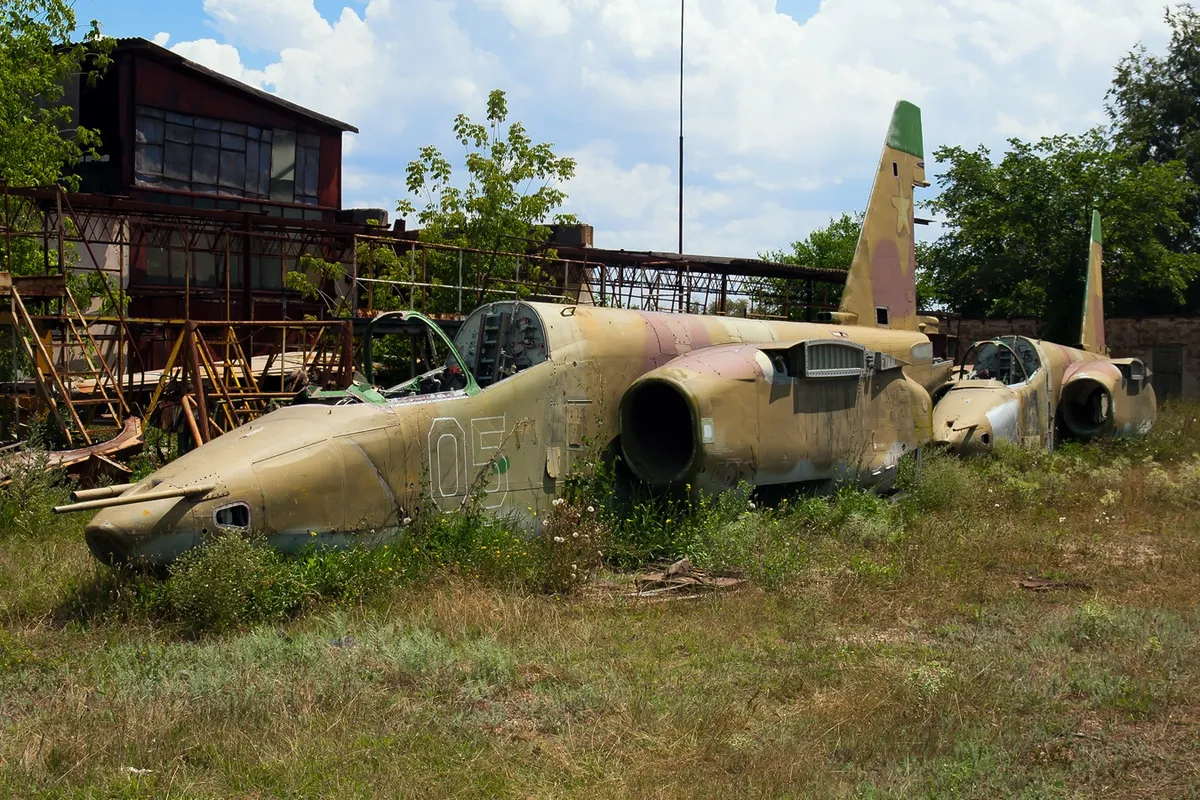
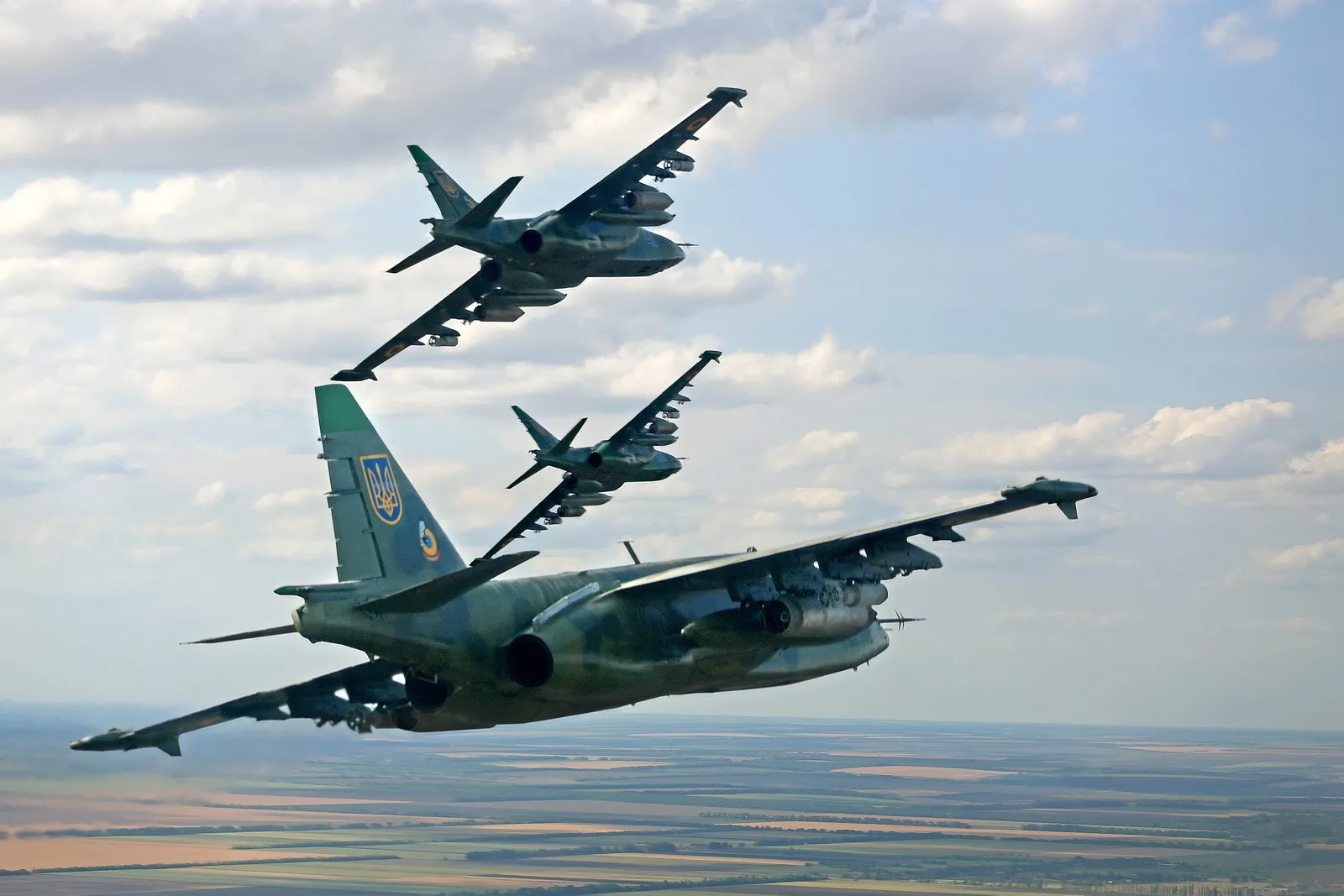
The Su-25 is a Soviet-designed armored close air support aircraft built for low-level battlefield strike, rough-field operation, and heavy stores carriage. Developed by Sukhoi and produced in Soviet, Russian, and Georgian factories, the twin-engine subsonic jet combines a protected cockpit, internal 30 mm cannon, and multiple pylons for rockets, bombs, missiles, and adapted guided weapons, with documented use from Afghanistan and Iraq to Darfur, Syria, Nagorno-Karabakh, and Ukraine.
Soviet Su-25s flew close-air-support and counterinsurgency sorties in Afghanistan, where the type became one of the VVS aircraft most associated with low-altitude battlefield attack.
Iraqi Su-25s entered service late in the Iran-Iraq War and were used for battlefield attack sorties against Iranian forces.
Iraqi Su-25s were fielded in the Gulf War as ground-attack aircraft; coalition air superiority limited their employment, with Su-25s documented among Iraqi aircraft shot down, destroyed on the ground, or flown to Iran.
Role detailsThe Su-25 operational history records combat use in Angola, but the currently retained source is a broad operational-history reference rather than a detailed campaign study.
Georgian Su-25s were used for ground-attack missions during the 1992-1993 war in Abkhazia, with losses documented during the campaign.
Azerbaijani and Armenian Su-25 aircraft were documented in the first Nagorno-Karabakh air war, including Azerbaijani ground-attack sorties and Armenian close-air-support aircraft.
Russian Su-25s flew strike sorties in the First Chechen War, including attacks around Grozny and other close-air-support missions.
Russian Su-25s were again used for close-air-support and strike missions in the Second Chechen War.
Ethiopia acquired and used Su-25TK attack aircraft during the Eritrean-Ethiopian War period as part of its ground-attack aviation force.
Macedonia bought four Su-25 aircraft from Ukraine during the 2001 conflict and used them in reconnaissance and ground-attack missions against Albanian insurgent positions.
Ivorian government Su-25UBs bombed rebel positions in northern Cote d'Ivoire in November 2004; after an attack killed French peacekeepers at Bouake, French forces destroyed two Sukhoi 25 aircraft on the ground at Yamoussoukro.
UN Panel of Experts reporting documented Sudanese Su-25 ground-attack aircraft operating in Darfur, including a May 2014 sighting at El Fasher Forward Operating Base treated as an arms-embargo violation.
Georgian and Russian Su-25s were used in the 2008 war; open-source loss accounting documents Russian Su-25 losses and the conflict record documents Georgian air-support sorties.
Iraqi Air Force Su-25s supported the anti-ISIS campaign in Iraq after aircraft were delivered from Russia and Iran in 2014.
Used by Russian forces in Syria to support Syrian government offensives, including close-air-support missions in the northwest.
Role detailsIraqi Air Force Su-25s flew strike sorties against Islamic State forces during the campaign that ended ISIS territorial control in Iraq.
Fielded by both sides during the 2020 war: Azerbaijani MoD releases described Azerbaijani Su-25 airstrikes and Armenian Su-25s attempting strikes on Azerbaijani positions.
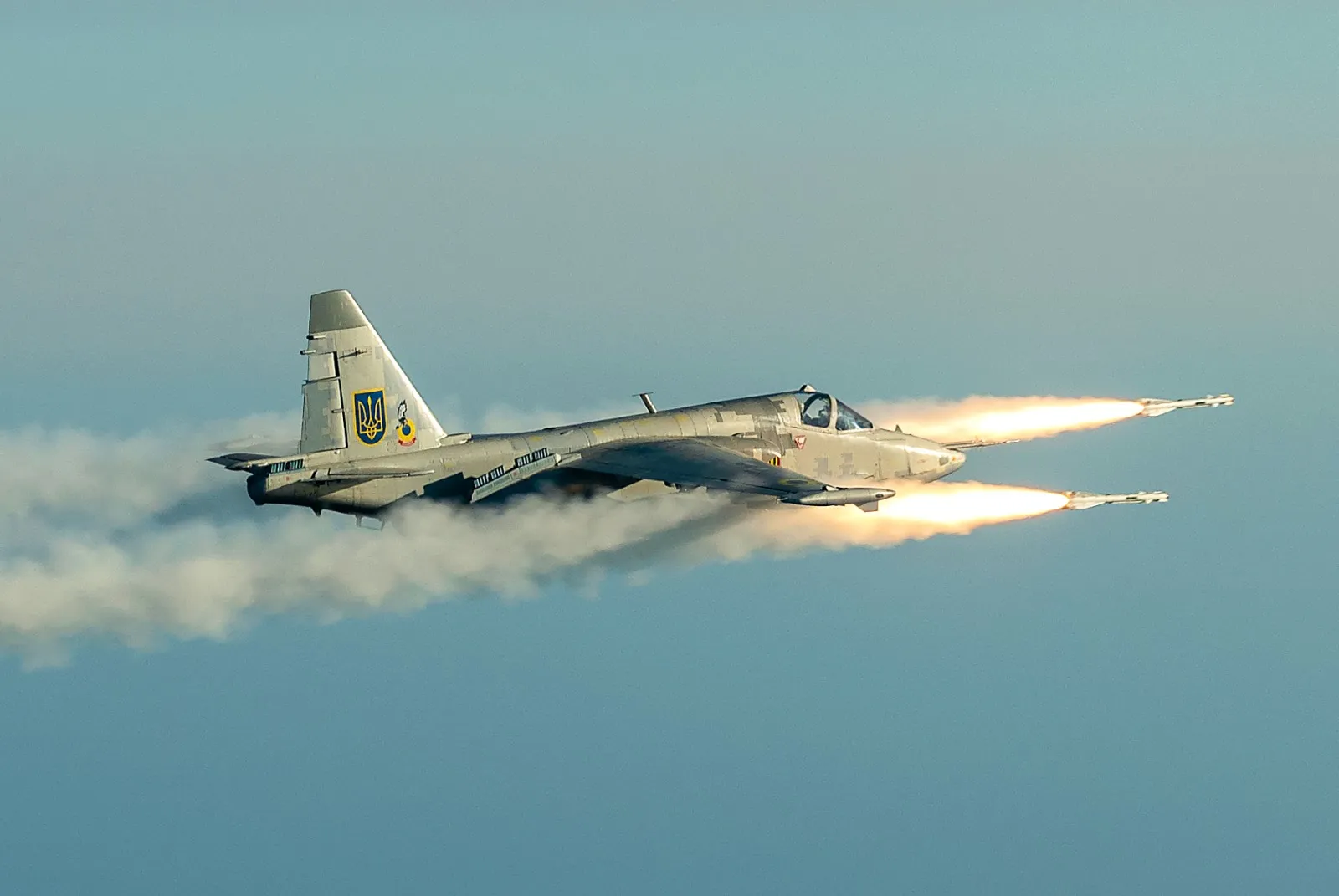
Operated by Ukraine for close air support and battlefield strike missions, while CNA assessed Russian Su-25SM/SM3 aircraft shifted to low-level and standoff rocket attacks after early losses in Ukraine's dense air-defense environment; Ukrainian Su-25s were later adapted to launch HAMMER/AASM guided bombs.
Role detailsSu-25 designations separate export, trainer, naval-training, target-tug, anti-tank, national modernization, and Russian service-modernization variants from the baseline single-seat attack aircraft.
| Variant | Configuration | Designation notes |
|---|---|---|
| Su-25K | Export single-seat attack aircraft | Export variant built at Factory 31 in Tbilisi, with 180 aircraft reported between 1984 and 1989. Sources: National Defence University of Ukraine Su-25, Sukhoi Su-25 - Archived 3/2008 |
| Su-25UB | Two-seat combat trainer | Two-seat trainer and operational-conversion variant first flown from Ulan-Ude in August 1985 and capable of weapons-training missions. Sources: National Defence University of Ukraine Su-25, Sukhoi Su-25 - Archived 3/2008 |
| Su-25UBK | Export two-seat combat trainer | Export trainer variant produced at Ulan-Ude for customers of the Su-25K. |
| Su-25UTG | Carrier landing trainer | Naval-training adaptation of the Su-25UB for ski-jump and arrester-wire landing practice. Sources: Sukhoi Su-25 - Archived 3/2008, RIA Su-25 Specifications |
| Su-25BM | Target-towing variant | Target-tug variant developed for air-defense training, with the T-8BM1 prototype first flown in March 1990. Sources: National Defence University of Ukraine Su-25, Sukhoi Su-25 - Archived 3/2008 |
| Su-25T | Anti-tank attack variant | One-seat anti-tank development with Shkval targeting equipment and compatibility with Vikhr missiles and guided bombs or missiles. Sources: National Defence University of Ukraine Su-25, RIA Su-25 Specifications |
| Su-25TM / Su-39 | Improved anti-tank and precision-attack development | Further Su-25T development with improved navigation and attack systems and provision for podded radar; production remained limited. Sources: Sukhoi Su-25 - Archived 3/2008, National Defence University of Ukraine Su-25 |
| Su-25KM Scorpion | Georgian/Israeli avionics upgrade | Tbilisi Aircraft Manufacturing and Elbit announced the Scorpion modernization in 2001 with glass-cockpit, navigation, helmet-display, and weapon-delivery upgrades. Sources: Sukhoi Su-25 - Archived 3/2008, National Defence University of Ukraine Su-25 |
| Su-25M1 | Ukrainian modernization | Ukrainian modernization with locally installed satellite navigation, warning and control, radio, and sighting updates. |
| Su-25SM3 | Russian service modernization | Russian modernization with updated sighting and navigation equipment, optical-laser thermal/television sighting equipment, satellite navigation, electronic-warfare systems, and precision-weapon compatibility. Sources: RIA on Su-25SM3 modernization, TASS on Rostec Su-25 modernization |
The Su-25's normal stores mix spans unguided rocket pods, missiles, bombs, and adapted Western precision munitions in Ukrainian service.
| Launched item | Item type | Launch evidence |
|---|---|---|
 | 57 mm unguided rocket | Airforce Technology identifies UB-32A pods for 57 mm S-5 rockets among Su-25 rocket options. Sources: Su-25 Attack Aircraft |
 | 80 mm unguided rocket family | Airforce Technology lists B-8M1 pods for 80 mm S-8 rockets among the Su-25's carried rocket armament. Sources: Su-25 Attack Aircraft |
 | Precision-guided bomb family | TWZ reported Ukrainian Su-25s launching Hammer rocket-boosted bombs, and The Aviationist said the aircraft began using AASM Hammer bombs in 2024. Sources: TWZ on Ukrainian Su-25s launching Hammer bombs, The Aviationist on Ukrainian Su-25s with AASM Hammer |
 | Short-range air-to-air missile | BFBS Forces News identifies the R-60/AA-8 Aphid among the air-to-air missiles carried on the Su-25's smaller outboard pylons. Sources: What is the Su-25 aircraft? |
The Su-25 was designed for low-altitude battlefield attack rather than high-speed interception. Its most page-relevant traits are the protected cockpit, cannon, rough-field tolerance, and broad stores compatibility; recent Ukraine reporting shows both the continuing utility and the limits of that design in dense air-defense conditions.
| Feature | Documented context | Sources |
|---|---|---|
| Armored cockpit | Airforce Technology describes a titanium-alloy cockpit and armored windscreen block protecting the pilot. | Su-25 Attack Aircraft |
| Rocket-pod attack | The aircraft can carry UB-32A pods for S-5 rockets and B-8M1 pods for S-8 rockets; CNA describes Russian Su-25s in Ukraine using standoff rocket-lobbing attacks after early low-level losses. | Su-25 Attack Aircraft; Russian Combat Air Strengths and Limitations |
| Western guided-bomb adaptation | Open reporting in 2024-2025 documented Ukrainian Su-25s launching French HAMMER/AASM rocket-boosted guided bombs. | TWZ on Ukrainian Su-25s launching Hammer bombs; The Aviationist on Ukrainian Su-25s with AASM Hammer |
RIA reports that Sukhoi OKB work on the Su-25 attack aircraft began in 1968.
Sources: RIA Su-25 Specifications
The first Su-25/T-8 prototype flew on February 22, 1975.
Sources: RIA Su-25 Specifications, Sukhoi Su-25 - Archived 3/2008
State testing began in 1978, and specialist reporting places the start of production in the same year.
Sources: RIA Su-25 Specifications, Sukhoi Su-25 - Archived 3/2008
National Defence University of Ukraine states that Su-25 testing in Afghanistan ran from April 16 to June 5, 1980, with 100 test flights including 44 combat flights.
Sources: National Defence University of Ukraine Su-25
National Defence University of Ukraine states that Su-25 operation began in 1981 after production at Tbilisi.
Sources: National Defence University of Ukraine Su-25
RIA reports official Soviet service acceptance by government decree on March 31, 1987, after serial production and Afghanistan service had already begun.
Sources: RIA Su-25 Specifications
The Georgian/Israeli Su-25KM Scorpion modernization prototype first flew at Tbilisi on April 18, 2001.
Sources: National Defence University of Ukraine Su-25, Sukhoi Su-25 - Archived 3/2008
Ivorian government Su-25 operations around Bouake escalated into the French destruction of two Sukhoi 25 aircraft at Yamoussoukro.
Sources: Ivory Coast's Su-25s - The Sharks Won't Bite Again
Russian reporting and reference sources place Su-25SM3 modernization activity from 2013, adding updated sighting/navigation, satellite navigation, and electronic-warfare systems.
Sources: RIA on Su-25SM3 modernization, GlobalSecurity Su-25SM3
The UN Panel of Experts reported Sudanese Su-25 aircraft operating from El Fasher Forward Operating Base in Darfur.
Sources: UN Panel of Experts Darfur report S/2015/31
Russian Su-25 aircraft joined the air campaign in Syria in support of the Syrian government.
Sources: The Russian Air Campaign in Syria, 2015 to 2018
Azerbaijani and Armenian Su-25 use was documented during the 2020 fighting around Nagorno-Karabakh.
Sources: The two Su-25 attack aircraft of Armenia were shot down, Video footage reflecting airstrikes of the Su-25 attack aircraft
Ukraine continued to fly Su-25 sorties, while Russian Su-25SM/SM3 aircraft were used in low-altitude and standoff rocket attacks.
Sources: Ukrainian Su-25 Shoot-Down Seen in Harrowing Onboard Video, Russian Combat Air Strengths and Limitations
Open reporting documented Ukrainian Su-25s launching French HAMMER/AASM rocket-boosted guided bombs.
Sources: TWZ on Ukrainian Su-25s launching Hammer bombs, The Aviationist on Ukrainian Su-25s with AASM Hammer