Munitions

Kh-59

Also known as
  • Kh-59 Ovod
  • Kh-59M Ovod-M
  • Kh-59ME
  • Kh-59MK
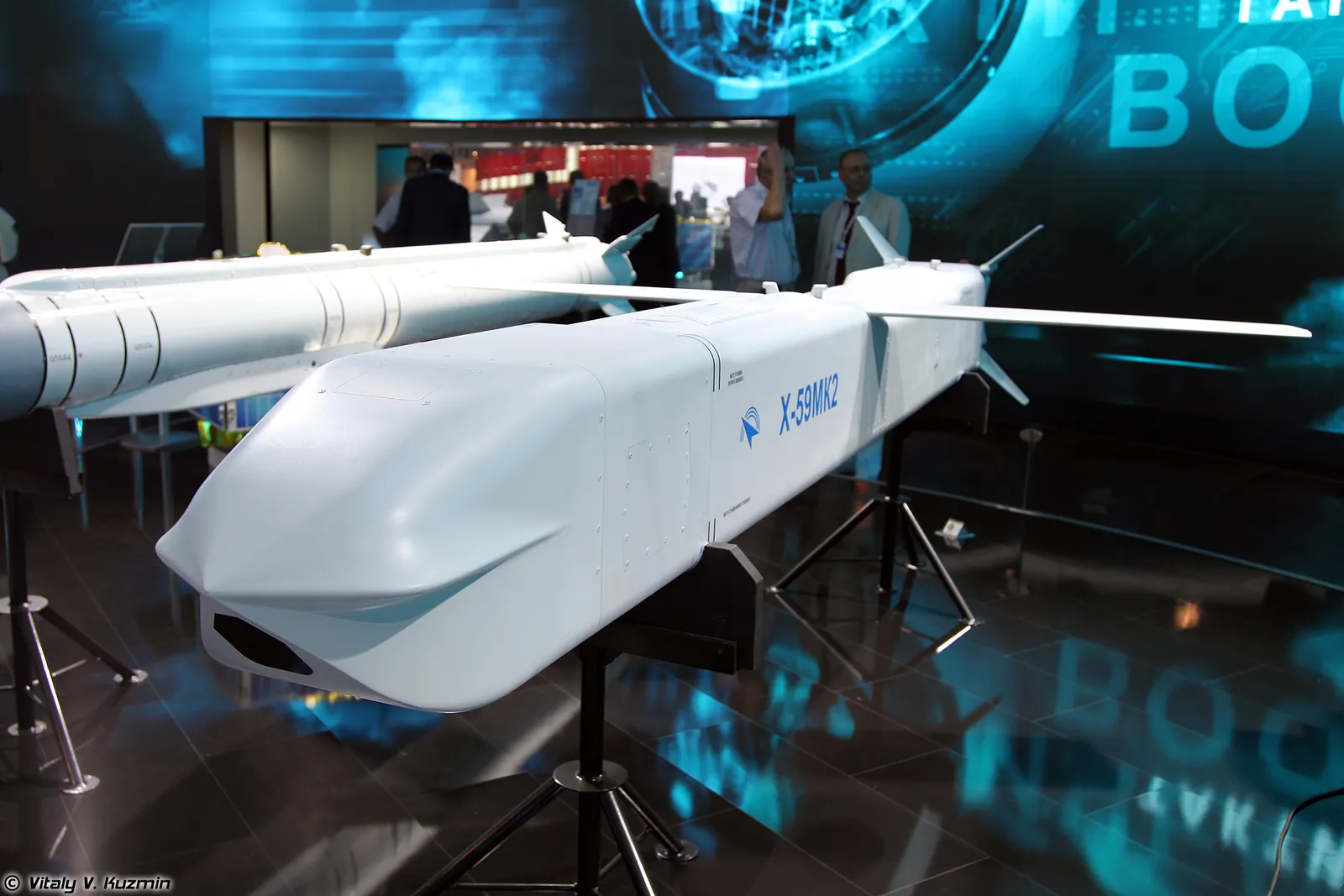
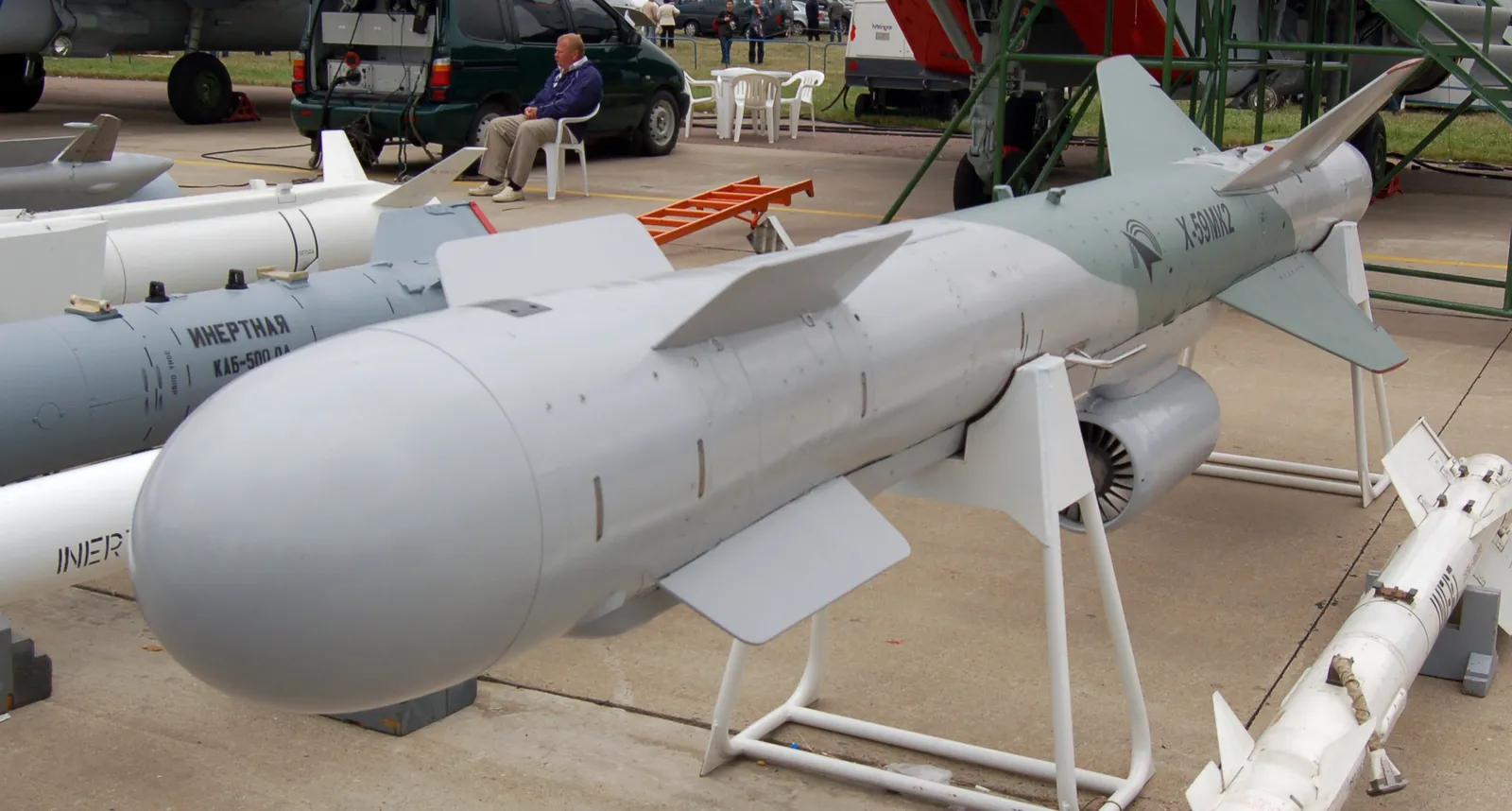
  • Kh-59MK2
  • Kh-59MKM
  • AS-13 Kingbolt
  • AS-18 Kazoo

The Kh-59 Ovod is a Soviet/Russian air-launched cruise missile family developed by Raduga for tactical standoff strike from combat aircraft. The family spans the original TV-guided Kh-59, turbojet-powered Kh-59M/ME, active-radar Kh-59MK anti-ship missile, satellite-guided Kh-59MK2 land-attack missile, and Kh-59MKM penetrator variant. Russia has used Kh-59-series missiles during the 2014 Russia-Ukraine War, and open sources separately describe caveated Kh-59MK2 combat-test reporting from Syria.

Role in Conflicts

Side
Russia

Russian forces have launched Kh-59-series guided air-launched missiles against Ukraine, including Ukrainian Air Force reporting of a Kh-59 destroyed over Poltava Oblast on February 21, 2024 and Southern Operational Command confirmation that a Kh-59 struck Zaporizhzhia airport terminal on May 26, 2024.

Role details
Profile / Specs

Profile

Origin
Soviet Union / Russia
Type
Air-launched cruise missile family
Service note
Entered service in the late Cold War; modernized variants remain in Russian service
Designer
Raduga Design Bureau
Designed
1970s original design; Kh-59M development began in the mid-1980s
Unit cost
Not publicly confirmed
Produced
Late Cold War to present for successive family variants
Number built
Not publicly confirmed

Specifications

Launch platform
Tactical aircraft including Su-24-family aircraft and later Russian fighters, depending on variant and integration
Guidance
Original and Kh-59M variants use inertial and TV guidance; Kh-59MK uses active radar homing for anti-ship attack; Kh-59MK2 uses satellite guidance with terrain matching
Range
About 40-50 km for the original Kh-59, about 120 km for Kh-59M, about 285 km for Kh-59MK/MKM, and reported up to 550 km for Kh-59MK2
Warhead
About 148 kg on the original Kh-59; later variants carry roughly 315-360 kg high-explosive, penetrating, or submunition warheads
Speed
High subsonic, roughly 900-1,050 km/h depending on variant
Dimensions
Kh-59MK: 5.7 m length, 1.3 m wingspan, 0.38 m body diameter
Target set
Land-attack, anti-ship, fixed-target, and hardened-target roles vary by variant
Guidance And Target Sets

The family designation covers several target sets. The original Kh-59 and Kh-59M/ME are TV-guided tactical strike missiles, Kh-59MK is the active-radar anti-ship branch, and Kh-59MK2 shifts to satellite-aided land attack with terrain matching.

BranchGuidance or seekerPrimary target set
Kh-59 / Kh-59MInertial and TV guidanceTactical land targets from strike aircraft
Kh-59MKActive radar homingSurface ships
Kh-59MK2Satellite guidance with terrain matchingFixed land targets at longer standoff range
Kh-59MKMModernized strike configurationHardened targets requiring a penetrating warhead
Variants

The Kh-59 family uses overlapping Russian, export, and NATO reporting names; later models changed propulsion, seeker, range, and target set rather than remaining a single missile configuration.

VariantConfigurationDesignation notes
Original Ovod configurationKh-59 tactical strike missile

Original Raduga design with TV guidance, about 40-50 km range, and use from Su-17, MiG-27, and Su-24 aircraft.

Sources: Russian Strike Missiles

Ovod-M turbojet configurationKh-59M / Kh-59ME strike variant

Kh-59M added a turbojet engine, larger warhead, TV guidance, and about 120 km range; the export version is identified as Kh-59ME.

Sources: Russian Strike Missiles

Active-radar anti-ship configurationKh-59MK anti-ship variant

Anti-ship version with active radar homing and an advertised range around 285 km.

Sources: Russian Strike Missiles, Kh-59MK

Satellite-guided land-attack configurationKh-59MK2 land-attack variant

Land-attack version described with satellite guidance, terrain matching, turbofan propulsion, and a reported range up to about 550 km.

Sources: Russian Strike Missiles, Russia Releases Video of New Standoff Missile

Penetrating-warhead configurationKh-59MKM upgrade

Unveiled in 2021 with a heavier warhead advertised for penetrating reinforced concrete and a listed range around 285 km.

Sources: Russian Strike Missiles

Carrier Aircraft

Kh-59 family carriage depends on variant and aircraft integration, spanning late Soviet strike aircraft and later Russian tactical fighters.

LauncherLauncher typeLaunch evidence
Su-24, Variable-geometry tactical bomber and strike aircraft, Aircraft & UAVsSu-24Tactical bomber / strike aircraft

Forecast International lists the original Kh-59 for Su-24-family carriage and also places the Kh-59M among weapons deployed on Su-24 Fencer aircraft.

Sources: Russian Strike Missiles

Su-57, Fifth-generation stealth multirole fighter aircraft, Aircraft & UAVsSu-57Stealth multirole fighter

CSIS described a May 2018 video showing a Su-57 launching a Kh-59MK2, while Forecast International says the Kh-59MK2 fuselage allowed carriage by the PAK FA/Su-57 fighter.

Sources: Russian Strike Missiles, Russia Releases Video of New Standoff Missile

Su-35, Single-seat multirole fighter, Aircraft & UAVsSu-35Multirole fighter

Forecast International ties Egypt's planned Su-35 procurement to Kh-59MK2 strike missiles, documenting the missile in a Su-35 export package.

Sources: Russian Strike Missiles

Timeline

Kh-59 Key Events

  1. Original Kh-59 service window

    Forecast International places Kh-59 entry into service between 1978 and 1982 after a 1970s Soviet development effort.

  2. Kh-59M publicly exhibited

    The turbojet-powered Kh-59M was first exhibited in 1993 after development began in the mid-1980s.

  3. Caveated Syria combat-test reporting

    Missile references and CSIS described Kh-59MK2 launch or possible combat-use reporting tied to Russian Su-57 activity in Syria, while noting the use claim was not fully confirmed.

  4. Kh-59MKM unveiled

    Russia unveiled the Kh-59MKM, a modernized variant with a heavier penetrating warhead.

  5. Zaporizhzhia airport terminal hit

    Ukraine's Southern Operational Command confirmed that a Russian Kh-59 cruise missile struck the Zaporizhzhia airport terminal.

Media
Related Weapon Systems
Kh-69, Air-launched land-attack cruise missile, MunitionsMunitionsKh-69Air-launched land-attack cruise missileThe Kh-69 is a Russian subsonic air-launched land-attack cruise missile developed by Raduga within Tactical Missiles Corporation for precision strikes against fixed targets. Its compact square-section body and folding surfaces are tied to tactical-aircraft carriage, including Su-34, Su-35, and Su-57 launch contexts, while its guidance stack combines inertial, satellite, terrain-height, and electro-optical terminal inputs. The missile has been documented in Russian strikes during the 2014 Russia-Ukraine War, including the April 2024 destruction of the Trypilska thermal power plant.
Kh-32, Supersonic air-launched anti-ship and land-attack cruise missile, ArtilleryArtilleryKh-32Supersonic air-launched anti-ship and land-attack cruise missileThe Kh-32 is a Russian supersonic air-launched cruise missile derived from the Kh-22 family for long-range attacks on ships and fixed ground targets. Built by the Raduga design bureau within Russia's Tactical Missiles Corporation network, it is carried by Tu-22M3-series bombers and combines a high-altitude flight profile, inertial navigation, and terminal radar homing. Russia has used the Kh-22/Kh-32 family against Ukraine, where its speed, steep terminal profile, and anti-ship design heritage make interception difficult and raise accuracy risks when fired at urban land targets.
Kh-22, Air-launched supersonic anti-ship cruise missile, MunitionsMunitionsKh-22Air-launched supersonic anti-ship cruise missileThe Kh-22, NATO reporting name AS-4 Kitchen, is a large Soviet air-launched cruise missile designed by Raduga for attacks on carrier groups, radar-contrast surface targets, and major fixed targets. Its liquid-propellant rocket motor, supersonic flight profile, and roughly one-ton conventional or nuclear warhead made it a heavy standoff weapon for Tu-22, Tu-22M, and modified Tu-95K-22 bomber variants. Russia has repurposed Kh-22-family missiles for land attack in the 2014 Russia-Ukraine War, where the missile's naval-targeting heritage, large warhead, and high terminal speed have produced severe urban-strike risks and a difficult air-defense problem.
Project 1234 Ovod / Nanuchka-class missile corvette, Guided missile corvette family, Naval SystemsNaval SystemsProject 1234 Ovod / Nanuchka-class missile corvetteGuided missile corvette familyProject 1234 Ovod, known in NATO reporting as the Nanuchka class, is a Soviet guided-missile corvette family built around a compact high-speed hull with heavy anti-ship missile armament. Soviet Project 1234 and 12341 ships carried P-120 Malakhit missiles and an Osa-M point-defense launcher, while export Project 1234E boats carried P-15/P-20 Termit missiles; documented combat losses connect Libyan export hulls to the 1986 Gulf of Sidra fighting, NATO's 2011 Libya campaign, and the 2014 Benghazi fighting.
Izdeliye 305 (LMUR), Helicopter-launched air-to-surface guided missile, MunitionsMunitionsIzdeliye 305 (LMUR)Helicopter-launched air-to-surface guided missileIzdeliye 305, commonly called LMUR, is a Russian helicopter-launched air-to-surface guided missile developed by KB Mashinostroyeniya for long-range precision attacks from Mi-8, Mi-28, and Ka-52 family helicopters. The missile combines inertial/satellite navigation with an electro-optical seeker and operator-in-the-loop terminal control, giving Russian crews a standoff weapon documented in Ukraine against vehicles, bridges, buildings, and other point targets.
Tu-95, Strategic turboprop bomber and cruise-missile carrier, Aircraft & UAVsAircraft & UAVsTu-95Strategic turboprop bomber and cruise-missile carrierThe Tupolev Tu-95 is a Soviet-designed four-engine turboprop strategic bomber family whose Tu-95MS and Tu-95MSM missile-carrier variants remain part of Russia's long-range aviation force. UAC traces the Bear's role from early nuclear missile carriage to the Tu-95MS cruise-missile carrier, while FAS and conflict reporting document its continuing use for standoff Kh-55/Kh-555 and Kh-101/Kh-102 strike missions in Syria and Ukraine.

Sources