- Side
- Russia

Russian forces have used Kh-69 air-launched cruise missiles in long-range strikes on Ukraine, including the April 2024 attack on the Trypilska thermal power plant documented from recovered missile fragments.
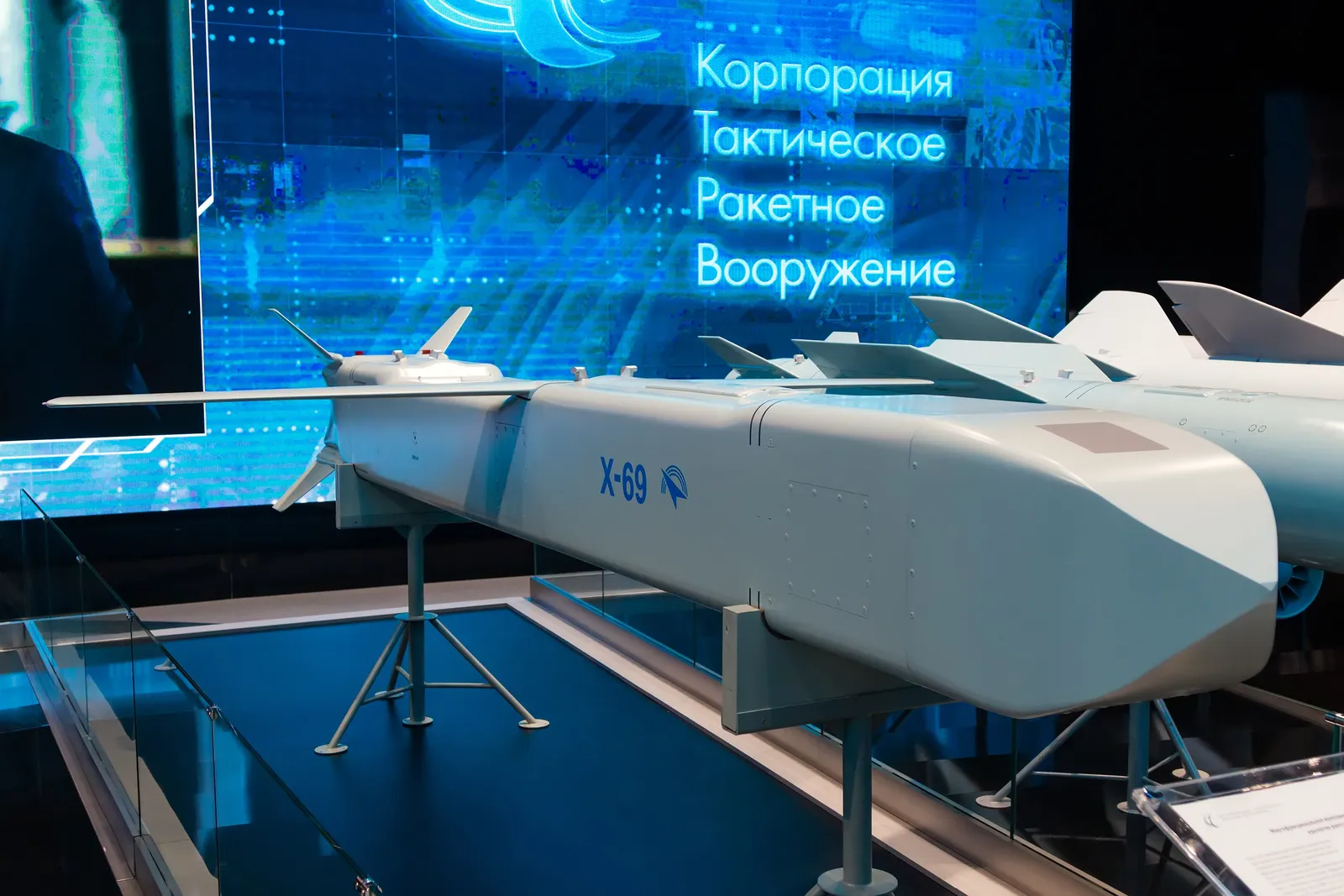
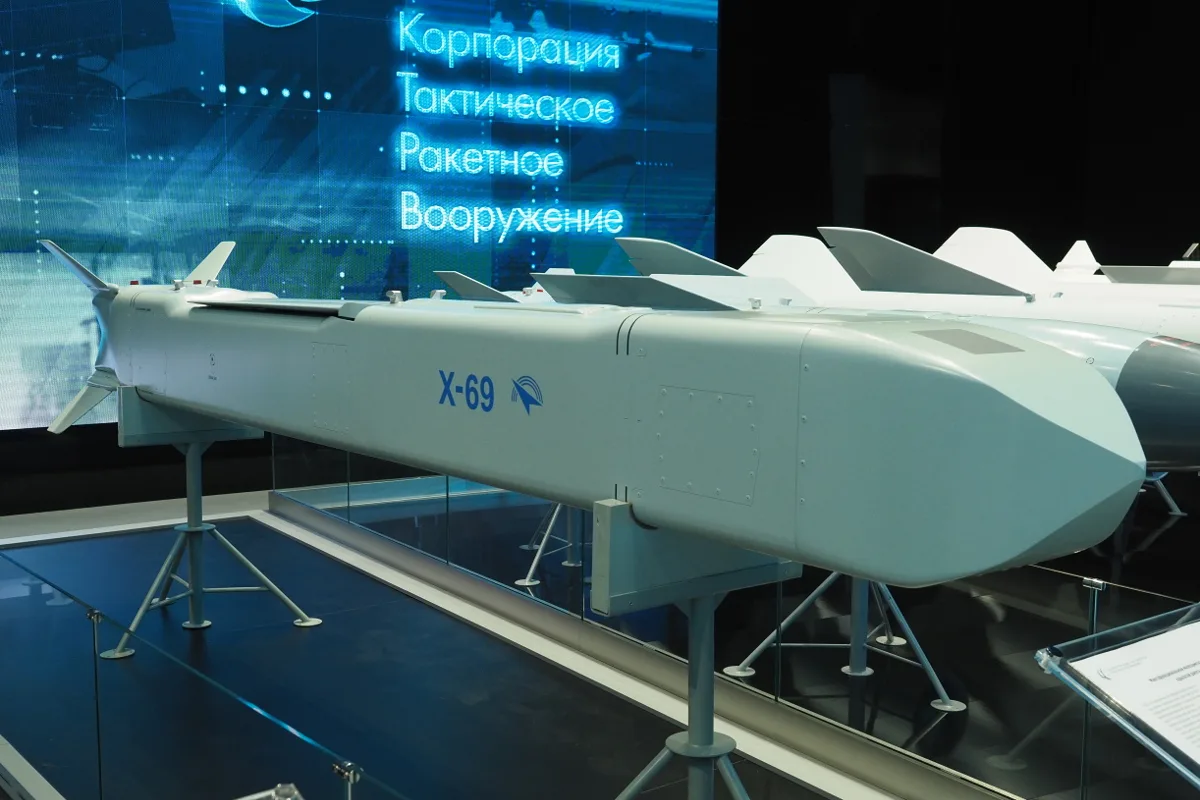
Role detailsThe Kh-69 is a Russian subsonic air-launched land-attack cruise missile developed by Raduga within Tactical Missiles Corporation for precision strikes against fixed targets. Its compact square-section body and folding surfaces are tied to tactical-aircraft carriage, including Su-34, Su-35, and Su-57 launch contexts, while its guidance stack combines inertial, satellite, terrain-height, and electro-optical terminal inputs. The missile has been documented in Russian strikes during the 2014 Russia-Ukraine War, including the April 2024 destruction of the Trypilska thermal power plant.
Russian forces have used Kh-69 air-launched cruise missiles in long-range strikes on Ukraine, including the April 2024 attack on the Trypilska thermal power plant documented from recovered missile fragments.
Role detailsDisplay-reported Kh-69 data describes a low-altitude, subsonic missile built around preplanned fixed-target attack rather than man-in-the-loop control.
| Feature | Reported detail | Source |
|---|---|---|
| Navigation stack | Strapdown inertial navigation, satellite navigation, radio-altimeter and airspeed inputs, plus electro-optical terminal guidance. | EDR Magazine |
| Flight profile | Reported 50-300 m cruise altitude with 750-1,000 km/h subsonic speed and 5-7 m circular error probable. | EDR Magazine |
| Launch envelope | Reported launch from 0.2-11 km altitude and Mach 0.5-0.9 carrier-aircraft speed. | EDR Magazine |
| Airframe fit | Square-section body, folding surfaces, and low-observable shaping are tied to compact tactical-aircraft carriage, especially Su-57 compatibility. | EDR Magazine; Defense Express |
Open sources describe the Kh-69 as a Kh-59MK2-lineage missile with warhead configurations advertised for different target sets.
| Variant | Configuration | Designation notes |
|---|---|---|
 | Development predecessor | The War Zone and IISS describe the Kh-69 as evolving from the Kh-59MK2 / Kh-59 family rather than as an unrelated missile design. Sources: Russia Now Using Kh-69 Cruise Missiles In Ukraine: Reports, Russia's War in Ukraine: Ballistic and Cruise Trajectories |
| Penetrating warhead configuration | Fixed-target penetration | Display-reported data lists a roughly 310 kg penetrating warhead option for hardened or structurally protected fixed targets. Sources: Dubai Airshow 2025 - The Kh-69 Cruise Missile Displayed Abroad |
| Cluster warhead configuration | Area-target payload | Display-reported data also lists a roughly 300 kg cluster warhead option. Sources: Dubai Airshow 2025 - The Kh-69 Cruise Missile Displayed Abroad |
Open reporting ties the Kh-69 to tactical aircraft rather than only to Russia's strategic bomber force.
| Launcher | Launcher type | Launch evidence |
|---|---|---|
 | Strike aircraft | Defense Express reports the Kh-69 can be launched from Su-34 tactical aircraft, a point repeated in coverage of the Trypilska strike. Sources: The Russians Used the Latest Kh-69 Missiles to Attack the Trypilska TPP |
 | Multirole fighter | Defense Express reports Su-35 aircraft among possible Kh-69 launch platforms in Russian use against Ukraine. Sources: The Russians Used the Latest Kh-69 Missiles to Attack the Trypilska TPP |
 | Stealth fighter | EDR Magazine describes Kh-69 use context with Su-57 fighters, while Defense Express notes the missile's intended internal-carriage role for the Su-57. Sources: Dubai Airshow 2025 - The Kh-69 Cruise Missile Displayed Abroad, The Russians Used the Latest Kh-69 Missiles to Attack the Trypilska TPP |
Commons image metadata identifies a KTRV Kh-69 cruise missile displayed at the Army-2022 forum near Moscow.
Sources: Kh-69 Army-2022
The War Zone reported Ukrainian claims that Kh-69 wreckage was tied to Russia's February 2024 missile attacks, while noting identification limits from the available imagery.
Sources: Russia Now Using Kh-69 Cruise Missiles In Ukraine: Reports
Defense Express and Ukrainska Pravda reported that recovered fragments identified Kh-69 missiles in the Russian strike that destroyed the Trypilska thermal power plant.
Sources: The Russians Used the Latest Kh-69 Missiles to Attack the Trypilska TPP, Ukrainska Pravda Obtains Photos of Wreckage from Advanced Kh-69 Missile
EDR Magazine reported a camouflaged Kh-69 display at Dubai Airshow 2025 and published updated technical data from the KTRV stand.
Sources: Dubai Airshow 2025 - The Kh-69 Cruise Missile Displayed Abroad