Munitions

P-270 Moskit

Also known as
  • P-100 Moskit
  • P-100
  • 3M80 Moskit
  • 3M-80
  • 3M82 Moskit-M
  • 3M80E
  • 3M-80E
  • 3M80E1
  • 3M-80E1
  • 3M80MVE
  • 3M-80MVE
  • Moskit-E
  • Moskit-MVE
  • SS-N-22 Sunburn
  • Sunburn

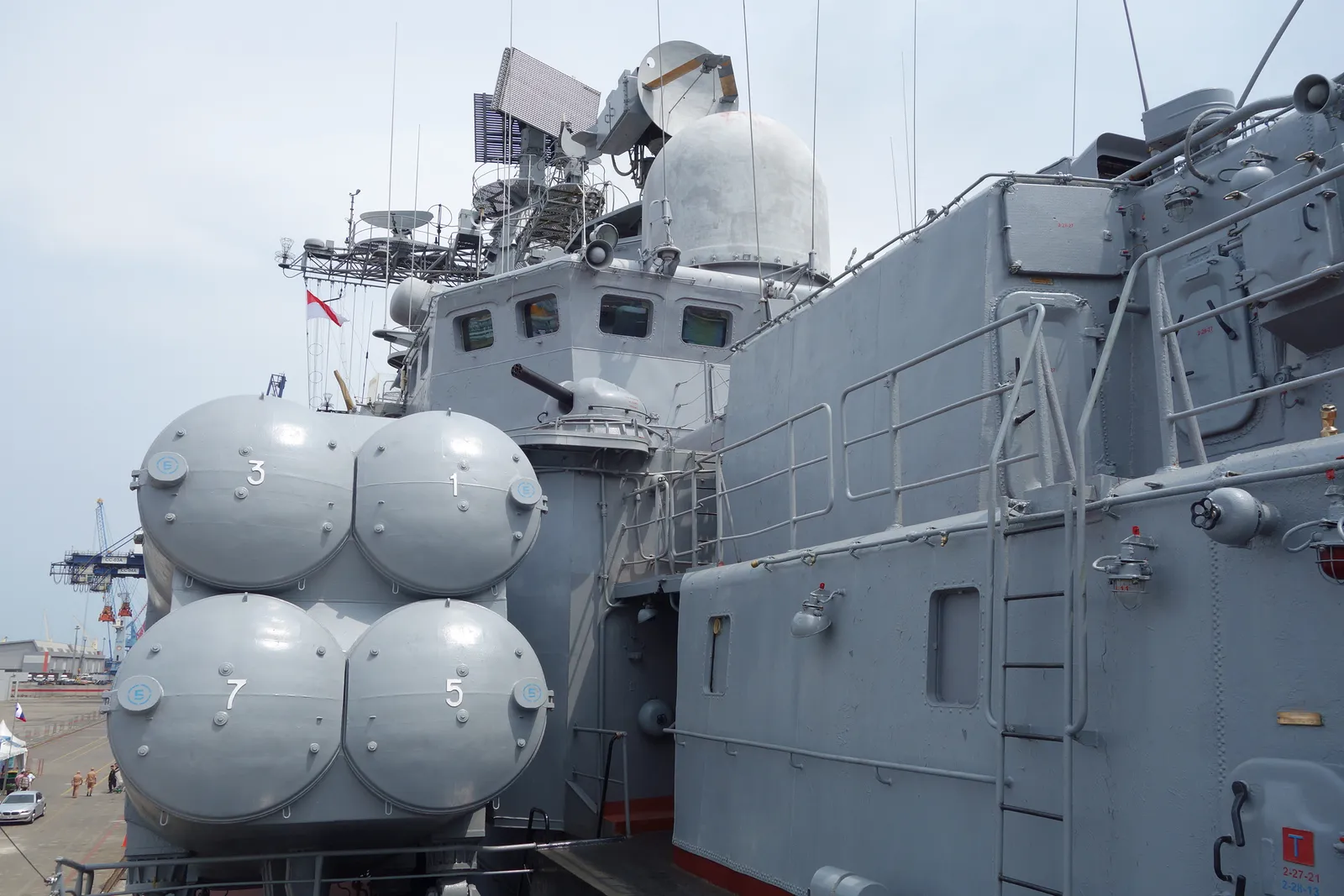
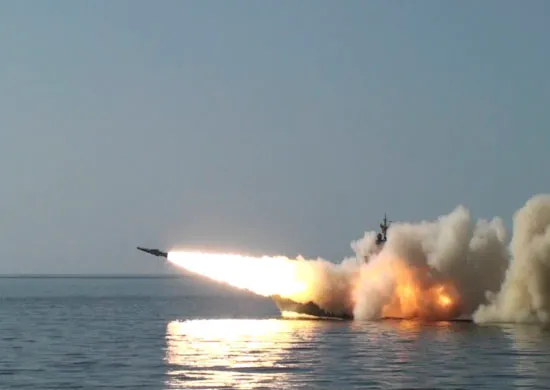
The P-270 Moskit, also known as 3M80/3M82 and SS-N-22 Sunburn, is a Soviet and Russian supersonic anti-ship cruise missile developed by MKB Raduga and produced at Progress plant in Arsenyev. The family is centered on shipboard strike from Sovremenny destroyers, Tarantul missile corvettes, and Project 1239 surface-effect corvettes, pairing inertial midcourse navigation with active/passive radar terminal homing and a low-altitude ramjet flight profile.

Profile / Specs

Profile

Origin
Soviet Union / Russia
Type
Supersonic anti-ship cruise missile
Service note
Late Cold War design; production listed from 1984 to 2014 in open references.
Designer
MKB Raduga
Designed
1973-late 1970s design project
Produced
1984-2014
Number built
Several hundred

Specifications

Guidance
Inertial midcourse navigation with active/passive radar terminal homing
Range
About 90 km for 3M80; about 120 km for 3M82/3M80E; about 140 km for 3M80MVE on a low-altitude profile or up to 240 km on a combined high-low profile in Missilery.info data
Warhead
About 300 kg penetrating high-explosive warhead, including about 150 kg explosive filler in WeaponSystems.net data
Speed
About Mach 2.35 for 3M80 and about Mach 2.8 for 3M82/3M80MVE in WeaponSystems.net data
Propulsion
Liquid-fueled ramjet sustainer with solid-propellant booster
Launch platforms
Project 956/Sovremenny-class destroyers, Project 1241.1/Molniya or Tarantul missile boats, Project 1239/Sivuch surface-effect corvettes, Lun ekranoplan test context, and reported Su-27K/Su-33 or Su-32FN air-launch carriage references
Dimensions
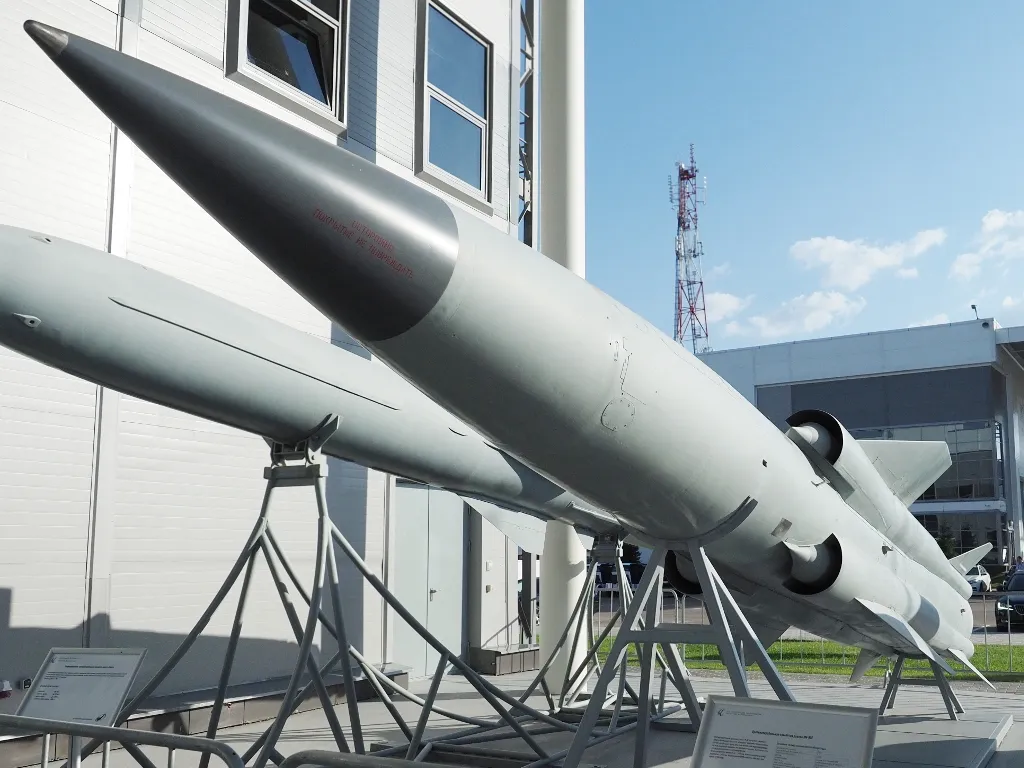
3M80 length 9.385 m; 3M82/3M80MVE length 9.745 m; 0.76 m body diameter; 2.1 m wingspan extended and 1.3 m folded in WeaponSystems.net data
Launch mass
About 3,950 kg for 3M80, 4,150 kg for 3M82/3M80E, and 4,450 kg for 3M80MVE in open data
Flight altitude
Sea-skimming profile typically 7-20 m above sea level; Missilery.info describes descent to about 7 m near the target
Salvo interval
Ship fire-control references describe four-target processing and a 5-second interval between missiles in a salvo
Guidance And Flight Profile

The Moskit family combined high speed with a low-altitude terminal approach, making the missile's guidance chain and launch preparation central to its design rather than secondary details.

Midcourse control

WeaponSystems.net describes inertial navigation toward a target area, with possible target-zone updates from airborne or space-based maritime reconnaissance assets before terminal seeker activation.

Terminal seeker

The terminal phase uses active/passive radar homing; Missilery.info describes the combined guidance system as intended to work under radio-countermeasure conditions.

Sea-skimming attack

Open data describes low-altitude cruise at roughly 7-20 m above sea level, with Missilery.info noting a final descent to about 7 m near the target.

Ship salvo handling

Missilery.info describes ship-control equipment for single or multiple launches, distribution of missiles to targets, and 5-second intervals during salvo firing.

Sources: P-270 Moskit; Anti-ship missile 3M80 (3M80E) Mosquito.

Variants

Open references group 3M80, 3M82, 3M80E, and 3M80MVE under the Moskit/Sunburn family, with range and flight-profile differences across variants.

VariantConfigurationDesignation notes
3M80 MoskitOriginal ship-launched missile

WeaponSystems.net lists the 3M80 as the original Moskit missile introduced in 1984 or 1985, with roughly 90 km effective range and active/passive radar terminal homing.

Sources: P-270 Moskit

3M82 Moskit-MImproved longer-range variant

WeaponSystems.net describes the 3M82 as an improved Moskit branch using a modified ramjet and larger fuel capacity to reach about 100-120 km maximum range.

Sources: P-270 Moskit

3M80EExport model

WeaponSystems.net identifies 3M80E as an export model of the 3M82 missile with a 120 km range, while Missilery.info ties the 3M80E modernization path to extended-range testing from 1987 to 1989.

Sources: P-270 Moskit, Anti-ship missile 3M80 (3M80E) Mosquito

3M80E1Lightened proposed export model

WeaponSystems.net lists 3M80E1 as a proposed export model with a 100 km range, and GlobalSecurity notes Raduga displayed a lighter 3M-80E1 in August 2001.

Sources: P-270 Moskit, Moskit / SS-N-22 Sunburn

3M80MVEExtended-range export variant

WeaponSystems.net describes the 3M80MVE as adding a high-low attack profile, trading sea-skimming throughout the flight for increased range.

Sources: P-270 Moskit

Kh-41Air-launched derivative

GlobalSecurity describes the air-launched ASM-MSS/Kh-41 branch as intended for Su-27K/Su-33 carriage, while Missilery.info also notes Su-27K and Su-32FN carriage references.

Sources: Moskit / SS-N-22 Sunburn, Anti-ship missile 3M80 (3M80E) Mosquito

Launch Platforms

Open references consistently tie Moskit to a small set of ship and small-combatant launch platforms rather than treating it as a universal anti-ship missile fit.

LauncherLauncher typeLaunch evidence
Project 956E / 956EM Sovremenny-class destroyer, Russian-built guided-missile destroyers exported to the Chinese People's Liberation Army Navy, Naval SystemsProject 956E / 956EM Sovremenny-class destroyerChinese Project 956E/956EM export destroyer branch

WeaponSystems.net identifies Project 956/Sovremenny destroyers as Moskit's main platform, and Missilery.info describes Project 956 ships with two quadruple KT-190 Moskit launchers; this local link points to the catalog's Chinese export-batch page rather than a full Soviet/Russian Project 956 class record.

Sources: P-270 Moskit, Anti-ship missile 3M80 (3M80E) Mosquito

Project 1241 Molniya / Tarantul-class missile corvette, Missile corvette class, Naval SystemsProject 1241 Molniya / Tarantul-class missile corvetteMissile corvette and fast-attack craft family

WeaponSystems.net lists conventional Project 1241.1 Molniya/Tarantul III craft among Moskit carriers, and Missilery.info describes Project 1241.1 boats receiving Moskit launchers.

Sources: P-270 Moskit, Anti-ship missile 3M80 (3M80E) Mosquito

Project 1239 Sivuch / Bora-class missile hovercraft, Surface effect guided-missile corvette, Naval SystemsProject 1239 Sivuch / Bora-class missile hovercraftSurface-effect missile corvette

WeaponSystems.net and Missilery.info both identify Project 1239/Sivuch-Dergach surface-effect corvettes as Moskit carriers; Missilery.info specifies two quadruple Moskit launchers on the class.

Sources: P-270 Moskit, Anti-ship missile 3M80 (3M80E) Mosquito

Udaloy-class anti-submarine destroyer, Guided-missile anti-submarine destroyer, Naval SystemsUdaloy-class anti-submarine destroyerProject 1155.1 / Udaloy II destroyer configuration

WeaponSystems.net documents the single completed Project 1155.1 Fregat-M/Udaloy II configuration with two quadruple KT-190 launchers for 3M82 Moskit-M; this should not be generalized to baseline Project 1155/Udaloy I ships.

Sources: Project 1155.1 Fregat-M class

Timeline

P-270 Moskit Key Events

  1. Moskit development begins

    Missilery.info says development of the 3M80 Moskit anti-ship missile began in 1973 at the Raduga design bureau.

    Sources: Anti-ship missile 3M80 (3M80E) Mosquito

  2. Soviet state tests

    WeaponSystems.net places Moskit state testing from 1978 to 1982, while Missilery.info describes flight-design and joint tests across coastal, Project 1241.1, and Project 956 launch settings.

    Sources: P-270 Moskit, Anti-ship missile 3M80 (3M80E) Mosquito

  3. Service entry

    WeaponSystems.net lists Moskit service entry in 1984 or 1985 after Soviet state tests from 1978 to 1982.

    Sources: P-270 Moskit

  4. Extended-range Moskit-M testing begins

    Missilery.info says upgraded Moskit-M testing began with a first launch on 6 August 1987 and continued through July 1989 to raise firing range.

    Sources: Anti-ship missile 3M80 (3M80E) Mosquito

  5. Lightened 3M-80E1 displayed

    GlobalSecurity reports that Raduga displayed a lighter 3M-80E1 in August 2001, reducing weight compared with the 3M-80E and listing a shorter range.

    Sources: Moskit / SS-N-22 Sunburn

  6. Production endpoint in open references

    WeaponSystems.net lists P-270 Moskit production at Progress plant, Arsenyev from 1984 to 2014.

    Sources: P-270 Moskit

Media
Related Weapon Systems
3M22 Tsirkon, Hypersonic anti-ship and land-attack missile, MunitionsMunitions3M22 TsirkonHypersonic anti-ship and land-attack missileThe 3M22 Tsirkon, also rendered Zircon, is a Russian hypersonic missile associated with the 3K22 shipborne missile complex and NATO reporting name SS-N-33. Open sources attribute design and production to Reutov-based NPO Mashinostroyenia within Tactical Missiles Corporation, with documented Project 22350 and Yasen-family launch reporting, broader 3S-14/UKSK compatibility claims, and thinner public reporting on Bastion coastal-launcher integration. Russia used the missile in strikes on Kyiv during the 2014 Russia-Ukraine War, with reporting expanding from fragment-based 2024 evidence to larger 2026 salvos, while its advertised speed, range, warhead, guidance, and even flight-profile details remain shaped by Russian claims, fragment analysis, and secondary estimates rather than fully transparent public test data.
Kh-22, Air-launched supersonic anti-ship cruise missile, MunitionsMunitionsKh-22Air-launched supersonic anti-ship cruise missileThe Kh-22, NATO reporting name AS-4 Kitchen, is a large Soviet air-launched cruise missile designed by Raduga for attacks on carrier groups, radar-contrast surface targets, and major fixed targets. Its liquid-propellant rocket motor, supersonic flight profile, and roughly one-ton conventional or nuclear warhead made it a heavy standoff weapon for Tu-22, Tu-22M, and modified Tu-95K-22 bomber variants. Russia has repurposed Kh-22-family missiles for land attack in the 2014 Russia-Ukraine War, where the missile's naval-targeting heritage, large warhead, and high terminal speed have produced severe urban-strike risks and a difficult air-defense problem.
Kh-32, Supersonic air-launched anti-ship and land-attack cruise missile, ArtilleryArtilleryKh-32Supersonic air-launched anti-ship and land-attack cruise missileThe Kh-32 is a Russian supersonic air-launched cruise missile derived from the Kh-22 family for long-range attacks on ships and fixed ground targets. Built by the Raduga design bureau within Russia's Tactical Missiles Corporation network, it is carried by Tu-22M3-series bombers and combines a high-altitude flight profile, inertial navigation, and terminal radar homing. Russia has used the Kh-22/Kh-32 family against Ukraine, where its speed, steep terminal profile, and anti-ship design heritage make interception difficult and raise accuracy risks when fired at urban land targets.

Sources