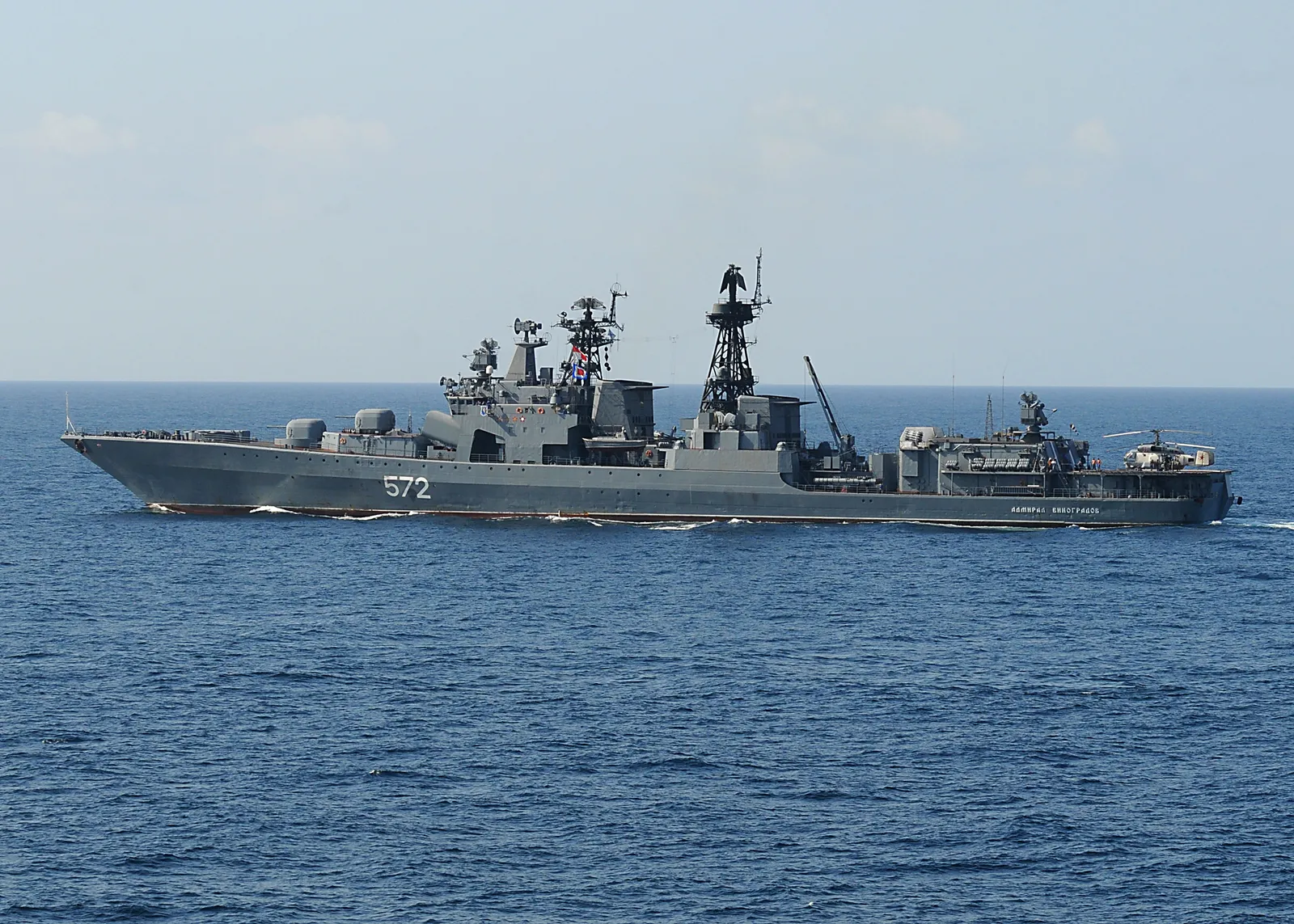

Russian Udaloy-class destroyer Vice Admiral Kulakov operated off Syria during Russia's intervention, where reporting described the ship protecting Russian vessels, supporting the air campaign, and tracking submarines in the eastern Mediterranean.
Role detailsNaval Systems
Udaloy-class anti-submarine destroyer
Also known as
- Project 1155
- Project 1155 Fregat
- Project 1155 Fregat I
- Project 1155.1 Fregat-M
- Udaloy class destroyer
- Udaloy-class destroyer
- Udaloy I-class destroyer
- Udaloy II
- Udaloy II-class destroyer
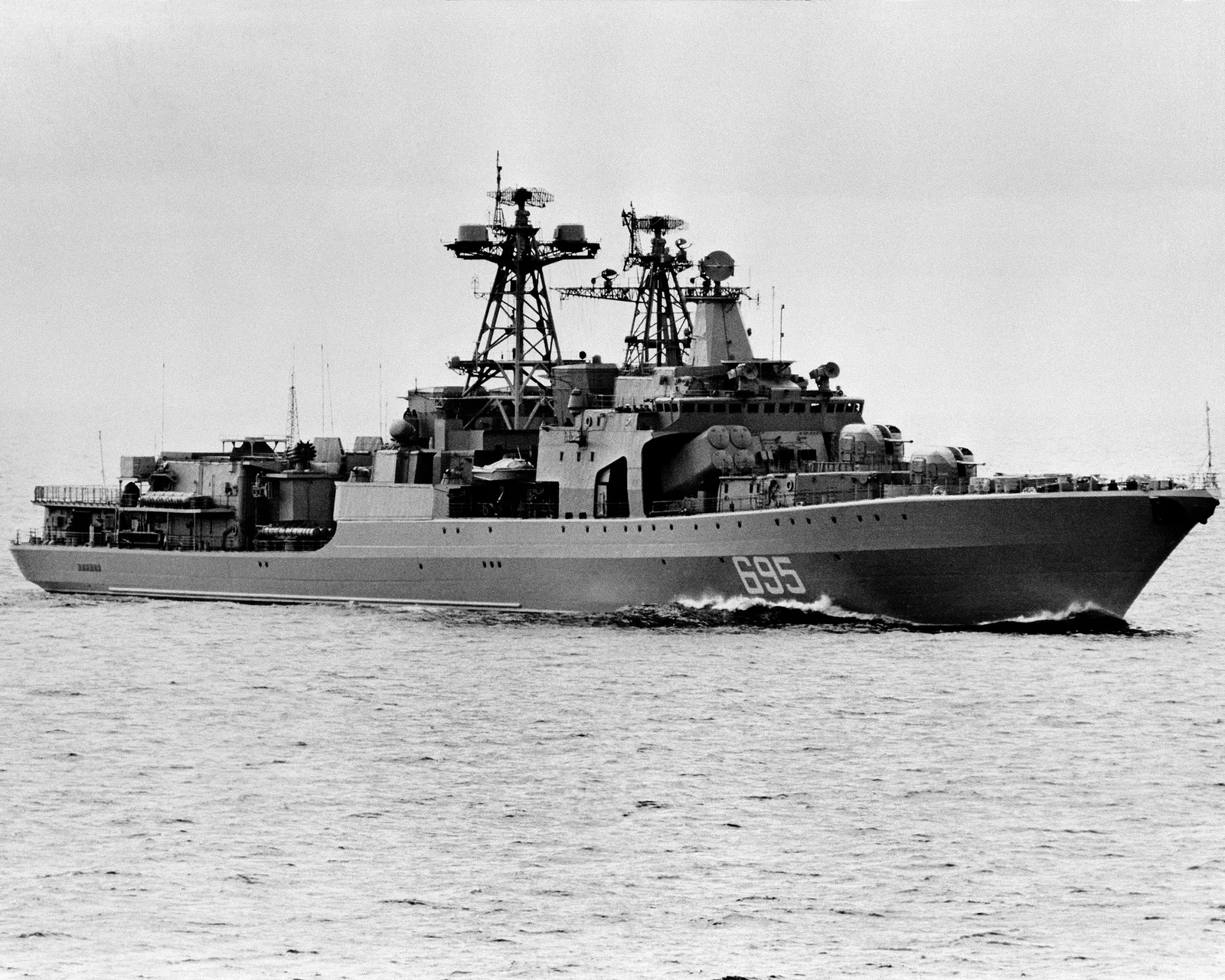
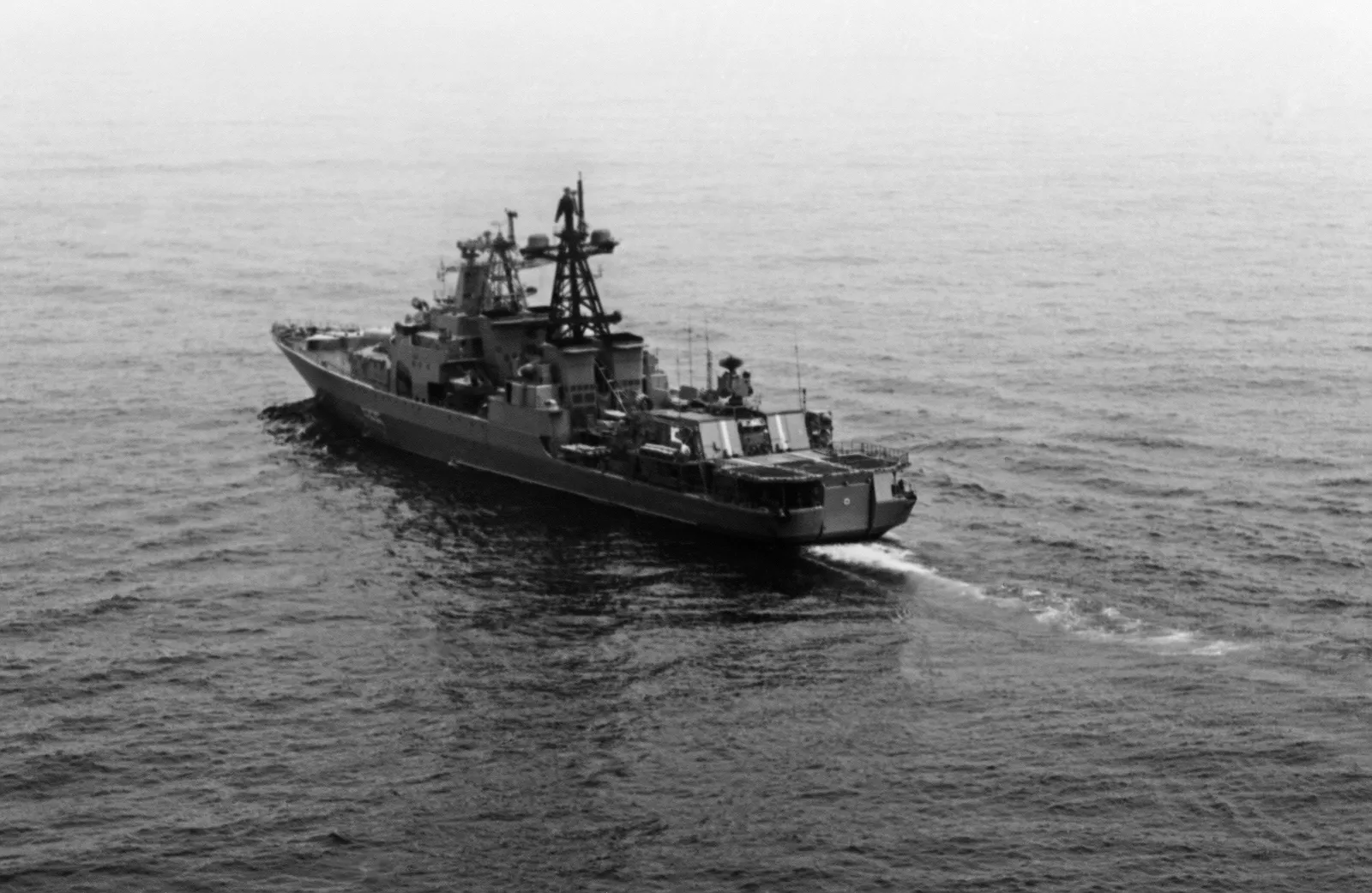
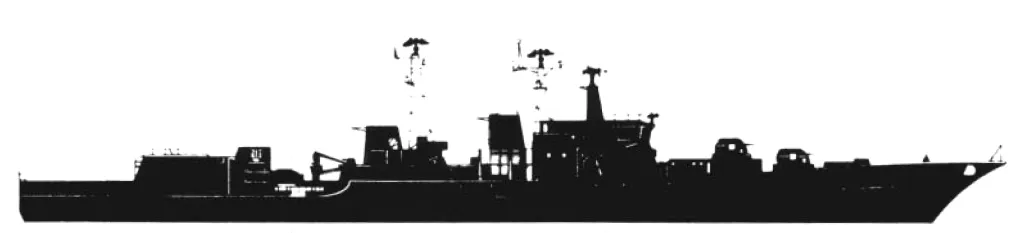
The Udaloy-class, Soviet Project 1155 Fregat, is a Soviet/Russian anti-submarine destroyer family built around long-range ocean escort and submarine-hunting missions. Project 1155 ships combined bow and variable-depth sonar, two Ka-27 helicopters, SS-N-14/Rastrub missiles, torpedoes, RBU-6000 launchers, and gas-turbine propulsion; later Udaloy II and Marshal Shaposhnikov-style refits added heavier multi-role strike fits. Documented deployments tie Udaloy-class ships to Russia's Syria intervention and counter-piracy patrols off Somalia.
Role in Conflicts


Russian Navy Udaloy-class destroyers were documented in Gulf of Aden and Somali-coast counter-piracy rotations, with Vice Admiral Kulakov assigned to an anti-piracy mission and Admiral Tributs reported escorting commercial convoys.
Profile / Specs
Profile
- Origin
- Soviet Union
- Built by
- Yantar ShipyardZhdanov Shipyard
- Type
- Guided-missile anti-submarine destroyer
- Service note
- 1980-present
- Designer
- Severnoye Design Bureau
- Designed
- 1970s
- Produced
- 1977-1999
- Number built
- 13
- Developed from
- Krivak-class anti-submarine ship
Specifications
- Displacement
- 6,930 tons standard; 7,570 tons full load
- Length
- 163 m
- Beam
- 19.3 m
- Draught
- 6.2 m
- Propulsion
- 2-shaft COGAG with 2 × D090 and 2 × DT59 gas turbines
- Speed
- 29 knots maximum sustained speed cited by USNI; over 28 knots in other open references
- Complement
- 300
- Baseline Project 1155 armament
- 2 × 100 mm AK-100 guns, 8 × SS-N-14/Rastrub missiles, 64 Kinzhal / SA-N-9 SAM cells, 4 × AK-630 CIWS, 2 × 12-tube RBU-6000 launchers, 2 × quadruple 533 mm torpedo tubes, and 2 × Ka-27PL helicopters
- Project 1155.1 armament
- Moskit-M anti-ship missiles, AK-130 gun, Kinzhal SAMs, Kortik CIWS, UDAV-1 rockets, Vodopad-NK/torpedo tubes, and 2 × Ka-27PL helicopters
- Modernized Marshal Shaposhnikov armament
- Kalibr-NK and Uran strike missile systems added during refit; USNI describes 16 Kalibr-family VLS cells and 8 Kh-35 Uran missiles
- Aviation
- Hangar and flight deck for two Ka-27PL anti-submarine helicopters
Design And Refit Paths
The family is best read as three related configurations: the original Project 1155 ASW destroyer, the single Project 1155.1/Udaloy II ship, and later refits that gave selected hulls a modern strike role.
| Configuration | Documented fit | Catalog implication |
|---|---|---|
| Project 1155 Fregat | SS-N-14/Rastrub, RBU-6000, torpedo tubes, Kinzhal SAMs, AK-630 CIWS, two Ka-27PL helicopters. | Baseline entries should emphasize anti-submarine escort and force-protection work. |
| Project 1155.1 Fregat-M | One completed Udaloy II ship with Moskit-M, AK-130, Kortik, UDAV-1, Vodopad-NK, torpedoes, and two Ka-27PL helicopters. | Udaloy II is part of the family but not representative of all Project 1155 hulls. |
| Marshal Shaposhnikov refit | Modernization added Kalibr-NK and Uran strike missiles and reclassified the ship as a frigate. | Kalibr/Uran should be described as a sourced refit capability, not a fleet-wide original armament. |
Variants
Project 1155 records should separate the baseline Udaloy I ASW destroyers, the single completed Project 1155.1/Udaloy II ship, and later individual refits such as Marshal Shaposhnikov rather than treating every hull as having the same weapon fit.
| Variant | Configuration | Designation notes |
|---|---|---|
| Project 1155 Fregat / Udaloy I | Baseline anti-submarine destroyer | Weaponsystems.net records 12 Project 1155 Fregat ships produced from 1977 to 1991 and entering service from 1980. Sources: Project 1155 Fregat class |
| Project 1155.1 Fregat-M / Udaloy II | Improved multi-role successor | The Project 1155.1 Fregat-M / Udaloy II design entered service in 1999 with one completed ship and a heavier anti-surface and close-defense fit. Sources: Project 1155.1 Fregat-M class |
| Modernized Project 1155 / Marshal Shaposhnikov refit | Refit configuration | Marshal Shaposhnikov's modernization converted the ship into a frigate and added Kalibr-NK and Uran strike missile systems; this should not be read as proof that every Udaloy-class hull received the same refit. Sources: Russian frigate Marshal Shaposhnikov conducts missile firings in Sea of Japan, Modernizing Udaloy-class ASW Destroyers |
Carried Anti-Submarine Weapons
Project 1155 combined shipboard rocket launchers, torpedo tubes, missiles, and helicopters for layered anti-submarine work.
| Carried item | Item type | Carriage evidence |
|---|---|---|
 | Anti-submarine rocket launcher | Weaponsystems.net lists two 12-tube RBU-6000 Smerch-2 launchers on the baseline Project 1155 Fregat class. Sources: Project 1155 Fregat class |
 | 533 mm anti-ship torpedo | Weaponsystems.net lists Type 53-65 / 53-65K torpedoes among the torpedo types used with Project 1155 and Project 1155.1 launchers. Sources: Project 1155 Fregat class, Project 1155.1 Fregat-M class |
Modernized Strike Weapons
Selected modernized Udaloy-family hulls gained strike weapons absent from the original Project 1155 fit.
| Launched item | Item type | Launch evidence |
|---|---|---|
 | Cruise missile family | USNI Proceedings and TASS report that Marshal Shaposhnikov's refit added Kalibr-family launch capability; this relationship applies to the modernized refit, not every Udaloy-class ship. Sources: Modernizing Udaloy-class ASW Destroyers, Russian frigate Marshal Shaposhnikov conducts missile firings in Sea of Japan |
Timeline
Udaloy-class anti-submarine destroyer Key Events
Project 1155 production begins
Weaponsystems.net records Project 1155 production running from 1977 to 1991, split between Yantar in Kaliningrad and Zhdanov in Leningrad.
Sources: Project 1155 Fregat class
The first Udaloy-class ship enters commission
Project 1155 entered Soviet service in 1980 as a dedicated anti-submarine destroyer class.
Sources: Project 1155 Fregat class, Modernizing Udaloy-class ASW Destroyers
The Udaloy II follow-on enters service
Project 1155.1 Fregat-M, the Udaloy II design, entered service in 1999 after only one ship was completed.
Sources: Project 1155.1 Fregat-M class, Modernizing Udaloy-class ASW Destroyers
Marshal Shaposhnikov enters modernization
TASS reports Marshal Shaposhnikov was placed in dock at Dalzavod in 2016 for repairs and modernization that converted it into a frigate with Kalibr-NK and Uran strike missile systems.
Sources: Russian frigate Marshal Shaposhnikov conducts missile firings in Sea of Japan
Marshal Shaposhnikov rejoins the Pacific Fleet
After modernization and trials, Marshal Shaposhnikov rejoined the Russian Pacific Fleet on April 27, 2021.
Sources: Russian frigate Marshal Shaposhnikov conducts missile firings in Sea of Japan
Media
Udaloy-class anti-submarine destroyer Videos
Udaloy-class anti-submarine destroyer Images
Related Weapon Systems


Sources
Udaloy Class Anti-Submarine DestroyersPublisher: Naval Technology | Note: Supports the class background, Project 1155 / Project 1155.1 design context, shipyard builders, propulsion, dimensions, range, armament, and helicopter fit. | Accessed: 2026-07-04Project 1155 Fregat classPublisher: WeaponsSystems.net | Note: Supports baseline Project 1155 identity, production, builders, service entry, ASW role, armament, torpedo types, and Ka-27PL helicopter fit. | Accessed: 2026-07-04Project 1155.1 Fregat-M classPublisher: WeaponsSystems.net | Note: Supports Project 1155.1 Fregat-M / Udaloy II identity, one completed ship, 1999 service entry, Yantar production, and the improved armament and aviation fit. | Accessed: 2026-07-04Modernizing Udaloy-class ASW DestroyersPublisher: U.S. Naval Institute Proceedings | Note: Supports the Project 1155 / Project 11551 production split, baseline ASW fit, speed and range, and Marshal Shaposhnikov modernization with Kalibr-family VLS and Kh-35 Uran missiles. | Accessed: 2026-07-04Russian frigate Marshal Shaposhnikov conducts missile firings in Sea of JapanPublisher: TASS | Note: Supports Marshal Shaposhnikov's Project 1155 origin, 2016 Dalzavod modernization, conversion into a frigate, Kalibr-NK and Uran missile systems, and April 27, 2021 return to the Pacific Fleet. | Accessed: 2026-07-04Russia displays naval might off Syria's Mediterranean coastPublisher: Associated Press via KSL.com | Note: Supports conflictUsage:2011 Syrian Civil War by directly reporting Vice Admiral Kulakov off Syria protecting Russian ships, supporting the air campaign, and tracking submarines during Russia's intervention. | Accessed: 2026-07-04HMS Somerset escorts Russian task groupPublisher: Royal Navy | Note: Supports conflictUsage:2011 Syrian Civil War by identifying Vice Admiral Kulakov as an Udaloy-class destroyer returning from a Syria deployment in March 2016. | Accessed: 2026-07-04Russia Pulling Carrier Admiral Kuznetsov from MediterraneanPublisher: USNI News | Note: Supports conflictUsage:2011 Syrian Civil War by reporting a Russian Syria-supporting carrier group with two Udaloy-class guided-missile destroyers and auxiliaries in the eastern Mediterranean. | Accessed: 2026-07-04Piracy - Russian Navy to Send Task Force to Gulf of AdenPublisher: MarineLink / Maritime Activity Reports | Note: Supports conflictUsage:2008 Somali Piracy / Operation Atalanta by reporting Udaloy-class destroyers Vice Admiral Kulakov and Admiral Tributs in Russian anti-piracy rotations off Somalia and in the Gulf of Aden. | Accessed: 2026-07-04Udaloy-class destroyerPublisher: Wikipedia | Note: Baseline terminology and lead source only; higher-quality sources above support the edited specifications, variants, and conflict-use rows. | Accessed: 2026-07-04AdmiralVinogradov2009.jpgPublisher: Wikimedia Commons | Note: Supports image provenance for the primary Udaloy-class ship photo. | Accessed: 2026-07-04Udaloy1983.jpgPublisher: Wikimedia Commons | Note: Supports image provenance for a public-domain U.S. Navy photo of the lead Udaloy-class ship underway in 1983. | Accessed: 2026-07-04Marshal Shaposhnikov underway official U.S. Navy photoPublisher: Wikimedia Commons / National Archives via DPLA | Note: Supports image provenance for a public-domain U.S. Navy/National Archives photo of Marshal Shaposhnikov underway. | Accessed: 2026-07-04Udaloy-I-class destroyer profile 1987.pngPublisher: Wikimedia Commons | Note: Supports image provenance for the Project 1155 profile diagram. | Accessed: 2026-07-04