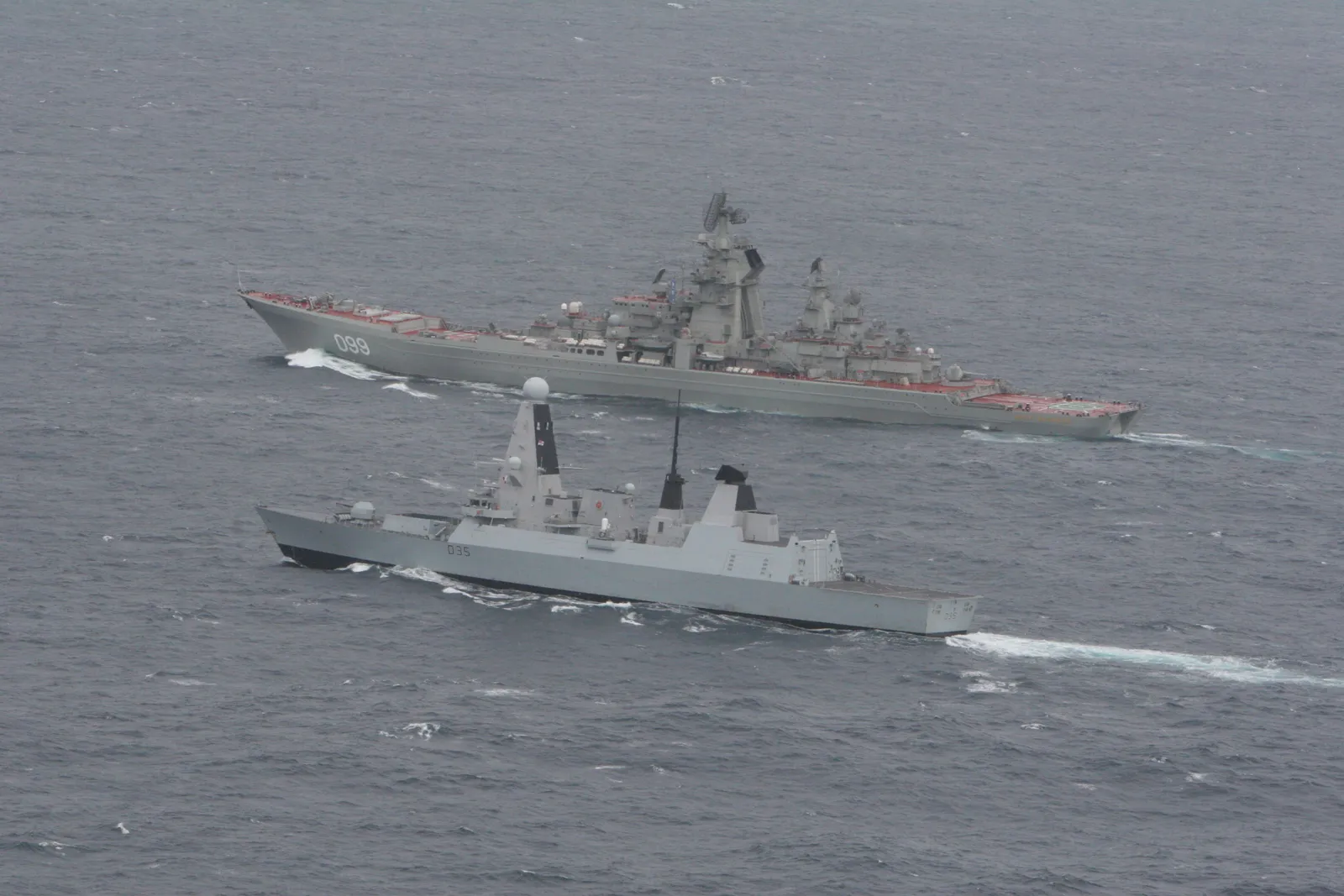

Pyotr Velikiy deployed with the Admiral Kuznetsov-led Northern Fleet task force off Syria in late 2016 and early 2017; cited sources support fielding and symbolic naval presence, not confirmed firing of Kirov-class onboard weapons.
Role detailsNaval Systems
Project 1144 Orlan / Kirov-class nuclear-powered guided-missile heavy cruiser
Also known as
- Project 1144 Orlan
- Project 1144.2
- Kirov-class
- Kirov-class battlecruiser
- Orlan class
Project 1144 Orlan, better known as the Kirov class, is a Soviet-designed nuclear-powered guided-missile heavy cruiser family built around P-700 Granit anti-ship missiles, layered air defense, anti-submarine weapons, and a three-helicopter aviation fit. Built by Baltic Shipyard in Leningrad, the class became one of the largest non-carrier surface combatant families of the Cold War and later appeared in Russian Syrian-war naval task-force operations through Pyotr Velikiy.
Role in Conflicts
Profile / Specs
Profile
- Origin
- Soviet Union
- Built by
- Baltic Shipyard
- Type
- Nuclear-powered guided-missile heavy cruiser
- Service note
- 1974-present
- Designer
- Northern Design Bureau (Severnoe TsKB)
- Designed
- 1968
- Produced
- 1974-1998
- Number built
- 4 completed, 1 canceled
Specifications
- Crew
- About 728-760, depending on ship and fit
- Displacement
- About 23,750-24,600 tons standard; roughly 25,860-26,700 tons full load
- Dimensions
- About 250.1 m overall length, 28.5 m overall beam, and up to 10.3 m maximum draft
- Propulsion
- Two KN-3 nuclear reactors with oil-fired boilers, steam turbines, and two shafts
- Speed
- About 30-31 knots at boost speed; about 18 knots on nuclear propulsion in reference data
- Missile battery
- Original fit centered on 20 P-700 Granit anti-ship missiles and S-300F/S-300FM Fort long-range air-defense launchers
- Close defense and ASW
- Osa-M/Osa-MA or Kinzhal short-range SAMs, AK-630 or Kortik close-in systems, torpedo tubes, RBU launchers, and later modernized systems on Admiral Nakhimov
- Aviation
- Landing pad, below-deck hangar, and elevator for up to three Ka-27/Ka-25-family helicopters
- Admiral Nakhimov modernization
- Granit launchers removed for 80 UKSK VLS cells, with updated air-defense and anti-submarine systems reported during sea-trial coverage
Design Evolution
Project 1144 evolved from a nuclear anti-submarine escort concept into a multipurpose heavy missile cruiser after surface-strike requirements were folded into the design.
Initial concept
Long-endurance nuclear ship for tracking and attacking enemy nuclear submarines.
Merged role
Project 1165-style long-range anti-ship missile requirements were merged into the Project 1144 design path in 1971.
Resulting fit
Large cruiser hull combining P-700 Granit strike missiles, Fort/S-300F air defense, anti-submarine weapons, and helicopter facilities.
Variants
Project 1144 started with the lead ship Kirov/Admiral Ushakov; later hulls moved through Project 1144.2 improvements, while Admiral Nakhimov has been rebuilt under the deeper Project 11442M modernization.
| Variant | Configuration | Designation notes |
|---|---|---|
| Admiral Ushakov (ex-Kirov) | Lead Project 1144 hull | Commissioned in 1980 with the original Project 1144 fit, including twin 100 mm guns and a bow Metel anti-submarine missile launcher rather than the later AK-130/Vodopad arrangement. Sources: Project 1144 Orlan class |
| Admiral Lazarev (ex-Frunze) | Project 1144.2 transitional hull | Introduced the improved 1144.2 arrangement with a single twin 130 mm AK-130 mount and torpedo-tube-launched Vodopad-NK replacing the earlier bow Metel launcher. Sources: Project 1144 Orlan class |
| Admiral Nakhimov (ex-Kalinin) | Project 1144.2 / 11442M modernization | The third hull entered service in 1988, was later laid up, and has been rebuilt with UKSK vertical launch cells replacing the original Granit battery during its long modernization. Sources: Project 1144 Orlan class, Admiral Nakhimov Commences Sea Trials |
| Pyotr Velikiy (ex-Yuriy Andropov) | Late Project 1144.2 Russian-service hull | Completed in 1998, Pyotr Velikiy was the active Kirov-class ship that accompanied the Kuznetsov task force off Syria in 2016-2017. Sources: Project 1144 Orlan class, Pyotr Veliky Factbox |
Installed Anti-Ship Missile
The original Kirov-class missile battery was built around a large below-deck P-700 Granit anti-ship missile fit.
| Carried item | Item type | Carriage evidence |
|---|---|---|
 | Long-range anti-ship cruise missile | Reference data list 20 P-700 Granit missiles in SM-233 launchers as the class's original principal anti-ship armament; Admiral Nakhimov's modernization replaces that battery with UKSK cells. Sources: Project 1144 Orlan class, Admiral Nakhimov Commences Sea Trials |
Timeline
Project 1144 Orlan / Kirov-class nuclear-powered guided-missile heavy cruiser Key Events
Project 1144 is developed
The design began as a large Soviet nuclear surface combatant intended to hunt enemy ballistic-missile submarines before expanding into a heavier multipurpose cruiser.
Sources: Project 1144 Orlan - History
Lead ship construction starts
Kirov, the lead ship of the class, was laid down at Leningrad's Baltic Shipyard.
Sources: Russian battlecruiser Pyotr Velikiy
Kirov enters service
The lead ship entered Soviet service, marking the arrival of the nuclear-powered heavy missile cruiser family.
Sources: Project 1144 Orlan class
Admiral Nakhimov is commissioned
The third ship, then named Kalinin, entered service before later becoming the long-running Admiral Nakhimov modernization hull.
Sources: Project 1144 Orlan class, The Republic Navies: The Last Cruiser...Probably
Pyotr Velikiy enters service
The fourth completed hull entered Russian Navy service and later became the class's main active representative.
Sources: Modernization of the Admiral Nakhimov, Pyotr Veliky Factbox
Admiral Nakhimov modernization begins
Russia contracted Sevmash for the Admiral Nakhimov modernization, beginning the long effort to replace major combat systems and return the cruiser to service.
Sources: Admiral Nakhimov Commences Sea Trials
Northern Fleet deployment to Syria
Pyotr Velikiy sailed with Admiral Kuznetsov and supporting ships toward the Eastern Mediterranean, where Russian sources later described the task force as performing missions linked to Syria.
Sources: Russian Carrier Deployment to Syria is Propaganda, not Practical, Russian Warships Back From Syria, Kuznetsov Class - Project 1143.5 First Combat Deployment
Admiral Nakhimov starts sea trials
After a lengthy modernization at Sevmash, Admiral Nakhimov was reported under way for sea and factory trials, with the original Granit battery replaced by UKSK vertical launch cells.
Sources: Admiral Nakhimov Commences Sea Trials
Modernized cruiser returns to Kola Bay
Barents Observer reported that Admiral Nakhimov was visible in Kola Bay near Severomorsk while still awaiting an official flag-raising ceremony after sea trials.
Sources: Barents Observer Kola Bay Return
Media
Project 1144 Orlan / Kirov-class nuclear-powered guided-missile heavy cruiser Videos
Project 1144 Orlan / Kirov-class nuclear-powered guided-missile heavy cruiser Images
Related Weapon Systems


Sources
Project 1144 Orlan classPublisher: Weaponsystems.net | Note: Supports class specifications, propulsion, speed, ship-by-ship fit differences, aircraft facilities, P-700 Granit carriage, and general technical background. | Accessed: 2026-07-03Project 1144 Orlan - HistoryPublisher: GlobalSecurity.org | Note: Supports the class's development history and original anti-submarine design context. | Accessed: 2026-07-03Russian battlecruiser Pyotr VelikiyPublisher: Wikipedia | Note: Supports Pyotr Velikiy's Baltic Shipyard construction, Russian service context, and the class's broad service history. | Accessed: 2026-07-03The Republic Navies: The Last Cruiser...ProbablyPublisher: U.S. Naval Institute Proceedings | Note: Supports design evolution from an anti-submarine concept into a larger multipurpose cruiser and provides ship commissioning chronology. | Accessed: 2026-07-03Russian Carrier Deployment to Syria is Propaganda, not PracticalPublisher: U.S. Naval Institute News | Note: Supports the October 2016 Northern Fleet deployment to the Eastern Mediterranean and identifies Pyotr Velikiy in the task group; contextual support for 2011 Syrian Civil War fielding. | Accessed: 2026-07-03Russian Warships Back From SyriaPublisher: TASS | Note: Supports Pyotr Velikiy being fielded with the Northern Fleet task force in missions linked to the 2011 Syrian Civil War, while identifying the air wing rather than Pyotr Velikiy's onboard weapons as the strike element. | Accessed: 2026-07-03Pyotr Veliky FactboxPublisher: TASS | Note: Supports Pyotr Velikiy's Project 1144.2 identity and says it was fielded in an October 2016-February 2017 long-range combat mission in the Mediterranean off Syria during the 2011 Syrian Civil War. | Accessed: 2026-07-03Russian Naval Forces in the Syrian WarPublisher: Foreign Policy Research Institute | Note: Supports Russian naval deterrence and gunboat-diplomacy context in the Syrian war and helps bound Pyotr Velikiy's role away from confirmed onboard weapons employment. | Accessed: 2026-07-03Kuznetsov Class - Project 1143.5 First Combat DeploymentPublisher: GlobalSecurity.org | Note: Supports the 2016 Mediterranean deployment context and the presence of Pyotr Velikiy in the Kuznetsov escort group. | Accessed: 2026-07-03Modernization of the Admiral NakhimovPublisher: GlobalSecurity.org | Note: Supports Admiral Nakhimov modernization background, projected replacement of legacy weapons, and technical context for the 11442M rebuild. | Accessed: 2026-07-03Admiral Nakhimov Commences Sea TrialsPublisher: Naval News | Note: Supports Admiral Nakhimov's August 2025 sea and factory trials and reported replacement of its original Granit battery with UKSK vertical launch cells. | Accessed: 2026-07-03Barents Observer Kola Bay ReturnPublisher: The Barents Observer | Note: Supports June 2026 reporting that Admiral Nakhimov was visible near Severomorsk while still before official recommissioning, and that Pyotr Velikiy had been laid up since autumn 2022. | Accessed: 2026-07-03HMS Dragon with Kirov Class 'Pyotr Velikiy' MOD 45157553.jpgPublisher: Wikimedia Commons | Note: Supports image provenance and Open Government Licence context for the primary image. | Accessed: 2026-07-03Pyotr Velikiy battlecruiser 1.jpgPublisher: Wikimedia Commons | Note: Supports image provenance and reuse context for the gallery image sourced from the Kremlin photo archive. | Accessed: 2026-07-03Russian battlecruiser Pyotr Velikiy and submarine Yuriy Dolgorukiy.jpgPublisher: Wikimedia Commons | Note: Supports image provenance and public-domain context for the 2017 gallery image. | Accessed: 2026-07-03