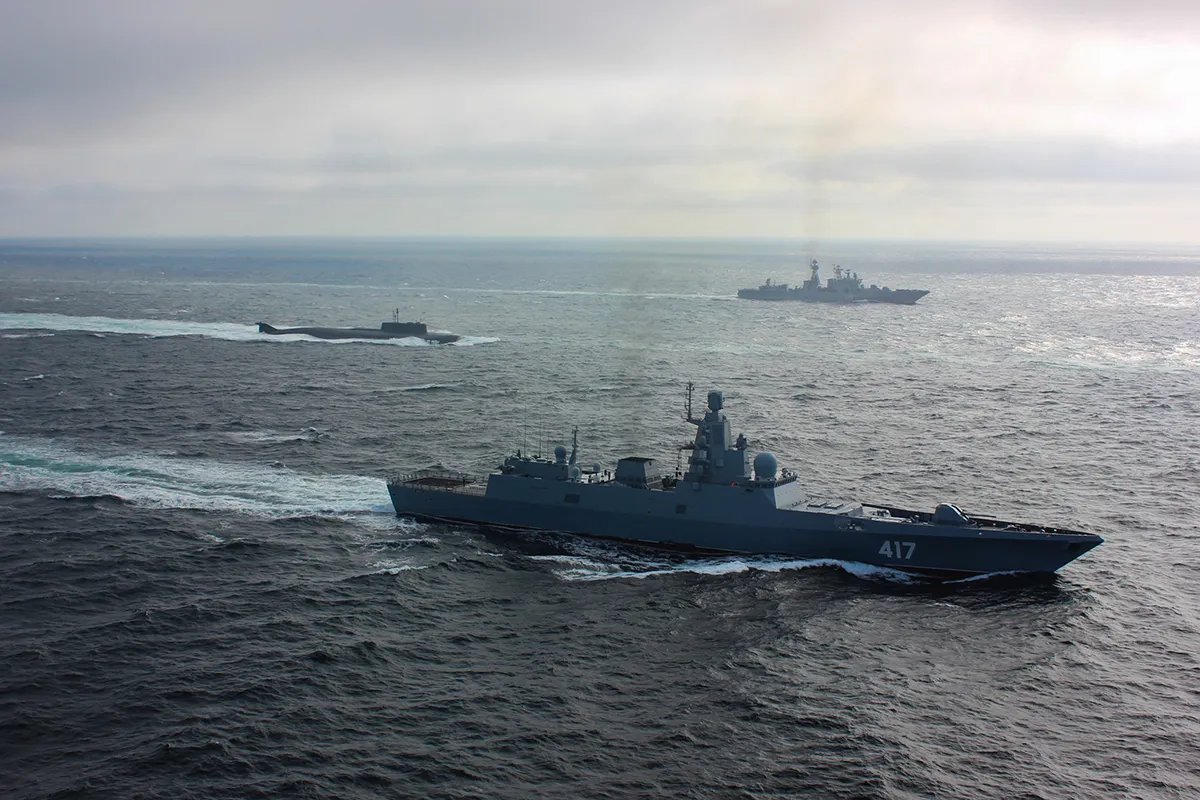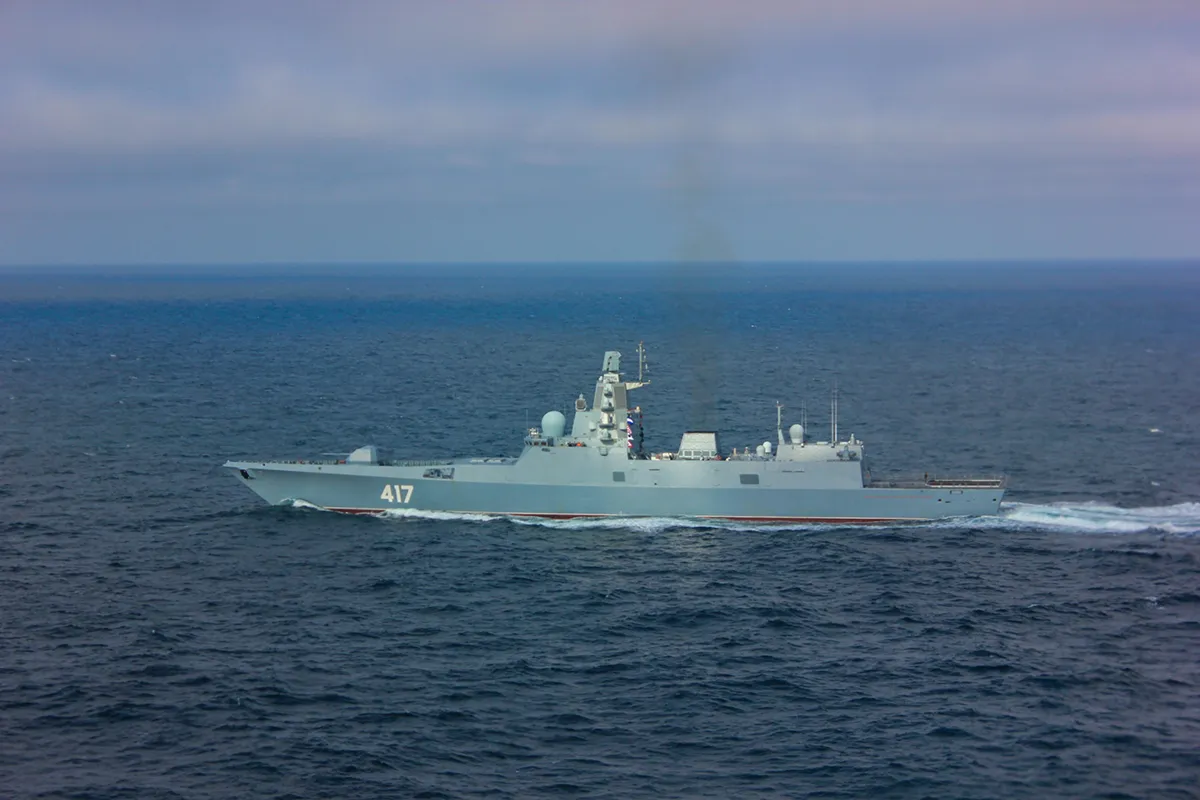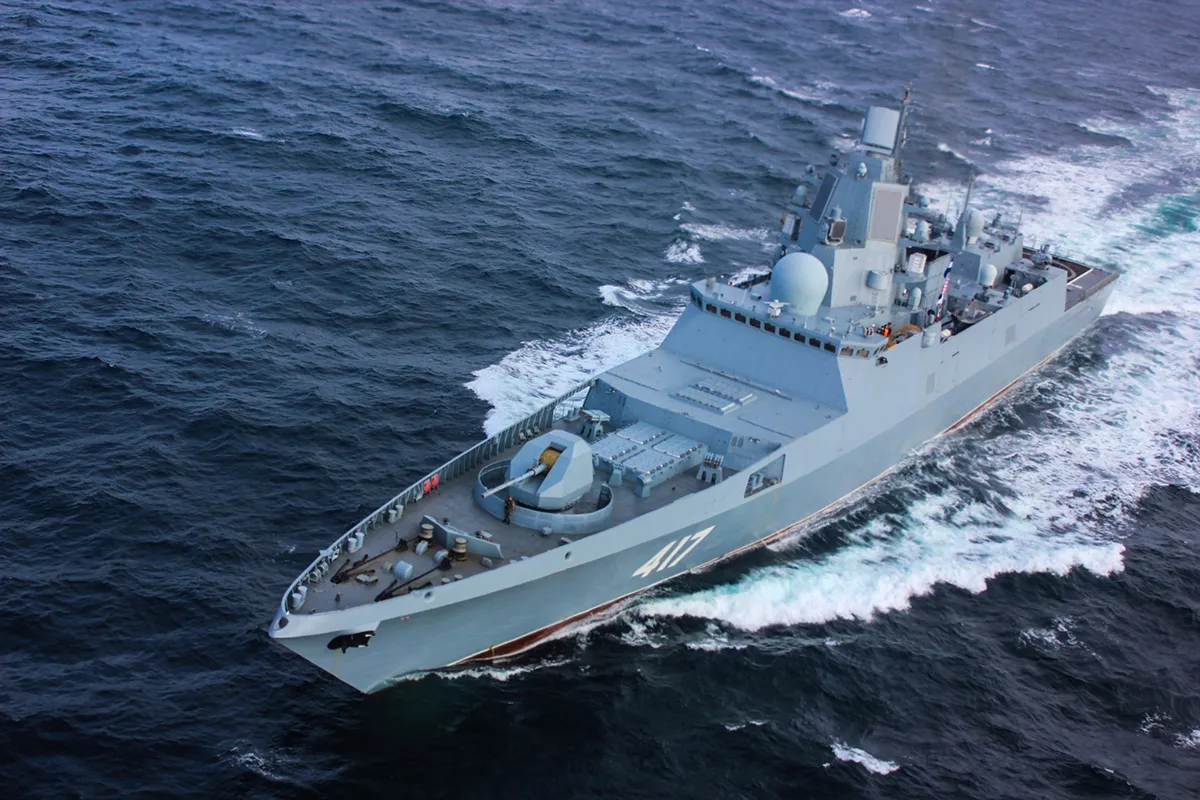
- Side
- Unconfirmed conflict context

Source-backed coverage documents Project 22350 missile trials, deployments, and Russian Navy service, but the available evidence still does not tie the class to one named catalog conflict.
The Project 22350 Admiral Gorshkov-class frigate is a Russian multirole guided-missile frigate family designed by Severnoye Design Bureau and built by Severnaya Verf for escort, air defense, anti-submarine warfare, and long-range strike. Public sources describe it as Russia's post-Soviet ocean-going surface combatant class built around UKSK vertical launch cells for Kalibr, Oniks, and Tsirkon missiles, with later hulls receiving expanded launcher fits.
Source-backed coverage documents Project 22350 missile trials, deployments, and Russian Navy service, but the available evidence still does not tie the class to one named catalog conflict.
Project 22350 sources split the class between early ships with the original UKSK fit and later hulls reported with expanded vertical-launch capacity.
| Variant | Configuration | Designation notes |
|---|---|---|
| Baseline Project 22350 | Early production fit | Admiral Gorshkov and Admiral Kasatonov represent the early service standard, with two UKSK launcher modules and Poliment-Redut air defense. Sources: Naval News: Second Project 22350 frigate joins Russian Navy |
| Expanded-UKSK Project 22350 builds | Later production fit | Later hulls are reported with increased UKSK launcher capacity, including follow-on builds described with 32 UKSK launcher cells. Sources: Naval News: First Project 22350 frigate for Pacific Fleet |
Project 22350 frigates use UKSK vertical-launch cells for the class's long-range strike and anti-ship missile fit.
| Launched item | Item type | Launch evidence |
|---|---|---|
 | Sea-launched cruise missile family | Project 22350 sources identify Kalibr as a basic strike weapon, and Admiral Kasatonov fired a Kalibr missile during Northern Fleet trials. Sources: Naval News: Admiral Kasatonov Kalibr test-fire, Naval News: Atlantic Tsirkon deployment |
 | Anti-ship cruise missile | Naval News describes the class's universal launchers as able to fire Oniks anti-ship missiles alongside Kalibr-family missiles. Sources: Naval News: Admiral Kasatonov Kalibr test-fire, Naval News: Second Project 22350 frigate joins Russian Navy |
Project 22350 combines long-range strike cells, area air defense, anti-submarine weapons, and organic helicopter support in one frigate hull. The launcher count is a visible distinction between early and later builds.
| System area | Reported fit | Operational meaning |
|---|---|---|
| Strike launchers | UKSK vertical-launch cells for Kalibr, Oniks, and Tsirkon-family weapons | Gives the class a land-attack and anti-ship strike role beyond normal escort duties. |
| Air defense | Poliment-Redut surface-to-air missile system with phased-array radar integration | Supports local and formation air defense against aircraft and missile threats. |
| Anti-submarine package | Paket-NK torpedo system, sonar fit, and one Ka-27 helicopter | Lets the frigate combine shipboard sensors and an embarked helicopter for submarine search and engagement. |
| Batch distinction | Early ships are described with the original UKSK fit; later hulls are reported with expanded launcher capacity | Separates the first operational ships from follow-on hulls that emphasize larger strike loads. |
Primary support: RussianShips.info: Frigates - Project 22350; Naval News: Second Project 22350 frigate joins Russian Navy; Naval News: First Project 22350 frigate for Pacific Fleet; Naval Today: Severnaya Verf rolls out fifth Project 22350 frigate.
ODIN reports that the lead ship Admiral Gorshkov was commissioned into the Russian Navy on 28 July 2018.
Sources: ODIN: Admiral Gorshkov commissioned on 28 July 2018
Naval News reported that Admiral Gorshkov fired a Tsirkon hypersonic missile from the Barents Sea during state trials, marking the first ship launch of the missile.
Sources: Naval News: First shipborne Tsirkon test
Naval News reported that Admiral Kasatonov, the second Project 22350 frigate, joined the Russian Navy and would operate with Admiral Gorshkov in the Northern Fleet.
Sources: Naval News: Second Project 22350 frigate joins Russian Navy
Naval News reported that Admiral Gorshkov conducted another Tsirkon test firing against a sea target in the Barents Sea trial area.
Sources: Naval News: Admiral Gorshkov Tsirkon test-fire in the Barents Sea
Naval News reported that Admiral Gorshkov began a long-distance deployment with Tsirkon and Kalibr missiles loaded, while also noting that the ship would not enter the Black Sea war zone.
Sources: Naval News: Atlantic Tsirkon deployment
Naval News reported the launch of Admiral Isakov, the fourth Project 22350 frigate and the first one assigned to the Russian Pacific Fleet.
Sources: Naval News: First Project 22350 frigate for Pacific Fleet