Munitions

P-500 Bazalt

Also known as
  • 4K80
  • 4K-80
  • SS-N-12 Sandbox
  • SS-N-12
  • Sandbox
  • Bazalt
  • P-1000 Vulkan
  • 3M70

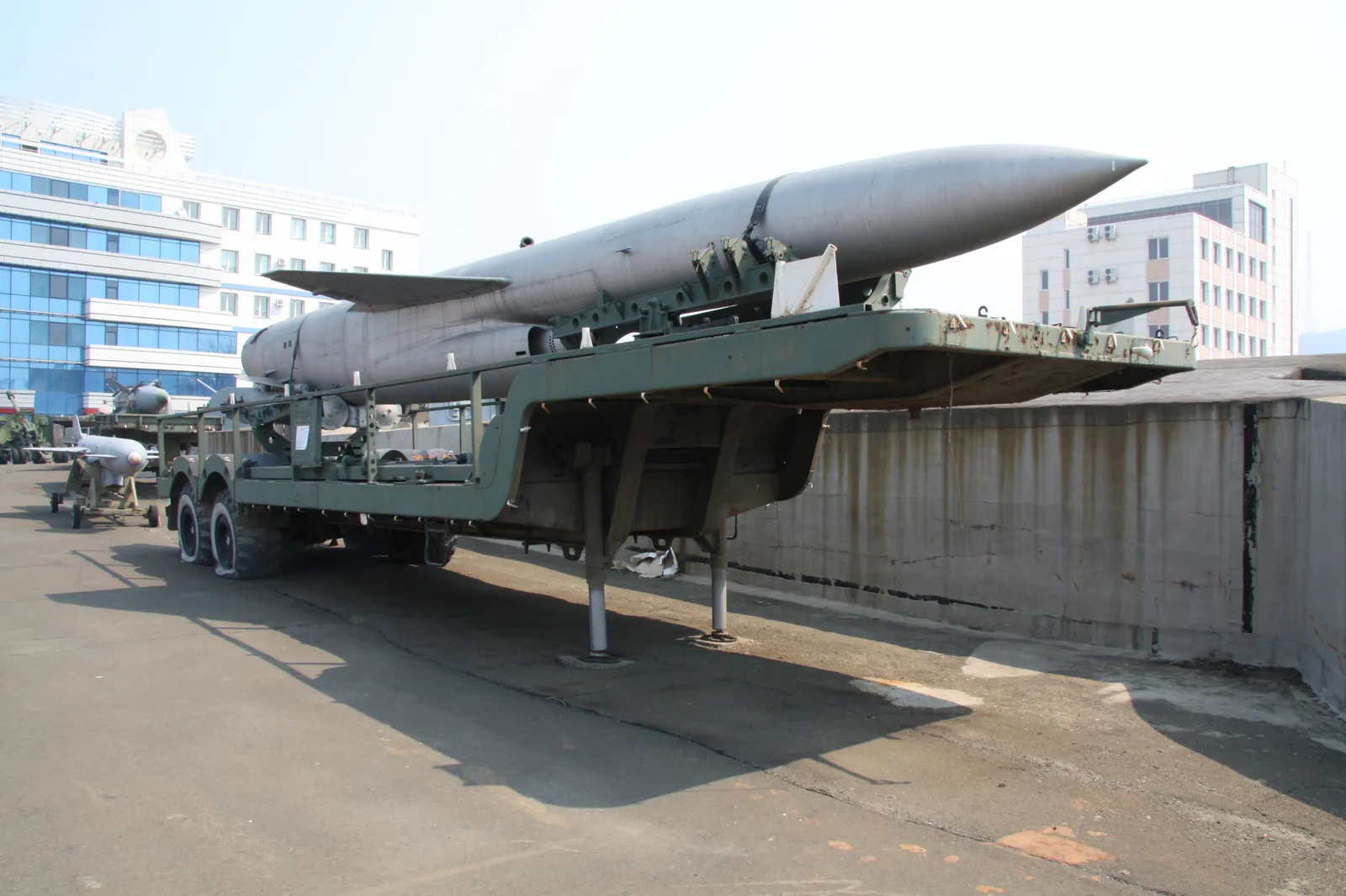
The P-500 Bazalt is a Soviet heavy anti-ship cruise missile known to NATO as SS-N-12 Sandbox. It armed Project 1143 Kiev-class aircraft-carrying cruisers, Project 1164 Atlant / Slava-class cruisers, and converted cruise-missile submarines, giving those platforms a large over-the-horizon surface-strike battery rather than a compact general-purpose missile fit.

Profile / Specs

Profile

Origin
Soviet Union
Type
Ship- and submarine-launched anti-ship cruise missile
Service note
Entered Soviet naval service in the mid-1970s; later replaced or modernized on some launch platforms.
Designer
OKB-52 / NPO Mashinostroyenia
Designed
1963-1974 for P-500 development
Produced
1970-1987 for P-500; later P-1000 Vulkan production reported from 1985-1992
Number built
Weaponsystems.net reports at least 200 P-500 and 50 P-1000 missiles produced.
Developed from
P-35 Progress / SS-N-3 Shaddock lineage
Developed into
P-1000 Vulkan modernization

Specifications

Designation
4K80; NATO reporting name SS-N-12 Sandbox
Role
Long-range heavy anti-ship cruise missile for surface ships and submarines
Range
About 550 km for P-500 in Weaponsystems.net and GlobalSecurity data
Speed
About Mach 2.5 at altitude and Mach 2.0 at sea level in Weaponsystems.net data
Warhead
About 1,000 kg conventional high-explosive fragmentation warhead or nuclear option in open references
Guidance
Inertial navigation with radar-homing terminal phase; open sources describe midcourse updates and salvo target exchange
Propulsion
Turbojet sustainer with solid-propellant launch boosters
Dimensions
About 11.7 m length, 0.88 m diameter, and 2.6 m wingspan
Launch weight
About 4.8 t without boosters in Weaponsystems.net data
Launch platforms
Project 1143 Kiev-class aircraft-carrying cruisers, Project 1164 Atlant / Slava-class cruisers, and converted Project 675 / Project 651 submarines
Variants

Open sources treat P-1000 Vulkan as a modernization of the P-500 family that retained broadly similar launcher infrastructure while increasing range and changing internal construction.

VariantConfigurationDesignation notes
P-1000 VulkanImproved-range derivative

Weaponsystems.net describes Vulkan as a P-500 development accepted later, with retained dimensions and launcher infrastructure but greater range.

Sources: WeaponSystems.net P-500 Bazalt

Documented Launch Platforms

The Bazalt family was tied to large naval platforms able to carry its heavy launch containers and targeting support.

LauncherLauncher typeLaunch evidence
Kiev-class aircraft carrier, Heavy aircraft-carrying cruiser / VTOL aircraft carrier, Naval SystemsKiev-class aircraft carrierHeavy aircraft-carrying cruiser

Weaponsystems.net says P-500 was first used by Project 1143 Krechyet / Kiev-class aircraft carriers; GlobalSecurity describes eight P-500 missiles on the first three Project 1143 cruisers and twelve on the fourth Project 1143.4 ship.

Sources: WeaponSystems.net P-500 Bazalt, GlobalSecurity SS-N-12 Sandbox

Project 1164 Atlant / Slava-class guided-missile cruiser, Guided-missile cruiser, Naval SystemsProject 1164 Atlant / Slava-class guided-missile cruiserGuided-missile cruiser

Weaponsystems.net identifies Project 1164 Atlant / Slava-class cruisers as the main application for P-500 and P-1000, with eight banks of twin launchers as a class feature.

Sources: WeaponSystems.net P-500 Bazalt

Guidance And Platform Fit

The P-500 was not a universal canister missile. Its size, launch containers, over-the-horizon targeting needs, and salvo logic tied it to a small set of large Soviet naval platforms.

Attack role

Heavy anti-ship strike against major surface groups, including carrier formations, at ranges beyond the launch ship's horizon.

Guidance

Inertial midcourse guidance with radar homing in the terminal phase; sources describe target data from aircraft, helicopters, or other ships.

Salvo behavior

Weaponsystems.net describes nearby P-500 missiles exchanging target information so a missile group can distribute targets during an attack.

Relationship boundary

This page does not copy the conflicts of ships that carried Bazalt. Direct conflict-use evidence for the missile itself was not added in this enrichment pass.

Sources: WeaponSystems.net P-500 Bazalt; GlobalSecurity SS-N-12 Sandbox.
Timeline

P-500 Bazalt Key Events

  1. P-500 development starts

    Weaponsystems.net dates P-500 development to 1963-1974, while GlobalSecurity describes February 1963 authorization for the Basalt anti-ship missile project.

    Sources: WeaponSystems.net P-500 Bazalt, GlobalSecurity SS-N-12 Sandbox

  2. Initial service entry

    Weaponsystems.net lists 1975 service entry for P-500; GlobalSecurity says Basalt entered service for Project 675 submarines in 1975 and for Project 1143 aircraft-carrying cruisers in 1977.

    Sources: WeaponSystems.net P-500 Bazalt, GlobalSecurity SS-N-12 Sandbox

  3. P-1000 Vulkan enters service

    Weaponsystems.net lists 1987 service entry for P-1000 Vulkan, the longer-range modernization associated with later Slava-class and converted submarine fits.

    Sources: WeaponSystems.net P-500 Bazalt

Media
Related Weapon Systems
Kiev-class aircraft carrier, Heavy aircraft-carrying cruiser / VTOL aircraft carrier, Naval SystemsNaval SystemsKiev-class aircraft carrierHeavy aircraft-carrying cruiser / VTOL aircraft carrierThe Kiev class, Soviet Project 1143 Krechyet, was a family of heavy aircraft-carrying cruisers built at the Black Sea Shipyard in Mykolaiv for Soviet naval aviation. The ships combined Yak-38 VTOL aircraft and Kamov helicopters with cruiser-style P-500 Bazalt anti-ship missiles, air-defense weapons, and anti-submarine systems; the revised fourth hull, Baku / Admiral Gorshkov, later became India's INS Vikramaditya after a major STOBAR carrier conversion.
Project 1164 Atlant / Slava-class guided-missile cruiser, Guided-missile cruiser, Naval SystemsNaval SystemsProject 1164 Atlant / Slava-class guided-missile cruiserGuided-missile cruiserThe Project 1164 Atlant / Slava-class guided-missile cruiser is a Soviet-designed surface-strike cruiser class built at the 61 Kommunara yard in Mykolaiv. Its large angled anti-ship missile battery, S-300F Fort area air defense, Osa-M point defense, AK-130 gun, and helicopter deck made the class a Russian fleet flagship type, with Moskva documented in the 2008 Russo-Georgian War, Russia's Syria operation, and the 2022 phase of the Russia-Ukraine War before its sinking in the Black Sea.
P-270 Moskit, Supersonic anti-ship cruise missile, MunitionsMunitionsP-270 MoskitSupersonic anti-ship cruise missileThe P-270 Moskit, also known as 3M80/3M82 and SS-N-22 Sunburn, is a Soviet and Russian supersonic anti-ship cruise missile developed by MKB Raduga and produced at Progress plant in Arsenyev. The family is centered on shipboard strike from Sovremenny destroyers, Tarantul missile corvettes, and Project 1239 surface-effect corvettes, pairing inertial midcourse navigation with active/passive radar terminal homing and a low-altitude ramjet flight profile.
Project 1144 Orlan / Kirov-class nuclear-powered guided-missile heavy cruiser, Nuclear-powered guided-missile heavy cruiser, Naval SystemsNaval SystemsProject 1144 Orlan / Kirov-class nuclear-powered guided-missile heavy cruiserNuclear-powered guided-missile heavy cruiserProject 1144 Orlan, better known as the Kirov class, is a Soviet-designed nuclear-powered guided-missile heavy cruiser family built around P-700 Granit anti-ship missiles, layered air defense, anti-submarine weapons, and a three-helicopter aviation fit. Built by Baltic Shipyard in Leningrad, the class became one of the largest non-carrier surface combatant families of the Cold War and later appeared in Russian Syrian-war naval task-force operations through Pyotr Velikiy.

Sources
