
United Nations and Lake Chad Basin Commission reporting lists the FN FAL among assault rifles used by Boko Haram, while HumAngle reported ISWAP looted FN FAL rifles during 2021 fighting in the Bama area of Borno State; the record treats the rifle as a documented insurgent small arm rather than a standardized issue weapon.
Infantry Weapons
FN FAL
Also known as
- Fusil Automatique Leger
- Fusil Automatique Léger
- FAL
- FN LAR
- L1A1 Self-Loading Rifle
- SLR
- FALO
- Argentine FAL
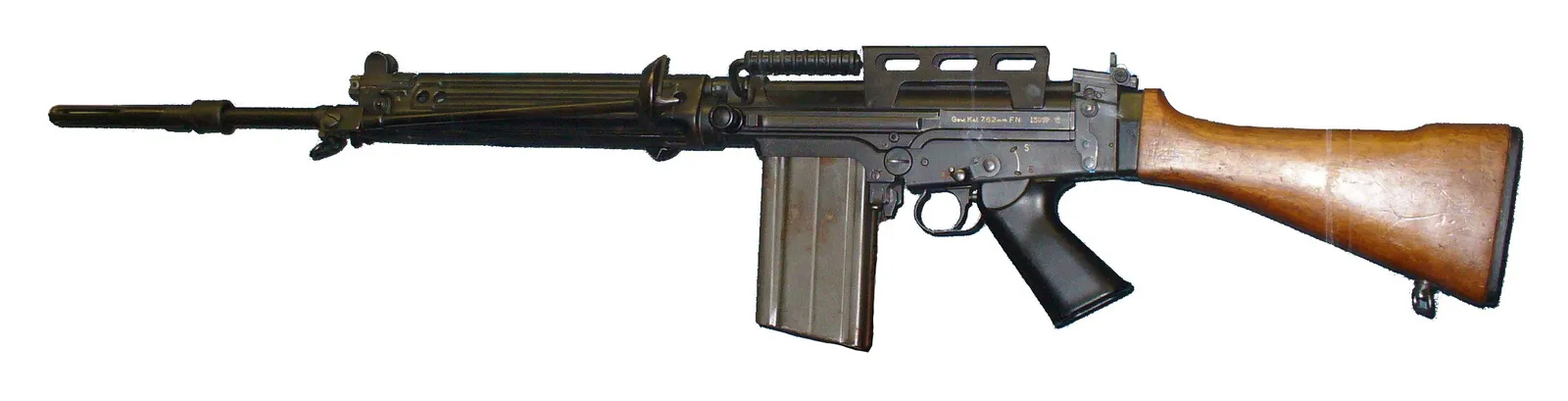
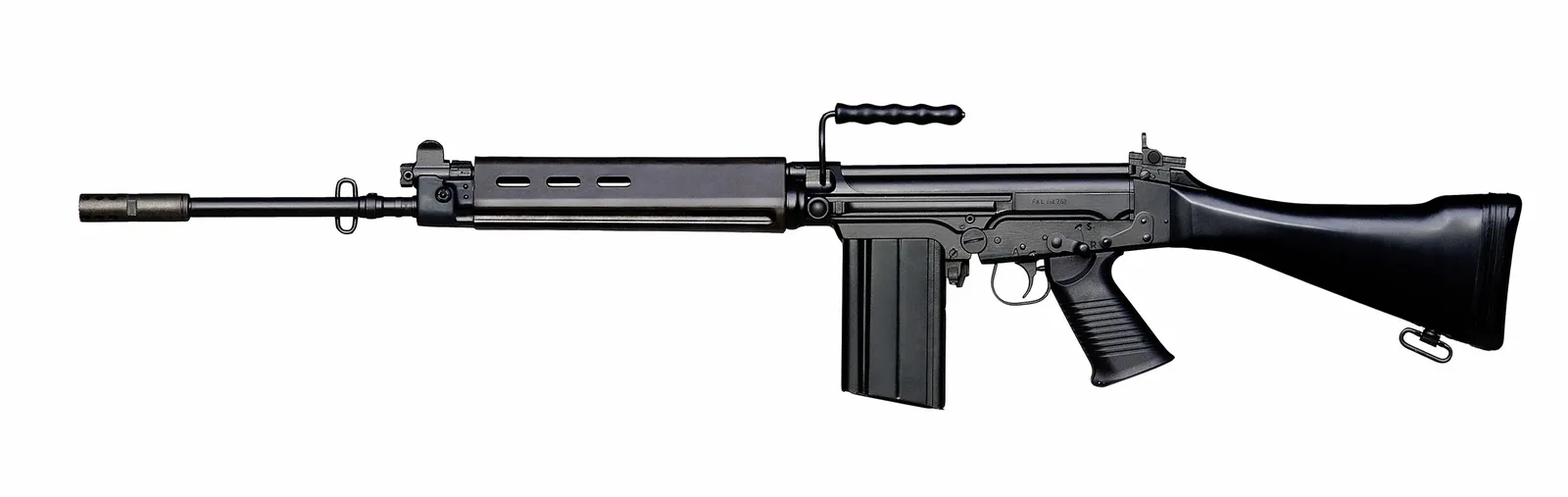
The FN FAL is a Belgian 7.62 x 51 mm NATO battle rifle designed at Fabrique Nationale after World War II and adopted or license-produced across many Cold War armies. The cataloged record spans state service, licensed Commonwealth and Argentine derivatives, and later illicit or captured rifles documented in conflicts from the Falklands to Marawi, Boko Haram operations, Haiti, and the Islamic State fight.
Role in Conflicts
Philippine forces recovered three FAL rifles from submerged weapons believed abandoned by Daesh-inspired Maute fighters after the 2017 Battle of Marawi, documenting the type among militant-held small arms rather than a standard Philippine government weapon in the battle.
- Side
- Armed gangs
The 2022 Haitian Gang Conflict is documented by Global Initiative against Transnational Organized Crime reporting that describes Haitian gangs using FN-FAL semi-automatic rifles in Port-au-Prince-area violence.
- Side
- Islamic State
The 2014 War Against the Islamic State includes FN FAL rifles captured from Islamic State forces in Kobane, Syria, documented by Conflict Armament Research as part of Islamic State weapons recovered in the conflict.
- Side
- ArgentinaUnited Kingdom


Museum records document Argentine FAL rifles captured at Goose Green and identify the British L1A1 as the Army's main rifle during the 1982 Falklands War, making the FAL family a directly documented small-arms system on both sides of the conflict.
Profile / Specs
Profile
- Origin
- Belgium
- Built by
- FN HerstalVarious manufacturers
- Type
- 7.62 mm battle rifle
- Service note
- Cold War design, still encountered in later conflicts and illicit stockpiles
- Designer
- Dieudonne Saive / Fabrique Nationale design team
- Designed
- Late 1940s to early 1950s
- Produced
- 1950s onward, including licensed and derivative production
Specifications
- Caliber
- 7.62 x 51 mm NATO
- Action
- Gas-operated, selective-fire rifle
- Feed
- 20-round detachable box magazine
- Length
- About 1,090 mm for the FN 50.00 pattern
- Barrel length
- 533 mm
- Weight
- About 4.45 kg unloaded
- Rate of fire
- About 600-700 rounds per minute
- Muzzle velocity
- About 840 m/s
- Estimated family production
- About 5.5 million FAL-type self-loading service rifles, per Small Arms Survey estimate
Design And Identification
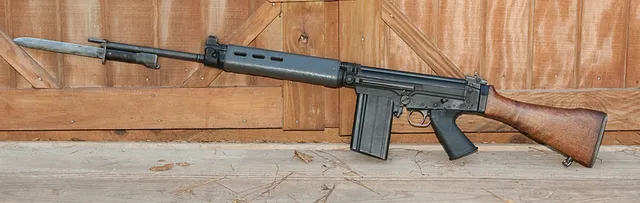
The FAL is useful to catalogue as a family rather than a single national issue rifle: the same Belgian design lineage appears as FN metric-pattern rifles, Commonwealth L1A1/SLR derivatives, Argentine licensed rifles, heavy-barrel automatic variants, and later diverted or captured examples.
Operating layout
Short-stroke gas operation, tilting breechblock locking, closed-bolt firing, and 7.62 x 51 mm NATO chambering define the core Belgian FAL pattern.
Tracing clues
ARES emphasizes receiver markings, physical features, and receiver-generation differences as practical indicators when identifying diverted or conflict-recovered FAL rifles.
Service split
British L1A1 rifles were semi-automatic service rifles, while Argentine FAL records note retained automatic-fire capability and separate heavy-barrel support variants.
Source labels used here: Identifying & Tracing the FN Herstal FAL Rifle; FN America About Us; L1A1 7.62 mm self-loading rifle, 1959 (c); Argentinian FAL rifle; Argentine FN 7.62 mm self-loading rifle, 1970 (c).
Variants
FN's metric-pattern rifles, Commonwealth inch-pattern derivatives, and national licensed builds share the FAL lineage but can differ in controls, furniture, receiver pattern, fire-control configuration, and support-weapon fittings.
| Variant | Configuration | Designation notes |
|---|---|---|
| FN FAL 50.00 | Standard fixed-stock rifle | The Royal Armouries collection and Small Arms Survey sheet document the 50.00-pattern rifle as a baseline 7.62 mm NATO FAL configuration, while ARES identifies the 50.00 as a common Belgian fixed-stock model. Sources: Centrefire self-loading rifle - FN FAL 50.00 - 1954, FN FAL (& close derivatives) Weapon Identification Sheet, Identifying & Tracing the FN Herstal FAL Rifle |
| FN FAL 50.41 / FALO | Heavy-barrel automatic rifle | Museum records describe the heavy-barrel FALO/Fusil Automatico Pesado pattern as a bipod-equipped squad automatic variant used by Argentine forces. Sources: Argentine FN 7.62 mm self-loading rifle, 1970 (c), Fusil Automatico Pesado (FN FALO) |
| FN FAL 50.61 / 50.63 / 50.64 | Folding-stock and Para-family rifles | ARES and museum records identify folding-stock FAL patterns, including Argentine Para rifles captured in the Falklands. Sources: Identifying & Tracing the FN Herstal FAL Rifle, Argentinian FAL Para rifle |
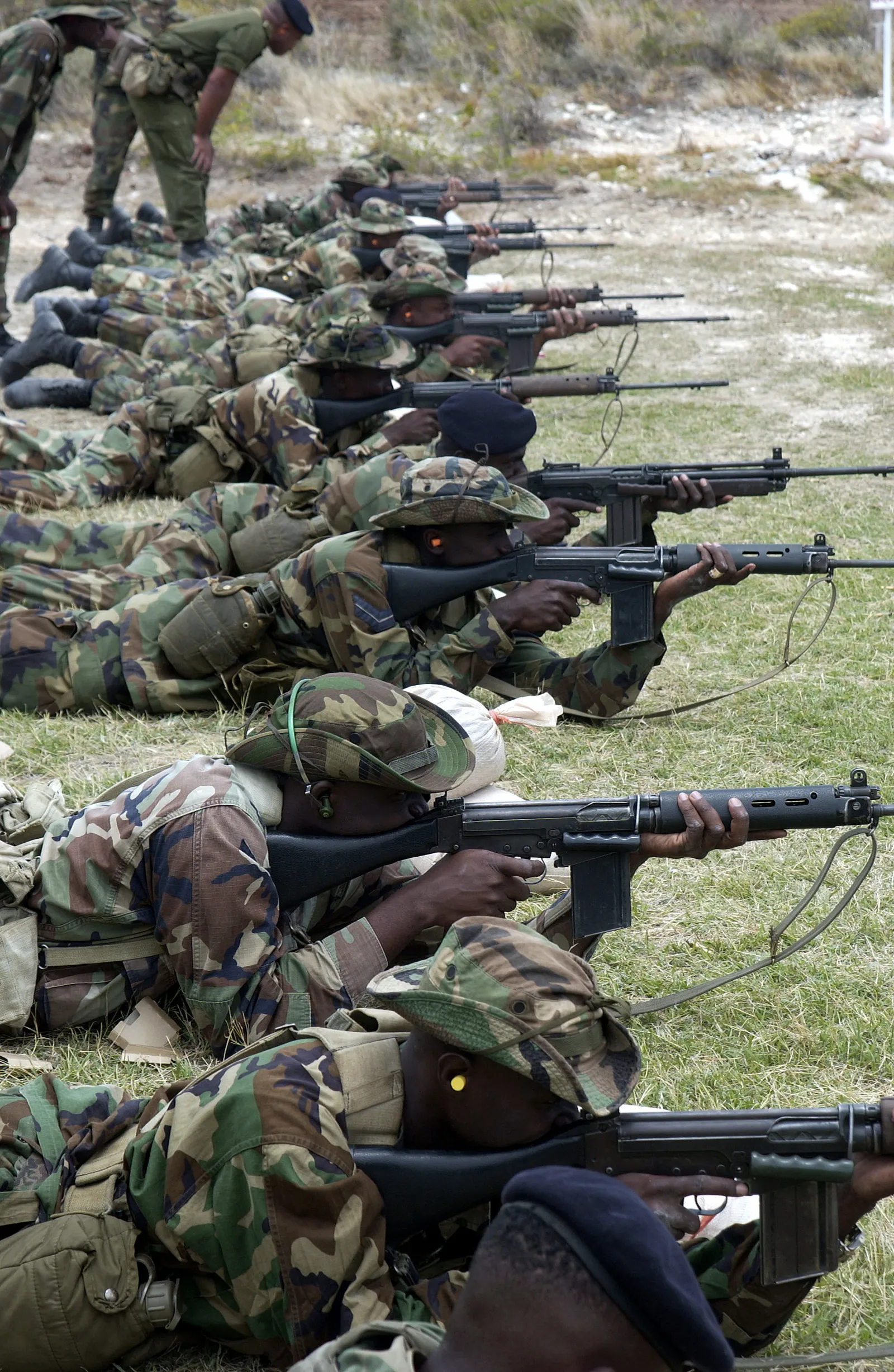
| L1A1 Self-Loading Rifle | Commonwealth inch-pattern derivative | The National Army Museum identifies the L1A1 as the British FN FAL derivative and records its Falklands service. |
| Argentine FAL | Argentine licensed-production rifle | IWM and National Army Museum records describe Argentine FAL rifles made under license and captured or used during the 1982 Falklands War. Sources: Argentinian FAL rifle, Argentine FAL 7.62 mm self-loading rifle, 1975 (c) |
| Indian 1A1 / South African R1 / Brazilian IMBEL derivatives | National derivative families | Small Arms Survey lists Indian 1A1, South African R1, and Brazilian IMBEL SAR/Para-SAR/MD rifles among close FAL derivatives; no separate public catalog pages were linked for these derivatives in this enrichment. Sources: FN FAL (& close derivatives) Weapon Identification Sheet, Global Development and Production of Self-loading Service Rifles |
Compatible Ammunition
This rifle is documented as chambered for the NATO-standard 7.62x51mm cartridge family.
| Ammunition | Ammunition type | Firing evidence |
|---|---|---|
 | Rifle cartridge | Royal Armouries and the ARES field guide both document the FN FAL as chambered for 7.62x51mm NATO cartridges. Sources: Centrefire automatic rifle - FN FAL, Identifying & Tracing the FN Herstal FAL Rifle |
Timeline
FN FAL Key Events
First FAL prototype
FN's company history credits chief designer Dieudonne Saive with creating the first FN FAL prototype in the postwar period.
7.62 mm NATO FAL introduced
ARES describes the Belgian FAL as introduced in 1953, chambered for the new 7.62 x 51 mm NATO cartridge and using a short-stroke gas system.
Canadian adoption begins broad service
FN's company history states that Canada was the first army to adopt the FAL in 1954, before wider adoption by many other countries.
Falklands War use by both sides
Museum records document British L1A1 rifles and Argentine FAL variants in the 1982 Falklands War, including examples captured at Goose Green.
ARES tracing guide published
Armament Research Services published a field guide for identifying and tracing Belgian FAL rifles, with attention to markings, variants, and diversion indicators.
Related Weapon Systems


Sources
FN FAL (& close derivatives) Weapon Identification SheetPublisher: Small Arms Survey | Note: Supports FN FAL background, manufacturer identification, 7.62 x 51 mm NATO caliber, dimensions, weight, feed device, operating system, rate of fire, muzzle velocity, and major variant families. | Accessed: 2026-07-04Centrefire self-loading rifle - FN FAL 50.00 - 1954Publisher: Royal Armouries | Note: Supports museum-reference background and physical specifications for an FN FAL 50.00-pattern rifle. | Accessed: 2026-07-04Centrefire automatic rifle - FN FALPublisher: Royal Armouries | Note: Supports the FN FAL being chambered for 7.62 x 51 mm Rimless NATO, which documents the cartridge relationship. | Accessed: 2026-07-04Identifying & Tracing the FN Herstal FAL RiflePublisher: Armament Research Services | Note: Supports the FN FAL being chambered for the 7.62 x 51 mm NATO cartridge family, the Belgian design's operating system, primary FN variant context, and tracing/identification features. | Accessed: 2026-07-04FN America About UsPublisher: FN America | Note: Supports FN company history for the first FN FAL prototype, Dieudonne Saive's role, Canadian adoption in 1954, and the rifle's Right Arm of the Free World nickname. | Accessed: 2026-07-04Global Development and Production of Self-loading Service RiflesPublisher: Small Arms Survey | Note: Supports production-scale context for FAL-type rifles, licensed production patterns after World War II, and the estimated 5.5 million FAL-type self-loading service rifles produced. | Accessed: 2026-07-04Troops recover 30 firearms in Marawi clearing opsPublisher: Philippine News Agency | Note: Supports 2017 Battle of Marawi direct use context: three FAL rifles were recovered by Philippine troops from weapons believed fielded by or abandoned by Daesh-inspired Maute militants after the 2017 Battle of Marawi. | Accessed: 2026-07-04Troops recover 30 guns abandoned by Maute groupPublisher: SunStar Philippines | Note: Supports 2017 Battle of Marawi direct use context: FAL rifles were recovered from firearms believed fielded by or abandoned by the Daesh-inspired Maute group after the 2017 Battle of Marawi. | Accessed: 2026-07-04Weapons and Ammunition Dynamics in the Lake Chad BasinPublisher: United Nations Department of Peace Operations and United Nations Office for Disarmament Affairs / Lake Chad Basin Commission | Note: Supports 2009 Boko Haram Insurgency direct use context: FN FAL rifles are listed among assault rifles used by Boko Haram in the Lake Chad basin. | Accessed: 2026-07-04Lake Chad: A Large Part Of Insurgents' Weaponry Are From Regional State ArsenalsPublisher: HumAngle | Note: Supports 2009 Boko Haram Insurgency direct use context: FN FAL rifles were used by or looted by ISWAP during 2021 fighting in the Bama area of Borno State. | Accessed: 2026-07-04Last Chance? Breaking Haiti's Political and Criminal ImpassePublisher: Global Initiative Against Transnational Organized Crime | Note: Supports 2022 Haitian Gang Conflict direct use context: the report describes Haitian gangs using FN-FAL semi-automatic rifles in the conflict. | Accessed: 2026-07-04Islamic State Weapons in KobanePublisher: Conflict Armament Research | Note: Supports 2014 War Against the Islamic State direct use context: FN FAL rifles were captured from Islamic State forces in Kobane, Syria, during the conflict. | Accessed: 2026-07-04L1A1 7.62 mm self-loading rifle, 1959 (c)Publisher: National Army Museum | Note: Supports L1A1 background as a British FN FAL derivative and direct 1982 Falklands War use by British forces. | Accessed: 2026-07-04L1A1X8 E1 Model 7.62 mm Self-Loading RiflePublisher: National Army Museum | Note: Supports the L1A1 as the British Army's main rifle during the 1982 Falklands War and as similar to the Argentine FN FAL. | Accessed: 2026-07-04Argentinian FAL riflePublisher: Imperial War Museums | Note: Supports Argentine licensed-production FAL background and direct 1982 Falklands War context through a rifle captured at Goose Green. | Accessed: 2026-07-04Argentinian FAL Para riflePublisher: Imperial War Museums | Note: Supports Argentine Para variant context and direct 1982 Falklands War context through a rifle captured at Goose Green and then carried by a British brigade commander. | Accessed: 2026-07-04Argentine FAL 7.62 mm self-loading rifle, 1975 (c)Publisher: National Army Museum | Note: Supports Argentine licensed-production FAL background, folding-stock configuration, automatic-fire distinction, and 1982 Falklands War service context. | Accessed: 2026-07-04Argentine FN 7.62 mm self-loading rifle, 1970 (c)Publisher: National Army Museum | Note: Supports the Argentine heavy-barrel FN/FALO support-weapon variant and direct 1982 Falklands War use as a squad light machine gun. | Accessed: 2026-07-04Fusil Automatico Pesado (FN FALO)Publisher: Imperial War Museums | Note: Supports the FALO as a heavy-barrel squad automatic FAL variant used by the Argentine Army and captured by British forces during the 1982 Falklands War. | Accessed: 2026-07-04FN FAL rifle.JPGPublisher: Wikimedia Commons | Note: Image provenance and licensing page for a Belgian FN FAL rifle photograph; file page lists own-work authorship and CC BY-SA / GFDL licensing. | Accessed: 2026-07-04Early FN FAL.jpgPublisher: Wikimedia Commons | Note: Image provenance and licensing page for an early FN FAL with Type A bayonet; file page lists own-work authorship and CC BY-SA 3.0 licensing. | Accessed: 2026-07-04FN FAL DA-SD-04-01067.jpgPublisher: Wikimedia Commons | Note: Image provenance and licensing page for Jamaica Defence Force soldiers firing L1A1 rifles; file page identifies the image as U.S. military public domain. | Accessed: 2026-07-04FN FAL Standard Model Left Side.jpgPublisher: Wikimedia Commons | Note: Image provenance and licensing page for an FN FAL Standard Model left-side view; file page lists FN Herstal authorship and CC BY-SA 2.0 licensing. | Accessed: 2026-07-04