
In the 2016 Colombian FARC Dissident Conflict, The City Paper reported former FARC commanders brandishing modern assault weapons and contrasted them with the 'old AK-47s' shown in a 2019 return-to-arms video by FARC dissidents.
Infantry Weapons
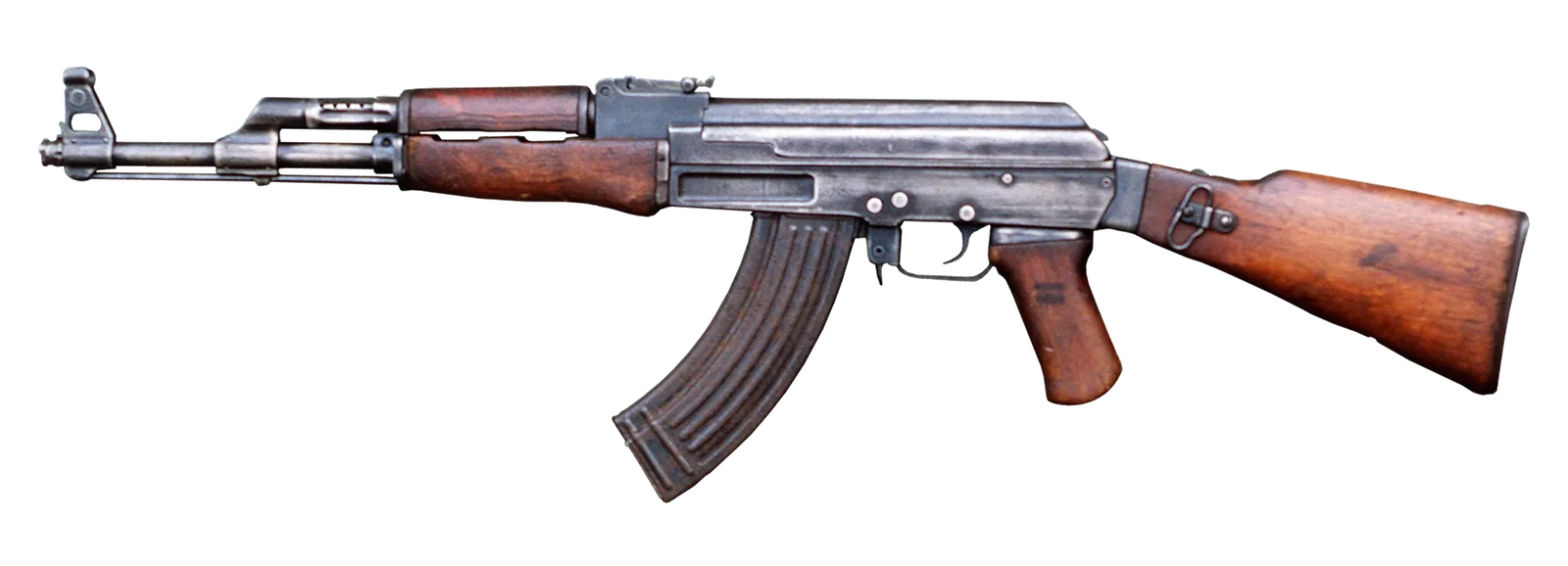
AK-47/AKM rifle family
AK-47/AKM-family rifles are Kalashnikov-pattern small arms derived from the Soviet AK-47 and 1959 AKM modernization, usually chambered in 7.62 x 39 mm. In the post-2015 catalog they appear with FARC dissidents in Colombia, gangs in Haiti, PKK fighters, GNA scouts in Libya, insurgents in Mali, Islamic State forces in Iraq and Syria, militants in Sinai, RSF units in Sudan, Hamas fighters in Gaza, Taliban fighters in Afghanistan, Boko Haram-linked militants in the Lake Chad basin, and Houthi-linked supply chains in Yemen.
Role in Conflicts
- Side
- Armed gangs

In the 2022 Haitian Gang Conflict, UNODC reported that Haitian gangs were using trafficked Russian AK-47s as part of the wider illicit arms trade.
In the 1984 Kurdish-Turkish Conflict, PKK fighters placed AK-47 assault rifles into a July 2025 disarmament ceremony in Iraq, showing the rifles remained in PKK hands during the conflict.

In the 2014 Second Libyan Civil War, The Washington Post reported Tripoli-government scouts armed with AK-47s on a reconnaissance mission west of Sirte.
- Side
- Rebel and jihadist armed groups
In the 2012 Mali War, The Washington Post reported JNIM and allied fighters using AK-47s during coordinated attacks across Mali in April 2026.
IS-aligned Maute militants fielded AK-47 rifles during the 2017 Battle of Marawi; post-battle clearing also recovered two AK-47 rifles among weapons believed abandoned by the Maute group near its last fighting position.
- Side
- Islamic State
In 2014 Operation Inherent Resolve, CAR documented Soviet and Russian AK-47 and AKM assault rifles among Islamic State weapons recovered and traced in Iraq and Syria.
Role detailsIn the 2011 Sinai Insurgency, militants used AK-47 assault rifles in the North Sinai attack described by Daily News Egypt.

In the 2023 Sudan War, Amnesty International published imagery of an RSF unit in Nyala carrying imported AK-pattern rifles.

In the 2023 Israel-Hamas War, AP analysis reported Hamas fighters using AK-47 assault rifles from China and Russia during the Gaza fighting after the October 7 attack.
Role details
In the 2001 War in Afghanistan, CNN footage reported by Business Insider showed Taliban fighters in Kabul with an AK-47 during the August 2021 takeover and evacuation period.
Role details- Side
- Islamic State
In the 2013 War in Iraq, CAR documented Soviet and Russian AK-47 and AKM assault rifles among Islamic State weapons recovered in Iraq.
In the 2009 Boko Haram Insurgency, Conflict Armament Research documented AKM assault rifles among weapons seized from JAS/Boko Haram and ISWAP-affiliated militants in the Lake Chad area.

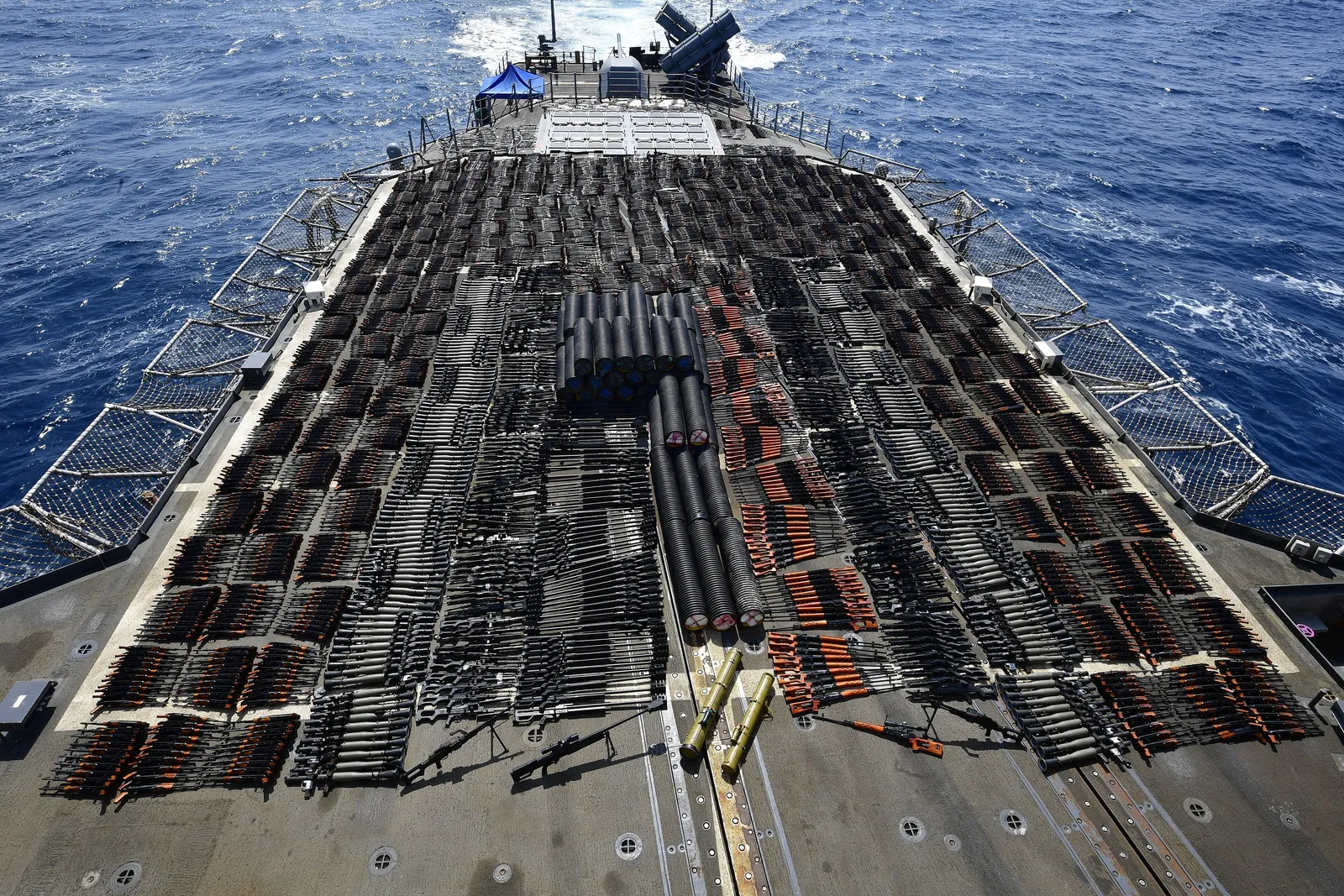
In the 2014 Yemen Civil War, U.S. Navy and CENTCOM reporting documented AK-47 assault rifles being smuggled from Iran toward Houthi-aligned forces on maritime routes used to traffic weapons to Yemen.
Role detailsProfile / Specs
Profile
- Origin
- Soviet Union; widely produced and copied internationally
- Built by
- Various manufacturers
- Type
- Selective-fire assault rifle family
- Service note
- Cold War design family still circulating in contemporary conflicts
- Designer
- Mikhail Kalashnikov
- Designed
- 1940s; AK-47 accepted by the Soviet Army in 1949
- Produced
- 1948-present across original, licensed, and copied AK-family production
Specifications
- Common caliber
- 7.62 x 39 mm M43 for AK-47, AKM, AKMS, and Type 56-family rifles listed here
- Operating system
- Gas-operated, long-stroke piston with rotating bolt
- Feed system
- Typically 30-round detachable box magazine
- Overall length
- About 87 cm for the AK-47 example in the Smithsonian collection
- AKMS length
- 907 mm stock extended; 657 mm stock folded in Small Arms Survey AKM-family data
- AKM-family cyclic rate
- About 600 rounds per minute in Small Arms Survey AKM-family data
- AKM-family muzzle velocity
- 715 m/s in Small Arms Survey AKM-family data
- Typical role
- Portable individual infantry weapon for semi-automatic or automatic direct fire
Variants
This family page covers the 7.62 x 39 mm Kalashnikov-pattern line from the original Soviet AK through the stamped-receiver AKM and AKMS branch and close Chinese Type 56 derivatives.
| Variant | Configuration | Designation notes |
|---|---|---|
| AK-47 | Original Soviet fixed-stock family baseline | The Smithsonian collection record describes the AK-47 as Mikhail Kalashnikov's gas-operated rifle based on the M43 cartridge and notes Soviet Army acceptance in 1949. Sources: AK-47 Automatic Rifle |
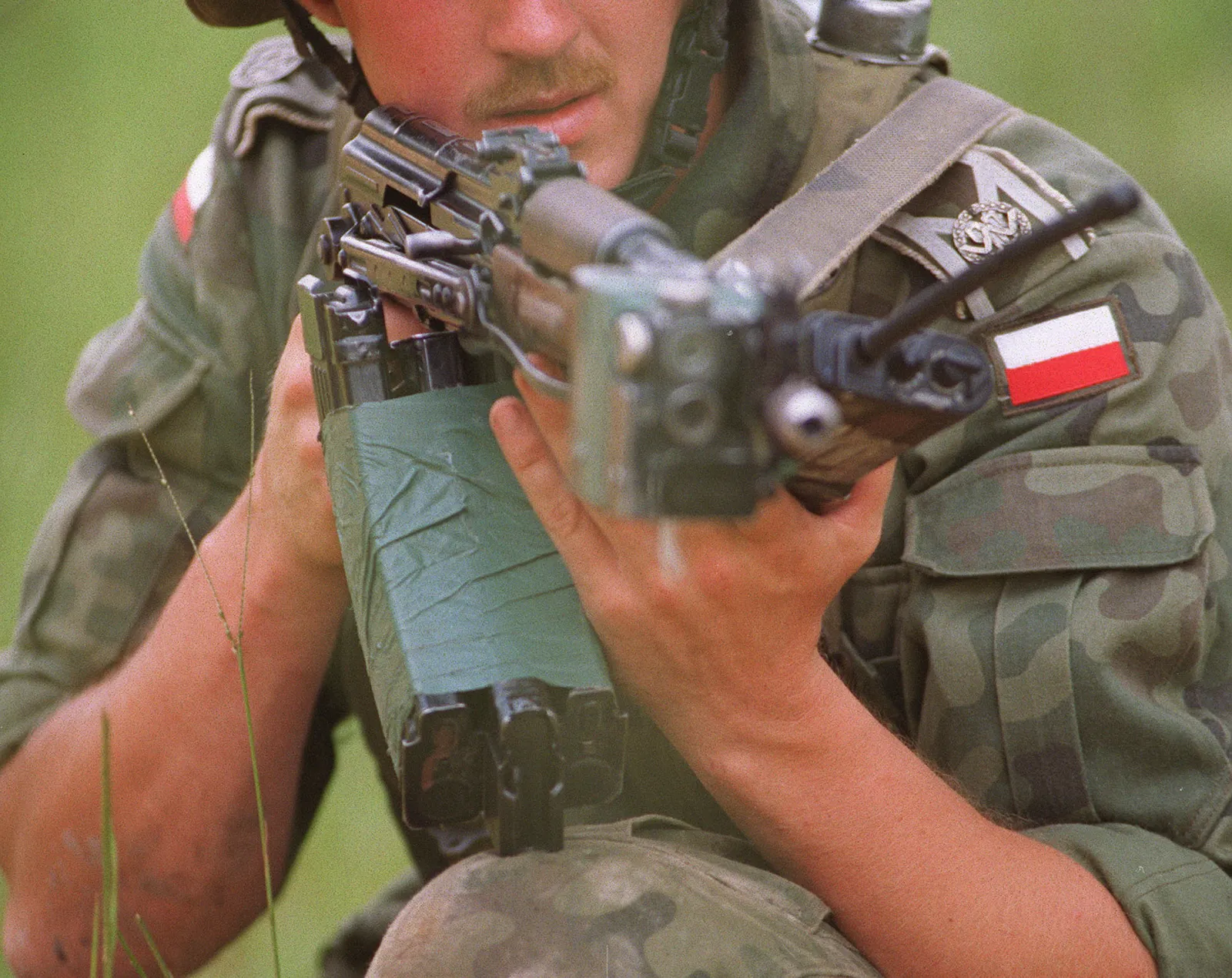
 | Stamped-receiver Soviet modernization | Small Arms Survey and GunRF describe the AKM as the 1959 modernized Kalashnikov rifle with a pressed or stamped receiver and the same 7.62 x 39 mm cartridge family. Sources: Kalashnikov AKM (& close derivatives), GunRF AKM and AKMS assault rifles |
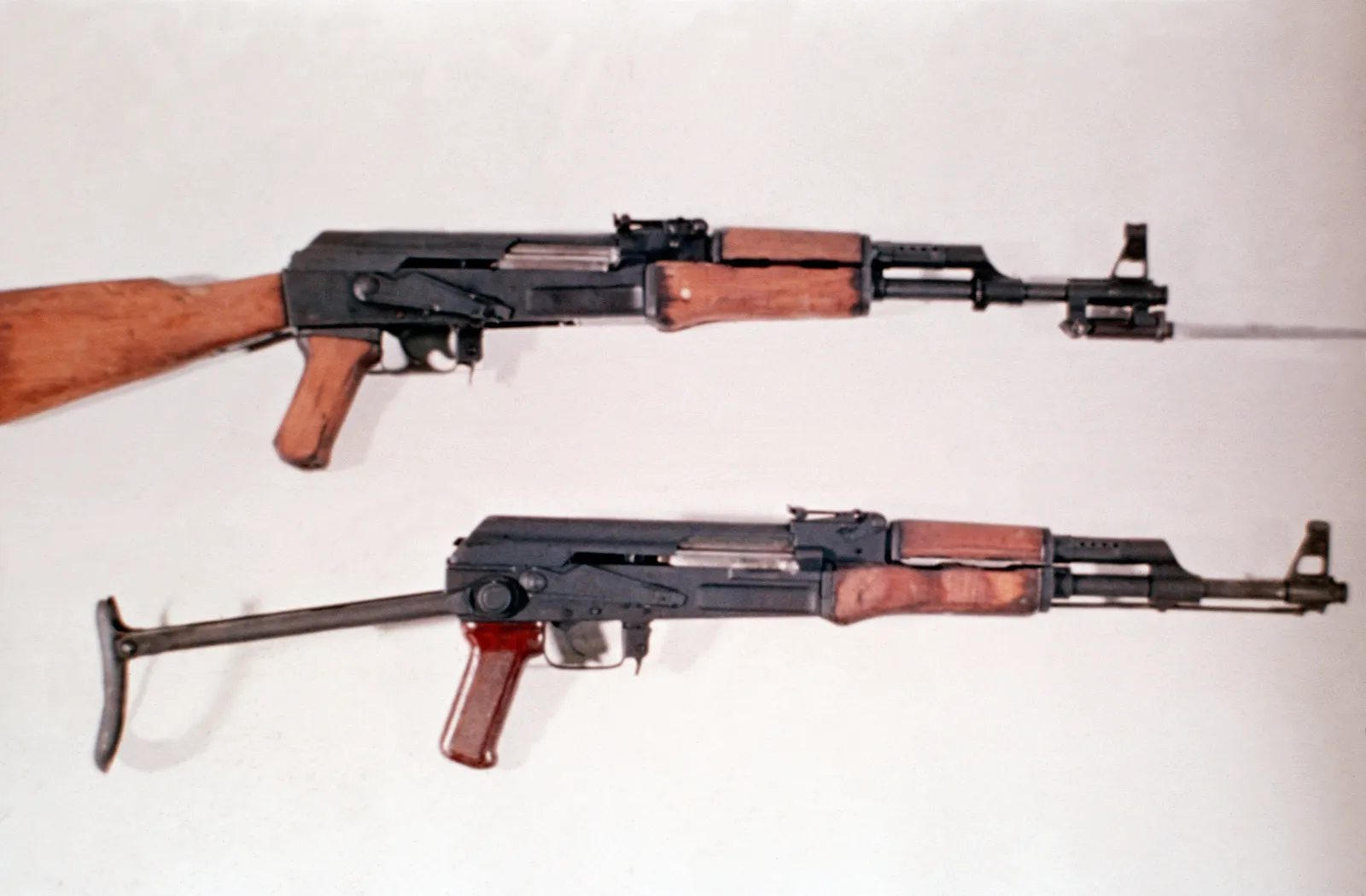
 | Under-folding-stock AKM variant | Small Arms Survey identifies the AKMS as the folding-stock AKM branch and gives folded and extended dimensions while retaining the same 7.62 x 39 mm operating family. |
 | Chinese AK-pattern production branch | Modern Firearms describes the Type 56 as a Chinese AK-pattern rifle chambered for 7.62 x 39 mm ammunition, with early milled and later stamped-receiver production under the same designation. Sources: Type 56 |
 | Chinese folding-stock Type 56 branch | Modern Firearms identifies the Type 56-1 as the folding-stock member of the Type 56 family, while Small Arms Survey treats it as a close AKM-family derivative. Sources: Type 56, Kalashnikov AKM (& close derivatives) |
Ammunition Fired
The AK-47/AKM family is tied to the Soviet intermediate cartridge that became the standard chambering for many Kalashnikov-pattern rifles.
| Ammunition | Ammunition type | Firing evidence |
|---|---|---|
 | Intermediate rifle cartridge | The Smithsonian AK-47 record says Kalashnikov submitted a gas-operated rifle based on the M43 cartridge, and Small Arms Survey lists 7.62 x 39 mm M1943 ammunition for the AKM-family derivatives represented here. Sources: AK-47 Automatic Rifle, Kalashnikov AKM (& close derivatives) |
Timeline
AK-47/AKM rifle family Key Events
Kalashnikov submits a gas-operated rifle design
The Smithsonian record says Mikhail Kalashnikov sent drawings to the Main Artillery Commission in Moscow for a new gas-operated rifle based on the M43 cartridge.
Sources: AK-47 Automatic Rifle
AK accepted into Soviet service
The Smithsonian collection record identifies Soviet Army acceptance of the AK-47 in 1949.
Sources: AK-47 Automatic Rifle
Chinese Type 56 production begins
Modern Firearms describes the Type 56 as China's AK-pattern rifle family and places its adoption and production start in the mid-1950s.
Sources: Type 56
AKM modernization enters Soviet service
Small Arms Survey and GunRF describe the AKM as the 1959 modernized Kalashnikov rifle with a pressed or stamped receiver.
Sources: Kalashnikov AKM (& close derivatives), GunRF AKM and AKMS assault rifles
Media
AK-47/AKM rifle family Videos
Related Weapon Systems


Sources
FARC dissidents brandish new weapons and call for Duque resignationPublisher: The City Paper Bogotá | Note: Supports 2016 Colombian FARC Dissident Conflict direct conflict-use: the article contrasts FARC dissidents' 2019 return-to-arms video showing old AK-47s with later weapons imagery. | Accessed: 2026-06-21Haiti: Gangs have 'more firepower than the police'Publisher: UNODC | Note: Supports 2022 Haitian Gang Conflict direct conflict-use: UNODC reported that Haitian gangs were using trafficked Russian AK-47s amid the current armed-gang conflict. | Accessed: 2026-06-21Kurdish fighters burn weapons in significant step towards peace with TurkeyPublisher: Sky News | Note: Supports 1984 Kurdish-Turkish Conflict direct conflict-use: PKK fighters placed AK-47 assault rifles into a July 2025 disarmament ceremony in Iraq during the conflict. | Accessed: 2026-06-21Russia, Turkey are sending fighters and weapons into LibyaPublisher: The Washington Post | Note: Supports 2014 Second Libyan Civil War direct conflict-use: Tripoli-government scouts were armed with AK-47s on a reconnaissance mission during the 2019-2020 civil war. | Accessed: 2026-06-21Al-Qaeda-linked militants launch coordinated attacks across MaliPublisher: The Washington Post | Note: Supports 2012 Mali War direct conflict-use: JNIM and allied fighters used AK-47s during coordinated attacks across Mali in April 2026. | Accessed: 2026-06-21Troops recover 30 guns abandoned by Maute groupPublisher: SunStar Philippines | Note: Supports 2017 Battle of Marawi direct conflict-use: AK-47 rifles were used by IS-aligned Maute militants, with two AK-47 rifles recovered from weapons believed abandoned by the Maute group near its last position in Marawi City. | Accessed: 2026-06-21Sending in the Cavalry: The Growing Militarization of Counterterrorism in Southeast AsiaPublisher: National Defense University Press | Note: Supports 2017 Battle of Marawi direct conflict-use: AK-47 assault rifles were fielded by pro-ISIL militants in Marawi alongside heavier weapons during the urban battle. | Accessed: 2026-06-21Weapons of the Islamic StatePublisher: Conflict Armament Research | Note: Supports 2014 Operation Inherent Resolve, 2014 War Against the Islamic State, and 2013 War in Iraq direct conflict-use: CAR documented Soviet and Russian AK-47 and AKM assault rifles among Islamic State weapons in Iraq and Syria. | Accessed: 2026-06-21Army kills 8 militants in large-scale operation inside North SinaiPublisher: Daily News Egypt | Note: Supports 2011 Sinai Insurgency direct conflict-use: militants used AK-47 assault rifles in the North Sinai attack described in the article. | Accessed: 2026-06-21New weapons fuelling the Sudan conflictPublisher: Amnesty International | Note: Supports 2023 Sudan War direct conflict-use: Amnesty International published imagery of an RSF unit in Nyala carrying imported AK-pattern rifles. | Accessed: 2026-06-21AP Hamas weapons analysisPublisher: AP News | Note: Supports 2023 Israel-Hamas War direct conflict-use: AP analysis reports Hamas fighters using AK-47 assault rifles from China and Russia. | Accessed: 2026-07-01Taliban Fighters Threaten CNN Crew With AK-47sPublisher: Business Insider | Note: Supports 2001 War in Afghanistan direct conflict-use: CNN footage reported by Business Insider showed Taliban fighters in Kabul with an AK-47 during the August 2021 takeover and evacuation period. | Accessed: 2026-06-21U.S. Navy Intercepts More Than 2,000 Assault Rifles Shipped from IranPublisher: U.S. Naval Forces Central Command | Note: Supports 2014 Yemen Civil War direct conflict-use: AK-47 assault rifles were supplied to Houthi-linked forces via a maritime route from Iran to Yemen used to traffic weapons to the conflict. | Accessed: 2026-06-20U.S. Navy Seizes 1,400 Assault Rifles During Illicit Weapons InterdictionPublisher: U.S. Navy | Note: Supports 2014 Yemen Civil War direct conflict-use: AK-47 assault rifles were transferred toward Houthi-linked forces on a route used to traffic weapons unlawfully to Yemen. | Accessed: 2026-06-20CENTCOM Forces Intercept More Than 2,000 Assault Rifles Shipped from IranPublisher: U.S. Central Command | Note: Supports 2014 Yemen Civil War direct conflict-use: more than 2,000 AK-47 assault rifles were being supplied to Houthi-linked forces along a route from Iran to Yemen. | Accessed: 2026-06-20Seized At Sea: Iranian Weapons Smuggled to the HouthisPublisher: Defense Intelligence Agency | Note: Supports 2014 Yemen Civil War direct conflict-use by describing thousands of assault rifles and other weapons destined for the Houthis between 2015 and 2024. | Accessed: 2026-06-20Maritime Interdictions of Weapon Supplies to Somalia and YemenPublisher: Conflict Armament Research | Note: Supports background on illegal dhow shipments destined for Yemen and the broader maritime interdiction context. | Accessed: 2026-06-20Weapon Supplies Fueling Terrorism in the Lake Chad CrisisPublisher: Conflict Armament Research | Note: Supports 2009 Boko Haram Insurgency direct conflict-use: AKM assault rifles were documented among weapons seized from JAS/Boko Haram and ISWAP-affiliated militants in the Lake Chad area. | Accessed: 2026-07-01AK-47 Automatic RiflePublisher: Smithsonian Institution | Note: Supports AK-47 background, designer context, acceptance into Soviet service, and collection measurements. | Accessed: 2026-06-20Kalashnikov AKM (& close derivatives)Publisher: Small Arms Survey | Note: Supports AKM and AKMS close-derivative identification and specs including 7.62 x 39 mm caliber, 30-round magazine, gas selective-fire operation, 600 rds/min rate, 715 m/s muzzle velocity, and AKMS folded and extended dimensions. | Accessed: 2026-07-01GunRF AKM and AKMS assault riflesPublisher: GunRF | Note: Supports AKM adoption date, AKMS folding-stock designation, 1959 AKM-family modernization context, and 7.62 x 39 mm cartridge relationship. | Accessed: 2026-07-01Type 56Publisher: Modern Firearms | Note: Supports Type 56 family background, Chinese production context, Type 56-1 under-folding stock identification, operating system, 7.62 x 39 mm chambering, and baseline specifications. | Accessed: 2026-07-01Commons AK-47 ImagePublisher: Wikimedia Commons | Note: Supports primary image provenance for a public-domain U.S. federal government AK-47 image. | Accessed: 2026-06-20Commons AK-47 and Type 56 ImagePublisher: Wikimedia Commons | Note: Supports gallery image provenance for a public-domain U.S. government comparison of a Chinese Type 56 and Soviet AK-47. | Accessed: 2026-06-20Commons Polish AKMS ImagePublisher: Wikimedia Commons | Note: Supports gallery image provenance for a public-domain U.S. defense image of an AKMS-pattern rifle in use during training. | Accessed: 2026-06-20Commons Illicit Arms Captured by the USN ImagePublisher: Wikimedia Commons | Note: Supports gallery image provenance for a public-domain U.S. Navy image of seized illicit arms including Type 56-1 assault rifles. | Accessed: 2026-06-20