- Role in conflict
- Small-unit rifle fire

Fielded by ISWAP fighters as a 5.45 mm assault rifle in Lake Chad propaganda imagery, with Nigerian reporting also describing an AK 74 recovered after Borno operations against ISWAP and Boko Haram fighters.
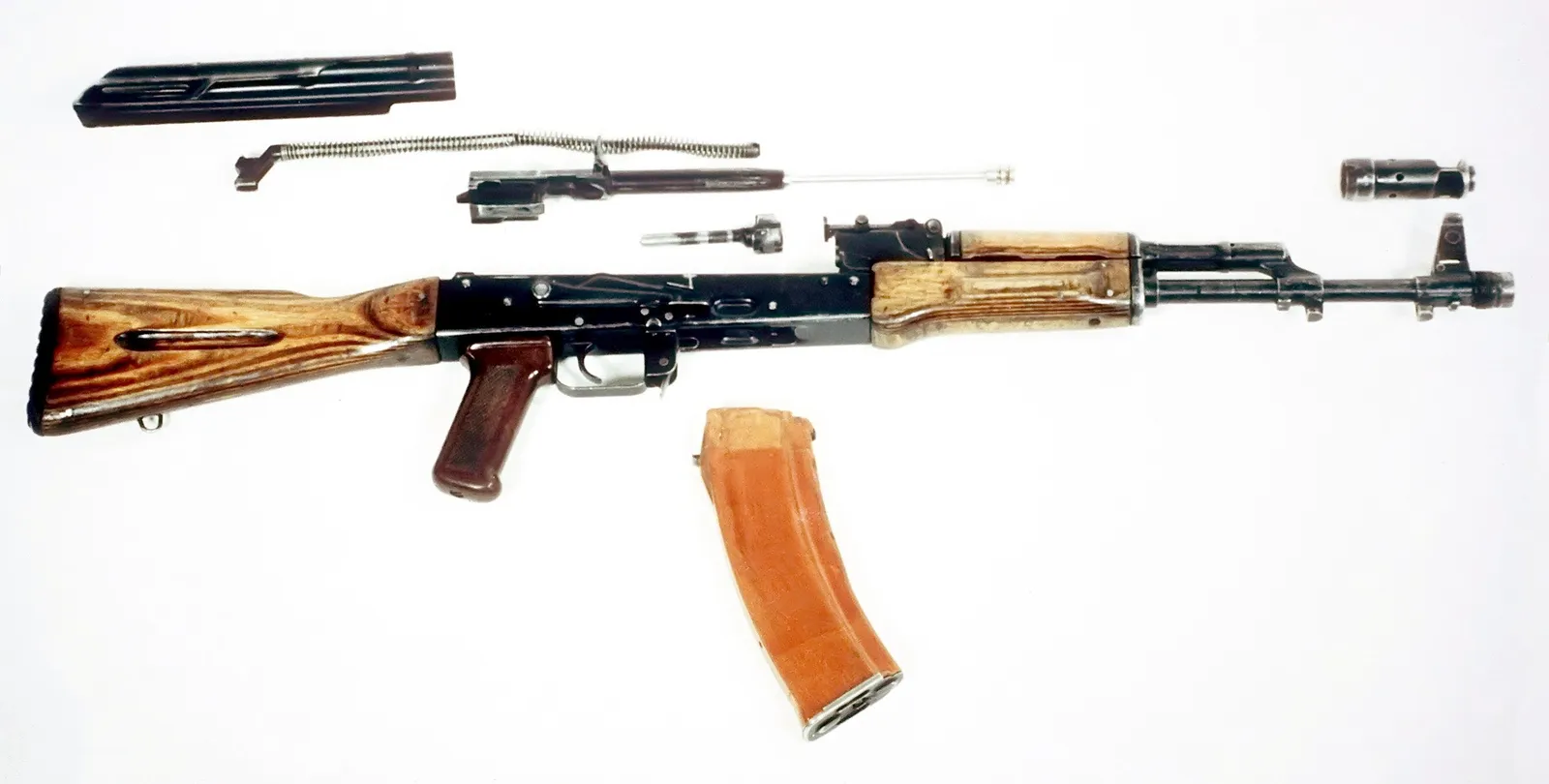
The AK-74 is a Soviet 5.45x39 mm assault rifle family built around a lighter small-caliber cartridge, 30-round magazines, and the familiar Kalashnikov operating pattern. Public conflict evidence spans its Soviet-Afghan combat debut, continuing 2014 Russia-Ukraine War service on both sides, Syrian Civil War AK-74M and AKS-74U use, Islamic State possession, ISWAP imagery, PKK raid footage, and Azerbaijani AK-74M fielding around Hadrut.
Fielded by ISWAP fighters as a 5.45 mm assault rifle in Lake Chad propaganda imagery, with Nigerian reporting also describing an AK 74 recovered after Borno operations against ISWAP and Boko Haram fighters.
Used by PKK fighters as a 5.45 mm Kalashnikov-family assault rifle in 2021 1984 Kurdish-Turkish Conflict raid imagery, including AK-74 rifles and AKS-74/AKS-74U variants documented around attacks on Turkish Armed Forces positions.
Bellingcat's open-source analysis of Hadrut footage during the 2020 Nagorno-Karabakh fighting identified Azerbaijani soldiers carrying AK-74M rifles, including one with a Rakurs sight.
Used by Ukrainian forces as a common 5.45 mm service rifle family, while CAR separately documented AK-74, AKS-74, AK-74N, and AK-74M rifles in Ukraine among weapons associated with Russia-aligned DPR/LPR forces.
Role detailsHistoryNet describes the AK-74 as adopted by the Soviet army in 1979 and making its combat debut in Afghanistan, with Afghan mujahedeen later capturing examples.
Bellingcat documented AK-74M and AKS-74U rifles with Syrian Arab Army and Republican Guard units, and also described Islamic State fighters in Syria using AK-74M rifles from captured or transferred stocks.
Role detailsAmnesty International documented AK-74M rifles among Islamic State automatic rifles in Iraq and Syria, most likely originating from looted Syrian army stocks.
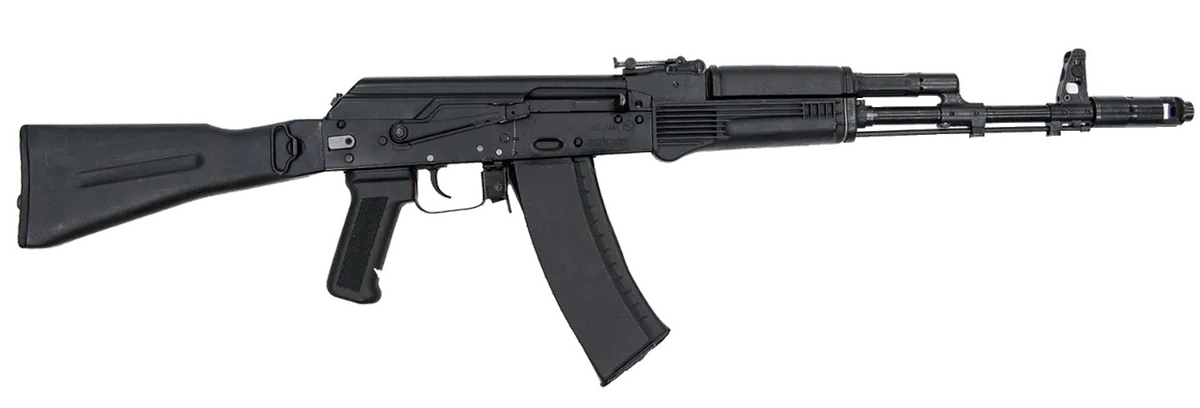
Role detailsAK-74 family designations usually mark stock, sight-rail, compact, or modernized configurations rather than wholly separate rifle families.
| Designation | Configuration | Documented context |
|---|---|---|
| AKS-74 | Side-folding stock branch | Modern Firearms describes it as the folding-stock 5.45 mm branch, and CAR later documented AKS-74 rifles in Ukraine. |
| AKS-74U | Compact carbine branch | Modern Firearms treats it as the compact AK-74-family weapon, while Bellingcat documents AKS-74U distribution alongside AK-74Ms in Syria. |
| AK-74N | Optics-rail branch | CAR documented AK-74N rifles among 5.45 mm weapons in Ukraine, distinguishing the rail-equipped branch from baseline AK-74 rifles. |
The AK-74 line starts with the fixed-stock 5.45 mm rifle and expands through folding-stock, night-sight, compact, and modernized branches.
| Variant | Configuration | Designation notes |
|---|---|---|
 | Modernized side-folding variant | Bellingcat describes the AK-74M as a modernized AK-74 variant that entered production in 1991 with a synthetic side-folding stock and broader optics/attachment compatibility. Sources: From Russia with Love, Syria's AK-74Ms, Kalashnikov AK-74M - Weaponsystems.net |
The AK-74 family is documented as a 5.45 mm rifle line, so it sits on the firing end of the 5.45×39 mm cartridge relationship.
| Ammunition | Ammunition type | Firing evidence |
|---|---|---|
 | Intermediate rifle cartridge | Kalashnikov Group identifies the AK-74M as a 5.45 mm rifle, and Modern Firearms describes the AK-74 family as chambered for the 5.45x39 mm cartridge. Sources: AK-74M Specifications, AK-74 / AK-74M Rifle |
AK-74-family rifles are commonly documented with GP-series 40 mm launchers, while the exact launcher model depends on rifle generation and operator configuration.
| Compatible item | Item type | Compatibility evidence |
|---|---|---|
 | 40 mm underbarrel launcher | Modern Firearms documents the GP-25/GP-30 family as underbarrel launchers for Soviet and Russian Kalashnikov rifles, including AK-74-family hosts. Sources: GP-25 and GP-30 - Modern Firearms |
 | 40 mm underbarrel launcher | Bellingcat documents Syrian AK-74M rifles fitted with GP-30M launchers, and Modern Firearms describes the GP-30 as a lighter GP-series launcher for Kalashnikov rifles. Sources: From Russia with Love, Syria's AK-74Ms, GP-25 and GP-30 - Modern Firearms |
 | 40 mm underbarrel launcher | Weaponsystems.net lists GP-34 compatibility within the AK-74M family, which keeps the later launcher relationship inside the modernized AK-74 branch. |
HistoryNet describes the AK-74 as adopted by the Soviet army in 1979 and making its combat debut in Afghanistan.
Bellingcat identifies the AK-74M as the modernized AK-74 variant that entered production in 1991 with a synthetic side-folding stock.
Bellingcat reported AK-74M and AKS-74U rifles with Syrian government units and Islamic State fighters during the Syrian Civil War.
Conflict Armament Research documented AK-74, AKS-74, AK-74N, and AK-74M rifles in Ukraine among 5.45 mm weapons recorded between 2018 and 2020.