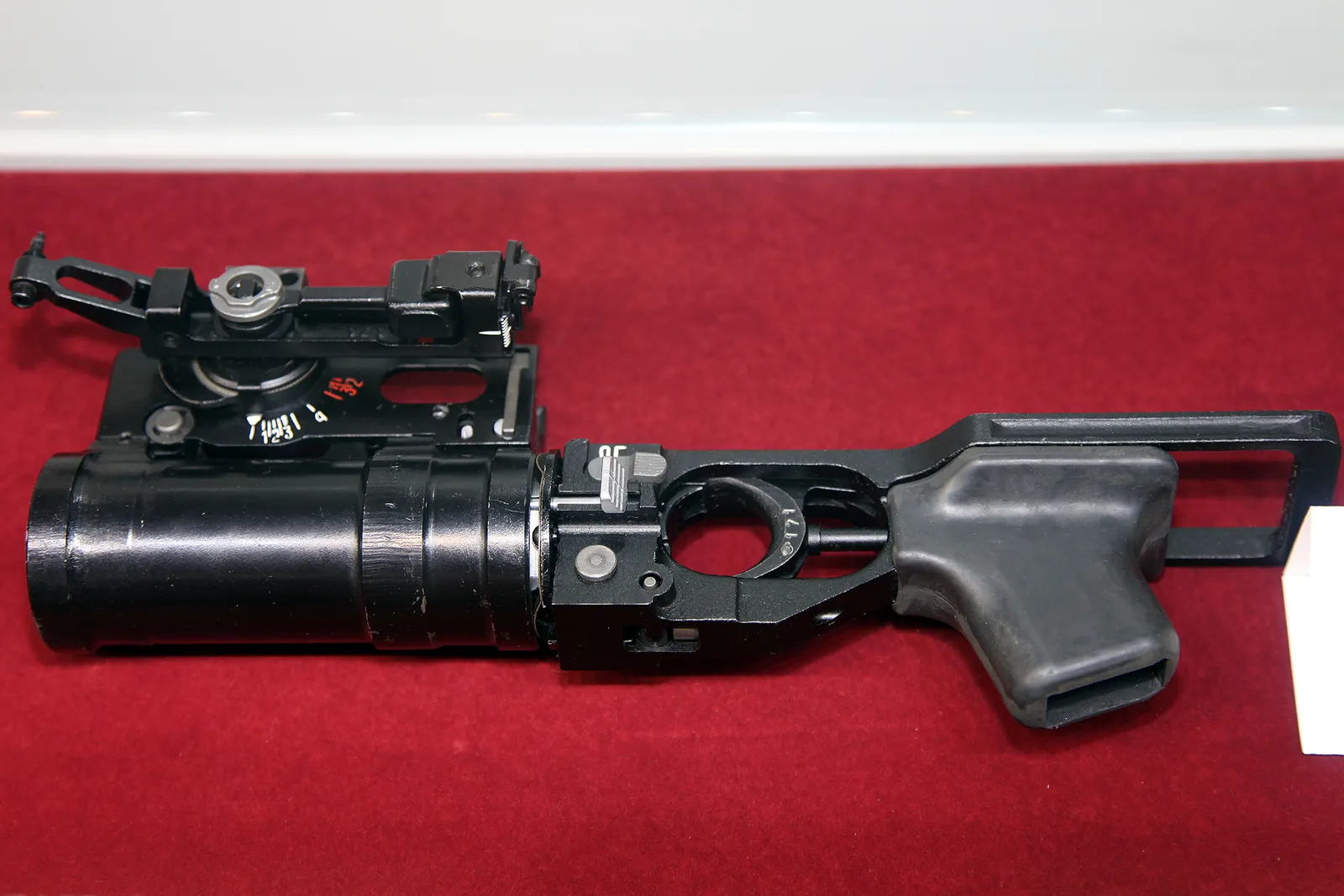


IPHR and Truth Hounds reported GP-25 grenade hits during an August 2014 attack on a Ukrainian border facility at Milove, CAR documented two Russian-manufactured GP-25 launchers in Mariupol in 2019, and DVIDS documented Ukrainian GP-25 training in 2017.
Role detailsInfantry Weapons
GP-25 Kostyor
Also known as
- GP-25
- Kostyor
- Koster
- 6G15
- Granatomyot Podstvolnyj GP-25
The GP-25 Kostyor is a Soviet 40 mm muzzle-loaded under-barrel grenade launcher developed by TsKIB SOO and produced by TOZ for Kalashnikov-pattern rifles. It fires VOG-25-family caseless grenades from a single-shot rifled tube, became the baseline GP-series launcher later followed by the GP-30 and GP-34, and has direct conflict documentation in Ukraine and Syrian government service.
Role in Conflicts

Bellingcat reported that the Syrian Arab Army had acquired GP-25 and GP-30M under-barrel grenade launchers for AK-74M and related Kalashnikov rifles during the Syrian Civil War.
Role detailsProfile / Specs
Profile
- Origin
- Soviet Union
- Built by
- TOZ
- Type
- 40 mm under-barrel grenade launcher
- Service note
- Adopted in 1978; still in service
- Designer
- TsKIB SOO / V. N. Telesh
- Designed
- 1972-1978
- Produced
- 1978-present
- Developed into
- GP-30
Specifications
- Caliber
- 40 mm VOG-25
- Operation
- Double-action, single-shot
- Feed system
- Muzzle-loaded
- Barrel length
- 120 mm
- Weight
- 1.5 kg empty; 1.76 kg loaded
- Length
- 323 mm
- Muzzle velocity
- 76 m/s
- Range
- Point blank up to 400 m
- Rifling
- 12 grooves, right-hand twist
- Practical rate of fire
- 4-5 aimed rounds per minute
- Sights
- Mechanical front post and rear notch with range adjustment
Variants
The GP-25 is the original Soviet GP-series under-barrel launcher in this catalog; later GP-30 and GP-34 entries keep the same general VOG-25 ammunition concept while changing weight, sighting, manufacturing, or safety details.
| Variant | Configuration | Designation notes |
|---|---|---|
 | Lighter successor | Modern Firearms describes the GP-30 as the 1989 improved design that retained GP-25 combat effectiveness while becoming lighter, simpler, and less expensive to manufacture. Sources: GP-25 and GP-30 |
 | Later Russian GP-series member | The GP-34 catalog record and reference sources place it after the GP-25 and GP-30 family while retaining 40 mm VOG-25-family ammunition compatibility. Sources: GP-34 Underbarrel Grenade Launcher - Modern Firearms |
Compatible Rifles
The GP-25 is a 40 mm under-barrel launcher designed to fit beneath Kalashnikov-pattern rifles rather than operate as a normal standalone grenade launcher.
| Compatible item | Item type | Compatibility evidence |
|---|---|---|
 | 7.62x39 mm assault rifle | Modern Firearms describes the GP-25 as adopted for AKM rifles as well as the AK-74, placing the launcher on the earlier Kalashnikov infantry-rifle branch. Sources: GP-25 and GP-30 |
 | 5.45x39 mm assault rifle | Modern Firearms describes the GP-25 as adopted for both AKM and AK-74 rifles, and Weaponsystems.net calls the AK-74 and GP-25 an iconic Soviet-Afghan War combination. Sources: GP-25 and GP-30, GP-25 Kostyor |
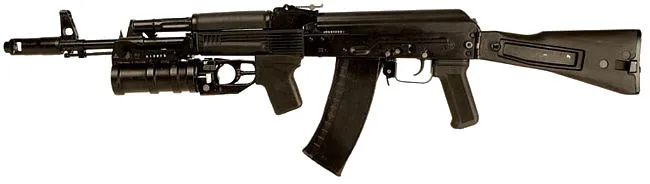
 | Modernized 5.45x39 mm assault rifle | The Commons file shows a GP-25 fitted to an AK-74M, while Bellingcat describes GP-25 and GP-30M launcher acquisition for Syrian AK-74M-era rifle use. Sources: AK-74M with GP-25.jpg, SAS GP-25 weapons ID sheet, From Russia with Love, Syria's AK-74Ms |
 | Kalashnikov rifle family | Small Arms Survey identifies the GP-25 and GP-30 as under-barrel grenade launchers designed to fit beneath Kalashnikov-pattern assault rifles. Sources: SAS GP-25 weapons ID sheet |
Design And Ammunition Notes
The GP-25's distinctive handling comes from combining a muzzle-loaded rifled tube with a self-contained 40 mm grenade: after firing, no cartridge case remains in the launcher, so the operator loads the next VOG-25-family round directly from the muzzle.
Ammunition family
VOG-25 is the standard high-explosive fragmentation round; Weaponsystems.net also identifies VOG-25P as a bouncing high-explosive fragmentation variant.
Launcher identity
Small Arms Survey highlights the GP-25's short barrel, slim profile, and Kalashnikov under-barrel mounting as key identification features.
Family context
Modern Firearms treats the GP-30 as a lighter 1989 successor that kept the same basic combat role and ammunition concept.
Sources: SAS GP-25 weapons ID sheet; GP-25 and GP-30; 40mm VOG-25.
Timeline
GP-25 Kostyor Key Events
GP-25 accepted into Soviet service
Modern Firearms describes the GP-25 as adopted by the Soviet Army in 1978 for AKM and AK-74 Kalashnikov rifles.
Sources: GP-25 and GP-30
GP-30 successor adopted
Modern Firearms says the Russian Army adopted the lighter GP-30 in 1989 while keeping the GP-25 family's basic combat role.
Sources: GP-25 and GP-30
Syrian government GP-25 acquisition reported
Bellingcat reported GP-25 and GP-30M launchers among the under-barrel grenade-launcher types acquired by the Syrian Arab Army.
Sources: From Russia with Love, Syria's AK-74Ms
Two GP-25s documented in Mariupol
Conflict Armament Research documented two 40 mm GP-25 under-barrel grenade launchers in Mariupol during its Ukraine weapons investigation.
Sources: Weapons of the War in Ukraine
Media
GP-25 Kostyor Videos
GP-25 Kostyor Images
Related Weapon Systems


Sources
GP-25 and GP-30Publisher: Modern Firearms | Note: Supports GP-25 development history, AKM/AK-74 compatibility, ammunition family context, and baseline technical characteristics. | Accessed: 2026-07-04GP-25 KostyorPublisher: Weaponsystems.net | Note: Supports GP-25 origin, designer, producer TOZ, and technical characteristics including caliber, length, weight, operation, and range. | Accessed: 2026-07-04SAS GP-25 weapons ID sheetPublisher: Small Arms Survey | Note: Supports GP-25 identification, technical data, and the fact that the launcher fits beneath Kalashnikov-pattern assault rifles. | Accessed: 2026-07-04Weapons of the War in UkrainePublisher: Conflict Armament Research | Note: Supports 2014 Russia-Ukraine War direct-use context by documenting two Russian-manufactured GP-25 launchers in Mariupol and Ukrainian trace-response information that they were not Armed Forces of Ukraine inventory. | Accessed: 2026-07-04Investigation of Cross-Border Attacks in Eastern UkrainePublisher: International Partnership for Human Rights / Truth Hounds | Note: Supports 2014 Russia-Ukraine War direct-use context by describing an August 2014 Milove attack involving GP-25 grenades and several GP-25 hits on a Ukrainian border department facility. | Accessed: 2026-07-04Ukrainian GP-25 Grenade Launcher TrainingPublisher: DVIDS | Note: Supports 2014 Russia-Ukraine War Ukrainian-side context by documenting 79th Air Assault Brigade GP-25 training at Yavoriv in 2017 for defensive operations. | Accessed: 2026-07-04From Russia with Love, Syria's AK-74MsPublisher: Bellingcat | Note: Supports 2011 Syrian Civil War direct-use context by reporting Syrian Arab Army acquisition of GP-25 and GP-30M under-barrel grenade launchers for Kalashnikov rifle use. | Accessed: 2026-07-04GP-34 Underbarrel Grenade Launcher - Modern FirearmsPublisher: Modern Firearms | Note: Supports GP-34 lineage from the GP-25 and GP-30 family, VOG-25 ammunition compatibility, right-side sights, and safety/handling changes. | Accessed: 2026-07-0440mm VOG-25Publisher: Weaponsystems.net | Note: Supports VOG-25 and VOG-25P ammunition-family context for GP-series muzzle-loaded under-barrel grenade launchers. | Accessed: 2026-07-04GP-25 at Tula State Museum of Weapons.jpgPublisher: Wikimedia Commons | Note: Primary image provenance for the standalone GP-25 image on Wikimedia Commons. | Accessed: 2026-07-04AK-74M with GP-25.jpgPublisher: Wikimedia Commons | Note: Gallery image provenance and visual evidence for a GP-25 fitted to an AK-74M. | Accessed: 2026-07-04