2014 Russia-Ukraine War

GP-25 Kostyor in the 2014 Russia-Ukraine War

The GP-25 appeared in the 2014 Russia-Ukraine War as an infantry under-barrel grenade launcher: IPHR and Truth Hounds documented GP-25 grenade impacts at Milove in August 2014, Conflict Armament Research documented two Russian-manufactured GP-25 launchers in Mariupol in 2019, and DVIDS documented Ukrainian GP-25 training in 2017.

Evidence Map

ClaimSources
GP-25 grenades were used in the 8 August 2014 Milove attack on a Ukrainian border service department.

Sources: Investigation of Cross-Border Attacks in Eastern Ukraine

Two Russian-manufactured GP-25 launchers were documented in Mariupol in 2019 among materiel recovered from DPR/LPR armed formations.

Sources: Weapons of the War in Ukraine

Ukrainian 79th Air Assault Brigade soldiers trained with GP-25 launchers at Yavoriv in May 2017.

Sources: Ukrainian GP-25 Grenade Launcher Training

Timeline

GP-25 Kostyor In 2014 Russia-Ukraine War

  1. Milove border facility attacked with GP-25 grenades

    IPHR and Truth Hounds reported that a Ukrainian border service department in Milove was attacked with RPO Shmel flamethrowers, SPG grenades, and GP-25 grenades, and that several GP-25 hits were found on the facility's garage.

    Sources: Investigation of Cross-Border Attacks in Eastern Ukraine

  2. Ukrainian 79th Air Assault Brigade trains with GP-25s

    DVIDS documented Ukrainian soldiers from the 1st Airmobile Battalion, 79th Air Assault Brigade training with GP-25 grenade launchers at Yavoriv.

    Sources: Ukrainian GP-25 Grenade Launcher Training

  3. Two GP-25 launchers documented in Mariupol

    Conflict Armament Research documented two Russian-manufactured GP-25 under-barrel grenade launchers in Mariupol while investigating weapons recovered from DPR/LPR armed formations.

    Sources: Weapons of the War in Ukraine

Documented Use

Direct proof of use

The clearest direct-use incident is the 8 August 2014 attack on the Ukrainian border service department in Milove, Luhansk province. International Partnership for Human Rights and Truth Hounds reported that the facility was attacked with RPO Shmel flamethrowers, SPG grenades, and GP-25 grenades, and that their field mission found several GP-25 hits on the garage of the border department facility.

The Milove report treated the attack as part of a set of cross-border incidents in Luhansk province and attributed the documented attacks to people operating from or returning to Russian territory. The GP-25 evidence in that report is therefore evidence of grenade-launcher use in a specific border-facility attack, not a complete accounting of every GP-25 in the theater.

Sources: Investigation of Cross-Border Attacks in Eastern Ukraine

Recovered and traced launchers

Conflict Armament Research separately documented two 40 mm GP-25 under-barrel grenade launchers in Mariupol on 18 September 2019 during its investigation of weapons recovered from the armed formations of the self-declared Donetsk and Luhansk People's Republics. CAR determined that the two launchers were manufactured on Russian territory.

Ukrainian trace responses to CAR said the two GP-25 launchers with serial numbers 15 4657 and 52 6734 had not been in service with the Armed Forces of Ukraine, had not been recorded as stolen, lost, or written off, and had not been transferred to other military units. That evidence supports recovered conflict materiel and Russian-side provenance, while the report does not by itself identify a firing incident for those two recovered launchers.

Sources: Weapons of the War in Ukraine

Ukrainian-side training

Ukrainian forces also had GP-25s in the conflict-era force structure. DVIDS documented soldiers from the 1st Airmobile Battalion, 79th Air Assault Brigade training with GP-25 grenade launchers at the Yavoriv Combat Training Center on 3 May 2017.

The DVIDS caption says the soldiers were being taught to employ the grenade launchers during defensive operations during the battalion's rotation at the training center. This is training and fielding evidence for the Ukrainian side, distinct from the Milove firing incident and the CAR recovery evidence.

Sources: Ukrainian GP-25 Grenade Launcher Training

Role in the conflict

Across the documented sources, the GP-25's conflict role was close infantry fire support from Kalashnikov-pattern rifles, with separate evidence streams for fired GP-25 grenades, recovered under-barrel launchers, and Ukrainian training. The sources support both Ukrainian possession and training and Russian-side or Russian-backed armed-formation materiel, but they do not support a single uniform operator history for every launcher observed in the war.

Sources: Investigation of Cross-Border Attacks in Eastern Ukraine, Weapons of the War in Ukraine, Ukrainian GP-25 Grenade Launcher Training

Images

Conflict Context

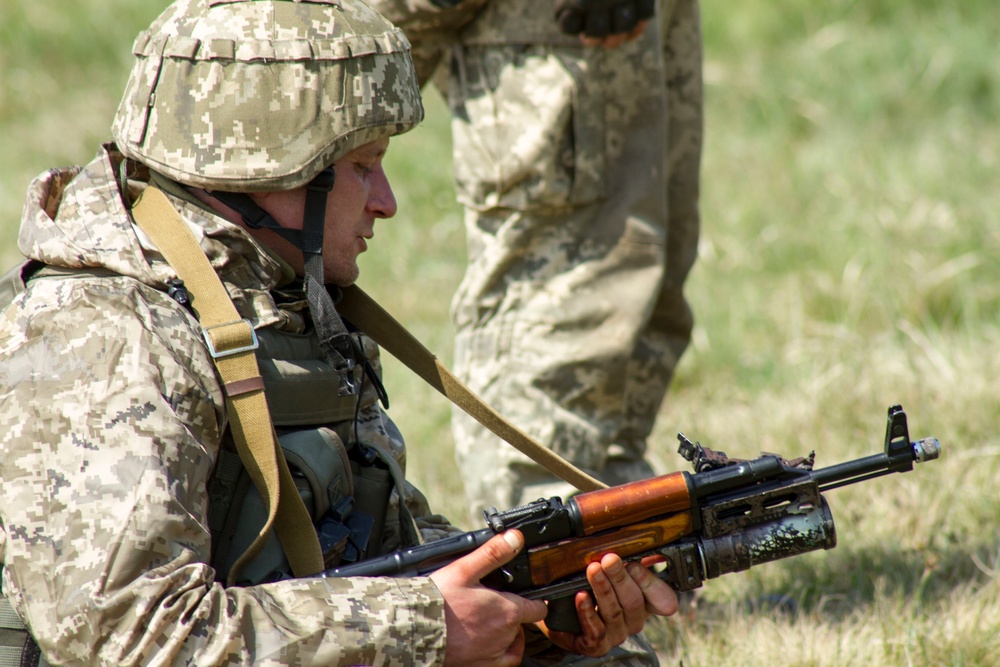
Ukrainian soldier inspecting a GP-25 grenade launcher during training at Yavoriv in 2017
A Ukrainian soldier assigned to the 1st Airmobile Battalion, 79th Air Assault Brigade inspects a GP-25 during training at Yavoriv on 3 May 2017.

Sources: Ukrainian GP-25 Grenade Launcher Training

Sources