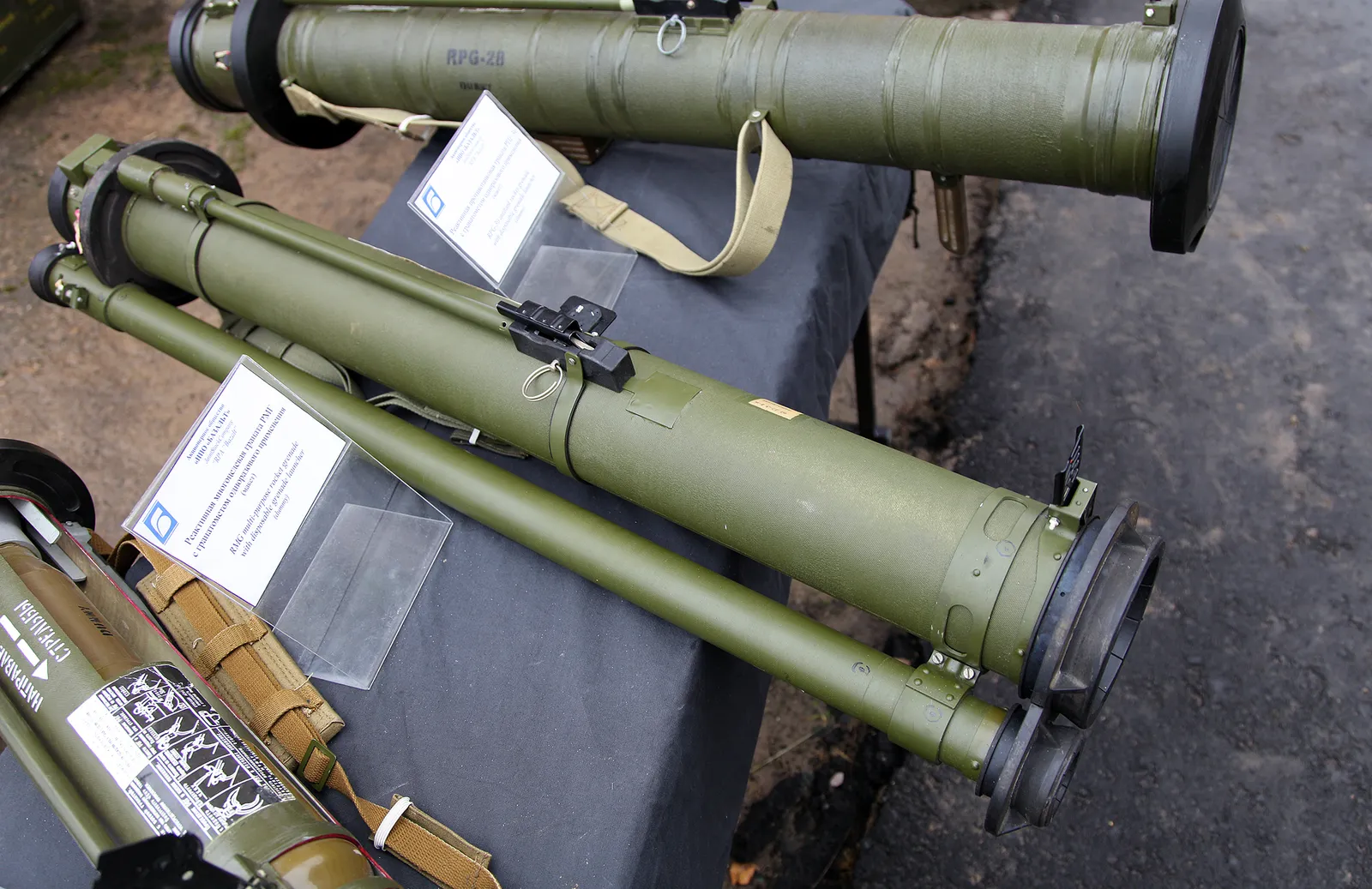


Documented with Russian forces during the 2022 invasion and later in Ukrainian hands through captured examples, including Azov-reported Mariupol captures and later footage of an examined and fired launcher.
Role detailsInfantry Weapons
RPG-30
Also known as
- RPG-30 Kryuk
- RPG-30 Hook
- 7P53
- 7P53 Kryuk
The RPG-30 Kryuk is a Russian disposable shoulder-fired anti-tank launcher built around a two-projectile attack: a small precursor round is fired just ahead of the 105 mm PG-30 tandem HEAT rocket to draw an active protection response before the main warhead arrives. In Ukraine it has appeared primarily as a Russian infantry anti-armor weapon, with captured examples also documented in Ukrainian hands.
Role in Conflicts
Profile / Specs
Profile
- Origin
- Russia
- Built by
- Bazalt
- Type
- Disposable anti-tank rocket-propelled grenade launcher
- Service note
- Entered Russian service in the early 2010s; documented during the 2014 Russia-Ukraine War
- Designer
- NPO Bazalt
- Designed
- Early 2000s development; publicly shown by 2008
- Unit cost
- Reported by Defense Express as over $3,000 per launcher in 2022
- Produced
- 2010s-present
- Number built
- Defense Express reported no more than about 1,000 Russian Army launchers in 2022
Specifications
- Crew
- 1 operator
- Caliber
- 105 mm main rocket with a smaller precursor projectile
- Warhead
- PG-30 tandem HEAT anti-tank warhead
- Effective range
- Commonly reported around 200 m; TASS cited 300 m range
- Weight
- About 10.3 kg
- Length
- About 1,135 mm
- Armor penetration
- Reported over 600 mm rolled homogeneous armor after explosive reactive armor
- APS defeat method
- Side-mounted precursor projectile intended to trigger active protection before the main rocket arrives
Launcher And Projectiles
The RPG-30 is best understood as a disposable launcher built around two closely sequenced projectiles rather than as a reusable RPG tube with interchangeable rounds.
| Element | Function | Documented context |
|---|---|---|
| 7P53 RPG-30 launcher | Disposable firing unit | Single-operator Russian anti-tank launcher associated with NPO Bazalt and Russian Army fielding. |
| IG-30 precursor projectile | Active-protection trigger | Small side-tube projectile fired just before the main rocket to draw the target vehicle's active protection response. |
| PG-30 main rocket | Tandem HEAT attack | 105 mm main round reported with post-ERA armor penetration above 600 mm RHA and short effective range. |
Timeline
RPG-30 Key Events
Russian service entry reported
Defense Express described the RPG-30 as a Russian Armed Forces disposable anti-tank launcher in service since 2012.
Sources: How Effective Against Tanks is the Newest Russian RPG-30 Worth $3,000
NPO Bazalt describes Army fielding
At Russia Arms Expo 2015, NPO Bazalt leadership told TASS that the RPG-30 had entered service and was being fielded by the Russian Army.
Sources: Russian Army receives cutting-edge antitank rocket launchers - manufacturer
Captured launchers reported at Mariupol
Ukrainska Pravda, citing Azov, reported that Mariupol defenders captured RPG-30 anti-tank rocket launchers from Russian forces.
Sources: Azov Battalion has destroyed 2 tanks, killed 17 troops and sunk a boat belonging to the occupying forces
Captured-example footage analyzed
The Armourer's Bench reviewed RPG-30 footage from Ukraine, including an examined captured launcher and a later fired example.
Sources: RPG-30: Russia's Dual Tube Rocket Launcher
Media
RPG-30 Videos
Related Weapon Systems


Sources
RPG-30 Kryuk (Hook) Russian Anti-tank Grenade LauncherPublisher: U.S. Army ODIN Worldwide Equipment Guide | Note: Supports RPG-30 background, Russian origin, launcher role, 105 mm PG-30 round, approximate weight, range, penetration claims, and launcher/projectile context. | Accessed: 2026-06-29Russian Army receives cutting-edge antitank rocket launchers - manufacturerPublisher: TASS | Note: Quotes NPO Bazalt leadership on Russian Army fielding, manufacturer context, dual-projectile layout, precursor projectile, 105 mm tandem warhead, penetration, and range. | Accessed: 2026-06-29RPG-30: Russia's Dual Tube Rocket LauncherPublisher: The Armourer's Bench | Note: Supports 2014 Russia-Ukraine War direct-use context: used by Russian forces from February 2022, captured by Ukrainian personnel, examined in later footage, and fired by a Ukrainian combatant. | Accessed: 2026-06-29How Effective Against Tanks is the Newest Russian RPG-30 Worth $3,000Publisher: Defense Express | Note: Supports 2014 Russia-Ukraine War context: fielded by the Russian army and captured for Ukrainian review, plus reported 2012 service, inventory, cost, and technical details including PG-30 caliber, weight, range, and penetration. | Accessed: 2026-06-29Azov Battalion has destroyed 2 tanks, killed 17 troops and sunk a boat belonging to the occupying forcesPublisher: Ukrainska Pravda | Note: Supports 2014 Russia-Ukraine War direct-use context: RPG-30 anti-tank rocket launchers were captured by Ukrainian defenders from Russian invaders in Mariupol. | Accessed: 2026-06-29RPG-30 grenade launcher at Interpolitex-2016 01.jpgPublisher: Wikimedia Commons | Note: Image by Vitaly V. Kuzmin, licensed CC BY-SA 4.0 with VRT permission noted by Wikimedia Commons. | Accessed: 2026-06-29