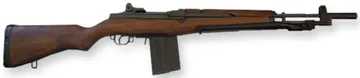
- Side
- Argentina
- Role in conflict
- Argentine infantry small arm

During the 1982 Falklands War, Argentine units in the Falklands/Malvinas included Italian-made Beretta BM-59E rifles among small arms held by the occupying force.
The Beretta BM59 is an Italian selective-fire battle rifle that converted the M1 Garand architecture into a 7.62x51mm NATO, detachable-magazine service rifle. Beretta built the core Italian family, while licensed or locally produced patterns appeared in Indonesia and Nigeria. Direct conflict-use sourcing ties BM59-family rifles to Argentine small arms in the 1982 Falklands War and to criminal-gang firearms in Haiti's current gang conflict.
During the 1982 Falklands War, Argentine units in the Falklands/Malvinas included Italian-made Beretta BM-59E rifles among small arms held by the occupying force.
In the 2022 Haitian Gang Conflict, the BM59 Beretta rifle was reported among weapons used by criminal gangs in Haiti, but the source does not identify a narrower tactical role.
The BM59 kept the M1 Garand action and fire-control lineage but changed the service-rifle package around NATO ammunition, detachable magazines, and selective fire. Its most recognizable military configuration added a 20-round box magazine, stripper-clip guide, folding bipod, grenade-launching sight with gas cut-off, and a tri-compensator muzzle device.
Reuse and modernize Garand tooling and receivers instead of starting with an entirely new rifle.
The en-bloc clip system gave way to a 20-round detachable box magazine, while clip-guide loading remained possible.
A bipod, muzzle device, and full-power 7.62x51mm NATO chambering made the rifle usable for limited automatic fire, though squad-automatic variants remained constrained by the magazine size.
Source labels used here: BM59: The Italian M14; The History of the Italian FAL - Beretta's Long-Serving BM59.
The BM59 family mixed Italian service models, export conversion packages, squad-automatic patterns, and licensed-production derivatives built around the same Garand-based 7.62x51mm NATO action.
| Variant | Configuration | Designation notes |
|---|---|---|
| BM59 ITAL | Baseline Italian service rifle | Standard fixed-stock Italian service model with the tri-compensator, bipod, and 20-round detachable magazine layout. Sources: The History of the Italian FAL - Beretta's Long-Serving BM59 |
| BM59 Mk. I | Simplified export conversion | Export package described without the distinctive tri-compensator muzzle device. Sources: The History of the Italian FAL - Beretta's Long-Serving BM59 |
| BM59 ITAL-TA / Alpini | Mountain-troop folding-stock model | Variant with a pistol grip and side-folding metal stock, developed for Italian mountain troops. Sources: The History of the Italian FAL - Beretta's Long-Serving BM59 |
| BM59 ITAL-Para / Mk. 3 | Paratrooper model | Paratrooper adaptation of the folding-stock model with a removable tri-compensator for a shorter jump package. Sources: The History of the Italian FAL - Beretta's Long-Serving BM59 |
| BM59 Mk. 2 / Mk. 4 | Squad-automatic proposals | Heavier-barrel support-weapon patterns; Small Arms Review says the Italian military did not adopt them, while Indonesia and Nigeria produced related licensed patterns. Sources: The History of the Italian FAL - Beretta's Long-Serving BM59 |
| NR-2 rifle | Nigerian licensed-production derivative | DICON's Kaduna plant was built with BM59 rifle production capacity, and Small Arms Review identifies the Nigerian NR-2 as a licensed Mk. 4-pattern derivative. Sources: The History of the Italian FAL - Beretta's Long-Serving BM59, DICON - Ministry of Defence |
| Pindad SP.3 | Indonesian licensed-production derivative | Small Arms Review identifies the SP.3 as an Indonesian licensed-production derivative of the Mk. 4 pattern from the Bandung Weapons Factory, now PT Pindad. Sources: The History of the Italian FAL - Beretta's Long-Serving BM59 |
BM59 sources identify the rifle as chambered for 7.62x51mm NATO after Beretta adapted the Garand-pattern action to the NATO rifle cartridge.
| Ammunition | Ammunition type | Firing evidence |
|---|---|---|
 | Rifle cartridge | Forgotten Weapons and Small Arms Review both describe the BM59 as a Garand-derived rifle converted to fire 7.62 mm NATO / 7.62x51mm NATO ammunition. Sources: BM59: The Italian M14, The History of the Italian FAL - Beretta's Long-Serving BM59 |
The BM59 is best read as Beretta's Italian modernization of the M1 Garand rather than as a direct M14 variant. Sources describe Beretta engineers adapting the Garand action and fire-control layout for a NATO-caliber, magazine-fed, selective-fire service rifle while the United States pursued the separate M14 program from the same broad Garand lineage.
| Linked weapon | Relationship | Source-backed context |
|---|---|---|
 | Developed from | Forgotten Weapons and Small Arms Review describe the BM59 as built around the Garand action, with 7.62 mm NATO chambering, a detachable 20-round box magazine, and selective-fire changes. |
 | Parallel lineage | Small Arms Review frames the M14 as the U.S. attempt to retain Garand-derived features in a new 7.62 mm service rifle, while Beretta produced the BM59 by modernizing existing Garand technology. |
Forgotten Weapons identifies 1957 as the start of Beretta engineering work by Vittorio Valle and Domenico Salza on the rifle that became the BM59.
Sources: BM59: The Italian M14
Forgotten Weapons says BM59 prototypes were ready in 1959 before trials and Italian service adoption.
Sources: BM59: The Italian M14
Forgotten Weapons and American Rifleman describe the BM59 entering Italian military hands in 1962 after trials.
Sources: BM59: The Italian M14, Evolution Of The BM-59
Nigeria's Ministry of Defence says the Kaduna Ordnance Factories were built with annual capacity for 5,000 BM59 rifles and 7.62x51mm ammunition.
Sources: DICON - Ministry of Defence
Small Arms Review says the BM59 officially served with the Italian military until 1990, with gradual replacement by the AR-70/90 and residual rear-line or reserve retention afterward.
Sources: The History of the Italian FAL - Beretta's Long-Serving BM59