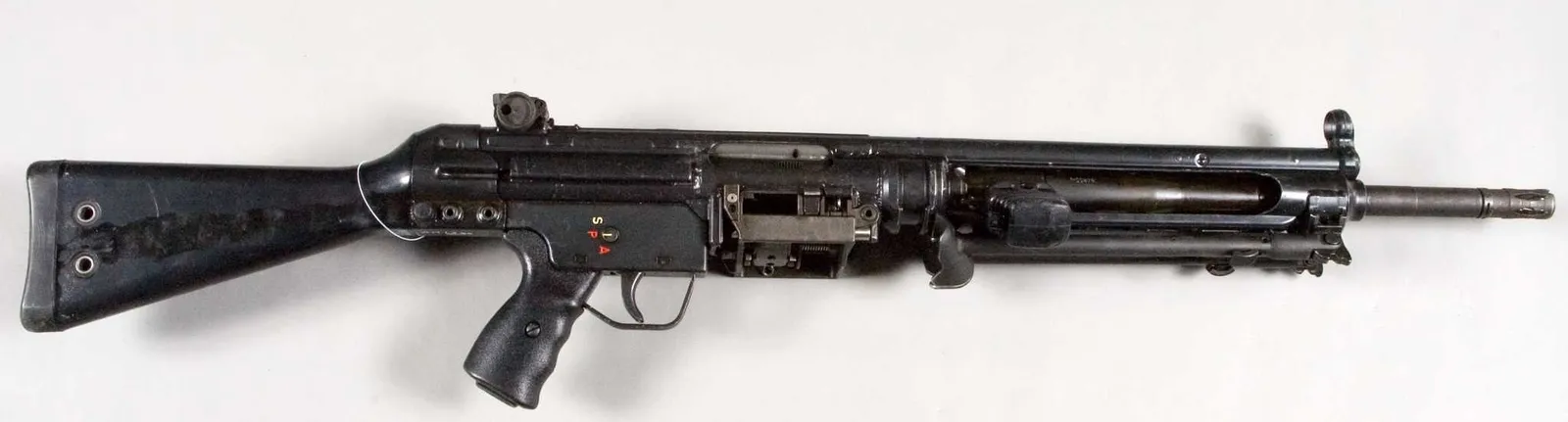

Documented with Boko Haram and ISWAP forces through Nigerian military reporting on recovered HK21 guns and independent analysis of ISWAP media showing HK21 machine guns, with many such weapons assessed as stolen from Nigerian or Chadian forces.
Infantry Weapons
HK21 general-purpose machine gun
Also known as
- HK21
- HK 21
- HK21A1
- HK21E
- HK 21E
- m/968
- MG21
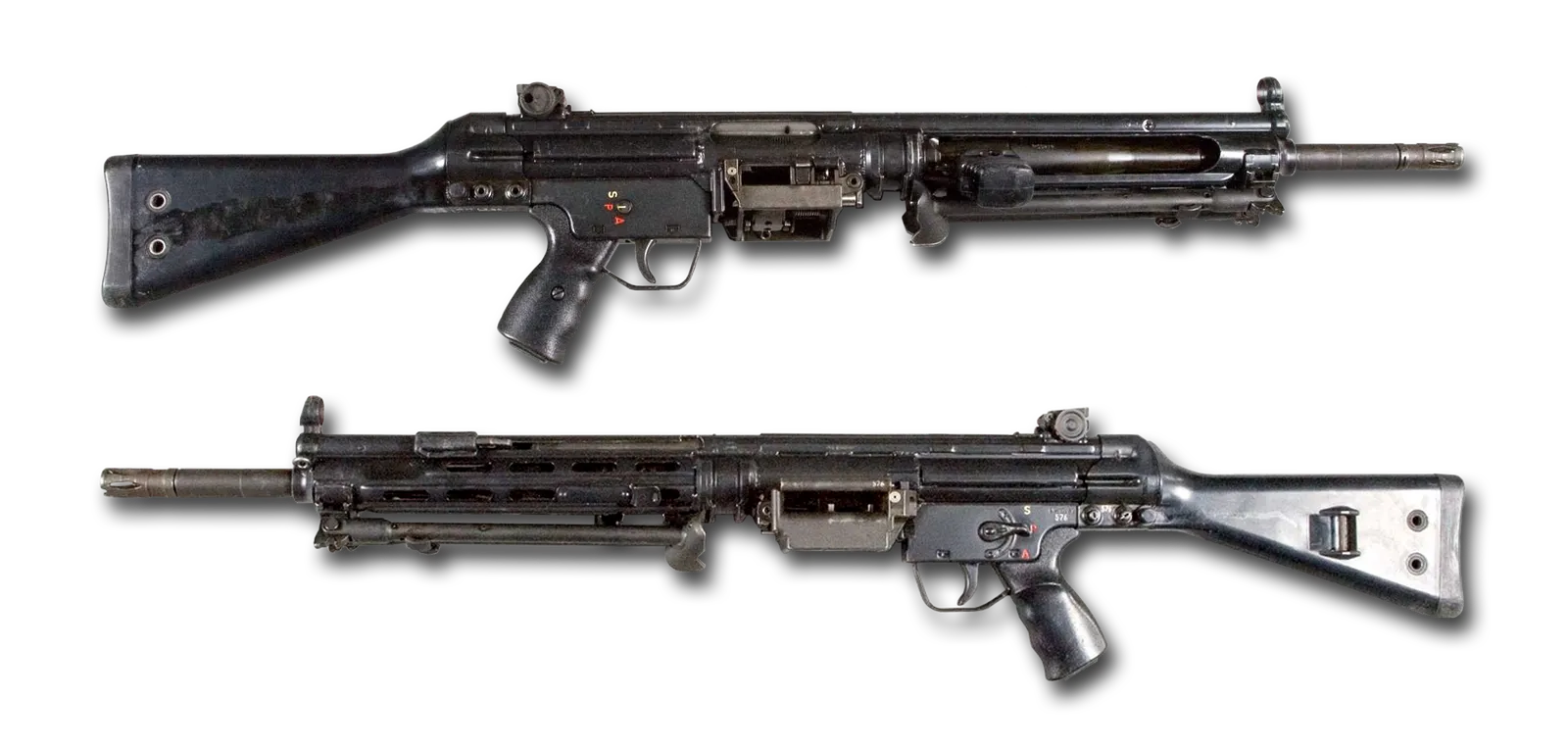
The HK21 is a Heckler & Koch belt-fed 7.62x51 mm NATO general-purpose machine gun derived from the G3 rifle family. In the 2009 Boko Haram Insurgency, Nigerian military reporting and ISWAP media analysis document HK21-pattern guns among weapons recovered from, or displayed by, Boko Haram and ISWAP forces, making it a small-unit fire-support weapon in Lake Chad conflict coverage.
Role in Conflicts
Profile / Specs
Profile
- Origin
- West Germany
- Built by
- Heckler & Koch
- Built in
- West GermanyGermany
- Type
- 7.62 mm general-purpose machine gun
- Service note
- Cold War design still appearing in contemporary conflicts
- Designer
- Heckler & Koch
- Designed
- 1961
- Produced
- 1960s onward, including variants and licensed production
Specifications
- Caliber
- 7.62x51 mm NATO
- Operation
- Roller-delayed blowback, selective fire
- Feed
- Belt feed using disintegrating M13 or DM6 links; German DM1 belt compatibility and magazine/drum feed depend on variant or conversion kit
- Barrel
- Quick-change barrel; HK21E examples used 22 in or 17.7 in barrels
- Weight
- HK21E about 20 lb unloaded with bipod and 22 in barrel; 19.40 lb with 17.7 in barrel
- Mounting
- Fired from bipod, tripod, shoulder, or vehicle mounts depending on configuration
- Family conversions
- HK21E-family components allowed 7.62 mm belt-fed, 7.62 mm magazine-fed, and 5.56 mm belt-fed configurations within the HK11/HK21/HK23 modular family
Variants
HK21-family designations cover the original G3-derived 7.62 mm belt-fed gun, early A1 improvements, the later E export redesign, magazine-fed HK11 branches, 5.56 mm HK23 branches, and licensed Portuguese or Mexican production designations.
| Variant | Configuration | Designation notes |
|---|---|---|
| HK21 | Original 7.62 mm belt-fed model | Introduced in 1961 as a G3-family light/general-purpose machine gun, with Portugal becoming an early adopter and licensed producer. Sources: Heckler & Koch's Modular Machine Gun: the HK21E, HK21 or Portuguese m/968: The H&K G3 Grows into a Light Machine Gun |
| HK21A1 | Early improved belt-fed model | Early-1970s changes added features such as a clubfoot stock and optics-mounting points before the later E-series redesign. |
| HK21E | Export modular redesign | The early-1980s E model used a longer receiver and barrel, a strengthened receiver, an improved recoil buffer, and modular HK11/HK21/HK23-family configuration options. Sources: Heckler & Koch's Modular Machine Gun: the HK21E, The HK21E Machine Gun |
| HK11E | 7.62 mm magazine-fed branch | Forgotten Weapons describes the E-series family as modular across HK11, HK21, and HK23 configurations, separating magazine-fed 7.62 mm use from belt-fed variants. |
| HK23E | 5.56 mm belt-fed branch | The E-series modular family included 5.56 mm belt-fed configuration within the HK23 branch. |
| m/968 | Portuguese licensed-production designation | Portugal adopted the HK21 as the m/968 and licensed production through FMP. Sources: HK21 or Portuguese m/968: The H&K G3 Grows into a Light Machine Gun |
| MG21 | Mexican licensed-production designation | Forgotten Weapons notes that licensed production in Mexico helped keep HK21-pattern guns in service after later HK catalog replacements. |
Firing Ammunition
The HK21 family is documented as firing 7.62x51mm NATO ammunition.
| Ammunition | Ammunition type | Firing evidence |
|---|---|---|
 | 7.62x51 mm NATO cartridge | Sources describe the HK21 family as chambered for and firing standard 7.62x51mm NATO ammunition. Sources: Heckler & Koch HK21, The HK21E Machine Gun |
Compatible Feed Systems
Small Arms Review describes HK21E box-magazine-fed variants and simple conversion from belt to box magazine or drum feed.
| Compatible item | Item type | Compatibility evidence |
|---|---|---|
 | Detachable box magazine | Small Arms Review describes simple conversion from belt to box magazine or drum feed for the HK21E in the field. Sources: The HK21E Machine Gun |
 | Drum magazine | Small Arms Review states the HK21 can be converted to magazine feed with a 50-round drum magazine. Sources: The HK21E Machine Gun |
 | Disintegrating metallic link belt | Small Arms Review describes HK21E belt feed using disintegrating M13 or DM6 links, with DM6 identified as the German counterpart to the M13-linked belt. Sources: The HK21E Machine Gun |
 | Ammunition belt | HK21 references identify the German DM1 belt as a compatible non-disintegrating feed belt; Small Arms Review notes that later HK21E feed changes affected DM1 compatibility unless ordered for that belt. Sources: Heckler & Koch HK21, The HK21E Machine Gun |
Timeline
HK21 general-purpose machine gun Key Events
HK21 introduced
Heckler & Koch introduced the G3-derived HK21 as a roller-delayed, belt-fed support weapon for countries already using the G3 rifle family.
Portuguese adoption
Portugal became a major early HK21 customer, adopting the gun as the m/968 and licensing domestic production.
A-series improvements
Early-1970s HK21A improvements added features such as a clubfoot stock and receiver optics-mounting points.
E-series modular redesign
The HK21E export redesign introduced a longer and strengthened receiver, longer barrel, improved recoil buffer, and modular HK11/HK21/HK23-family configuration options.
Boko Haram recovery reporting
Nigerian reporting on fighting at Wurge listed an HK21 among weapons abandoned by Boko Haram/ISWAP fighters and recovered by troops.
Media
HK21 general-purpose machine gun Videos
HK21 general-purpose machine gun Images
Related Weapon Systems


Sources
Heckler & Koch's Modular Machine Gun: the HK21EPublisher: Forgotten Weapons | Note: Supports HK21/HK21E background, Heckler & Koch origin, 1961 design context, G3-family relationship, export history, early-1970s HK21A improvements, HK21E modular redesign, and licensed production context. | Accessed: 2026-07-04HK21 or Portuguese m/968: The H&K G3 Grows into a Light Machine GunPublisher: Forgotten Weapons | Note: Supports the original HK21's G3-family role, Portuguese m/968 adoption and licensed production, belt-fed 7.62x51 mm focus, quick-change barrel, weight, and cyclic-rate context. | Accessed: 2026-07-04Heckler & Koch HK21Publisher: Wikipedia | Note: Supports the HK21's belt-feed description and its compatibility with the German DM1 ammunition belt. | Accessed: 2026-07-04The HK21E Machine GunPublisher: Small Arms Review | Note: Supports HK21E specifications, including 7.62x51 mm NATO chambering, belt-fed configuration, box-magazine-fed variants, bipod/tripod/shoulder use, barrel options, unloaded weights, quick-change barrel details, and modular conversion context. | Accessed: 2026-07-04Troops neutralise Boko terrorists at Wurge in BornoPublisher: The Guardian Nigeria | Note: 2009 Boko Haram Insurgency: HK21 rifle was used by Boko Haram/ISWAP terrorists and abandoned during a 2020 encounter before being recovered by Nigerian troops. | Accessed: 2026-07-04Nigerian troops eliminate 85 terrorists; 2,783 surrenderPublisher: P.M. News | Note: 2009 Boko Haram Insurgency: HK21 guns were used by Boko Haram/ISWAP forces and recovered by Nigerian troops during Operation Hadin Kai reporting for September 2021. | Accessed: 2026-07-04Islamic State Province's Media in Africa: Comparing Trends in West and Central AfricaPublisher: Jamestown Foundation | Note: 2009 Boko Haram Insurgency: HK21 machine guns were used by ISWAP and appeared in ISWAP media, with the source assessing many weapons as stolen from Nigerian and Chadian armies. | Accessed: 2026-07-04File:HK 21 LMG RIGHT SIDE.jpgPublisher: Wikimedia Commons | Note: Supports image provenance for the primary HK21A1 right-side view; Wikimedia Commons lists the Swedish Army Museum source and public-domain release. | Accessed: 2026-07-04File:HK 21 LMG Left and Right noBG.pngPublisher: Wikimedia Commons | Note: Supports image provenance for a composite left-and-right HK21 view licensed under CC BY-SA 4.0. | Accessed: 2026-07-04File:HK21.JPGPublisher: Wikimedia Commons | Note: Supports image provenance for an HK21 machine-gun photo licensed under CC BY-SA 2.5. | Accessed: 2026-07-04