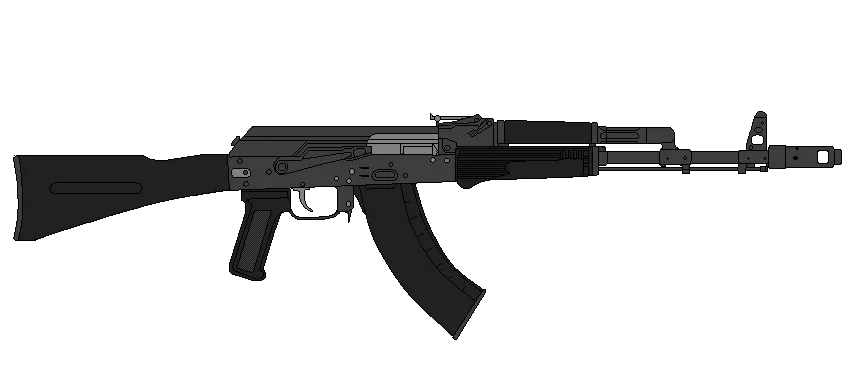

Open-source visual identification from a Lake Chad attack attributed to Boko Haram described militants using armed boats with at least two uncommon AK-103-2 rifles; separate 2026 Nigerian court reporting concerned AK-103-family rifles moved from Diffa toward a Boko Haram member, without confirming the AK-103-2 subvariant.
Infantry Weapons
AK-103-2 assault rifle
Also known as
- AK-103-2
- AK103-2
- AK 103-2
- AK-103 three-round-burst variant
The AK-103-2 is the three-round-burst export variant of the Russian AK-103, a 7.62x39mm AK-100-series rifle derived from the AK-74M layout but chambered for the older AKM cartridge. In the 2009 Boko Haram Insurgency context, available open-source evidence is limited: the specific AK-103-2 identification comes from visual reporting of Boko Haram militants around Lake Chad, while separate Nigerian court reporting documents alleged AK-103 rifle trafficking from Diffa toward a Boko Haram recipient.
Role in Conflicts
Profile / Specs
Profile
- Origin
- Russia
- Type
- 7.62x39mm assault rifle variant
- Service note
- 1990s design; documented in Lake Chad conflict reporting in the 2020s
- Designer
- Mikhail Kalashnikov design lineage / Izhmash
- Designed
- Early 1990s AK-100 series
- Produced
- 1990s-present AK-103 family
- Developed from
- AK-74M
Specifications
- Cartridge
- 7.62x39mm
- Action
- Gas-operated, selective-fire Kalashnikov action
- Fire modes
- Safe, semi-automatic, three-round burst, and fully automatic on the AK-103-2 variant
- Overall length
- 943 mm with stock extended; about 705 mm with stock folded
- Barrel length
- 415 mm
- Weight
- 3.6 kg with empty magazine; about 4.1 kg with loaded magazine
- Feed system
- 30-round detachable 7.62x39mm AK-pattern magazine
- Muzzle velocity
- 715 m/s
- Cyclic rate
- About 600 rounds per minute
Variants
The AK-103-2 is an AK-103-family suffix variant inside the export-oriented AK-100 series; reference sources treat AK-100 as a family label rather than a standalone rifle designation.
| Variant | Configuration | Designation notes |
|---|---|---|
 | Base 7.62x39 mm AK-103 rifle | Full-length AK-100-series rifle chambered for 7.62x39 mm, derived from the AK-74M layout and fitted with the solid folding stock and optical sight rail typical of the series. Sources: A Tale of Two Rifles, Small Arms Survey AK-100 series |
| AK-103-1 | Semi-automatic AK-103 suffix variant | Small Arms Survey identifies the -1 suffix as denoting semi-automatic, self-loading-only AK-100-series weapons. Sources: Small Arms Survey AK-100 series |
| AK-103N2 | Night-sight AK-103 suffix variant | Small Arms Survey identifies the N2 suffix as a variant fitted for the 1PN58 night sight. Sources: Small Arms Survey AK-100 series |
| AK-103N3 | Night-sight AK-103 suffix variant | Small Arms Survey identifies the N3 suffix as a variant fitted for the 1PN51 night sight. Sources: Small Arms Survey AK-100 series |
Ammunition Fired
The AK-103-2 is documented as a 7.62 x 39 mm rifle and accepts AK magazines in that calibre.
| Ammunition | Ammunition type | Firing evidence |
|---|---|---|
 | Intermediate rifle cartridge | ARES identifies the AK-103-2 as chambered for 7.62 x 39 mm ammunition and notes that it accepts existing AK magazines in that calibre. Sources: A Tale of Two Rifles |
Launcher Compatibility
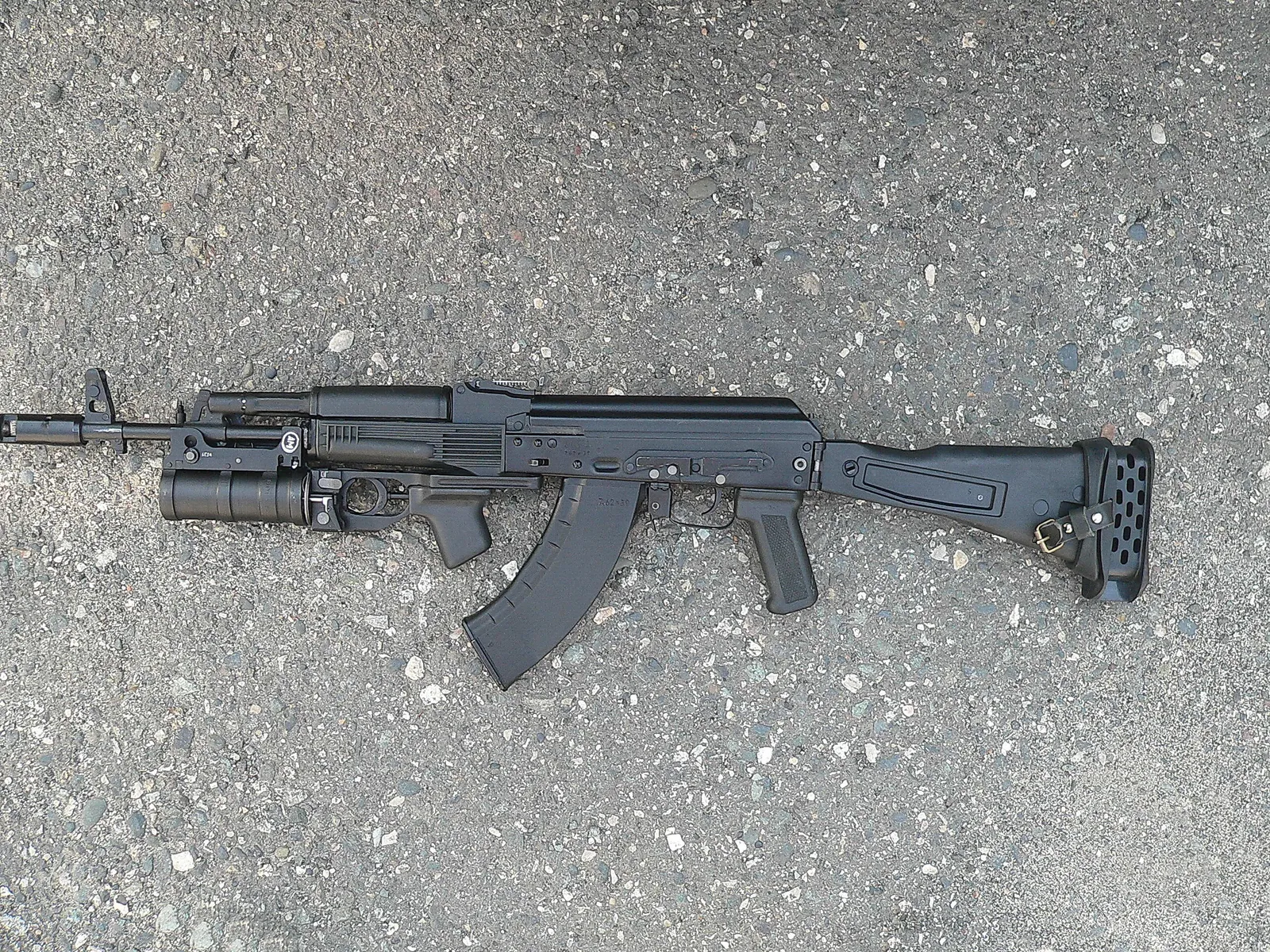
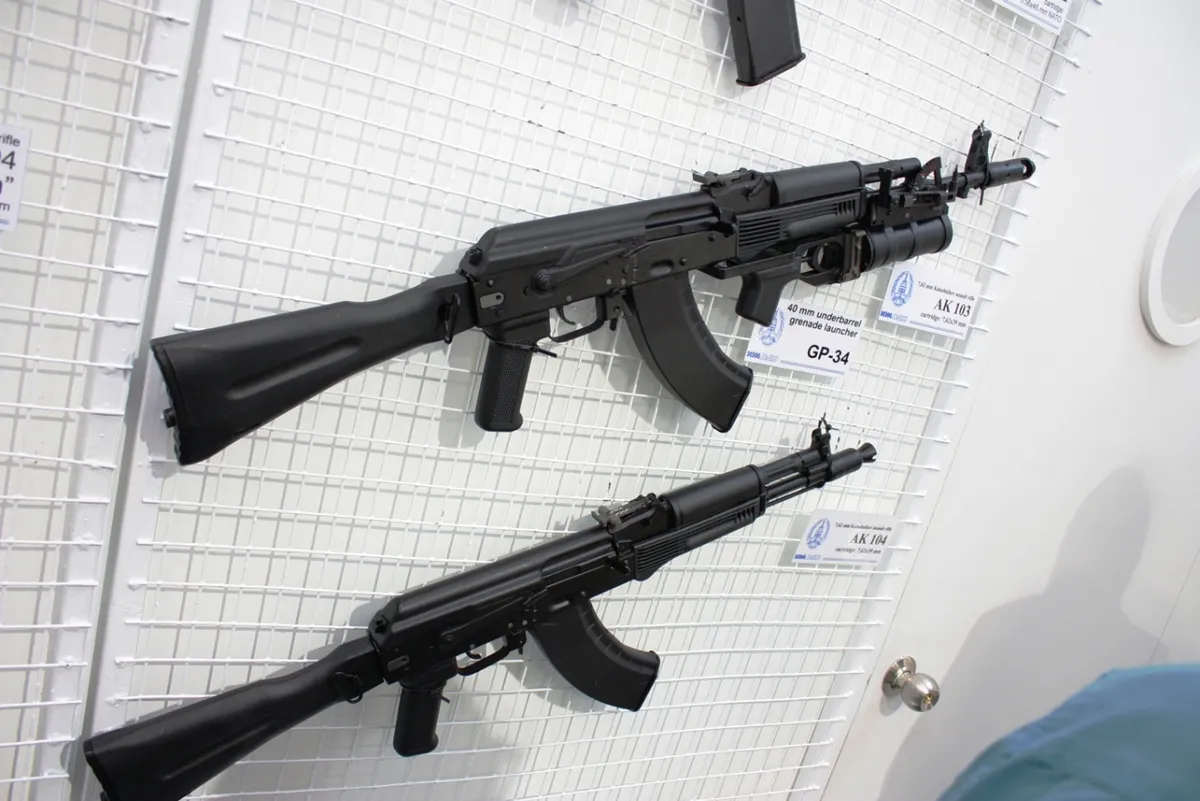
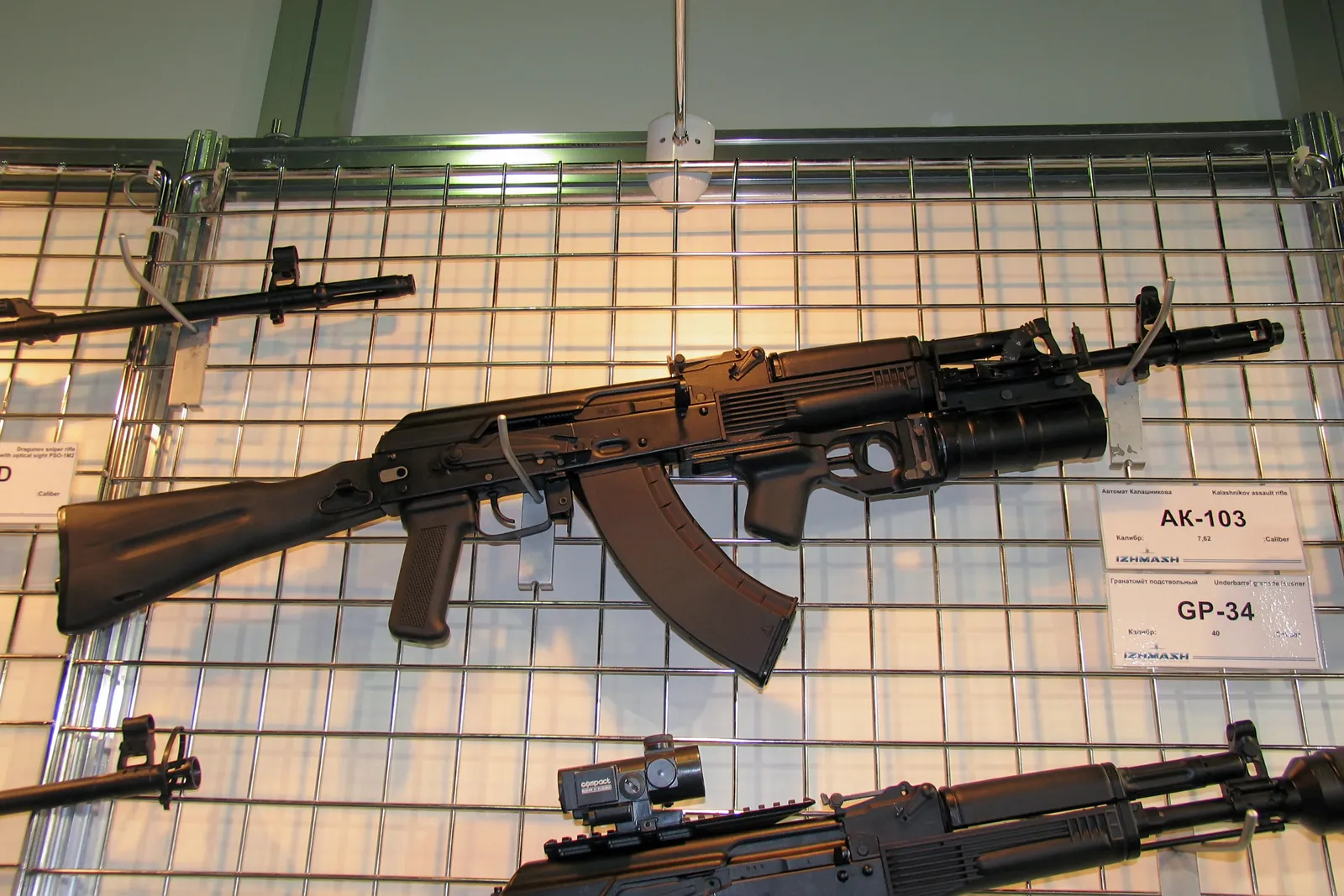
The GP-34 is documented as compatible with the AK-103 family; the available sources support this as a family-level relationship, not a documented Boko Haram configuration.
| Compatible item | Item type | Compatibility evidence |
|---|---|---|
 | 40 mm underbarrel grenade launcher | Modern Firearms says the GP-34 can be installed on the AK-103, while ARES and Small Arms Survey identify the AK-103-2 as an AK-103 / AK-100-series variant with the same 415 mm rifle format. Sources: GP-34 Underbarrel Grenade Launcher - Modern Firearms, A Tale of Two Rifles, Small Arms Survey AK-100 series |
Timeline
AK-103-2 assault rifle Key Events
AK-100-series development context
ARES places the AK-103 in the AK-100 export family derived from the AK-74M pattern but chambered for 7.62x39 mm ammunition.
Sources: A Tale of Two Rifles
Libyan AK-103-2 contract evidence
ARES reports that shipping documents, packaging, and imagery indicated large AK-103-2 orders under a 2004 Libyan contract, later relevant to regional proliferation.
Sources: A Tale of Two Rifles
Lake Chad visual identification
War Noir identified at least two AK-103-2 rifles in footage or imagery from a Lake Chad attack attributed to Boko Haram militants.
Sources: Lake Chad Boko Haram AK-103-2 visual identification
Nigerian court reporting on AK-103 supply attempt
Premium Times and Channels Television reported allegations that AK-103 rifles and 7.62 mm ammunition were moved from Diffa toward a Boko Haram recipient; the reporting did not identify the AK-103-2 subvariant.
Sources: FG arraigns five men for terrorism, attempted supply of smuggled arms to Boko Haram, Court Sentences Five Linked To Attack To 25 Years Imprisonment
Media
AK-103-2 assault rifle Videos
Related Weapon Systems


Sources
A Tale of Two RiflesPublisher: Armament Research Services | Note: Supports AK-103-2 background, manufacturer lineage, variant distinction, AK-100-series relationship context, Libya-origin proliferation context, magazine compatibility, and technical specifications. | Accessed: 2026-07-04Small Arms Survey AK-100 seriesPublisher: Small Arms Survey | Note: Supports AK-100-series family context, the AK-103-2 variant listing, 7.62 x 39 mm AK-103 caliber, 415 mm AK-103 barrel length, and the -2 suffix as a three-shot-burst model. | Accessed: 2026-07-04GP-34 Underbarrel Grenade Launcher - Modern FirearmsPublisher: Modern Firearms | Note: Supports AK-103-family launcher compatibility by listing the GP-34 as installable on the AK-103 and showing it mounted on a 7.62 mm AK103 rifle. | Accessed: 2026-07-04AK103 7.62mm Kalashnikov Assault RiflePublisher: Rosoboronexport | Note: Supports AK-103 family specifications, including cartridge, weight, sighting range, muzzle velocity, rate of fire, and magazine capacity. | Accessed: 2026-07-04Lake Chad Boko Haram AK-103-2 visual identificationPublisher: War Noir | Note: Supports 2009 Boko Haram Insurgency direct-use claim: AK-103-2 rifles were identified as used by Boko Haram militants in a Lake Chad attack; evidence is open-source visual identification rather than official recovery documentation. | Accessed: 2026-07-04FG arraigns five men for terrorism, attempted supply of smuggled arms to Boko HaramPublisher: Premium Times | Note: Supports 2009 Boko Haram Insurgency related supply context: Nigerian prosecutors alleged an attempted movement of 15 AK-103 rifles from Diffa toward a Boko Haram member in Nigeria, but the article does not identify the AK-103-2 subvariant. | Accessed: 2026-07-04Court Sentences Five Linked To Attack To 25 Years ImprisonmentPublisher: Channels Television | Note: Supports related Boko Haram AK-103 trafficking context from Nigerian court proceedings, including the Diffa-to-Borgu route and 7.62mm ammunition; it does not identify the AK-103-2 subvariant. | Accessed: 2026-07-04Weapon Supplies Fuelling Terrorism in the Lake Chad CrisisPublisher: Conflict Armament Research | Note: Supports Lake Chad weapons-context background for materiel seized from Boko Haram/JAS and ISWAP-linked groups around Diffa and Lake Chad. | Accessed: 2026-07-04AK-103 2.pngPublisher: Wikimedia Commons | Note: Image provenance and licensing page for the primary AK-103 illustration, released as CC0 public-domain dedication. | Accessed: 2026-07-04AK103 GP 34.jpgPublisher: Wikimedia Commons | Note: Image provenance and licensing page for an AK-103 with underbarrel grenade launcher, licensed CC BY-SA 3.0 with VRT permission. | Accessed: 2026-07-04Izhmash Rifles - AK-103 with GP-34 Grenade Launcher and AK-104Publisher: Wikimedia Commons | Note: Image provenance and licensing page for Izhmash AK-103 and AK-104 display rifles, confirmed from Flickr under CC BY-SA 2.0. | Accessed: 2026-07-04AK-103 assault rifle with GP-34 grenade launcher at Engineering Technologies 2012Publisher: Wikimedia Commons | Note: Image provenance and licensing page for an AK-103 display rifle photographed at Engineering Technologies 2012, licensed CC BY-SA 3.0. | Accessed: 2026-07-04