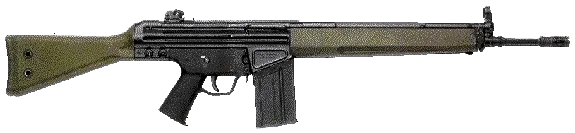

G3 rifles are listed among manufactured small arms used by Boko Haram in the Lake Chad basin, and Nigerian-Chadian forces reported recovering a Heckler & Koch G3 rifle from militants during 2019 operations in Borno State.
Infantry Weapons
Heckler & Koch G3
Also known as
- HK G3
- H&K G3
- G3 rifle
- Gewehr 3
- G3A3
- G3A4
- G3K
- AG-3
- G3-A3
- G3-A4
The Heckler & Koch G3 is a roller-delayed 7.62 x 51 mm NATO battle rifle developed in West Germany from the CETME rifle family. Its long service life and licensed production have left G3-pattern rifles in multiple conflict arsenals, including documented Boko Haram small-arms holdings in the Lake Chad basin, RSF-linked evidence in Sudan, Saudi-linked G3 rifles reported in Yemen, and G3/BA64 rifles still circulating in Myanmar's post-2021 war.
Role in Conflicts

Amnesty International identified G3 rifles in 2023 Sudan War visual evidence from East Darfur and reported Yemeni transfer markings, with the broader report tying verified battlefield imagery to parties in the conflict.

German and arms-control reporting connected G3 rifles to Saudi aircraft deliveries for anti-Houthi militias around Aden and to later diversion concerns involving German transfers to Saudi Arabia and Yemen.
Role details- Side
- State Administration Council and allied forcesPeople's Defense Forces and ethnic armed organizations

The Diplomat reported that Myanmar's military still relies on domestically produced G3/BA64 rifles after the 2021 coup and that resistance fighters are frequently shown with captured or repurposed G3 rifles.
Profile / Specs
Profile
- Origin
- West Germany
- Type
- 7.62 mm select-fire battle rifle
- Service note
- Cold War design with continued use in modern conflicts
- Designer
- CETME, Mauser, and Heckler & Koch
- Designed
- 1950s
- Produced
- 1958-present for original and licensed production
Specifications
- Caliber
- 7.62 x 51 mm NATO / .308 Winchester
- Operation
- Roller-delayed blowback, select fire
- Feed system
- Detachable box magazine, commonly 20 rounds; Small Arms Survey lists 20- or 30-round boxes
- Barrel length
- 450 mm in the BICC profile; Small Arms Survey identification data lists 488 mm for the illustrated G3A3
- Overall length
- About 1,024-1,025 mm for fixed-stock rifles; G3A4 retractable stock about 840 mm closed
- Weight
- About 4.38 kg in the BICC G3A3 profile; Small Arms Survey lists 4.58 kg unloaded for the G3A3 and 4.6 kg for the G3A4
- Muzzle velocity
- About 780-800 m/s
- Rate of fire
- About 500-600 rounds per minute
- Sights
- Front post with rear V notch/rotating aperture pattern in Small Arms Survey identification data
- Accessories
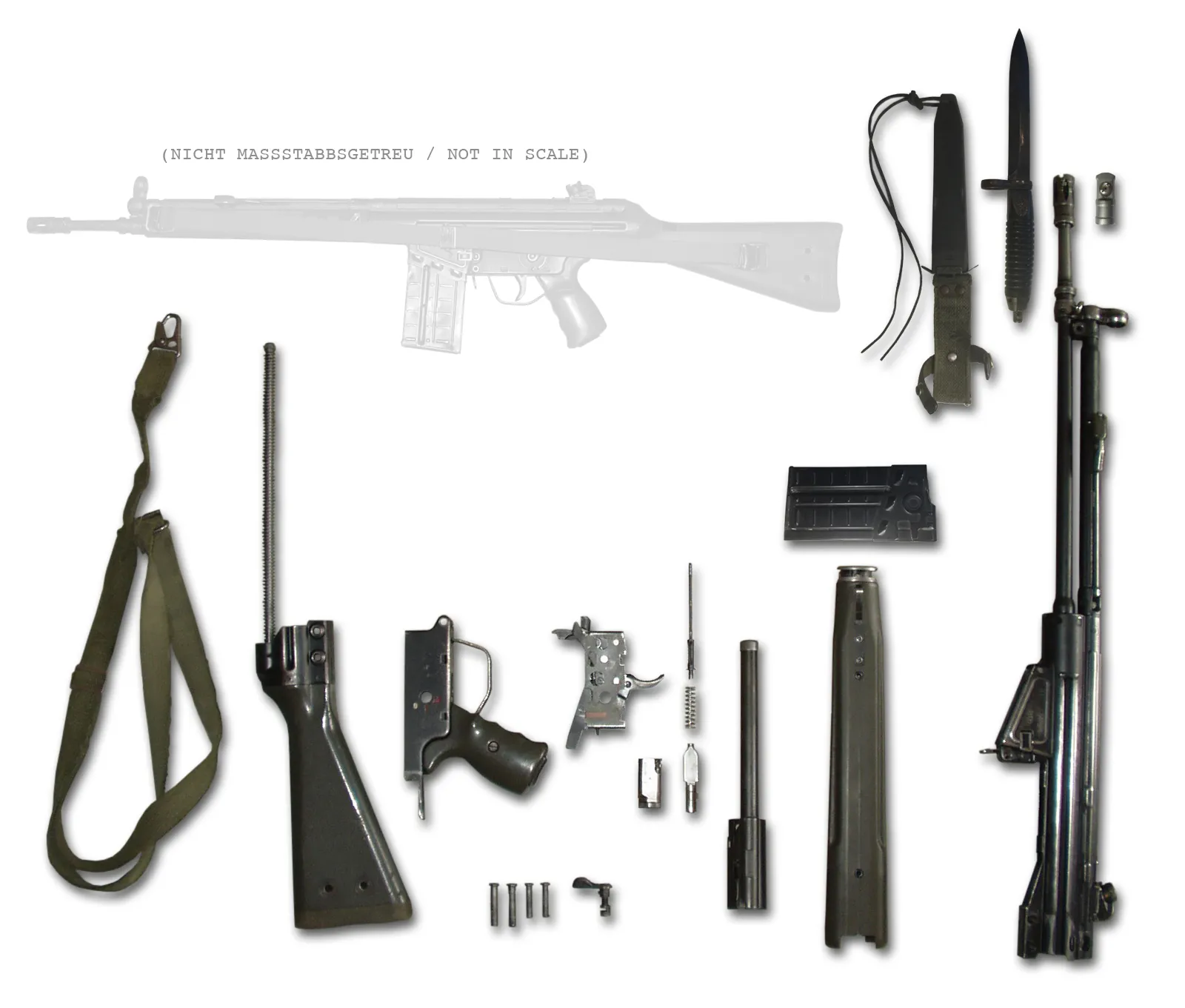
- Bayonet and bipod listed in Small Arms Survey identification data
Design And Licensed Production
The G3 is best read as a family of licensed and locally marked rifles rather than a single West German production run. Small Arms Survey traces the design from the Spanish CETME Model B and lists producer or marking evidence across Germany, Pakistan, Iran, Mexico, Myanmar, Norway, Portugal, Saudi Arabia, Turkey, and other users.
Operating concept
Roller-delayed, selective-fire 7.62 x 51 mm NATO rifle built around detachable box magazines.
Sources: HK G3 SALW Guide; Small Arms Survey G3 Identification Sheet.
Identification clues
Stock type, handguard shape, sighting arrangement, and receiver markings help separate G3A3, G3A4, G3K, AG-3, POF, FMP, Iranian, Saudi, and other G3-pattern rifles.
Source: Small Arms Survey G3 Identification Sheet.
Conflict relevance
Licensed and diverted examples matter because modern conflict evidence often identifies G3-pattern rifles by markings or transfer context, not just by the Heckler & Koch brand.
Sources: Amnesty International; Middle East Monitor; The Diplomat.
Variants
G3 designations mainly separate stock, sighting, barrel, and licensed-production configurations. The page keeps these as family variants unless a related catalog record covers a different weapon class.
| Variant | Configuration | Designation notes |
|---|---|---|
| G3A3 | Fixed-stock production rifle | Small Arms Survey identifies the G3A3 among the plastic-furniture fixed-stock variants and lists multiple licensed production countries for the model. |
| G3A4 | Retractable-stock rifle | The G3A4 is the retractable-stock family member, with the identification sheet listing Germany, Greece, Turkey, Iran, Mexico, Pakistan, and Portugal among associated producers or designations. |
| G3A3ZF | Optical-sight variant | Small Arms Survey lists the G3A3ZF as a German optical-sight variant inside the G3 family. |
| G3K | Short-barrel variant | The G3K appears in Small Arms Survey's variant list as the short-barrel G3 configuration. |
| AG-3 | Norwegian G3A3 designation | Small Arms Survey lists Norway's AG-3 as a G3A3-family designation, and the ARES report treats Norwegian production as part of the wider licensed G3 production pattern. Sources: Small Arms Survey G3 Identification Sheet, The H&K G3 Rifle |
| Saudi-produced G3 rifles | Licensed-production conflict-relevant examples | Middle East Monitor reported German concern over Saudi-licensed G3 rifles appearing in deliveries for anti-Houthi militias around Aden. Sources: German government seeks clarification from Saudi Arabia on supply of German weapons to Yemen |
| Yemeni-marked modified G3 rifles | Conflict-documented modified rifles | Amnesty International identified G3 rifles in Sudan with Yemen transfer context, making the modified examples relevant to conflict-use documentation rather than a formal factory variant. |
Ammunition Fired
The rifle's core compatibility is the full-power NATO cartridge around which the G3 family was built.
| Ammunition | Ammunition type | Firing evidence |
|---|---|---|
 | Rifle cartridge | The G3 is documented as chambered for 7.62x51mm NATO, making this cartridge an explicit firing compatibility rather than an inferred one. Sources: HK G3 SALW Guide |
Compatible Feed Components
The G3's detachable box magazine is cataloged separately because the component also appears in recovery and compatibility records.
| Compatible item | Item type | Compatibility evidence |
|---|---|---|
 | Detachable box magazine | Small Arms Survey identifies the G3 feed device as a 20- or 30-round detachable box magazine, and the linked support page covers the standard 20-round G3-family magazine. |
Timeline
Heckler & Koch G3 Key Events
CETME-derived development period begins
Small Arms Survey traces the G3's development from the Spanish CETME Model B rifle across the 1954-1959 period.
Sources: Small Arms Survey G3 Identification Sheet
Production period opens
The ARES G3 report and catalog background sources place original and licensed G3 production from the late 1950s onward.
Sources: The H&K G3 Rifle
Saudi licensed-production context
Middle East Monitor reported that Saudi Arabia obtained a license to manufacture G3 rifles in 1969, a fact later cited in questions about G3 rifles appearing in Yemen.
Sources: German government seeks clarification from Saudi Arabia on supply of German weapons to Yemen
G3 rifles reported around Aden
German reporting summarized by Middle East Monitor described television footage showing G3 rifles landed from Saudi aircraft to support anti-Houthi militias around Aden.
Sources: German government seeks clarification from Saudi Arabia on supply of German weapons to Yemen
G3 recovered in Borno State operation
Nigerian-Chadian forces reported recovering a Heckler & Koch G3 rifle among arms and materiel after a joint operation against Boko Haram-area militants near Wulgo.
Sources: Nigeria-Chad operation kills 27 'terrorists' near Wulgo as ISIS claims multiple attacks
Amnesty documents G3 rifles in Sudan evidence
Amnesty International published visual-evidence findings that included G3 rifles in East Darfur with Yemen transfer context during the Sudan war.
Sources: New Weapons Fuelling the Sudan Conflict
G3/BA64 rifles reported in Myanmar's post-coup war
The Diplomat reported continued G3/BA64 use by Myanmar's military and captured or repurposed G3 rifles in resistance hands during the post-2021 civil war.
Sources: The German Connection in Myanmar's Civil Wars
Media
Related Weapon Systems


Sources
HK G3 SALW GuidePublisher: Bonn International Centre for Conflict Studies | Note: Supports G3 background, ammunition, operating mechanism, dimensions, and technical specifications. | Accessed: 2026-07-04The H&K G3 RiflePublisher: Armament Research Services | Note: Supports development history, widespread licensed production, variants, and service background for the G3 family. | Accessed: 2026-07-04Small Arms Survey G3 Identification SheetPublisher: Small Arms Survey | Note: Supports G3 identification, development from the CETME Model B, technical data, variant distinctions, and licensed-production markings. | Accessed: 2026-07-04The End User: How did western weapons end up in the hands of ISIS and AQAP in Yemen?Publisher: Arab Reporters for Investigative Journalism | Note: Supports 2014 Yemen Civil War direct-use context: G3 rifles used by or supplied to anti-Houthi forces in Yemen, with captured examples reported in Houthi hands. | Accessed: 2026-07-04Weapons and Ammunition Dynamics in the Lake Chad BasinPublisher: United Nations Department of Peace Operations and United Nations Office for Disarmament Affairs / Lake Chad Basin Commission | Note: Supports 2009 Boko Haram Insurgency direct conflict use: G3 rifles used by Boko Haram are listed among manufactured small arms in the Lake Chad basin. | Accessed: 2026-07-04Nigeria-Chad operation kills 27 'terrorists' near Wulgo as ISIS claims multiple attacksPublisher: The Defense Post | Note: Supports 2009 Boko Haram Insurgency direct conflict use: a Heckler & Koch G3 rifle used by Boko Haram or ISWAP-area militants was reported recovered by Nigerian-Chadian forces in Borno State. | Accessed: 2026-07-04New Weapons Fuelling the Sudan ConflictPublisher: Amnesty International | Note: Supports 2023 Sudan War direct conflict use: modified G3 rifles were used by or fielded by armed groups in Sudan, including an example seen with RSF forces. | Accessed: 2026-07-04The German Connection in Myanmar's Civil WarsPublisher: The Diplomat | Note: Supports 2021 Myanmar Civil War direct conflict use: G3/BA64 rifles are described as still used by Myanmar military forces and as captured or repurposed by resistance fighters after the 2021 coup. | Accessed: 2026-07-04German government seeks clarification from Saudi Arabia on supply of German weapons to YemenPublisher: Middle East Monitor | Note: Supports 2014 Yemen Civil War direct-use context: G3 rifles supplied to or landed for anti-Houthi militias around Aden in 2015. | Accessed: 2026-07-04Dealing in Double Standards: How arms sales to Saudi Arabia are causing human suffering in YemenPublisher: Arms Trade Treaty Monitor | Note: Supports 2014 Yemen Civil War direct-use context: G3 rifles transferred to Saudi Arabia were reported as diverted to Yemen and air-dropped to conflict parties. | Accessed: 2026-07-04Commons G3A3 Rifle ImagePublisher: Wikimedia Commons | Note: Supports image provenance and licensing for the primary G3A3 rifle image. | Accessed: 2026-07-04Commons G3A3 Disassembled ImagePublisher: Wikimedia Commons | Note: Supports image provenance and licensing for the disassembled G3A3 gallery image. | Accessed: 2026-07-04Commons Portuguese G3 Rifle ImagePublisher: Wikimedia Commons | Note: Supports image provenance and public-domain licensing for the Portuguese Army G3 gallery image. | Accessed: 2026-07-04