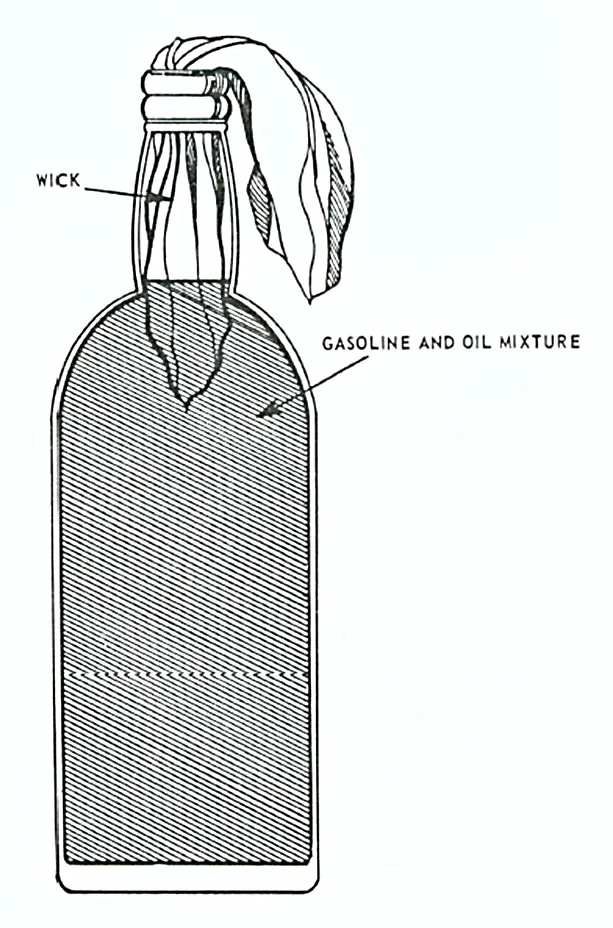

National Defense summarized a 3rd Battalion, 5th Marines lessons-learned report from Operation Phantom Fury saying Marines made and used old-fashioned Molotov cocktails to burn insurgents out of houses during the November 2004 Fallujah fighting.
Role detailsMunitions
Molotov cocktails
Also known as
- Petrol bomb
- Fire bomb
- Fire bottle
- Burn bottle
- Bottle bomb
- Bottle grenade
- Incendiary bottle
- Frangible incendiary grenade
- Molotov grenade
Molotov cocktails are hand-thrown improvised incendiary weapons built around a breakable container and ignition source, but wartime examples range from ad hoc bottles to semi-standardized military incendiary grenades. The cataloged conflict record now spans U.S. Marine use during Fallujah house-clearing in the 2003 Iraq War, IS-aligned militant use against Philippine troops in Marawi, and Ukrainian volunteer production and distribution during the 2022 full-scale Russian invasion.
Role in Conflicts
- Role in conflict
- Close-range incendiary attacks against assaulting troops

Reuters reporting from Marawi described Philippine soldiers being hit by Molotov cocktails during the June 2017 urban fighting, alongside sniper fire, RPGs, and improvised defenses used by IS-aligned militants.
- Side
- Ukraine

Los Angeles Times reporting from Kyiv documented territorial-defense volunteers assembling Molotov cocktails to use against invading Russian troops, while Sky News and RFE/RL reported that Lviv's Pravda brewery produced and distributed bottles to roadblocks, territorial defense units, and areas with fighting in early March 2022.
Role detailsDocumented Employment Patterns
Open sources describe Molotov cocktails less as a fixed model than as a short-range incendiary bottle family. The table separates recurring documented uses without providing construction instructions.
| Pattern | Documented context | Catalog note |
|---|---|---|
| Urban close-range attack | In Marawi, Reuters described soldiers being hit during an approach over the Mapandi bridge; in Fallujah, Marine lessons reporting described U.S. Marines using bottle incendiaries in house-clearing. | Both examples tie the weapon to close terrain where cover, upper floors, and short sight lines limit conventional fires. |
| Local mobilization | In Kyiv and Lviv in early 2022, civilian and territorial-defense networks collected bottles, assembled incendiaries, and moved finished weapons to defensive positions or fighting areas. | The 2014 Russia-Ukraine War sources support fielding and distribution by volunteer networks, not a standardized military procurement program. |
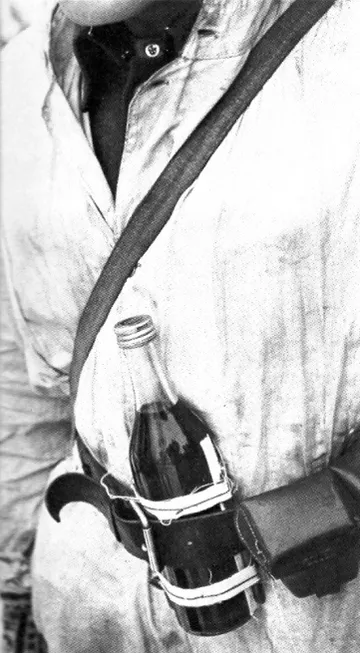
| Semi-standardized wartime form | IWM's Finnish collection object shows an Alko-marked bottle with attached matches, while Britannica treats the modern name as rooted in the 1939-1940 Winter War. | The weapon can be improvised in small batches or prepared to a repeatable wartime pattern, depending on the user and supply context. |
Sources: Reuters Marawi Molotov Cocktails; National Defense Marines Share Hard-Earned Knowledge; LA Times Kyiv civilians mix Molotov cocktails; Sky News Pravda brewery Molotov cocktails; RFE/RL Lviv home-front Molotov cocktails; IWM Molotov Cocktail Incendiary Grenade; Encyclopaedia Britannica Molotov Cocktail.
Profile / Specs
Profile
- Origin
- Improvised weapon with no single national origin
- Built by
- ImprovisedLocally Fabricated
- Built in
- Varies by user
- Type
- Hand-thrown improvised incendiary weapon
- Service note
- Modern improvised and irregular warfare use
- Designer
- Not standardized
- Designed
- Improvised incendiary bottle weapons predate the modern name; the Molotov cocktail name dates to the 1939-1940 Winter War
- Unit cost
- Not standardized
- Produced
- Improvised as needed; no standardized production run
- Number built
- Unknown
Specifications
- Weapon class
- Hand-thrown improvised incendiary munition
- Container
- Usually a breakable bottle or similar frangible vessel
- Effects
- Ignites and spreads burning liquid on impact against a hard surface
- Employment
- Very short-range throwing distance from exposed or covered positions
- Standardization
- No fixed universal standard; composition, size, and ignition method vary by maker and wartime supply context
- Documented Finnish example
- IWM collection object MUN 39: Alko-marked bottle, 267 mm high by 76 mm diameter, with attached woodsman's matches
Variants
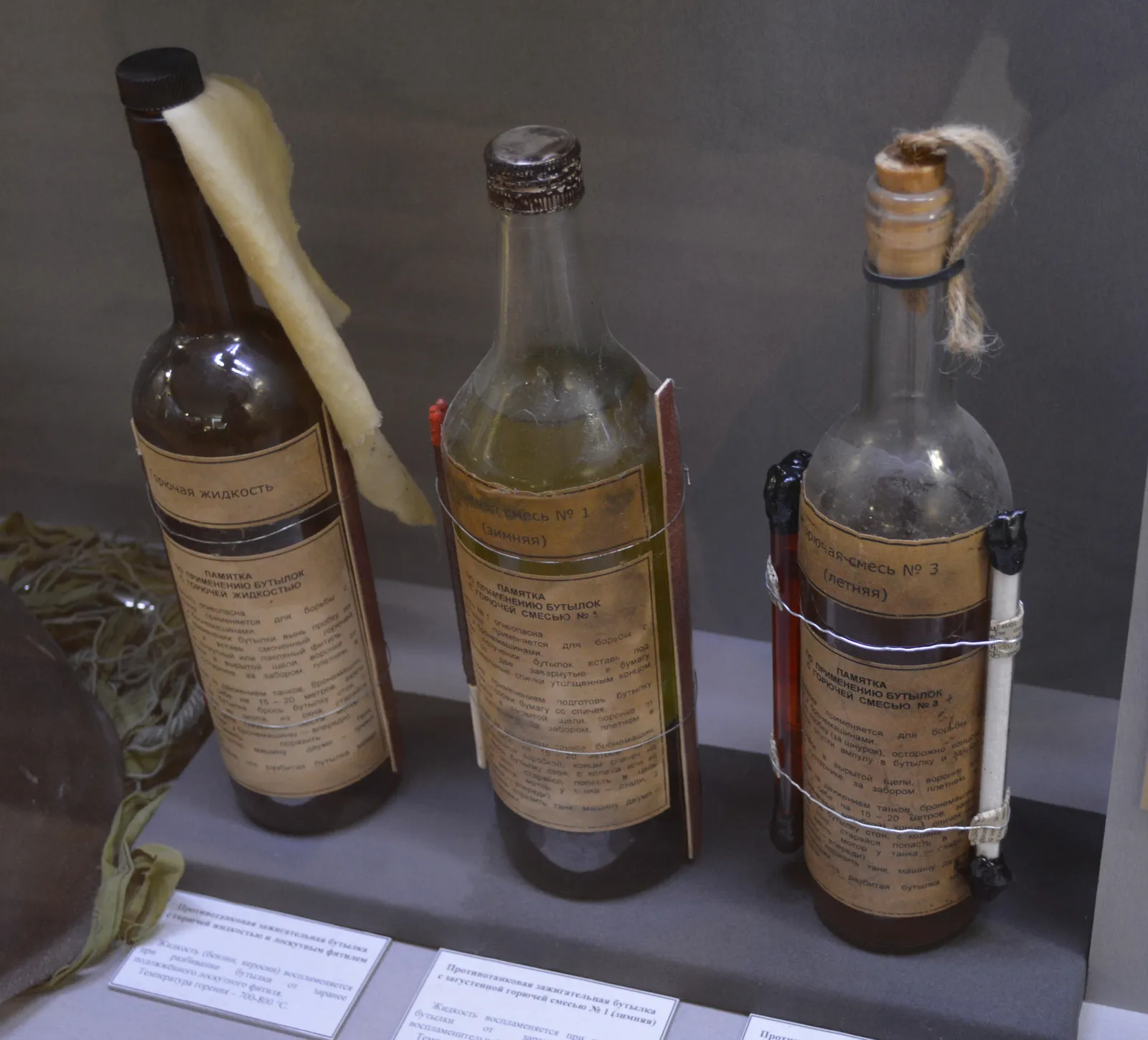
Molotov cocktails are better understood as a family of improvised or semi-standardized bottle incendiaries than as one fixed model.
| Variant | Configuration | Designation notes |
|---|---|---|
| Wick-lit bottle incendiary | Common improvised form | General references describe the basic pattern as a breakable bottle incendiary with an external ignition source, but the exact container, fuel, and ignition arrangement vary by maker. Sources: Encyclopaedia Britannica Molotov Cocktail, IWM Molotov Cocktail Incendiary Grenade |
| Finnish military burn-bottle | Winter War-era semi-standardized form | The IWM preserved example is an Alko-marked Finnish bottle incendiary with attached woodsman's matches, showing that some wartime examples were prepared to a repeatable military pattern. |
| Urban-combat bottle incendiary | Documented Fallujah expedient | National Defense summarized a Marine lessons-learned report that identified old-fashioned Molotov cocktails among improvised devices used by Marines during Operation Phantom Fury. Sources: National Defense Marines Share Hard-Earned Knowledge |
Timeline
Molotov cocktails Key Events
Winter War name and Finnish pattern
The modern name is tied to Finland's 1939-1940 Winter War context; IWM's preserved Finnish example shows a semi-standardized bottle incendiary associated with that period.
Sources: Encyclopaedia Britannica Molotov Cocktail, IWM Molotov Cocktail Incendiary Grenade
Fallujah lessons-learned use
A 3rd Battalion, 5th Marines lessons-learned report from Operation Phantom Fury described old-fashioned Molotov cocktails among improvised incendiary devices used during house-clearing in Fallujah.
Sources: U.S. Army Second Battle of Fallujah chronology, National Defense Marines Share Hard-Earned Knowledge
Marawi Reuters report
Reuters reporting from Marawi described Philippine troops being hit by Molotov cocktails during an assault through dense urban terrain held by IS-aligned militants.
Sources: Reuters Marawi Molotov Cocktails
Kyiv volunteer assembly
Los Angeles Times reporting from Kyiv documented territorial-defense volunteers assembling Molotov cocktails for use against Russian troops during the opening days of the full-scale invasion.
Sources: LA Times Kyiv civilians mix Molotov cocktails
Pravda brewery production
Sky News and RFE/RL reported that Lviv's Pravda brewery had switched from beer production to making Molotov cocktails for roadblocks, territorial defense units, and fighting areas.
Sources: Sky News Pravda brewery Molotov cocktails, RFE/RL Lviv home-front Molotov cocktails
Media
Molotov cocktails Videos
Molotov cocktails Images
Related Weapon Systems


Sources
Reuters Marawi Molotov CocktailsPublisher: Interaksyon / Reuters | Note: Supports 2017 Battle of Marawi direct conflict-use context: Molotov cocktails were used by IS-aligned militants against Philippine government troops during the June 2017 Marawi urban fighting. | Accessed: 2026-06-29Encyclopaedia Britannica Molotov CocktailPublisher: Encyclopaedia Britannica | Note: Supports background on the Molotov cocktail as a crude bottle incendiary weapon, its common names, and the origin of the modern term. | Accessed: 2026-06-29IWM Molotov Cocktail Incendiary GrenadePublisher: Imperial War Museums | Note: Supports background and non-instructional physical characteristics for a preserved Finnish Molotov cocktail incendiary grenade, including dimensions and attached ignition matches. | Accessed: 2026-06-29National Defense Marines Share Hard-Earned KnowledgePublisher: National Defense Magazine | Note: Supports 2003 Iraq War direct conflict-use context: old-fashioned Molotov cocktails were made and used by U.S. Marines during Operation Phantom Fury in Fallujah to burn insurgents out of houses. | Accessed: 2026-06-29U.S. Army Second Battle of Fallujah chronologyPublisher: U.S. Army | Note: Supports the November 7, 2004 start date and 2003 Iraq War context for Operation Phantom Fury, the Second Battle of Fallujah. | Accessed: 2026-06-29LA Times Kyiv civilians mix Molotov cocktailsPublisher: Los Angeles Times | Note: Supports 2014 Russia-Ukraine War direct conflict-use context: territorial-defense volunteers in Kyiv assembled Molotov cocktails to use against invading Russian troops in February 2022. | Accessed: 2026-06-29Sky News Pravda brewery Molotov cocktailsPublisher: Sky News | Note: Supports 2014 Russia-Ukraine War direct conflict-use context: Lviv's Pravda brewery produced Molotov cocktails and sent them to roadblocks and Kyiv during the 2022 invasion. | Accessed: 2026-06-29RFE/RL Lviv home-front Molotov cocktailsPublisher: Radio Free Europe / Radio Liberty | Note: Supports 2014 Russia-Ukraine War direct conflict-use context: Pravda Beer Theater produced more than 2,000 Molotov cocktails by March 1, 2022, with some shipped to fighting areas and others distributed to territorial defense units. | Accessed: 2026-06-29Molotov cocktail.pngPublisher: Wikimedia Commons | Note: Image provenance for a U.S. Federal Government public-domain illustration of a Molotov cocktail from FM 23-3. | Accessed: 2026-06-29Talvisota Molotov Cocktail.PNGPublisher: Wikimedia Commons | Note: Image provenance for a public-domain Finnish Winter War photograph showing a soldier with a Molotov cocktail. | Accessed: 2026-06-29Molotov cocktail - Kostroma guardhouse.jpgPublisher: Wikimedia Commons | Note: Image provenance for a CC0 museum display photograph of Molotov cocktails at the Kostroma museum-reserve guardhouse. | Accessed: 2026-06-29