Infantry Weapons

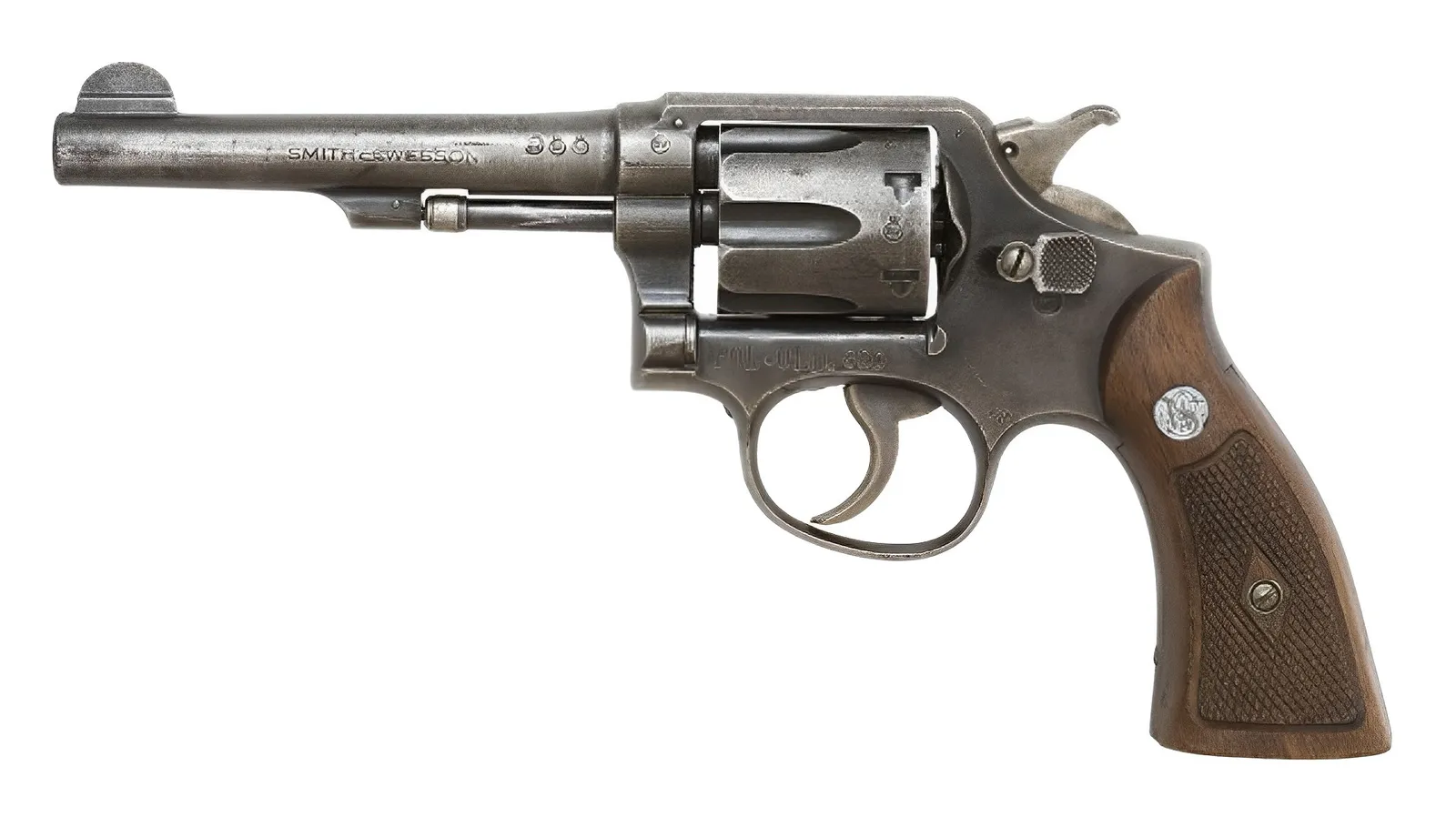
Smith & Wesson Victory Model revolver

Also known as
  • S&W Victory Model
  • Smith & Wesson M&P Victory Model
  • Smith & Wesson .38 Military & Police Victory Model
  • Smith & Wesson Model 10 Victory Model
  • Caliber .38-200 Revolver
  • Caliber .38 Special Military and Police Model Revolver

The Smith & Wesson Victory Model revolver was the wartime Military & Police K-frame revolver built in .38 Special for U.S. contracts and .38 S&W/.38-200 for British and Commonwealth use, with V-prefix serial numbers, parkerized finish, smooth walnut grips, and lanyard fittings distinguishing it from standard commercial Model 10 production.

Role in Conflicts

Side
State Administration Council and allied forces
Role in conflict
Captured police sidearm

A WWII Lend-Leased Smith & Wesson Victory Model revolver was photographed after capture from Myanmar police forces in Monywa in 2021.

Wartime Contract Split

The Victory Model was not one single chambering. It grouped wartime Military & Police revolvers around the same K-frame pattern while U.S. and British/Commonwealth contracts drove different ammunition and barrel-length choices.

ConfigurationDocumented detailsService context
.38 Special U.S. contract4-inch barrel Military & Police revolver; 352,315 produced under U.S. government contracts from 1941 to 1945.Procured for the U.S. Navy and Ordnance needs when M1911A1 pistol supply could not cover every requirement.
.38-200 British contract.38 S&W/.38-200 chambering; 5-inch barrel standard after April 10, 1942; 590,305 made from October 1941 to March 1945.Built mainly for British/Commonwealth requirements, with some U.S. and resistance-force distribution also documented.
Postwar circulationSurviving revolvers remained in military, police, and civilian circulation long after World War II.A captured example was documented in Myanmar police hands during the post-2021 civil war.
Profile / Specs

Profile

Origin
United States
Type
Double-action revolver
Service note
World War II military sidearm later documented in the 2021 Myanmar Civil War as a captured police weapon
Designer
Smith & Wesson
Designed
1941 wartime Military & Police contract adaptation
Produced
1941-1945
Number built
352,315 U.S. .38 Special contract revolvers and 590,305 .38-200 revolvers documented for 1941-1945 wartime production

Specifications

Action
Double-action revolver
Frame
Smith & Wesson K-frame Military & Police pattern
Caliber
.38 Special for U.S. contracts; .38 S&W/.38-200 for British and Commonwealth contracts
Capacity
6 rounds
Barrel lengths
4 in common on U.S. .38 Special contracts; 5 in standard for British .38-200 after April 10, 1942; some .38-200 examples in 4 or 6 in
Finish
Parkerized wartime finish
Distinctive features
V-prefix serial numbers, smooth walnut grips, and a lanyard swivel
Collection example dimensions
Te Papa .38-calibre Victory Model example: 250 mm overall length, 35 mm width, 145 mm height
Variants

The Victory Model name covers wartime Smith & Wesson Military & Police contract revolvers split mainly by chambering, barrel length, and contract customer.

VariantConfigurationDesignation notes
.38 Special U.S. contract Victory ModelU.S. Navy and Ordnance sidearm

American Rifleman describes the U.S. contract revolver as a .38 Special Military & Police model with a 4-inch barrel; production under U.S. government contracts totaled 352,315 between 1941 and 1945.

Sources: American Rifleman Victory Model article

.38-200 British contract Victory ModelBritish and Commonwealth .38 S&W/.38-200 sidearm

American Rifleman identifies the British-contract revolver as the .38-200 version, with 5-inch barrels standard after April 10, 1942, and 590,305 made from October 1941 to March 1945.

Sources: American Rifleman Victory Model article

Timeline

Smith & Wesson Victory Model revolver Key Events

  1. Wartime contract production starts

    Smith & Wesson began wartime Victory Model production for .38 Special U.S. contracts and .38-200 British/Commonwealth requirements.

  2. British .38-200 barrel length standardized

    The 5-inch barrel became the standard length for .38-200 British-contract Victory Model revolvers.

  3. World War II contract production ends

    NRA Museums identifies the Victory Model as built during World War II and discontinued in 1945.

  4. Captured police revolver documented in Monywa

    A source covering WWII weapons in Myanmar identified a Lend-Leased Victory Model captured from Myanmar police forces in Monywa.

Media

Smith & Wesson Victory Model revolver Videos

Smith & Wesson Victory Model revolver Images

Related Weapon Systems
.44 Smith & Wesson Special cartridge, Revolver cartridge, MunitionsMunitions.44 Smith & Wesson Special cartridgeRevolver cartridgeThe .44 Smith & Wesson Special is a U.S. rimmed centerfire revolver cartridge developed from the .44 Russian lineage for Smith & Wesson's New Century / Triple Lock revolver context. C.I.P. lists the cartridge at 29.46 mm case length, 41.02 mm overall length, and 1000 bar Pmax, while SAAMI lists 15,500 psi MAP and recognizes 44 S&W Spl as the abbreviated name. Later .44 Remington Magnum development used the .44 Special case family as its starting point.
.40 S&W cartridge, Semi-automatic pistol cartridge, MunitionsMunitions.40 S&W cartridgeSemi-automatic pistol cartridge.40 S&W is an American centerfire semi-automatic pistol cartridge introduced by Smith & Wesson and Winchester Ammunition in 1990. It packaged the FBI's reduced-velocity 10mm service-load concept into a shorter cartridge suitable for 9mm-size duty pistols, while SAAMI and C.I.P. standards define the cartridge's pressure and dimensional limits. The strongest documented context is design history, specifications, and firearm compatibility rather than conflict-specific battlefield use.
Mossberg 590 Shotgun, 12-gauge pump-action shotgun, Infantry WeaponsInfantry WeaponsMossberg 590 Shotgun12-gauge pump-action shotgunThe Mossberg 590 is O.F. Mossberg & Sons' U.S.-built pump-action shotgun line for military, law-enforcement, and defensive use. The 590A1 variant is the military-oriented branch of the family, with Mossberg listing MIL-SPEC 3443G compliance, a heavy-walled barrel, metal trigger guard and safety, a clean-out magazine tube, and Parkerized finish; DVIDS imagery documents U.S. Marines firing and handling 590A1 shotguns in Iraq during Operation Inherent Resolve.

Sources