Munitions

.44 Remington Magnum cartridge

Also known as
  • 44 Remington Magnum
  • 44 Rem. Magnum
  • 44 Magnum
  • .44 Magnum
  • 44 Rem Mag
  • .44 Rem Mag
  • 44 Mag
  • 44 Mag.

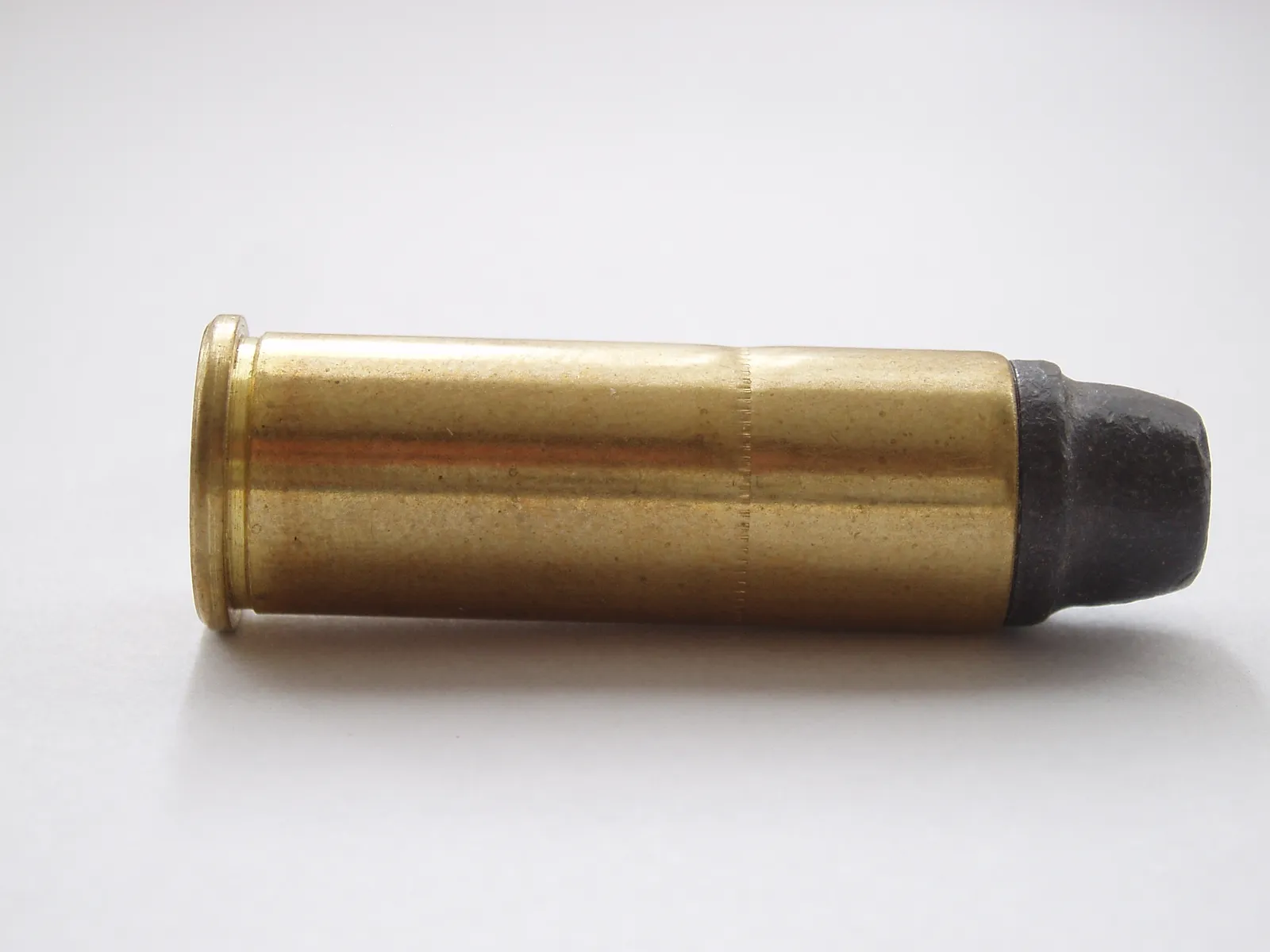
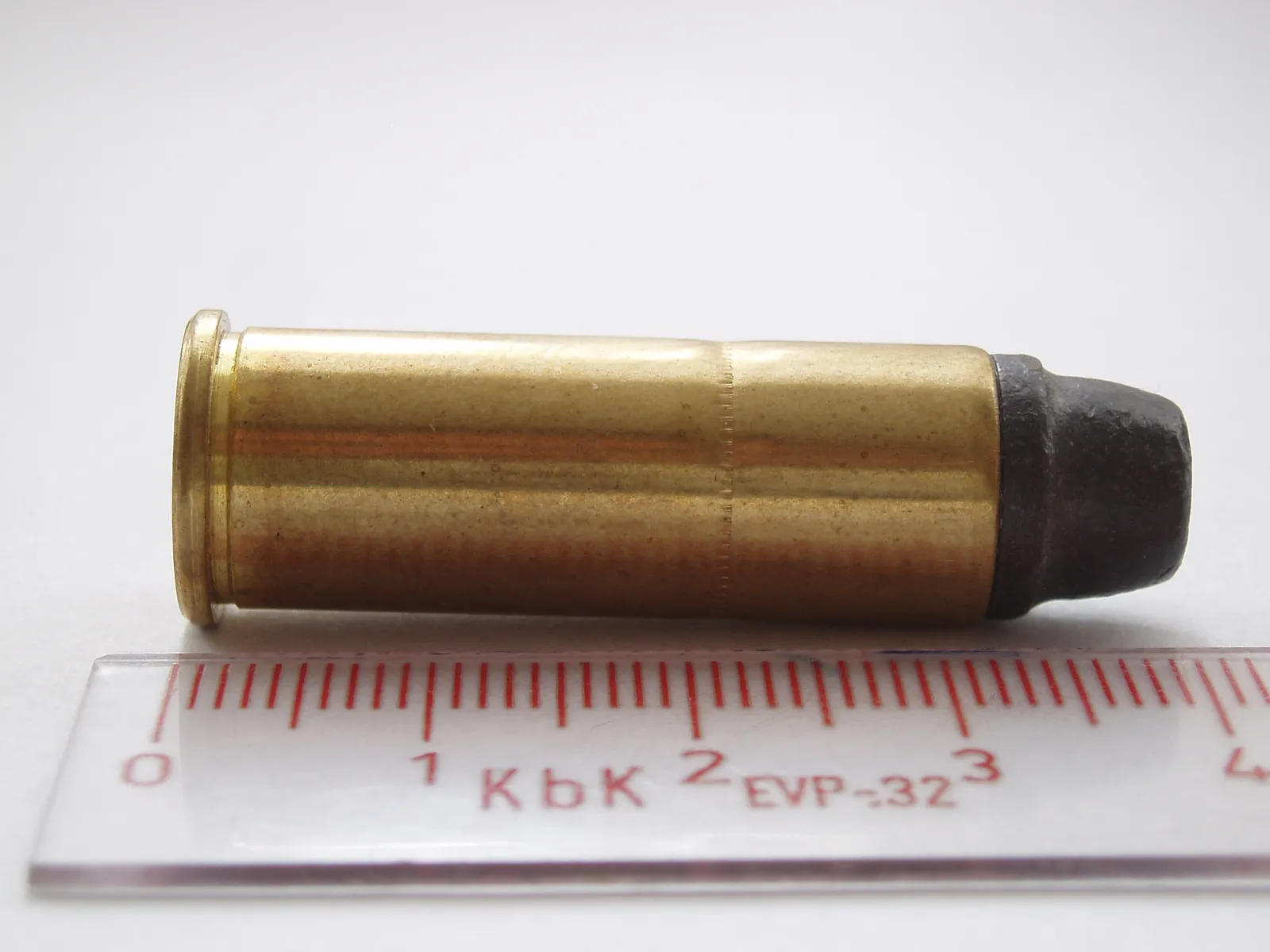
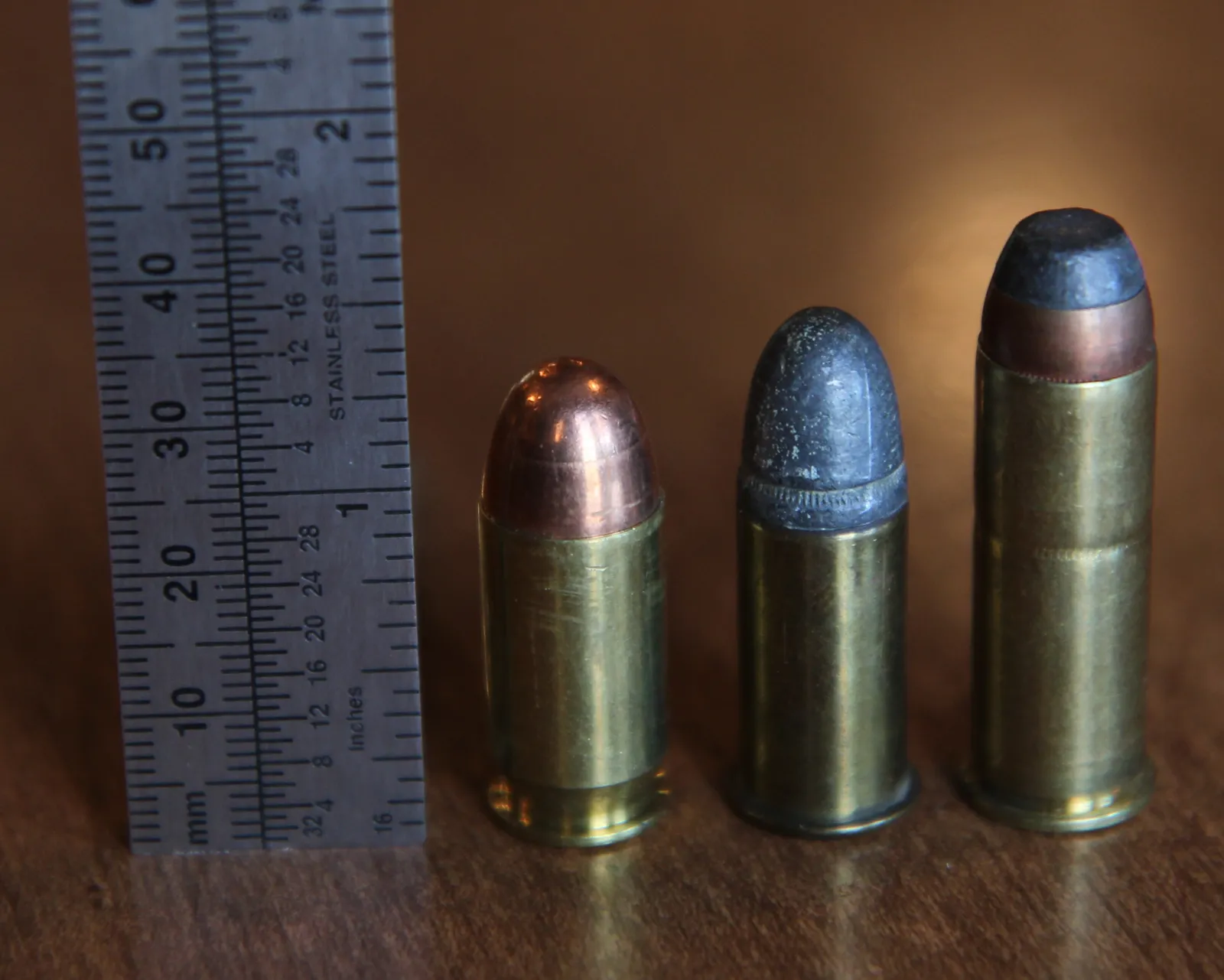
The .44 Remington Magnum is a U.S. rimmed centerfire revolver cartridge developed from heavy .44 Special handloading and commercialized through Remington ammunition and Smith & Wesson revolvers. Smith & Wesson and specialist histories tie the program to Elmer Keith's pressure for a stronger .44-caliber handgun round, while C.I.P. lists the standardized cartridge at 32.64 mm case length, 40.89 mm overall length, and 2800 bar Pmax.

Representative Factory Loads

Current commercial loads cover practice, defensive, backcountry, and hunting use with 180-grain to 240-grain bullets.

LoadBulletRole
Remington UMC Handgun180-grain jacketed soft pointHigh-volume target shooting at 1610 fps.
Federal Personal Defense HST230-grain HST jacketed hollow pointPersonal-defense load listed at 1085 fps.
Remington High Terminal Performance240-grain jacketed soft pointPersonal protection or handgun hunting at 1180 fps.
Remington Core-Lokt Handgun240-grain Core-Lokt hollow pointBig-game handgun hunting at 1220 fps.
Hornady Backcountry Defense240-grain DGHBackcountry sidearm load listed at 1620 fps from an 8-inch test barrel.
Design Lineage And Chambering Context

The .44 Remington Magnum grew out of attempts to move beyond normal .44 Special performance in a stronger large-frame revolver. Rock Island Auction and American Rifleman both describe the Remington/Smith & Wesson commercial cartridge as following Elmer Keith's high-pressure .44 Special work, while C.I.P. shows the magnum case as longer and much higher-pressure than .44 S&W Special.

Parent case family

The cataloged parent relationship is .44 S&W Special, whose C.I.P. case length is 29.46 mm versus 32.64 mm for .44 Remington Magnum.

Standards names

SAAMI uses 44 Rem Mag as the abbreviated name; C.I.P. lists 44 Magnum and 44 Mag. as alternative names.

Documented chamberings

Current Smith & Wesson and Ruger product pages list .44 Magnum / 44 Rem Mag revolvers, including Model 29 and Redhawk-family examples.

Profile / Specs

Profile

Origin
United States
Type
Revolver cartridge
Service note
Commercialized in 1955-1956; still in production
Designed
1955
Unit cost
Remington lists $41.99 for a 20-round box of High Terminal Performance and $76.99 for a 50-round box of UMC Handgun ammunition; commercial pricing varies by load.
Produced
1955-present

Specifications

Cartridge type
Rimmed centerfire revolver cartridge
Case length
32.64 mm
Overall length
40.89 mm
Bullet diameter
10.97 mm / .429 in
Maximum pressure
2800 bar C.I.P. Pmax
Parent case
.44 S&W Special / lengthened .44 Special case family
SAAMI abbreviated name
44 Rem Mag
C.I.P. alternative names
44 Magnum; 44 Mag.
Example headstamp
Imperial War Museums catalogues a Remington R-P / 44 REM MAG headstamp example
Parent Cartridge

.44 Remington Magnum development used the .44 Special case family as the starting point for a longer, higher-pressure commercial magnum revolver cartridge.

Compatible itemItem typeCompatibility evidence
.44 Smith & Wesson Special cartridge, Revolver cartridge, Munitions.44 Smith & Wesson Special cartridgeParent revolver cartridge

C.I.P. lists .44 S&W Special with a 29.46 mm case and 1000 bar Pmax, compared with .44 Remington Magnum's longer 32.64 mm case and 2800 bar Pmax.

Sources: 44 S&W Special - C.I.P., 44 Magnum - C.I.P.

Compatible Handguns

Federal lists 44 Remington Magnum among its popular handgun calibers, while current Smith & Wesson and Ruger pages show representative revolver chamberings.

Compatible itemItem typeCompatibility evidence
Handgun/pistol, Handheld small arm / sidearm, Infantry WeaponsHandgun/pistolHandgun and pistol platform

Federal lists 44 Remington Magnum among its popular handgun calibers; Smith & Wesson lists Model 29 revolvers in 44 Magnum, and Ruger lists Redhawk-family revolvers in 44 Rem Mag.

Sources: Shop products in Handgun today | Federal Premium, Revolvers | Smith & Wesson, Ruger Redhawk Double-Action Revolver Models

Timeline

.44 Remington Magnum cartridge Key Events

  1. .44 Special handloading work

    Elmer Keith and other .44-caliber experimenters pursued heavier, higher-performance .44 Special loads before a commercial .44 Magnum cartridge existed.

  2. Smith & Wesson completes a .44 Magnum revolver

    Smith & Wesson describes the .44 Magnum revolver as a 1955 development made at Keith's urging; American Rifleman places the first completed .44 Magnum revolvers at the end of 1955 and January 1956.

  3. Remington ammunition and S&W revolver reach the public

    Specialist accounts place the public debut of Remington .44 Magnum ammunition and Smith & Wesson's new large-frame revolver in January 1956.

  4. Model 29 designation follows

    Smith & Wesson's early .44 Magnum revolver line became the Model 29 after the company's model-number system was adopted.

  5. C.I.P. TDCC entry dated

    C.I.P. lists the .44 Remington Magnum tabulation date as December 14, 1986, with a later 2020 revision and the alternative names 44 Magnum and 44 Mag.

Media
Related Weapon Systems
.44 Smith & Wesson Special cartridge, Revolver cartridge, MunitionsMunitions.44 Smith & Wesson Special cartridgeRevolver cartridgeThe .44 Smith & Wesson Special is a U.S. rimmed centerfire revolver cartridge developed from the .44 Russian lineage for Smith & Wesson's New Century / Triple Lock revolver context. C.I.P. lists the cartridge at 29.46 mm case length, 41.02 mm overall length, and 1000 bar Pmax, while SAAMI lists 15,500 psi MAP and recognizes 44 S&W Spl as the abbreviated name. Later .44 Remington Magnum development used the .44 Special case family as its starting point.
.40 S&W cartridge, Semi-automatic pistol cartridge, MunitionsMunitions.40 S&W cartridgeSemi-automatic pistol cartridge.40 S&W is an American centerfire semi-automatic pistol cartridge introduced by Smith & Wesson and Winchester Ammunition in 1990. It packaged the FBI's reduced-velocity 10mm service-load concept into a shorter cartridge suitable for 9mm-size duty pistols, while SAAMI and C.I.P. standards define the cartridge's pressure and dimensional limits. The strongest documented context is design history, specifications, and firearm compatibility rather than conflict-specific battlefield use.
45 Automatic (45 Auto), Rimless centerfire pistol cartridge, MunitionsMunitions45 Automatic (45 Auto)Rimless centerfire pistol cartridge45 Automatic (45 Auto) is SAAMI's recognized name for the .45 ACP cartridge developed around John Browning and Colt's early self-loading pistol work and adopted by the U.S. Army with the Model 1911 pistol. This relationship-only page covers the cartridge as a standardized handgun and submachine-gun round, with SAAMI and C.I.P. dimensions, U.S. military ball-cartridge context, current commercial loads, and a sourced compatibility link to the Glock 21 family.
.338 Lapua Magnum cartridge, 8.6 mm long-range centerfire rifle cartridge, MunitionsMunitions.338 Lapua Magnum cartridge8.6 mm long-range centerfire rifle cartridge.338 Lapua Magnum is a Finnish 8.6x70 mm centerfire rifle cartridge developed from .338/416 work into a long-range military, law-enforcement, and precision-rifle round. C.I.P. lists Finland as the country of origin, while Lapua and Nammo sources show current tactical, target, armor-piercing, hunting, and special-purpose load families. The linked rifle relationships stay limited to cataloged weapons whose sources document .338 Lapua chambering.
.308 Winchester cartridge, Centerfire rifle cartridge in .308 Win, MunitionsMunitions.308 Winchester cartridgeCenterfire rifle cartridge in .308 Win.308 Winchester is a centerfire, rimless bottleneck rifle cartridge introduced by Winchester in 1952 and still loaded by major ammunition makers for hunting, match, and sporting use. C.I.P. lists 308 Winchester and 7,62 x 51 as alternate names, while SAAMI cautions that chamber fit alone does not guarantee safe interchangeability. This relationship-only page records the cartridge family and its rifle links without inheriting any conflict-use claims from a parent weapon page.

Sources